

















BlogHow To Guides
What Is RevOps? Revenue Operations and GTM Ops Explained (2026)
Revenue operations runs marketing, sales and customer success as one revenue engine: the funnel definitions, the CRM, the handoffs, the reporting and the forecast. GTM ops is the wider name the same job has been taking on. What the function owns, how it differs from sales ops and marketing ops, the stack, the metrics, and the one thing all of it depends on: whether the CRM record says where the customer came from.

Contents
Summarise this article with AI
Opens the page with a ready prompt in:


Nothing is sent until you pick a service.
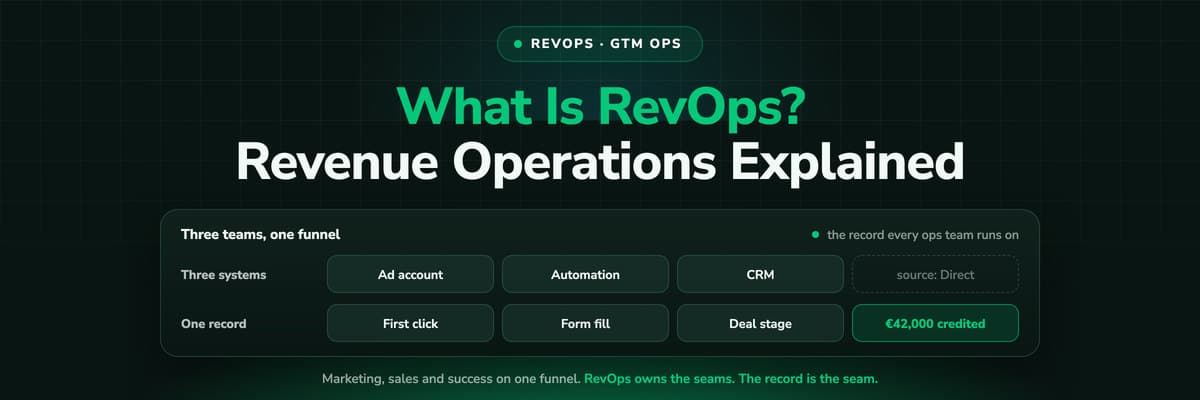
Ask three people what RevOps is and you get an org chart, a job description and a tool list. All three are partly right, and none of them explains why the function appeared or why it is now being renamed GTM ops in the companies that adopted it first. The short version: marketing, sales and customer success each built their own reporting, their own definitions and their own view of the customer, and somebody had to own the seams.
This guide is the long version. What revenue operations is and what it owns, how it differs from sales ops and marketing ops, where GTM ops and GTM engineering come in, the stack and the metrics, and then the part most definitions leave out: the data the whole function runs on, where it breaks, and what an ops team needs from attribution so that the pipeline report is a fact rather than a Thursday afternoon.
Quick Summary: RevOps in One Paragraph
In short
Revenue operations (RevOps) is the function that runs the systems, data and processes behind marketing, sales and customer success as one revenue engine rather than three departments with three CRM views. It owns the funnel definitions, the CRM and the tools around it, the handoffs between teams, and the reporting and forecast leadership runs on. GTM ops (go-to-market operations) is the newer, wider name for the same job, taken up as companies added product-led, outbound, partner and AI-driven motions that a marketing and sales split no longer describes. Both stand or fall on one thing: whether the record in the CRM says where the customer came from. This guide covers what RevOps is, how it differs from sales ops and marketing ops, what GTM ops and GTM engineering add, the stack and the metrics, and the attribution data it all runs on.
It is written for three readers. The person who has just been handed the title and wants to know what it is supposed to cover. The founder or marketing leader deciding whether to hire for it. And the marketing ops or sales ops person who already does most of it and wants the words for the rest. If you are the person the pipeline questions land on, the second half is about you.
What Is RevOps (Revenue Operations)?
Revenue operations is the operational backbone of the revenue side of a company. Where marketing operations serves marketing and sales operations serves sales, RevOps serves the revenue process end to end: from the first anonymous visit through the lead, the opportunity and the closed deal to the renewal and the expansion. The premise is that these are one process with several owners, and that a process with several owners needs one team looking after the whole of it.
In practice the function owns five things, and a RevOps team of one owns them all at a smaller scale than a team of ten. What it does not own is the selling, the campaigns or the accounts. RevOps builds and maintains the machine the revenue teams work inside; it does not work the machine itself.
- ProcessThe funnel definitions everyone shares: what a lead is, when it becomes qualified, what an opportunity needs before it exists, which stage means what. And the handoffs between teams, with routing rules and response times.
- SystemsThe CRM as the system of record and everything wired to it: the marketing automation platform, the enrichment tools, the sales engagement tool, the attribution layer, billing. Who administers each, and what integrates with what.
- DataThe quality of what sits in those systems: duplicates, empty fields, a lead source that says Direct on half the records. The definitions of every metric, so that two dashboards showing pipeline show the same pipeline.
- Reporting and forecastingThe funnel report, the pipeline report and the forecast, built once and read by everyone. Which channels produced the pipeline, how fast it moves, what will close this quarter, and why the number changed since last week.
- Enablement and planningTerritories, quotas and compensation plans on the sales side; the annual plan and the capacity model that say how many leads and reps the revenue target needs; the training that makes people use the systems as designed.
The one-line version
RevOps is the team that makes the revenue teams' numbers agree with each other, and then makes them agree with the bank account.
Why RevOps Exists: The Handoff Problem
The function appeared because of what happens at the seams between departments. Marketing counts leads and MQLs in the automation platform. Sales counts opportunities and closed deals in the CRM. Customer success counts renewals and churn in a third tool or a spreadsheet. Each team's numbers are correct inside its own system, and none of them describe the same customer, so the board meeting spends its first twenty minutes reconciling.
The symptoms are the same in almost every company that reaches a few dozen employees, and they are what a RevOps hire is usually asked to fix in the first quarter. Here are the four that show up first.
Three definitions of a lead
Marketing's MQL, sales' accepted lead and finance's pipeline are three different counts of what should be one thing. Every conversion rate between them is an argument rather than a number.
The source field is a rumour
Half the CRM records say Direct, Website or Unknown, because the form wrote whatever it could see when it fired. The channel report is built on that column.
One person, three records
The same buyer exists once in the automation platform, once in the CRM and once in the billing tool, with three ids. Any join across them double counts, and every stakeholder gets a different total.
The bottleneck is a person
Every question about pipeline by channel is a two hour export, done by the one person who knows the four systems. The numbers are as fresh as their last afternoon.
None of these is a tooling problem in the first instance. They are ownership problems: nobody was responsible for the process as a whole, so nobody was responsible for the places where one team's output became another team's input. RevOps is the decision to make somebody responsible for exactly those places.
RevOps vs. Sales Ops vs. Marketing Ops
The three functions overlap in tools and in people, which is why the titles get used loosely. The cleanest way to separate them is by who they serve and which seam they cannot see from where they sit.
The four operations functions, and the seam each one cannot see
| Function | Serves | Owns | The seam it cannot see |
|---|---|---|---|
| Marketing ops | Marketing | The automation platform, forms, lead scoring, campaign tracking, the MQL definition and the marketing dashboard | What happens to a lead after it is handed to sales, and whether it ever became revenue |
| Sales ops | Sales | The CRM configuration, pipeline stages, territories, quotas, compensation, the forecast and the sales tooling | Where the lead came from before a rep touched it, and what it cost to produce |
| Customer success ops | Customer success | Onboarding workflows, health scores, renewal and expansion tracking, the support tool | Which acquisition channel produced the customers who renew and which produced the ones who churn |
| RevOps | The revenue process end to end | All of the above, plus the definitions, the data model and the reporting that span the three | By design, none. The whole point is that the seams have an owner |
RevOps vs. sales ops is the comparison people search most, because in many companies RevOps started as sales ops with a wider remit. The difference is the starting point of the funnel. Sales ops begins where the opportunity exists and optimises everything from there: stages, velocity, forecast, rep productivity. RevOps begins at the first anonymous visit and treats the opportunity as one stage among several, so it has to care what marketing did, what it cost and which channels produced the deals that closed.
RevOps vs. marketing ops is the mirror image. Marketing ops runs the top of the funnel superbly and loses sight of the lead at the handoff. It reports MQLs because MQLs are what its system can see. RevOps reports closed revenue by channel because it owns the CRM as well, which changes what marketing gets measured on. The marketing and revenue ops page is written for the person who holds both roles at once, which at most companies under a few hundred people is the actual arrangement.
What Is GTM Ops, and How Is It Different From RevOps?
GTM ops, go-to-market operations, is the name the RevOps job has been taking on in software companies over the last few years, and on most job boards the two titles describe the same role. The reason for the rename is the shape of the go-to-market itself. RevOps was named for a world with two revenue teams, marketing and sales, plus customer success. A company running a product-led motion, an outbound motion, a partner channel and paid acquisition at the same time has more teams than that, and "revenue" undersells how much of the work is about planning which motion gets which resources.
So GTM ops usually means RevOps plus the go-to-market planning layer: segmentation, ideal customer profile, territory and account assignment, launch and pricing operations, and the capacity model that says how many people each motion needs. Where a RevOps team keeps the machine running, a GTM ops team also decides which machines to build. In a smaller company the distinction is academic and one person does both.
GTM engineering is the newer title inside that team, and it is a builder's role rather than an analyst's: the person who automates prospecting and enrichment, wires the AI tooling into the CRM, builds the outbound workflows and the routing, and treats the go-to-market stack as a product with its own backlog. Where GTM ops decides what the process should be, the GTM engineer writes the automation that makes it happen. It is a role that has grown with the enrichment and workflow tools of the last two years, and its job descriptions read like a data engineer's with a quota next to them.
Not that GTM
On this site, and in any tracking conversation, GTM usually means Google Tag Manager, the container that loads a website's scripts. GTM ops has nothing to do with it. A GTM ops manager may well administer Google Tag Manager, but the abbreviation is a coincidence.
The RevOps Tech Stack
A RevOps stack is less a list of tools than a set of layers, each of which has to hand a clean record to the next. The specific products vary; the layers do not. Here they are in the order a lead passes through them, with the question each one answers.
- The CRM, as the system of recordHubSpot, Salesforce, Pipedrive, Close, Attio or another. One record per person and per company, the stages, the deals and the amounts. Everything else either writes into it or reads out of it.
- Marketing automation and formsWhere the anonymous visitor becomes a named lead, and where the nurture runs. The lead source field is usually written here, which is where it usually goes wrong.
- Tracking and attributionThe layer that records the first click and every session after it, joins them to the person at the form, and writes the source onto the CRM record so the pipeline report has a channel column that is true.
- Enrichment and data qualityCompany size, industry, technology and contact data appended to the record; deduplication and normalisation so the same buyer is one record. Increasingly where the GTM engineer lives.
- Sales engagement and conversation intelligenceSequences, dialers, call recording and the notes that come out of them. Sales touches are touchpoints too, and they belong on the same record as the marketing ones.
- Quoting, billing and the finance systemCPQ, subscriptions, invoices. The closed amount in the CRM has to match the amount that was billed, or every revenue number upstream is a forecast rather than a fact.
- Warehouse, BI and workflow automationWhere the layers are joined for reporting when the CRM's own reports are not enough: a warehouse, a BI tool, and Zapier, Make or n8n moving records between everything else.
The mistake most stacks make is at the third layer. The tracking script belongs to marketing, the CRM to sales, and the source field between them is written once at the form by whichever tool got there first. Every report downstream inherits that field, which is why the data section of this guide is longer than the stack section.
The Metrics RevOps Owns
RevOps does not own a KPI the way marketing owns leads or sales owns bookings. It owns the definitions of everybody's KPIs and the report they are read from. These are the ones a revenue operations team is expected to be able to produce on demand, with where the number has to come from for it to be trusted.
The metrics a RevOps team is asked for, and where each has to come from
| Metric | What it answers | Where the number comes from |
|---|---|---|
| Pipeline created, by channel | Which sources produced the opportunities this quarter | The CRM's opportunity amounts, joined to a source field that is true for every record |
| Funnel conversion rates | Lead to qualified, qualified to opportunity, opportunity to won, per channel | One shared stage definition, stamped on the record when the stage changes |
| Sales cycle length | How long from first touch to closed deal, as a median and an 80th percentile | The first touch date on the record, not the create date of the contact |
| Win rate | Of the opportunities that reached a decision, how many closed | Closed-won over closed-won plus closed-lost, per channel and per segment |
| Cost per qualified lead and cost per deal | What a lead that sales accepted actually costs, per channel | Ad spend from the platforms, joined to CRM stages rather than form fills |
| CAC and CAC payback | What a customer costs to acquire and how many months until they have paid it back | Spend plus the people cost of marketing and sales, over customers won, against gross margin |
| Net and gross revenue retention | Whether the customers won a year ago are worth more or less now | Billing data, by cohort, by the channel that originally won them |
A customer who cost €6,000 to win and contributes €500 of gross profit a month pays back in 12 months.
Notice the third column. Every metric on the list is a join between spend or effort on one side and a CRM outcome on the other, and every join runs through the source field on the record. Customer acquisition cost by channel, the number a board asks for most, cannot be computed while the channel column is Direct on half the customers. That is not a reporting problem. It is the data problem the next section is about.
The Data RevOps Runs On, and Where It Breaks
Everything above assumes the record in the CRM knows where the customer came from. In most companies it does not, and the reasons are structural rather than careless. Here are the five that a new RevOps hire finds in the first month, in the order they are usually found.
- The source was written at the formThe form integration wrote whatever it could see when it fired: the current page, a referrer, or nothing. The LinkedIn ad three weeks earlier was gone from the browser by then, so the record says Direct or Website.
- The click id never reached the contactgclid, fbclid, li_fat_id and msclkid arrive on the landing page URL and leave with the session. Unless something stored them at the first visit and put them on the record, nothing can join the deal back to the click.
- The same person is three recordsA form fill, a demo booking and a call each created a contact, each with its own source. The deal is joined to one of them, usually the last, and the first touch is on one of the others.
- Four dashboards, four totalsMeta, Google, LinkedIn and the CRM each count the same conversions under their own windows and their own view-through rules. Summed, they report more customers than exist.
- Revenue never goes back to the platformsThe platforms optimise on the form fill because that is the last event they were told about. The closed deal, the one number that matters, stays in the CRM and never reaches the bidding.
The CRMs' own tools help less than their feature pages suggest. HubSpot's attribution reports are bucketed by the session its tracking code recorded in the browser, capture only the gclid natively and put revenue attribution behind Marketing Hub Enterprise; HubSpot lead source tracking and HubSpot's attribution explained go through the details. Salesforce Campaign Influence credits campaigns a contact role on the opportunity is a member of, and knows nothing about a click that never became a campaign member (the explainer). Pipedrive has no attribution model and no ad spend anywhere in the product.
Which is why RevOps teams so often end up proposing a data warehouse. Export the ad platforms, export the CRM, export the analytics tool, join them in SQL. It works, and it costs a quarter, a data engineer and a modelling debate before the first report, and the join is still only as good as the identifiers that made it into each export. Why GA4, Meta and Google never match your CRM lists the seven reasons the numbers disagree; BigQuery attribution shows what the GA4 export is missing before you start.
What a RevOps Team Needs From Attribution
An ops team buys attribution differently from a marketer. The marketer wants a channel report with a better model. The ops team wants the record to be right, so that every report anybody builds on it, in any tool, comes out right without them in the loop. That produces a different requirements list, and it is worth writing down before the vendor calls.
- First-party capture on your own domain, server-side. The identifier is set by your subdomain and kept on the server, so the first visit survives longer than a browser cookie and does not depend on the marketing site's tag manager staying tidy. Server-side tracking is the mechanism.
- Click ids stored at the first visit. gclid with gbraid and wbraid, fbclid, li_fat_id, msclkid and ttclid, plus the UTM parameters and the landing page, on the record from the first session. The click id is the join key every later step depends on.
- Identity at the form, the call or the booking, and every earlier session attached. One journey per person, whichever of the three ways they identified. The stitching happens outside the CRM, so your records keep their own shape and nothing is merged or deleted there.
- The source written onto the CRM contact and the deal, in your property names. First touch and last touch, the campaign, the attributed source and amount, as fields on your own objects, so that every existing report, workflow and list in the CRM can use them. You decide which fields are written.
- Pipeline stages as conversions, with the deal value, back to the platforms. Qualified, opportunity and closed-won sent to Meta, Google, LinkedIn and Microsoft with the amount, so the bidding optimises on what closed rather than on the form fill.
- A model per question, switchable. First click for what opened the journey, last click for what closed it, linear or position-based for the budget split, on the same record, so the model is a view and not a rebuild. Multi-touch attribution is the report; the attribution model entry is the primer.
- An API, webhooks, a warehouse export and a log. The journeys, sources and revenue go out to the BI tool, the warehouse and the automation platform; the log holds every event with the rule that produced it, so that when a number is questioned, somebody can open the record and point.
Connected LeadJourney for 2 clients, setup took literally 20 minutes each. The data became more accurate, the reports actually make sense. Now clients look at the dashboard and the 'why don't the numbers match?' questions are gone.
 Alexander SamarPerformance Marketing Agency
The seventh item is the one ops teams underrate until they have it. A source field is a claim; a log is evidence. When sales says a deal was a referral and marketing says it was the webinar, the argument ends the moment somebody opens the journey and reads the dates, and an attribution layer without that view moves the argument rather than settling it.
How to Start RevOps in a Small Company
RevOps is a function before it is a hire. Most companies under a hundred people already have one, distributed across a marketing ops person, a CRM admin and whoever builds the board deck. Starting it means putting the pieces under one owner and doing six things in the first quarter, in this order, because each one depends on the previous.
- Agree one funnel definition, in writing. What a lead is, when it is qualified, what an opportunity needs before it exists, what each stage means, who moves a record between stages. One page, signed off by marketing and sales, stamped on the CRM's lifecycle stages. Every metric later is a count of these.
- Make the CRM the system of record, and say so. Every other tool either writes into it or reads out of it. A number that cannot be produced from the CRM is not a company number yet, however good the dashboard it lives in.
- Fix the lead source field before buying a dashboard. Find out what the source column actually holds, how much of it is Direct, Website or Unknown, and why. Put the lead source right at the record, with the first touch on it, before any report reads it. This is where an attribution layer earns its place.
- Build one funnel report and one pipeline report, and retire the others. Leads to qualified to opportunity to won, by channel, with the spend at the top and the revenue at the bottom. If marketing and sales read different reports, they will keep bringing different numbers.
- Automate the handoffs. Routing rules, ownership, response time targets, the notification that a lead has waited too long. Handoffs are where records get lost, and a lost record is a source that never reaches a deal.
- Then forecast. A forecast built on the five steps above is a projection of a process. A forecast built before them is a poll of the sales team. Do it last, and do it from the stage conversion rates the report now produces.
The third step is the one that gets skipped, because a dashboard is a more satisfying purchase than a data fix. What the CRM says the lead source is shows what the column usually looks like before the fix; proving marketing ROI is what the same report looks like after it.
When to Hire for RevOps or GTM Ops
There is no headcount at which a company needs the role. There is a set of signals, and when three of them are true at once the job already exists and is being done badly by several people part time. The forecast is a feeling rather than a calculation. Marketing and sales bring different pipeline numbers to the same meeting. Every question about revenue by channel is an export. The CRM has a source field nobody trusts. Somebody has just proposed a data warehouse to answer a question about last quarter.
Whether the title says RevOps or GTM ops matters less than the remit: the role has to own the CRM and the definitions, not only the reporting, or it becomes an analyst reconciling other people's systems. And the first hire should be a builder rather than a strategist. The strategy is mostly obvious at that stage; the records are not. A GTM engineer profile, somebody who will wire the tracking, the routing and the enrichment together and write it down, gets a company further in six months than a slide about operating models does.
The honest alternative
If the company cannot yet justify the hire, buy the layer instead of building it. An attribution platform that writes the source onto the CRM and keeps the log does the third and hardest step of the six, and it is maintained by somebody else.
How LeadJourney Fits a RevOps Stack
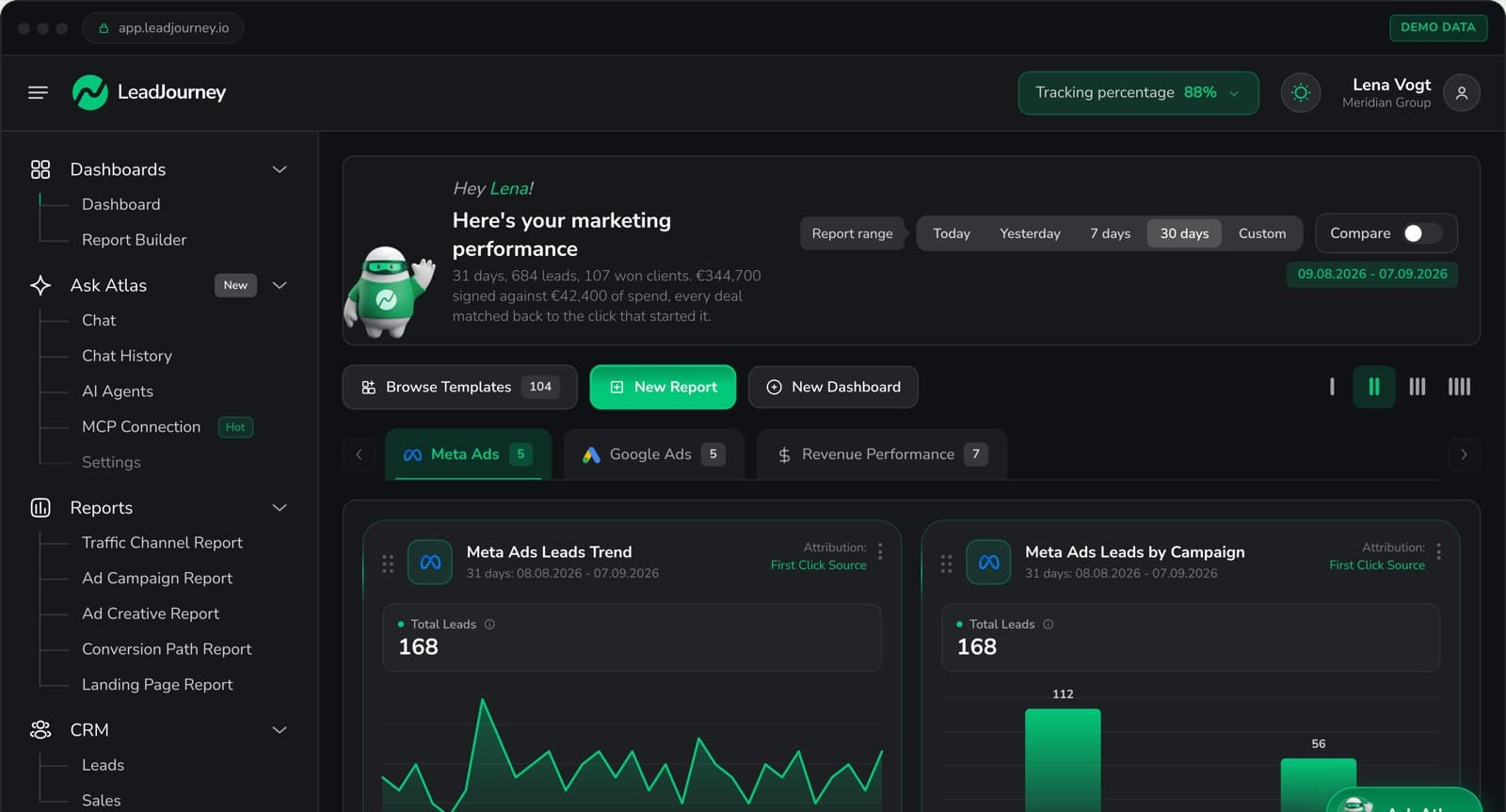
LeadJourney is the third layer of the stack above, the one between the ad platforms and the CRM, and it is built to be run by an ops team rather than around one. Tracking runs server-side on your own domain, first-party, at 95%+ accuracy. The first visit sets the LeadJourney Click ID, our own identifier for that visitor, and stores the platform click ids on it: gclid with gbraid and wbraid, fbclid, li_fat_id, msclkid and ttclid, plus the UTM parameters and the landing page. Every later session is appended to the same record.
The visitor becomes a person at the form fill, the call or the booking, and the journey follows the CRM stages to the closed deal: natively in HubSpot, Salesforce, Pipedrive, Close, Attio, GoHighLevel, ActiveCampaign and Odoo, by webhook, Zapier, Make, n8n or the API for anything else. The source and the attributed amount are written onto the contact and the deal in your own property names, so the CRM's existing reports, lists and workflows can use them. Closed stages go back to Meta, Google, LinkedIn and Microsoft as conversions with the deal value, on every plan.
For the reporting layer: five attribution models on every report, switchable; a per-lead journey view with every touchpoint and its date; a BigQuery export of the raw clicks, conversions and leads into your own dataset; a documented API and webhooks in both directions; and an MCP server so Claude or ChatGPT can query the workspace directly. Every event sits in a log with the rule that produced it. What it is not: it is not the CRM, not the forecast and not an account-level model. It attributes per named lead and joins that lead to the deal; it does not identify anonymous colleagues or model a buying committee, and it says so. Setup is 21 minutes, pricing starts at €129 a month, and there is a 14-day free trial with no credit card. The live demo is the product itself.
Further Reading
Related reading: the marketing and revenue ops page for the layer this guide ends on; B2B marketing attribution for the discipline behind the pipeline report; the B2B buyer journey for what the record holds touch by touch; HubSpot lead source tracking and why GA4, Meta and Google never match your CRM for the data problems; the GCLID explained for the join key; attribution for long sales cycles for the window; the best attribution tools for HubSpot and for Salesforce for the tool choice; revenue attribution, lead source and customer acquisition cost in the glossary; CRM integration as the product page; and the pages for sales teams, demand generation, marketing leaders and SaaS companies.
FAQ
Frequently Asked Questions
What people ask about revenue operations, GTM ops and the roles inside them.
What is RevOps?
RevOps, short for revenue operations, is the function that runs the systems, data and processes behind marketing, sales and customer success as one revenue engine. It owns the shared funnel definitions, the CRM and the tools around it, the handoffs between teams, and the reporting and forecast that leadership runs on. It does not do the selling or the campaigns; it builds and maintains the machine those teams work inside, and makes sure the numbers coming out of each team describe the same customers and add up to the same revenue.
What does a RevOps team do day to day?
Administer the CRM and the tools wired to it, keep the data in them clean, define and enforce the lifecycle stages, build routing and handoff automation, produce the funnel and pipeline reports and the forecast, run territory and quota planning on the sales side, and answer the questions every revenue meeting asks: which channels produced the pipeline, how fast it moves, what will close and why the number changed. In a small company one person does all of it alongside a marketing ops or CRM admin role; in a larger one it is a team with specialists per system.
What is the difference between RevOps and sales ops?
Sales ops serves the sales team and starts where the opportunity exists: pipeline stages, velocity, forecast, territories, quotas, compensation and the sales tooling. RevOps serves the whole revenue process and starts at the first anonymous visit, treating the opportunity as one stage among several. So RevOps also has to care what marketing did, what it cost and which channels produced the deals that closed, and it owns the definitions that span marketing, sales and customer success rather than the sales team's alone. Many RevOps functions began as a sales ops team given the wider remit.
What is GTM ops, and is it the same as RevOps?
GTM ops, go-to-market operations, is the newer and wider name for the RevOps job, common in software companies that run several motions at once: inbound, outbound, product-led, partner and paid. On most job boards the two titles describe the same role. Where they differ, GTM ops adds the go-to-market planning layer to the operations one: segmentation, ideal customer profile, territory and account assignment, launch and pricing operations, and the capacity model that says how many people each motion needs. RevOps keeps the machine running; GTM ops also decides which machines to build.
What is a GTM engineer?
A GTM engineer is the builder inside a GTM ops or RevOps team. Rather than defining the process or reading the reports, they write the automation that runs it: prospecting and enrichment workflows, the wiring between the AI tooling and the CRM, outbound sequences, routing, data quality jobs and the integrations between systems, treating the go-to-market stack as a product with its own backlog. The role has grown with the enrichment and workflow tools of the last two years, and its job descriptions read like a data engineer's with a revenue target attached. GTM here means go-to-market, not Google Tag Manager.
What tools does a RevOps team use?
A stack in layers rather than a fixed list: a CRM as the system of record (HubSpot, Salesforce, Pipedrive, Close, Attio or another), marketing automation and forms, a tracking and attribution layer that records the first click and writes the source onto the CRM record, enrichment and data quality tools, sales engagement and conversation intelligence, quoting and billing, and, when the CRM's own reports are not enough, a warehouse, a BI tool and workflow automation such as Zapier, Make or n8n. The layer most stacks get wrong is attribution, because the source field is written once at the form and every report inherits it.
When should a company hire for RevOps?
When three of these are true at once: the forecast is a feeling rather than a calculation, marketing and sales bring different pipeline numbers to the same meeting, every question about revenue by channel is an export, the CRM has a source field nobody trusts, and somebody has proposed a data warehouse to answer a question about last quarter. The job already exists by then and is being done part time by several people. Give the hire the CRM and the definitions, not only the reporting, and prefer a builder to a strategist: the records need fixing before the operating model does.
Keep reading
More from the blog
 How To Guides
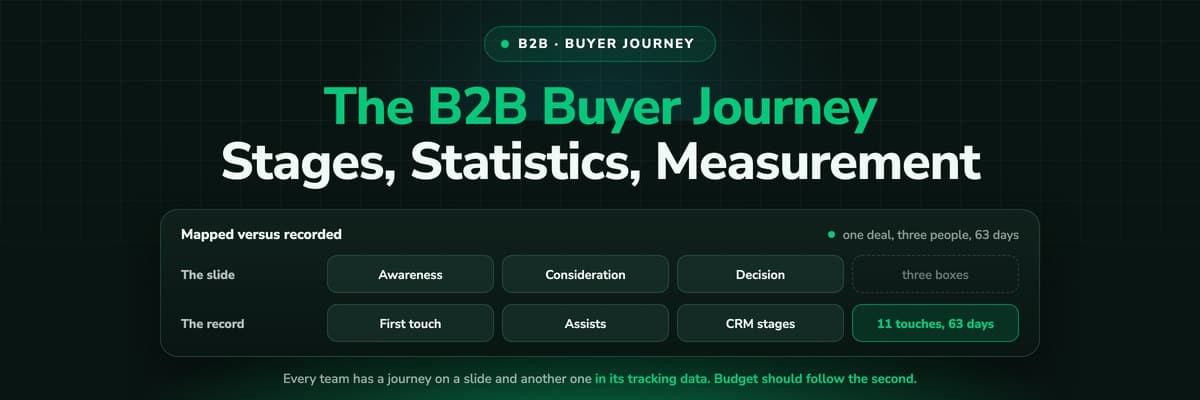
B2B Buyer Journey: Stages, Statistics and Measurement (2026)
Every B2B team has two buyer journeys: the one mapped in a workshop and the one recorded in the tracking data and the CRM. The stages, Gartner's six buying jobs, the statistics worth knowing, one recorded €46,000 journey touch by touch, and how to build the map from the record and set the budget by it.Read the article15 min read How To Guides
PostHog Attribution: How It Works and Where It Stops
PostHog can tell you where a user first came from and put ad spend next to your conversions. Here is exactly how its attribution works, what quietly breaks it, and the point where teams add something next to it.Read the article11 min read How To Guides
BigQuery Marketing Attribution Without the GA4 Blind Spots
You can write a multi-touch attribution model in BigQuery in about eighty lines of SQL. Here they are, free. What no tutorial tells you is that the GA4 export you are querying carries no ad cost, no CRM revenue, no attribution model result and none of the consent-modelled conversions your GA4 dashboard shows, so the finished query answers a question nobody in the budget meeting asked.Read the article18 min read
The layer, not the data project
Give RevOps the record, not another export
LeadJourney captures every click server-side on your own domain, stitches one journey per person, writes the source onto the CRM contact and deal, and sends closed revenue back to the platforms. Live in 21 minutes, maintained by us.