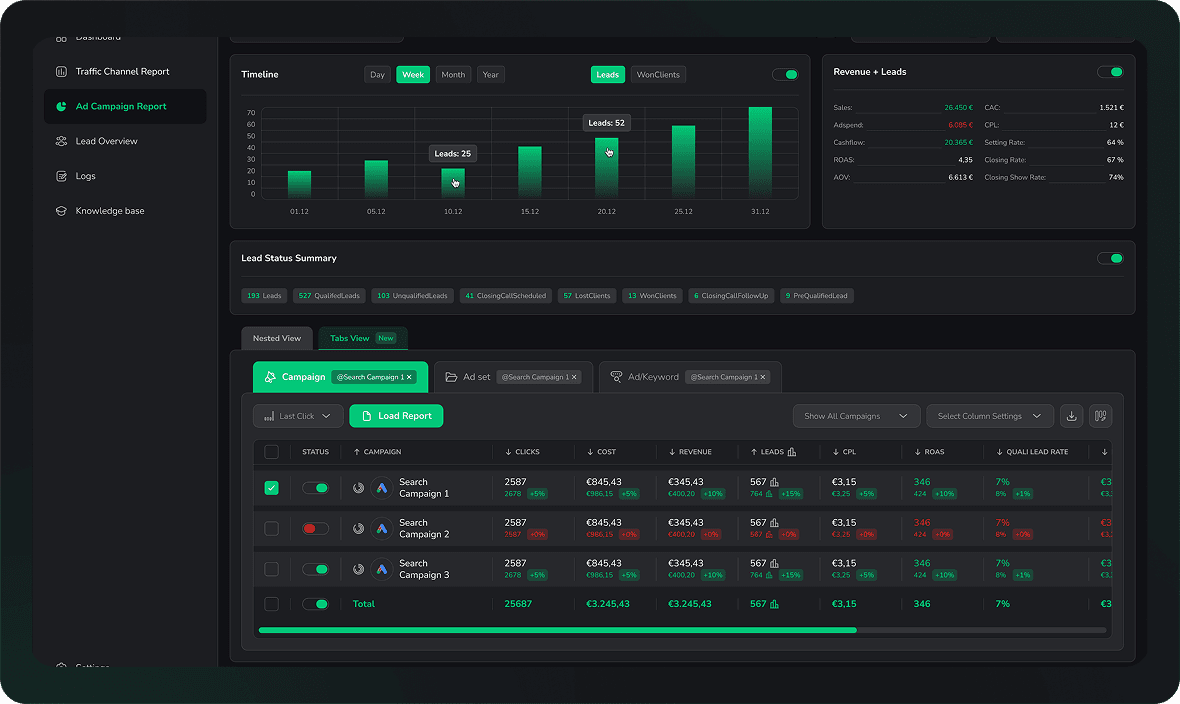

















Revenue Attribution
Crediting closed revenue, rather than clicks, leads or platform conversions, to the marketing and sales touchpoints that produced it. The deal amount from the CRM is divided across the journey by an attribution model, so every channel and campaign reports the money it helped close.

Summarise this article with AI
Opens the page with a ready prompt in:


Nothing is sent until you pick a service.
In short
Revenue attribution is the practice of crediting the money a customer actually paid to the marketing and sales touchpoints that led to the purchase. Instead of counting a click, a form submission or a conversion an ad platform reported, it takes the closed amount from the CRM, or the order from the shop, and divides it across the journey with an attribution model, so a channel report shows what each channel earned rather than how many leads it produced.
The distinction matters because the two numbers disagree more often than not. A channel can produce the cheapest leads in the account and the least revenue, and a report that stops at the lead cannot tell you. Revenue attribution is the report that can, and it is the one a marketing budget is defended with.
What Revenue Attribution Measures
Attribution can credit three different things to a touchpoint, and they get more useful and harder to obtain in that order.
Conversions
A form submit, a call or a purchase event, counted the moment it happens. Every ad platform and analytics tool reports this, each inside its own window and its own model.
Pipeline
The value of the open opportunities a touchpoint helped create, taken from the CRM stage the lead has reached. Available weeks before revenue, and the operating report during a long cycle.
Revenue
The amount the deal closed for, or the order total, credited back across the touchpoints. The only one of the three a finance team recognises as an outcome.
Revenue attribution is the third. It needs everything the first two need plus one more join: the touchpoint has to be connected to a record that later carries a closed amount. That join is the whole difficulty, because the click happens in a browser in March and the amount is typed into a CRM in June, and nothing in the ad platform or the analytics tool lives long enough to connect the two.
How Revenue Attribution Works
- The touchpoints are recorded first-party. A script on your own domain writes each visit with its source, campaign, landing page and any click ID in the URL against one visitor identifier, server-side, so the record survives the browser losing its cookies.
- The visitor becomes a person. At the form submission, the booked call or the recognised phone number, the anonymous history is attached to a contact, and any other device on which the same person identified is merged in.
- The source is written onto the CRM record. Contact and deal carry the first touch, the last touch and the channels in between as fields, so sales sees where the person came from and a report can filter by it.
- The deal closes with an amount. Weeks or months later a rep moves the deal to won and enters the value. Nothing about the journey has to be remembered at this point, because it was recorded when it happened.
- An attribution model divides the amount. First click, last click, linear, position-based or time decay assigns shares of the closed amount to the touchpoints, and the shares roll up into a revenue figure per channel, campaign and ad.
Every step depends on the one above it. A team that starts at step five, picking a model, over a CRM whose lead source says Direct for half the deals gets a precise split of the wrong record. Lead attribution software is the category built around steps one to four; the model is the last afternoon of the work.
One Deal, Five Splits
Take a €24,000 consulting deal, an example rather than one customer's books. Four touchpoints: a LinkedIn sponsored post clicked on day 0, an organic search that landed on a comparison article on day 9, a Google Ads brand search on day 20, and a webinar invitation by email on day 22, attended, with the demo booked the same afternoon. The deal closed six weeks later. Here is the €24,000 credited five ways.
€24,000 of closed revenue, four touchpoints, five attribution models
| Touchpoint | First click | Last click | Linear | Position-based | Time decay |
|---|---|---|---|---|---|
| LinkedIn Ads (day 0) | €24,000 | €0 | €6,000 | €9,600 | €1,230 |
| Organic search (day 9) | €0 | €0 | €6,000 | €2,400 | €2,998 |
| Google Ads, brand (day 20) | €0 | €0 | €6,000 | €2,400 | €8,910 |
| Webinar via email (day 22) | €0 | €24,000 | €6,000 | €9,600 | €10,862 |
Under last click the webinar earns everything and LinkedIn, which started the journey, earns nothing, which is how a paid social channel ends up cut from a budget it was feeding. Under first click it is the reverse. Linear splits the amount evenly, position-based gives 40 percent each to the opening and the closing touch, and time decay on a seven day half-life weights the last fortnight heavily. The €24,000 sums correctly in every column; what changes is which channel manager gets to say it was theirs.
Which model to start on
Linear, because it makes no assumption you would have to defend. Then switch models on the same report and watch which channels change rank. A channel that earns under every model is genuinely earning.
The Revenue Attribution Reports Your Tools Already Have
Three tools most B2B teams already pay for ship something called a revenue attribution report, and each is worth knowing the edges of before buying anything else.
- HubSpot's revenue attribution reportNine models, from first interaction to W shaped and time decay, applied to closed deals. It needs Marketing Hub Enterprise (contact attribution is on Professional), it buckets touches by the session its own tracking code saw in the browser, and it captures the Google click ID natively but not Meta's, LinkedIn's or Microsoft's.
- LinkedIn's Revenue Attribution ReportIn Business Manager, connected to Salesforce, Dynamics 365 or HubSpot. It reports revenue won, pipeline amount and return on ad spend for the CRM opportunities LinkedIn influenced, by impression or by engagement, inside a lookback of 30 to 365 days. Influence is a yes or a no, not a share, and only LinkedIn's own touches count.
- Salesforce Campaign InfluenceCredits the campaigns a contact role on the opportunity is a member of, on a predefined model or on percentages you enter. A click that never became a campaign member does not exist to it.
What the three share is that each credits what it can see: its own tracking code, its own ads, its own campaign membership. None of them holds the whole journey across Google, Meta, LinkedIn, organic search and the CRM on one record, which is what the split in the table above needs. How HubSpot's attribution reports work and how Campaign Influence works go through the two CRM reports in detail.
Pipeline Attribution vs Revenue Attribution
In a sales cycle that runs a quarter or more, revenue attribution arrives too late to steer the campaign that produced it. Pipeline attribution fills the gap: the same journey, credited with the value of the opportunity the moment a lead reaches a qualified stage, before anyone has signed. It is an estimate, because part of that pipeline will be lost, and it is the report a paid team runs on a Monday. Revenue attribution is what checks it a quarter later.
Both need the deal stage to arrive on the same record as the click, which is why customer journey tracking is the prerequisite for either. B2B marketing attribution walks through both reports on one quarter of data, and attribution for long sales cycles covers what happens when the window closes before the deal does.
What a Revenue Attribution Report Answers
Revenue per channel
What Google, Meta, LinkedIn, organic and referral each helped close under the model you chose, summing to the revenue the CRM booked rather than to four platform claims.
Cost per closed deal
Spend divided by the deals a channel helped win. It is the figure that survives a finance meeting where cost per lead does not.
Return on ad spend on real money
Closed revenue over spend per campaign, so a campaign with cheap leads that never close stops looking like the account's best.
What to send back
Which closed stages, with which amounts, go back to the ad platforms through the Conversions API, so the bidding optimises toward customers rather than forms.
The ability to track both online and offline conversions in one unified dashboard has given us insights we never had before. Our ROI has improved dramatically since we started integrating LeadJourney with our CRM. We're finally able to see the full customer journey, and it's been a game changer for our strategy.
 Andre WitzelFounder, Trading.de
Conclusion
Revenue attribution is attribution with the right thing at the end of it. Clicks and leads are what the ad platforms can count, so that is what they report, and a budget allocated on those numbers pays for the channel that produces forms rather than the channel that produces customers. Getting to the closed amount takes a first-party record of the journey, an identification step that ties it to a person, and a CRM connection that adds the outcome months later. With those in place, the attribution model is a switch on the report, and the argument moves from whose number is right to which channel actually earned the money.
Keep exploring
Related glossary terms
Attribution Model
The rule set that decides how much credit each marketing touchpoint gets for a conversion or a deal. It turns a recorded customer journey into a channel report, and the choice of model can change that report more than the campaigns did.
Read the definition7 min read
Multi-Touch Attribution
A measurement approach that distributes credit for a conversion across every touchpoint a customer interacted with, not just the last click before the sale.
Read the definition6 min read
Customer Journey
The full sequence of touchpoints a person passes through on the way to becoming a customer, in the order they happened: ads, searches, visits, the form, the call and the closed deal. Analytics tools show the last step; the journey is everything before it.
Read the definition6 min read
95%+ data accuracy, even with ad blockers and iOS
See which ads really created your
Connect your ad accounts and your CRM once, and every lead arrives with the campaign that created it already attached.