
















Meta Ads integration
Meta Ads attribution, server-side, from ad click to closed deal
Clicks from Facebook and Instagram survive ad blockers and iOS, and closed deals go back to Meta through the Conversions API.
- Live in 21 minutes
- 95%+ accuracy, first-party
- No developer required
Rated by the teams who connected their stack
How the data moves
- Touchpoints and spend flowing in
- Conversions and revenue going back
Meta AdsWhere the budget goes Facebook
 Instagram
AI Attribution Engine
LeadJourneyServer-side tracking, multi-touch models, every channel in one place- Server-side tracking of every visit
- Multi-touch attribution per lead
- Won deals sent back to the ad platforms
The loop closes in Ads Manager. Every deal your CRM marks as won goes back to Meta through the Conversions API with its value, so campaigns optimise on revenue instead of form fills.
Trusted by 100+ lead generation businesses, agencies and freelancers
The gap
Meta knows the ad was clicked. It never learns the deal was won.
Since iOS 14.5, Ads Manager models a growing share of its conversions instead of measuring them, and its view still ends at the form fill. The revenue happens weeks later, in your CRM.
Meta Ads attribution on its own
Accurate about clicks, blind to revenue
- The pixel fires in the browser, so ad blockers, Safari and declined cookie banners silently remove conversions.
- App Tracking Transparency stripped the iOS signal, so Ads Manager fills the gaps with modelled estimates.
- The attribution window is 7-day click, 1-day view. A deal that closes in week three credits nothing.
- Optimisation stops at the lead event, so budget drifts to the audiences that fill forms cheapest, not the ones that buy.
- Meta only reports Meta, so its conversions overlap with what Google and LinkedIn claim for the same lead.
- Custom audiences are CSV exports someone uploads by hand, so retargeting lists start going stale the day they are built.
- Spend never meets outcomes, so cost per closed deal is a spreadsheet exercise someone runs once a quarter.
Meta Ads with LeadJourney
One journey per lead, from the click to the closed deal
- Every Facebook and Instagram click is captured server-side with its fbclid, past ad blockers and iOS, at 95%+ accuracy.
- The click is stitched to the lead at form submit, and the journey stays alive for the whole sales cycle.
- The lead is followed through your CRM, stage by stage, to closed won.
- Won deals go back through the Conversions API, enriched with value, currency and hashed match keys, so match rates stay high.
- Meta is measured next to Google, LinkedIn, organic and AI search in one attribution model.
- Audiences built in LeadJourney sync to Meta automatically and stay current, so nobody exports another CSV.
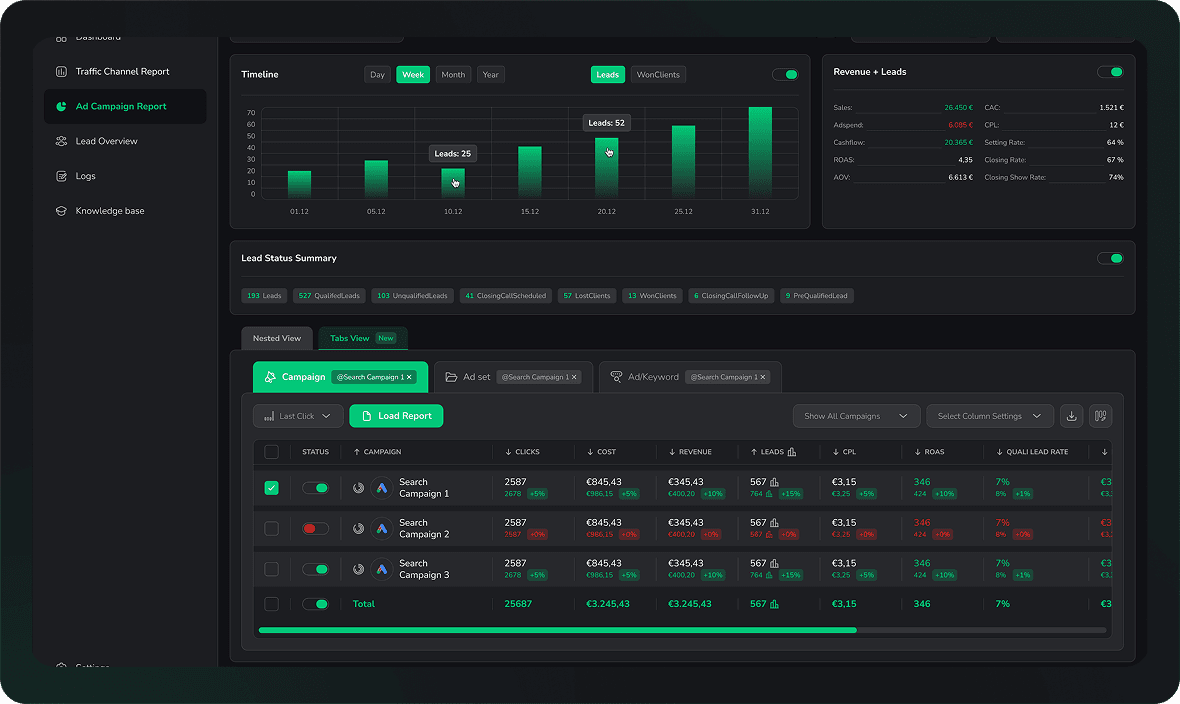
- Spend is pulled automatically, so ROAS and cost per closed deal are live per campaign, ad set and creative.
How it works
Meta Ads tracking in, revenue and audiences back out
All three run on their own once connected. The first makes real Meta Ads attribution possible, the other two make campaigns cheaper: conversion events teach the bidding, synced audiences tell it who to reach.
1 Server-side ad tracking for every Meta click
The journey starts recording before the pixel would even fire.
LeadJourney imports your campaigns, ad sets, ads and daily spend, and captures every Facebook and Instagram click with its fbclid.

On your site, sessions, page views and form fills are tracked server-side, past ad blockers, Safari and iOS.
The click is stitched to the lead the moment the form is submitted, and the journey keeps recording long after Meta's own window closes.
ROAS and cost per closed deal, live per campaign, ad set and creative, next to every other channel.
2 Send enriched conversions back to Meta
So the algorithm optimises on buyers instead of form fills.


Your CRM reports the outcome as it happens: stage changes, deal value and closed won.
LeadJourney enriches the event with the deal value, currency and hashed match keys from the CRM record, then matches it to the click that started it.
The event reaches Meta through the Conversions API with high match rates, deduplicated against your pixel if one is still running.
Bidding learns which clicks become revenue, so lead quality rises and the price per qualified lead falls.
3 Sync audiences to Meta automatically
Build the audience once in LeadJourney. It stays current on Meta by itself.
Build an audience from what LeadJourney already knows: qualified leads, open opportunities, closed customers, or leads that went quiet.
The audience syncs to Meta as a Custom Audience on its own. Identifiers are hashed before they leave, and membership updates as leads move through your pipeline.
In Ads Manager the audience is simply there: retarget it, exclude it, or seed a lookalike from your best customers.
No more CSV exports and manual uploads. The list a media buyer used to rebuild every week now maintains itself.
Your CRM closes the loop
The revenue signal comes from the CRM you already run
LeadJourney follows every Meta lead into your CRM and reads the outcome back out. Whatever your pipeline looks like, the deal value ends up on the campaign, ad set and creative that earned it.
- HubSpotTwo-way sync
Contacts and Deals, with stage, amount and close date, read as they change.
- SalesforceTwo-way sync
Leads, Contacts and Opportunities, including custom objects where your deals live elsewhere.
- PipedriveTwo-way sync
Persons and Deals, with pipeline stage and won value.
- AttioTwo-way sync
People, Companies and Deals from your workspace.
 CloseTwo-way sync
Leads and Opportunities, with status changes as they happen.
You choose what counts as a conversion
Map any CRM stage to any Meta event. Qualified lead, proposal sent, closed won, or all three.
Lead quality becomes the optimisation target
When Meta learns which leads qualify and which stall, it buys more of the first kind, so lead quality rises and the price per qualified lead falls.
Sent server to server
No pixel to fire, nothing for an ad blocker or a declined cookie banner to remove.
Reporting
The questions Ads Manager cannot answer
Every one of these is a report in LeadJourney rather than an export project. Meta stays where you buy, and LeadJourney shows what the buying produced.
Which Meta campaign produced the revenue we closed last quarter, not just the leads?
What does a closed deal actually cost us on Facebook and Instagram?
Which ad sets buy leads that never leave the first CRM stage?
Which creatives start our biggest deals, even when another channel closes them?
How does Meta compare with Google Ads and LinkedIn on cost per qualified lead?
Which landing pages turn Meta clicks into pipeline instead of bounces?
Watch it
What goes back to Meta
A walkthrough of sending qualified leads and closed revenue through the API, so the algorithm optimises on customers.
LeadJourney and Meta's own attribution
Where Ads Manager ends and LeadJourney starts
Ads Manager and the pixel credit the conversions they can see, and since iOS 14.5 they model what they cannot. Both stop at the conversion event.
| Capability | Meta Ads Manager | With LeadJourney |
|---|---|---|
| Ad tracking | Meta Ads ManagerIn the browser through the pixel, with modelled estimates filling the gaps iOS and blockers leave. | With LeadJourneyServer-side and first-party, so the click and the conversion are recorded even when the pixel is blocked. |
| The attribution window | Meta Ads Manager7-day click, 1-day view. A deal that closes in week three credits nothing. | With LeadJourneyNo window. The journey runs from the first click to closed won, however long the cycle takes. |
| What counts as a conversion | Meta Ads ManagerEvents the pixel or your own Conversions API setup sends: page views, form fills, purchases. | With LeadJourneyAny CRM stage you map, with the deal value attached: qualified lead, opportunity, closed won. |
| Revenue | Meta Ads ManagerConversion values passed at event time. CRM revenue that arrives weeks later never appears. | With LeadJourneyWon CRM revenue, attributed per campaign, ad set and creative. |
| Lead quality and lead price | Meta Ads ManagerOptimises toward the cheapest lead event, whatever those leads later do. | With LeadJourneyQualified stages go back as events, so bidding buys leads that convert and the price per qualified lead falls. |
| Custom audiences | Meta Ads ManagerBuilt from pixel events, or from customer lists someone exports and uploads by hand, which go stale between uploads. | With LeadJourneyBuilt on journey and CRM data in LeadJourney and synced automatically, so retargeting, exclusion and lookalike seed lists stay current on their own. |
| Match rates | Meta Ads ManagerDepend on what the pixel can read in the browser after consent banners and iOS. | With LeadJourneyEvents are enriched with hashed CRM identifiers and the server-side fbclid, which keeps match rates high. |
| Other channels | Meta Ads ManagerReports Meta touchpoints only, so its numbers overlap with what Google and LinkedIn claim. | With LeadJourneyOne model across paid, organic, referral and AI search, so every deal is counted once. |
| Consent and GDPR | Meta Ads ManagerThe pixel needs consent to set its cookies, and declined banners mean missing conversions. | With LeadJourneyFirst-party by design and processed in the EU, at 95%+ accuracy, with a DPA. |
Keep Ads Manager. Feed it better data.
Ads Manager stays where you plan and buy. LeadJourney fills in the measurement underneath and returns the closed deals Meta cannot see on its own, so Advantage+ and cost caps finally optimise on revenue.
Setup
Connected to Meta Ads in about 21 minutes
No developer, no pixel surgery and no data warehouse.
- 1About 5 minutes
Add a single line of code
Paste the LeadJourney script into your site or your GTM container. It starts recording sessions, fbclids and form fills immediately.
- 2About 10 minutes
Connect Meta Ads and your CRM
Sign in to Meta over OAuth and pick the ad accounts in scope, then connect the CRM where your deals live. Historic campaign data and spend are imported for you.
- 3Same day
Map stages to Meta events
Choose which CRM stages count as a qualified lead and which count as revenue, and build your first synced audience while you are there. From then on every stage change flows back through the Conversions API and your audiences keep themselves current.
Original reviews
What our customers wrote, word for word
4.9 out of 5 across 11 public reviews. Quoted as they were left, shortened only by dropping whole sentences.
- 5 out of 5 starsGoogle
“Before LeadJourney, we had no reliable tracking concept for our five-figure ad spend. We were manually building spreadsheet and CRM reports, inaccurate and time-consuming. Within two days, everything was set up. For the first time, I know exactly what I pay per lead and which campaigns actually bring in the best-qualified prospects.”
 Florian BuckCEO, Klickkraft GmbH
 “With LeadJourney we are able to track all our leads and connect them with sales and attribution data to make better decisions. In the first month of using it we scaled from 0 to 100k revenue from paid ads only.”
 GetreachBacklinks Marketplace (SaaS)
- 5 out of 5 starsG2
“LeadJourney finally fixed my Marketing Analytics. It goes way beyond basic Ad Tracking Software. The Customer Journey Report saves hours of digging, and capturing everything from Offline Conversions to AI Search Tracking makes it the Best B2B Attribution Platform available.”
Sascha LenzMarketing Manager
- 5 out of 5 starsTrustpilot
“Connected LeadJourney for 2 clients, setup took literally 20 minutes each. The data became more accurate, the reports actually make sense. Now clients look at the dashboard and the 'why don't the numbers match?' questions are gone.”
 Alexander SamarPerformance Marketing Agency
 - 5 out of 5 starsGoogle
“With LeadJourney, we have finally found a tool that provides us with the data we need to scale our performance marketing campaigns. The most important KPI is no longer lead price but cost per qualified lead.”
 Steffen SiesingCEO, Bilanzmanufaktur GmbH
- 5 out of 5 starsG2
“The ability to track both online and offline conversions in one unified dashboard has given us insights we never had before. Our ROI has improved dramatically since we started integrating LeadJourney with our CRM. We're finally able to see the full customer journey, and it's been a game changer for our strategy.”
 Andre WitzelFounder, Trading.de
 - 5 out of 5 starsTrustpilot
“The ability to seamlessly integrate data from multiple channels and see real-time insights has significantly improved our campaign results. We now focus on metrics that truly matter, like ROI and qualified leads.”
 Nikita YatsunCEO, RLV Media GmbH
Read the reviews where they were left
FAQ
What media buyers ask before connecting
If yours is not here, our team answers in the chat within a few minutes.
Does LeadJourney replace the Meta pixel?
It can run alongside it or instead of it. LeadJourney's tracking is server-side, so it does not depend on the pixel, and if you keep the pixel running the events are deduplicated through shared event IDs, so nothing is counted twice in Events Manager.
How is this different from setting up the Conversions API myself?
The Conversions API is a pipe: it moves events you already have. The hard part is having the right events. LeadJourney captures the click and the fbclid server-side, follows the lead through your CRM, enriches the event with the deal value and hashed match keys from the CRM record, and sends it at every stage you mapped. A hand-built setup only ever knows what your website knows, which is still just the form fill.
Does Meta ad tracking still work with iOS and ad blockers?
Yes, that is the point of tracking server-side. The click, the fbclid and the visit are recorded on the server before an ad blocker, Safari or a declined banner can remove them, at 95%+ accuracy. Ads Manager keeps modelling its own numbers; LeadJourney shows you the measured ones.
Which events can I send back to Meta?
Any CRM stage you map: marketing qualified, sales qualified, opportunity created, deal won, or all of them. Each event carries the deal value and currency, so value based bidding and cost caps optimise against real numbers rather than a flat lead value.
Can I sync audiences from LeadJourney to Meta?
Yes. Build an audience in LeadJourney from anything the platform knows about your leads, such as pipeline stage, deal value, source channel or inactivity, and it syncs to Meta as a Custom Audience automatically. Membership stays current as leads move through your pipeline, and identifiers are hashed before they leave. Use it for retargeting, for excluding existing customers from prospecting, or as the seed for a lookalike, without anyone exporting and uploading another CSV.
What match rates can I expect?
High ones, because the events are enriched before they are sent. Every event carries the fbclid captured server-side at click time plus hashed email and phone from the CRM record, and the more identifiers an event carries, the more conversions Meta can land on the ad that earned them.
Can Meta optimise for lead quality instead of cheap leads?
Yes, and this is where the integration pays for itself. When your qualified stage goes back as a conversion event, you can run campaigns that optimise on it directly. Meta stops buying the audiences that fill forms cheapest and starts buying the ones that qualify, so lead quality rises and the price per qualified lead falls.
A deal closes six weeks after the click. Is it still attributed?
In LeadJourney, yes: the journey has no window, so the deal is credited to the campaign and creative that started it regardless of the cycle length. Ads Manager applies its own attribution setting to the events it receives, so late deals mainly improve optimisation and audience quality there. The report that matches revenue to the ad lives in LeadJourney.
Is sending CRM data to Meta GDPR compliant?
Identifiers are hashed before they leave, you control which stages and which fields are used for matching, and nothing is sent that you have not mapped. LeadJourney itself processes and stores data in the EU, signs a data processing agreement, and tracks first-party and server-side, so consent decisions are respected rather than worked around.
Do I need a developer?
No. Connecting Meta is an OAuth sign in, the CRM connection is the same, and mapping stages to events is a settings screen. Most accounts are live in about 21 minutes, and our team will do the setup with you on a call if you prefer.
What does it cost?
The Meta Ads integration is part of the platform rather than a paid add on. Plans are priced on tracked events instead of seats, so your whole team and your agency can share one workspace, and every plan starts with a 14 day free trial without a credit card.
More integrations
More ad platform integrations
Connected the same way, attributed in the same dashboard. The rest of your stack reports right next to this one.
95%+ accuracy, from Meta click to closed deal
See which Meta ads produce revenue, not just leads
Connect Meta Ads and your CRM, and watch closed deals line up against the campaigns, ad sets and creatives that started them.