

















ChatGPT integration
ChatGPT attribution, no setup needed, from AI referral to closed deal
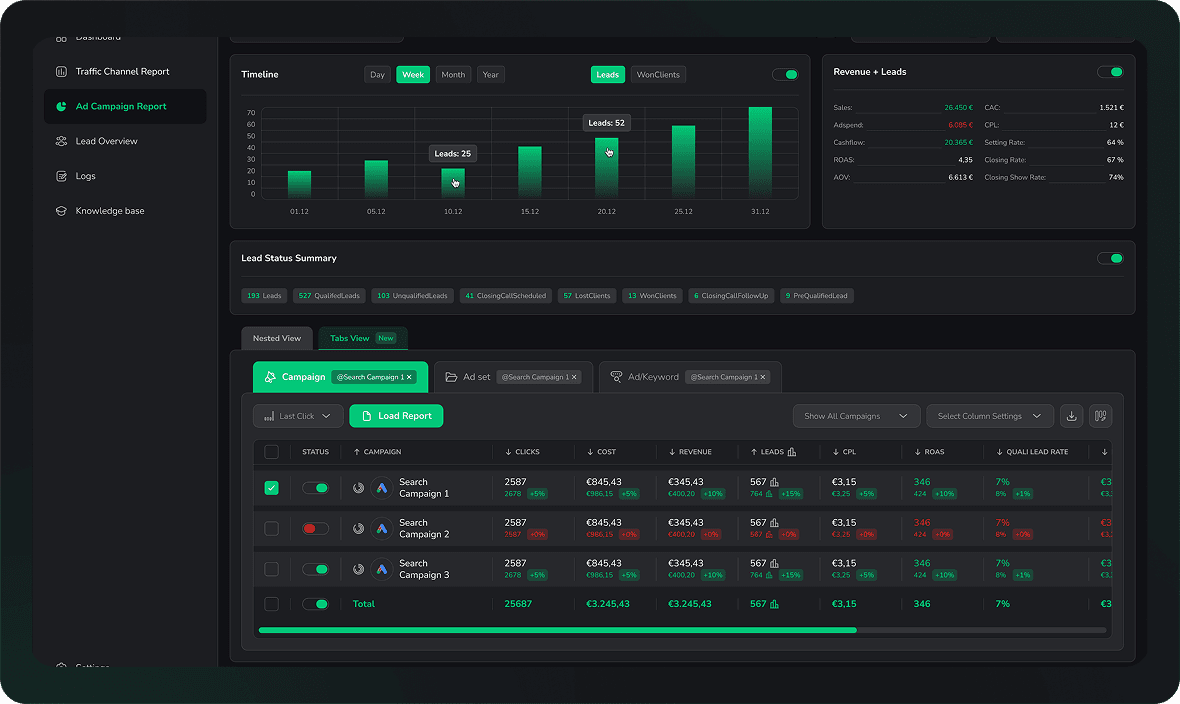
Your analytics files ChatGPT referrals under direct. LeadJourney recognises them on arrival and attributes every lead, deal and won revenue to ChatGPT.
- Reported as its own source
- No setup required
- 95%+ accuracy, first-party
Rated by the teams who connected their stack
How the data moves
ChatGPTWhere the visitor comes from- chatgpt.com
AI search tracking
LeadJourneyThe tracking script recognises the referrer on arrival, no setup- Own traffic source
- Leads
- Pipeline
- Won revenue
ChatGPT referrals used to land in direct. The tracking script separates them on arrival, so your reports show how many leads and how much revenue AI search actually produces.
Trusted by 100+ lead generation businesses, agencies and freelancers
The gap
ChatGPT cites your site. Your analytics files the visit under referral, Unassigned and direct.
When ChatGPT answers with the web, it cites sources, and every citation is a link. Depending on the referrer and the parameter, GA4 files the same click as a referral, as Unassigned or as direct. None of the three says ChatGPT.
ChatGPT traffic in your analytics today
Three buckets, none of them named ChatGPT
- A click from chatgpt.com in a browser carries a referrer, so GA4 lists it as a referral, one domain in a list of every site that ever linked to you.
- Many of the links ChatGPT cites carry a utm_source parameter and no medium, and a source without a medium lands in GA4's Unassigned channel.
- A click from the ChatGPT desktop or mobile app opens your site in a browser that often sends no referrer at all, and no referrer means direct.
- GA4 records the visit in the browser, so an ad blocker or a declined cookie banner removes the session before ChatGPT gets any credit.
- GA4 counts sessions and key events, so the trail ends at the form. Whether the lead qualified or the deal closed is a question for the CRM.
- ChatGPT is where people describe their problem in full sentences before they search for a vendor, so the visits it sends arrive late in the decision, and they are the ones being filed as if they came from nowhere.
- Gathering the three buckets into one line means a custom channel group with a regex somebody maintains, and it still stops at the session.
ChatGPT with LeadJourney
One source, recognised on arrival, followed to revenue
- The tracking script recognises a ChatGPT visit server-side as the page loads, from the chatgpt.com referrer and from the utm_source parameter ChatGPT appends, and reports it as one source called ChatGPT.
- ChatGPT is separated from the referral list, from Unassigned and from direct, so those three lines get honest at the same time.
- The visit is recorded server-side and first-party, at 95%+ accuracy, past ad blockers and declined banners.
- The visit is stitched to the lead at form submit, and the journey follows the lead through your CRM, stage by stage, to closed won.
- ChatGPT sits in the same multi-touch model as Google Ads, Meta, LinkedIn, organic and the other AI engines, so a ChatGPT first touch and a paid brand-search close are one journey, not two sessions.
- The page ChatGPT cited is on the journey, so you learn which pages it sends readers to and which of those readers become deals.
- Nothing to configure. The source is on from the first page view, with no channel group, no regex and no filter to maintain.
How it works
ChatGPT attribution in two steps: name the visit on arrival, then follow it to the deal
Both run on their own once the script is on the site: the visit is read server-side, then the leads, the pipeline and the won revenue behind a ChatGPT citation.
1 ChatGPT traffic tracking from the first page view
The visit is named on the server, not in a channel group somebody maintains.
A reader asks ChatGPT a question, ChatGPT searches the web and cites your page, and the reader clicks through from chatgpt.com in a browser or from the desktop or mobile app.

The tracking script reads the referrer and the utm_source parameter server-side on arrival and files the visit under ChatGPT, not under referral, Unassigned or direct.
The cited page, the pages read next and every later visit join one anonymous first-party journey, so the same reader coming back through a brand search a week later is one person, not two sessions.
When the reader fills in a form or books a call, the journey is stitched to the lead, and ChatGPT is on record as the first touch.
2 Follow the lead through your CRM and weigh ChatGPT against every other channel
The click cost nothing. The question is what it turned into.
With a two-way CRM connected, the journey is written onto the record: ChatGPT as the source, the page it cited, and every touch that followed.


Your CRM reports the outcome as it happens: qualified, opportunity, deal value and closed won, read back into the journey as the stages change.
ChatGPT is a line of its own in the traffic channel report: visits, leads, pipeline and won revenue, with no spend behind it, so revenue per lead reads what the CRM says.
The multi-touch models weigh ChatGPT against Google Ads, Meta, LinkedIn, organic and the other AI engines, so you learn whether it opens deals, closes them, or both.
Your CRM closes the loop
Your CRM shows what the ChatGPT visit was worth
A ChatGPT citation is earned, not bought: no spend to reconcile, no conversions API to feed. Its value only appears in the CRM, so LeadJourney follows every ChatGPT lead there and reads the outcome back out.
- HubSpotTwo-way sync
Contacts and Deals, with stage, amount and close date, read as they change.
- SalesforceTwo-way sync
Leads, Contacts and Opportunities, including custom objects where your deals live elsewhere.
- PipedriveTwo-way sync
Persons and Deals, with pipeline stage and won value.
- AttioTwo-way sync
People, Companies and Deals from your workspace.
 CloseTwo-way sync
Leads and Opportunities, with status changes as they happen.
Won revenue on the ChatGPT line
The ChatGPT line in your reports carries won revenue from the CRM, so an engine that sends fewer visits than Google and larger deals is visible for what it is, and one that sends visits and nothing else is too.
Lead quality per engine
You see how many ChatGPT leads qualify, how many stall, and how that compares with organic search, paid and the other AI engines, before you decide how much content to write for it.
No window to expire
A ChatGPT visit in January that becomes a deal in April still credits ChatGPT. The journey runs until the deal closes, not for a lookback period.
Reporting
The questions GA4 cannot answer about ChatGPT
Each of these is a report filtered to the ChatGPT source, not a channel group, a regex and an export. The ChatGPT line simply exists now, and it runs all the way to revenue.
How many leads did ChatGPT send us last month, and how many of them qualified?
How much won revenue started with a ChatGPT citation this quarter?
Which of our pages does ChatGPT cite, and which of those turn readers into leads?
Is ChatGPT opening deals that Google Ads later closes, or closing deals our content opened?
How does ChatGPT compare with Perplexity, Gemini and Claude on leads and deal size?
How much of what we reported as direct and Unassigned was ChatGPT all along?
Watch it
ChatGPT as its own channel
How the traffic ChatGPT sends stops being filed under direct, and gets followed through to meetings and revenue.
LeadJourney and Google Analytics 4
Where GA4 ends and LeadJourney starts
GA4 sorts sessions and key events into channel groups designed before ChatGPT existed, and a CRM was never part of them.
| Capability |  Google Analytics 4 Google Analytics 4 | With LeadJourney |
|---|---|---|
| ChatGPT attribution | Google Analytics 4No ChatGPT source. A click with a referrer is a chatgpt.com referral, a click with the utm_source parameter is Unassigned, and a click from the app with neither is direct. | With LeadJourneyOne source called ChatGPT, recognised server-side on arrival from the referrer and from the parameter, separated from referral, Unassigned and direct. |
| Where the visit is recorded | Google Analytics 4In the browser, through the gtag.js tag, so an ad blocker or a declined banner removes the session. | With LeadJourneyServer-side and first-party, so the visit is recorded past blockers and banners, at 95%+ accuracy. |
| What is counted | Google Analytics 4Sessions, engaged sessions and the key events your site fires, per channel. | With LeadJourneyLeads, qualified leads, pipeline and won revenue, per source. |
| Revenue | Google Analytics 4Purchase and key event values passed at event time. Revenue that closes in the CRM weeks later never appears. | With LeadJourneyWon CRM revenue, attributed to the ChatGPT visit that started the journey. |
| The attribution window | Google Analytics 4Lookback windows of up to 90 days on key events. A deal that closes after that credits nothing. | With LeadJourneyNo window. The journey runs from the ChatGPT click to closed won, however long the sales cycle. |
| Other touches | Google Analytics 4Data-driven attribution across the sessions GA4 can tie to one user, usually through a browser cookie. A new device starts a new user. | With LeadJourneyChatGPT weighed against Google Ads, Meta, LinkedIn, organic and the other AI engines in one multi-touch model, joined at the lead. |
| Landing pages | Google Analytics 4The landing page report shows sessions per page. Which cited page produced a lead is an exploration you build yourself. | With LeadJourneyLeads and revenue per landing page, filtered to ChatGPT, so you see which pages ChatGPT cites and which of those convert. |
| Setup | Google Analytics 4A custom channel group with a regex for each AI domain and each parameter, maintained by hand as the engines change. | With LeadJourneyNothing. The script recognises ChatGPT and the other AI engines and reports each as its own source. |
| Consent and GDPR | Google Analytics 4Needs consent to set its cookies. Consent mode models the sessions that declined. | With LeadJourneyFirst-party by design and processed in the EU, at 95%+ accuracy, with a DPA. |
Keep GA4. Give ChatGPT a line of its own.
GA4 stays where you read page behaviour. LeadJourney adds the source GA4 does not have and the revenue GA4 cannot see.
MCP server
Chat with your ChatGPT attribution data
The ChatGPT source, the leads behind it and the revenue they closed are also served over MCP. Ask in Claude or ChatGPT, and the answer comes from your own numbers.
LeadJourney MCP connected, try any tab
Which campaigns produced our closed revenue last month?
Based on your LeadJourney data, 3 campaigns produced 148,200 EUR of closed revenue last month:
- Google Ads, Brand
- 38 leads, 9 closed deals, 61,400 EUR. Shortest path to signature.
- LinkedIn, Retargeting
- 21 leads, 6 closed deals, 48,900 EUR. Seven touchpoints on average.
- Meta, Lookalike DACH
- 54 leads, 5 closed deals, 37,900 EUR. Cheapest qualified lead.
Want this as a weekly summary in Slack?
Ask anything about your lead journeys
Where did our three biggest deals this quarter come from?
Your 3 largest deals this quarter all started somewhere the last click never showed you:
- 42,000 EUR
- First touch LinkedIn Ads, closed 63 days later after a webinar signup.
- 28,500 EUR
- First touch Google organic, paid click on day 11, demo on day 19.
- 21,800 EUR
- First touch a Meta video view, form filled from email six weeks on.
Want the full touchpoint list for any of them?
Ask anything about your closed deals
Which landing pages turn LinkedIn traffic into qualified leads?
3 pages take your LinkedIn traffic, and the qualified rate between them runs from 4% to 18%:
- /demo/attribution
- 18% qualified from 214 visits. Highest intent page on the site.
- /guide/server-side
- 9% qualified from 612 visits. Most journeys stall after the download.
- /pricing
- 4% qualified from 488 visits. Second most traffic, lowest intent.
Want the same breakdown for Google Ads traffic?
Ask anything about your landing pages
What did each channel cost per qualified lead last week?
3 channels spent budget last week. Cost per qualified lead ran from 41 EUR to 187 EUR:
- LinkedIn Ads
- 41 EUR per qualified lead. 2,300 EUR spent, 56 qualified.
- Google Ads
- 88 EUR per qualified lead. 4,400 EUR spent, 50 qualified.
- Meta Ads
- 187 EUR per qualified lead. 3,740 EUR spent, 20 qualified.
Want an alert the moment a channel passes 120 EUR?
Ask anything about your cost per lead
What do the journeys that close have in common?
3 signals show up in most of your closed deals and in almost none of the lost ones:
- Pricing page, 2+ visits
- In 71% of closed deals. In 12% of the ones that never closed.
- Demo within 14 days
- In 64% of closed deals. Median 9 days from the first click.
- Second contact
- In 58% of closed deals. A colleague of the lead arrives on site.
Want these three scored onto every lead in your CRM?
Ask anything about your lead journeys
Setup
ChatGPT in your reports in about 21 minutes, none of them spent on OpenAI's side
There is no OpenAI account to connect and no channel group to build. The time goes on the script and your CRM.
- 1About 5 minutes
Add a single line of code
Paste the LeadJourney script into your site or your GTM container. From the first page view it reads referrers and parameters server-side and reports ChatGPT as its own source, with the referral, Unassigned and direct numbers corrected at the same time.
- 2About 10 minutes
Connect your CRM
Sign in to HubSpot, Salesforce, Pipedrive, Attio or Close and pick the pipelines in scope. From then on every ChatGPT lead is followed through its stages, and won revenue lands on the ChatGPT source.
- 3Same day
Ask the question
Open the traffic channel report and ChatGPT is a line with leads, pipeline and revenue on it, or ask Atlas in plain words. Nothing was configured for ChatGPT. It was recognised from the first visit.
Original reviews
What our customers wrote, word for word
4.9 out of 5 across 11 public reviews. Quoted as they were left, shortened only by dropping whole sentences.
- 5 out of 5 starsGoogle
“Before LeadJourney, we had no reliable tracking concept for our five-figure ad spend. We were manually building spreadsheet and CRM reports, inaccurate and time-consuming. Within two days, everything was set up. For the first time, I know exactly what I pay per lead and which campaigns actually bring in the best-qualified prospects.”
 Florian BuckCEO, Klickkraft GmbH
 “With LeadJourney we are able to track all our leads and connect them with sales and attribution data to make better decisions. In the first month of using it we scaled from 0 to 100k revenue from paid ads only.”
 GetreachBacklinks Marketplace (SaaS)
- 5 out of 5 starsG2
“LeadJourney finally fixed my Marketing Analytics. It goes way beyond basic Ad Tracking Software. The Customer Journey Report saves hours of digging, and capturing everything from Offline Conversions to AI Search Tracking makes it the Best B2B Attribution Platform available.”
Sascha LenzMarketing Manager
- 5 out of 5 starsTrustpilot
“Connected LeadJourney for 2 clients, setup took literally 20 minutes each. The data became more accurate, the reports actually make sense. Now clients look at the dashboard and the 'why don't the numbers match?' questions are gone.”
 Alexander SamarPerformance Marketing Agency
 - 5 out of 5 starsGoogle
“With LeadJourney, we have finally found a tool that provides us with the data we need to scale our performance marketing campaigns. The most important KPI is no longer lead price but cost per qualified lead.”
 Steffen SiesingCEO, Bilanzmanufaktur GmbH
- 5 out of 5 starsG2
“The ability to track both online and offline conversions in one unified dashboard has given us insights we never had before. Our ROI has improved dramatically since we started integrating LeadJourney with our CRM. We're finally able to see the full customer journey, and it's been a game changer for our strategy.”
 Andre WitzelFounder, Trading.de
 - 5 out of 5 starsTrustpilot
“The ability to seamlessly integrate data from multiple channels and see real-time insights has significantly improved our campaign results. We now focus on metrics that truly matter, like ROI and qualified leads.”
 Nikita YatsunCEO, RLV Media GmbH
Read the reviews where they were left
FAQ
What marketers ask before trusting the ChatGPT line
If yours is not here, our team answers in the chat within a few minutes.
Why does GA4 show my ChatGPT traffic as referral, Unassigned and direct?
Because GA4 classifies by referrer and by UTM parameters, and a ChatGPT click can arrive with either, both or neither. A click from chatgpt.com in a browser carries a referrer, so it is a referral. Many of the links ChatGPT cites carry a utm_source parameter and no medium, and GA4 has no channel for a source without a medium, so those land in Unassigned. A click from the desktop or mobile app often sends no referrer at all, and no referrer is direct. Nothing is broken; GA4 simply has no ChatGPT bucket to put them in.
How does ChatGPT attribution work when the click comes from the ChatGPT app?
The tracking script reads both the referrer and the utm_source parameter server-side as the page loads. An app click that arrives without a referrer but with the parameter is still recognised and filed under ChatGPT, rather than under direct. The rest of the journey works as for any other source: the visit is stitched to the lead at form submit and followed through your CRM to revenue.
Do I have to configure anything for ChatGPT traffic tracking?
No. There is no OpenAI account to connect, no channel group to build and no regex to maintain. Once the LeadJourney script is on the site, ChatGPT is reported as its own source from the first page view, alongside Perplexity, Claude, Gemini, Copilot, Grok and DeepSeek.
Which ChatGPT clicks can be recognised, and which cannot?
Any click that carries the chatgpt.com referrer or ChatGPT's utm_source parameter is recognised. A click that arrives with neither, for example a link copied out of an answer and pasted into a message, arrives as direct for everybody, LeadJourney included. We say so rather than model a number for it.
What about ads inside ChatGPT?
OpenAI has started placing ads in ChatGPT, and a paid click belongs to a campaign, not to the earned ChatGPT source. The ChatGPT Ads integration handles that side, so paid clicks are credited to the campaign and the ChatGPT line on this page stays citations only. Paid and earned never blur into one number.
Can I see which of my pages ChatGPT cites?
Yes. The landing page report filtered to ChatGPT lists every page a ChatGPT reader arrived on, with visits, leads and won revenue per page. That is the closest thing to a citation report that exists today, and the revenue column tells you which of those pages deserve more of your writing time.
Does LeadJourney track the other AI assistants too?
Yes, each as its own source: Perplexity, Claude, Gemini, Copilot, Grok and DeepSeek next to ChatGPT. So AI search in your channel report is a set of engines you can compare on leads, pipeline and deal size, not one bucket, and a new engine is picked up as it appears rather than waiting for a regex.
A ChatGPT visit turns into a deal three months later. Is it still attributed?
Yes. The journey has no window, so the deal is credited to the ChatGPT visit that started it however long the cycle takes. GA4's lookback windows would have dropped the connection weeks earlier, which is one reason AI search looks smaller in GA4 than it is.
Is tracking ChatGPT referrals GDPR compliant?
Yes. LeadJourney reads the referrer and the parameter the browser already sends, on servers in the EU, first-party, so consent decisions are respected rather than worked around. Nothing is sent to OpenAI, and the lead is only identified when the reader fills in your form. A data processing agreement is part of every plan.
Do I need a developer?
No. The script is one line in your site or your GTM container, the CRM connection is an OAuth sign in, and ChatGPT itself needs nothing. Most accounts are live in about 21 minutes, and our team will do the setup with you on a call if you prefer.
What does it cost?
ChatGPT tracking is part of the platform rather than a paid add on. Plans are priced on tracked events instead of seats, so your whole team and your agency can share one workspace, and every plan starts with a 14 day free trial without a credit card.
More integrations
More AI search integrations
Connected the same way, attributed in the same dashboard. The rest of your stack reports right next to this one.


95%+ accuracy, from ChatGPT citation to closed deal
Count the leads ChatGPT sends you in LeadJourney, not under direct
Add the script, connect your CRM, and ChatGPT becomes a line in your reports with leads, pipeline and won revenue on it. Nothing to configure on OpenAI's side.