














Customer Acquisition Cost (CAC)
The total sales and marketing cost of winning one new customer: everything spent on acquisition in a period divided by the customers gained in it. The cost that CPL and CPA lead up to.


Summarise this article with AI
Opens the page with a ready prompt in:

Nothing is sent until you pick a service.
In short
Customer acquisition cost (CAC) is the total amount a business spends on sales and marketing to win one new customer, calculated by dividing all acquisition costs in a period by the number of new customers gained in the same period. Where cost per lead stops at the form and cost per acquisition stops at a chosen conversion, CAC goes all the way to the paying customer and counts the people and tools it took to get there.
For a lead generation business CAC is the number that decides whether growth is affordable. A €50 lead is neither cheap nor expensive until you know how many of those leads become customers, what those customers pay, and what the sales team cost while closing them.
The Formula
The division is easy; the discipline is in the numerator. A full CAC includes ad spend, agency and freelancer fees, marketing and sales software, the salaries or salary share of the people doing the acquiring, and commissions. Leave the sales team out and you have a marketing acquisition cost, which is a useful number but a different one.
€18,000 in ads + €5,000 agency fee + €7,000 of sales time = €30,000, ÷ 25 new customers = a CAC of €1,200.
The CAC calculator takes the cost lines separately so nothing is forgotten, and the CAC target planner works backwards from the customer value to the CAC you can afford.
CAC Versus CPL Versus CPA
The three metrics measure the same funnel at different depths, and confusing them is how a cheap campaign gets scaled into an expensive one.
Cost per lead (CPL)
Ad spend divided by leads. Counts every form submit, qualified or not. The number the ad platform shows first.
Cost per acquisition (CPA)
Ad spend divided by a conversion you define: a qualified lead, a booked meeting, a sale. Deeper than CPL, but still ad spend only.
Customer acquisition cost (CAC)
All sales and marketing cost divided by new customers. The only one of the three that includes the people and the whole period.
Follow one campaign down the funnel. €10,000 of spend brings 200 leads, a cost per lead of €50. Sales qualifies 40 of them, so the cost per qualified lead is €250. Ten become customers, so the paid cost per acquisition is €1,000. Add the €4,000 of sales time it took to work those 40 leads and the CAC is €1,400. Every step is the same campaign, and every step tells a different story about whether it should get more budget.
Blended Versus Paid CAC
- Blended CACAll acquisition cost divided by all new customers, including the ones who came through referrals, organic search or a founder's network. The board number: it says what growth costs the company overall, and it hides which channel is doing the work.
- Paid CACPaid media cost divided by the customers paid media produced. The budget number: it says what one more customer from advertising costs, and it needs attribution that follows the lead from the ad click to the won deal.
- CAC per channelPaid CAC split by Google, Meta, LinkedIn and the rest. Two channels with the same CPL routinely show CACs that differ by a factor of three once close rates are in.
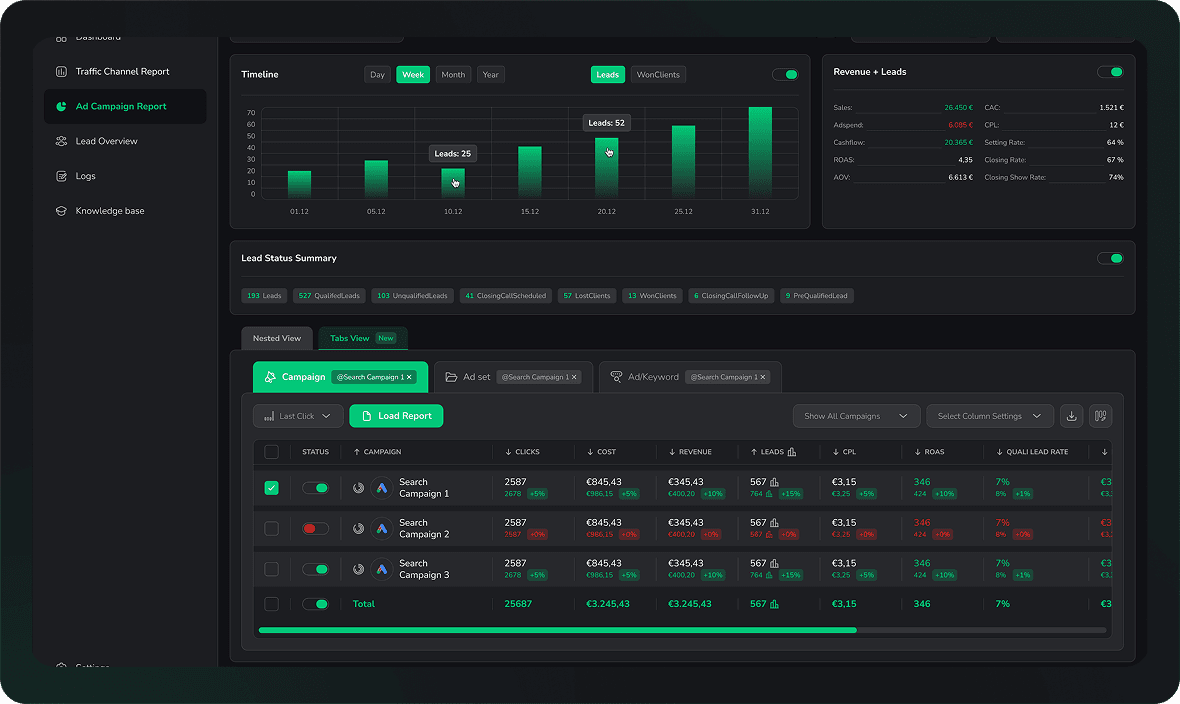
A business that only knows its blended CAC will scale paid spend and watch the blended number rise without knowing why: the organic customers stayed the same and the paid ones cost more than the average. Splitting the two requires knowing which customers came from paid, which is a question for the CRM and the lead source on each contact, not for the ad platform. Marketing reporting that joins spend and CRM outcomes is what produces the per-channel figure.
What a Good CAC Looks Like
CAC has no benchmark on its own; it is judged against what a customer is worth. Two ratios are in common use.
- LTV to CAC. Customer lifetime value divided by CAC. A ratio of 3:1 is the rule of thumb most investors and operators quote: a €1,200 CAC is comfortable for a customer worth €3,600 over their lifetime and alarming for one worth €1,500. The LTV calculator gives the numerator.
- CAC payback. The months of gross profit it takes to earn the CAC back. A subscription at €200 a month with 70% margin pays back a €1,200 CAC in about nine months; the shorter, the less cash growth consumes.
- CAC trend. A rising CAC at flat spend means the channel is saturating or lead quality is falling; a rising CAC while spend grows is the normal cost of scale and only a problem when it crosses the ratio you can afford.
Conclusion
Customer acquisition cost is where cost per lead and cost per acquisition were heading all along: the price of a paying customer, with the people counted in. The blended figure tells you whether growth is affordable; the paid figure per channel tells you where the next euro should go. Both need the same thing, a line from the ad spend to the customer in the CRM, which is why CAC is an attribution problem before it is an arithmetic one. See optimise on revenue for the version of that line the ad platforms can act on.
Keep exploring
Related glossary terms
Cost Per Lead (CPL)
How much a business spends on advertising to acquire a single lead: total ad spend divided by leads generated. Useful only once 'lead' means more than a form fill.
Read the definition6 min read
Cost Per Acquisition (CPA)
Advertising spend divided by the number of conversions it produced. Which action counts as the acquisition decides whether the number means anything.
Read the definition5 min read
Return on Ad Spend (ROAS)
Revenue generated by advertising divided by the amount spent on it, written as a multiple (4x) or a percentage (400%). The number every platform reports, and the one whose meaning depends entirely on where the revenue figure came from.
Read the definition6 min read
95%+ data accuracy, even with ad blockers and iOS
See which ads really created your
Connect your ad accounts and your CRM once, and every lead arrives with the campaign that created it already attached.