















For founders and CEOs
Run marketing like you run the rest of the company. On numbers.
You sign the ad invoices, but nothing you run says what marketing returns. LeadJourney connects ad spend to revenue in your CRM.
- Live in 21 minutes
- ROI on real CRM revenue
- GDPR, hosted in the EU
One month of marketing, twice
- Meta Ads Manager
- 34 leads
- Google Ads
- 27 conversions
- GA4
- 1,412 sessions
- CRM
- 9 deals, source "Direct"
- Gut feeling
- "Probably Meta?"
- Ad spend
- €4,310
- Leads
- 48, each with a source
- Pipeline created
- €86,400
- Closed revenue
- €38,900
- Marketing ROI
- 9.0x
Meta and Google claimed 61 conversions between them. The CRM received 48 leads and closed 9 of them. One view holds all three numbers, plus the one that was missing: what the month returned.
The problem
Every tool reports a number. None of them is the answer.
Ad platforms grade their own homework, GA4 counts sessions, and the CRM knows revenue but not where it came from. You could reconcile them in a spreadsheet, but you are also running a company.
How the budget gets decided today
Five sources, no single truth
- Meta and Google both claim the same lead, so the platform numbers add up to more conversions than you have leads.
- GA4 reports sessions and engagement, but never what a channel returned in revenue.
- The CRM knows which deals closed, and its lead source column says Direct or nothing at all.
- The spreadsheet that joins it all is out of date the week after you build it.
- So the budget conversation runs on gut feeling and whichever channel looked good last.
- Scaling means spending more while hoping the mix is right.
The same month with LeadJourney
Spend and revenue joined in one system
- Every lead is tracked server-side from its first ad click, first-party, at 95%+ accuracy.
- Spend is pulled automatically from Meta, Google, LinkedIn and Microsoft Ads and matched to the leads it created.
- Closed deals in your CRM are connected back to the campaign that started them.
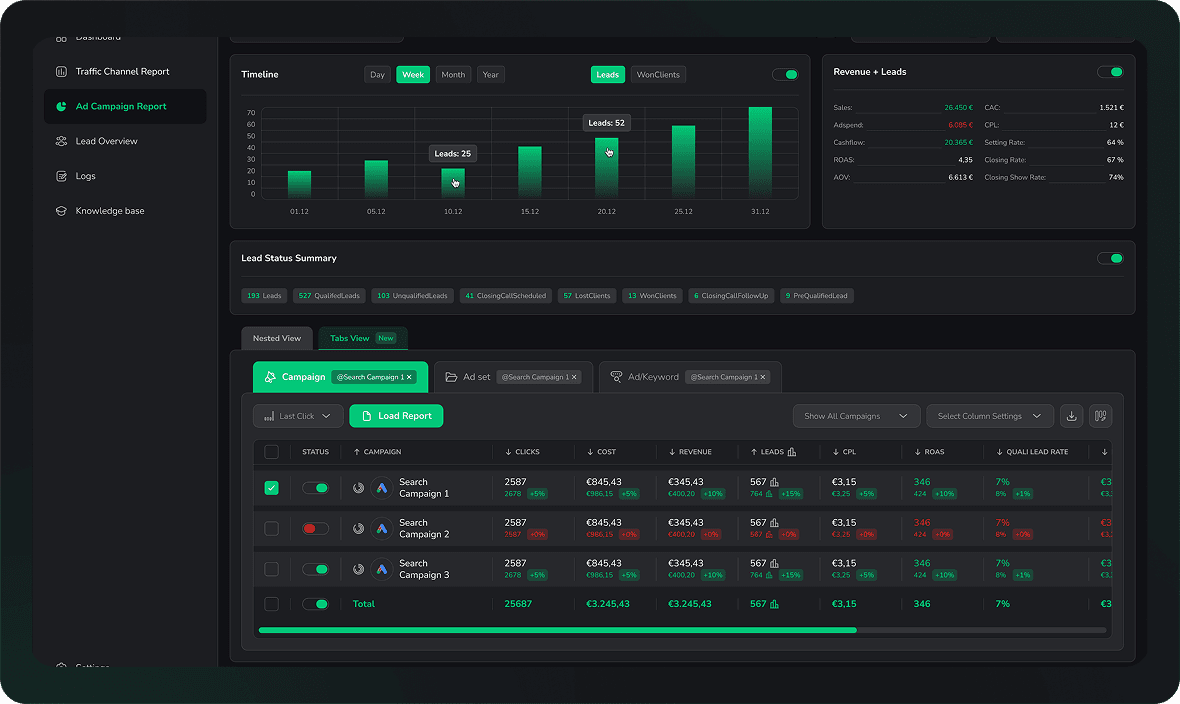
- One dashboard shows spend, leads, pipeline and revenue per channel, updated live.
- Cost per lead and ROI are computed on real CRM outcomes, not platform-reported conversions.
- When you double a budget, a number said so, and next month the same number tells you if it worked.
The fix
The numbers to decide on, without hiring an analyst
LeadJourney is built for the operator who runs marketing on top of everything else. The reports are ready to act on, and the analysis comes to you instead of waiting in a tool.
A P&L view of marketing
What went in, what came back
- Spend, leads, pipeline and closed revenue per channel and per campaign, in one view.
- See which channels produce customers and which only produce form fills.
- Open any lead and read its whole journey, so you can verify any number down to the click.
- Paid, organic, referral and AI search compared on the same revenue yardstick.
Answers that come to you
For the weeks you never open a dashboard
- Ask Atlas in Slack in plain language, like "what did Google Ads return last month", and get the number with the report behind it.
- Automated daily, weekly or monthly summaries in email, Slack or WhatsApp, written from live data.
- Live dashboards you can put on the screen in a board meeting or share with an advisor as they are.
- Teams save 15+ hours a month that used to go into manual reporting.
What changes
The questions you can finally answer with a number
Every one of these is a report in LeadJourney, ready the moment you ask. No SQL, no spreadsheet, no analyst in the loop.
Which channel should get the next thousand in budget, based on revenue rather than clicks?
What does a customer actually cost us from Meta, from Google and from organic?
Which campaigns create deals that close, and which only create leads that go quiet?
What did marketing return last quarter, in pipeline and closed revenue?
Did raising the ad budget last month produce more customers, or just more spend?
Do the numbers in the agency's monthly report match what landed in the CRM?
Reports and features behind this
Setup
Live before your next budget decision, in about 21 minutes
No developer, no migration, and nothing changes for whoever works in the CRM.
- 1About 5 minutes
Add a single line of code
Paste the LeadJourney script into your site or your GTM container. It works with WordPress, Webflow, Wix and custom builds, and starts recording sessions and form fills immediately.
- 2About 10 minutes
Connect your ads and your CRM
Sign in over OAuth. Spend flows in from Meta, Google, LinkedIn and Microsoft Ads, and leads and deals sync with HubSpot, Pipedrive, Salesforce, Close and more.
- 3Same day
Make the next call on data
From the next lead onwards every record carries its real source, and the dashboard builds the spend to revenue picture as deals close.
FAQ
What founders ask before switching this on
If yours is not here, our team answers in the chat within a few minutes.
Are we too small for marketing attribution?
The smaller the company, the more each budget decision weighs: a channel that does not work is a percentage of your revenue, not a rounding error. LeadJourney is built for businesses without a data team, plans follow your marketing spend rather than your headcount, and setup takes about 21 minutes. Attribution is not an enterprise ritual. It is knowing what you got for the money.
I do not have time to set up or learn another tool.
Setup is one snippet and a few OAuth logins, about 21 minutes in total, and if you book a demo we build the setup plan for your channels and CRM together on the call. After that the tool comes to you: Atlas answers questions in Slack and scheduled reports arrive by email, Slack or WhatsApp, so weeks can pass without you opening the dashboard and you still know your numbers.
We already have GA4. Is this not the same thing?
GA4 measures sessions and events on your website. LeadJourney measures money: it matches ad spend to the leads in your CRM and the revenue they turn into, keeps journeys intact across the weeks where GA4 loses them to consent banners and iOS, and reports ROI per channel. Most customers keep GA4 for site behaviour and run budget decisions on LeadJourney.
Our agency already sends a monthly report.
Keep the agency, add an independent measurement. Agency reports are built from the ad platforms, which only see part of each journey and grade their own work. LeadJourney measures from your website and your CRM, so you can hold the retainer against revenue you can verify yourself. Good agencies tend to welcome it, because it also proves work the platforms under-credit.
Most of our leads come from referrals and organic, not ads.
Then you have even more reason to measure. LeadJourney tracks organic search, referral, email, social and AI engines like ChatGPT and Perplexity as first class channels, and custom channels cover podcasts, partnerships and newsletters. You see which of them actually produces customers before you ever scale paid.
Do I need an analyst to get value out of it?
No. The reports are prebuilt around the questions a founder actually asks, from cost per customer to ROI per channel, and Atlas answers anything else in plain language in Slack, with the report behind the number one click away. The one person marketing department is exactly who this was designed for.
What does it cost?
Plans follow your marketing spend, so a small company pays a small price, and it scales only as your budget does. Every plan starts with 14 days free, no credit card. Pricing is public, in five currencies, on the pricing page.
Is this GDPR compliant?
Yes. Data is processed and stored in the EU, we sign a data processing agreement, and tracking runs first-party and server-side, so it respects consent decisions rather than working around them.
Marketing, finally accountable
See what your marketing returned, on your own numbers
Book a demo and we build the spend to revenue picture for your channels and your CRM, live on the call.