














BlogB2B Marketing Attribution
Attribution for Long Sales Cycles: Crediting a Late Deal
Attribution windows were built for checkouts, so a 7 or 90 day window expires long before a nine month B2B deal closes. The four things you have to persist, why last click is useless here, the reporting cadence that makes a long cycle legible, and what to send back to the ad platforms and when.

Contents
Summarise this article with AI
Opens the page with a ready prompt in:


Nothing is sent until you pick a service.
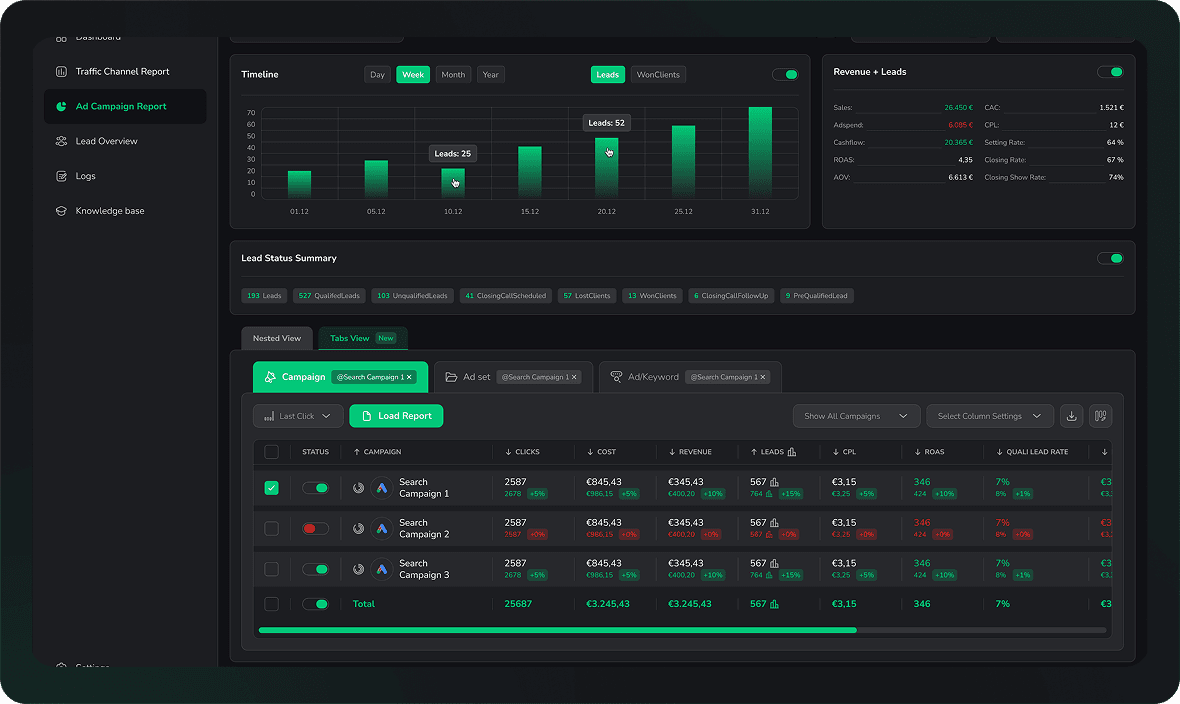
The deal closed in September. The first touch was a LinkedIn ad in January, then a webinar in March, a comparison page in June and a demo in July. Your ad account has no idea. By the time the contract was signed, the click that started it had fallen out of the attribution window six months earlier, so the campaign that opened the relationship shows nothing and the branded search that closed it shows everything.
This is the standard shape of B2B, SaaS and high-ticket services, and it is not a tracking bug. Attribution windows were designed for checkouts, where the decision takes a session and the money arrives the same day. This guide is about what to do instead: what to persist, which model to pick, how to report on a cycle longer than a quarter, and what to send back to the platforms so bidding gets a signal it can use.
Quick Summary: Attribution for Long Sales Cycles
In short
Ad platforms forget a click long before a nine month deal closes, so a 7, 30 or 90 day attribution window never learns the outcome. The fix is not a longer window, it is a journey record you own: persist the first touch and its click ID, every touch in between, the identity join from anonymous visitor to CRM contact, and the deal value at close. Then report on cohorts by first-touch month rather than the current month, and send an intermediate stage back to the platforms early with the closed deal when it is true.
What follows is the detail: the mechanical problem, what it does to a budget two quarters later, the four things to persist and what destroys each, honest model choice, the reporting cadence, and the platform side.
Why Attribution Windows Expire Before the Deal Does
Every ad platform measures conversions inside a window: a period after the click during which a conversion can still be credited to it. Google Ads lets you set that window per conversion action, currently up to about ninety days. Meta's default attribution setting is a seven day click window. LinkedIn offers a selectable range in a similar band. The exact numbers move; the shape does not. Once the window closes, the click is gone from the platform's ledger and nothing you upload later can be attached to it.
For a checkout that is fine, because the decision fits inside the window. For a deal that takes nine months it means the platform never learns the outcome at all. The model behind Smart Bidding or automated delivery is trained only on what happens in the first days after the click: a form fill, a content download, a demo request. Those are the events it will keep buying, whether or not they ever become customers. See attribution window for the mechanics in short form.
What each measurement approach can and cannot credit
| Measurement | What it can credit | What it misses | Effect on budget decisions |
|---|---|---|---|
| 7 day window | The click and a form fill within the week | Every stage after the first week: qualification, opportunity, offer, close | Optimises for form volume, so cheap leads win and pipeline quality drifts down |
| 90 day window | The click, the form fill and an early sales stage if it lands fast | Anything slower than a quarter, which in a nine month cycle is most of it | Better, and still blind to the deals that pay for the year |
| Journey based | Every touch, the stage each led to, and the deal value whenever it arrives | Touches you never captured, mainly offline conversations and dark social | Lets you compare channels on pipeline and revenue instead of lead count |
What That Does to Your Budget
Follow the money through one planning cycle and the damage is easy to trace. The channels that start relationships, LinkedIn, YouTube, podcasts, a good comparison page, look expensive, because everything they produce closes too late to be counted. The channels that catch demand at the end, branded search above all, look extraordinary, because they are the last thing a buyer touches before signing something they had already decided to sign.
So budget moves down the funnel. Branded search gets more money than it can spend, the top of the funnel is cut, and for a quarter or two the numbers improve, because the pipeline built earlier is still closing. Then it runs out. Two quarters after the cut, new pipeline falls, and nobody links it back to a budget decision made three quarters before.
That delay is worth naming out loud in the planning meeting. In a nine month cycle, the feedback on a budget decision arrives roughly nine months late, which is longer than many people stay in the role that made it. Long-cycle attribution is mostly about shortening that loop honestly, rather than pretending the loop is short.
The Four Things You Have to Persist
A nine month journey survives only if four pieces of data survive with it. Each one has a familiar way of getting destroyed.
- The first touch and its click IDThe gclid, fbclid, li_fat_id or msclkid captured on the very first visit, with the UTMs and the landing page. Capture it once, store it first-party, and never let a later visit overwrite it.
- Every touch in between, timestampedThe webinar in March and the pricing page in June are what makes a multi-touch model possible at all. Without timestamps you have a set of sources, not a journey.
- The identity joinThe link between the anonymous visitor and the CRM contact, made at the first form fill, call or booking. If that join is missing, everything before the form is orphaned.
- The deal value at closeThe amount and currency on the won deal, written back onto the same record. Without it you can only rank channels by lead count, which is the metric that caused the problem.
The usual causes of loss are mundane. Session storage that clears when the browser does. A cookie with a lifetime measured in days, which on Safari is shorter than most people expect. A CRM where lead source is one editable field that the last rep to touch the record overwrites. And a re-tracking migration halfway through the year that starts history again from zero.
Do not re-track in the middle of a cycle
Switching tracking tools or rebuilding the data layer resets the journey for everyone currently in the pipeline. In a nine month cycle that is nine months of deals that will close with no first touch, and the report you build afterwards shows a channel mix that is simply wrong. If a migration is unavoidable, run old and new side by side until the cohort that was open at the switch has closed, and mark that cohort in the reporting so nobody reads it as a trend.
Why Last Click Fails Here
Last click is the default in most reporting, and in a long cycle it is close to useless. In a nine month journey the last click is almost always branded search or a direct visit, because a buyer who has decided types your name. Crediting the deal there tells you that people who were already going to buy went and bought.
First click has the opposite failure. It gives everything to the top of the funnel, which flatters whichever channel produces the cheapest awareness traffic and hides how much of it never came back. In a nine month cycle it is at least the more useful error, because the top of the funnel is exactly what last click erases. It is still a single-touch model pretending a nine month decision had one cause.
The practical answer is to keep both visible and treat neither as the truth. First click tells you what starts pipeline. Last click tells you what closes it. The interesting number is the gap between them, and any channel with a large gap is a channel somebody in the business is arguing about.
Which Multi-Touch Model Answers Which Question
Linear, time decay and position based all spread credit across the journey. Choosing between them is choosing a question, not choosing a truth.
- Linear splits credit evenly across every touch. It answers: which channels appear in the journeys that close? Useful for content and for channels that never get the last click, and it flatters anything that produces a lot of small touches.
- Time decay weights recent touches more heavily. It answers: what moved this deal in the months that mattered? Reasonable when the last quarter is the sales process, and it will always understate the first touch.
- Position based, usually forty per cent to the first touch, forty to the last and the rest shared, answers: what opened this and what closed it? For most B2B teams it is the least argued-about default.
Pick one as the number in the board deck and keep the others available for the argument. What matters more than the choice is being able to switch models without re-tracking, so a disagreement is settled by looking rather than by rebuilding. A model you cannot change is a model you will end up defending for the wrong reasons.
The Account Level Problem in B2B
A nine month deal is rarely one person. A developer finds you through a comparison page, the head of marketing sees a LinkedIn ad two months later, the CFO reads the pricing page in month seven, and procurement books the call. Four people, four journeys, one deal.
Contact-level attribution either splits that deal across four records or credits it to whichever contact happens to sit on the opportunity. Neither is right. The workable pattern is to roll journeys up to the account: match contacts to a company by email domain or by the CRM's own account object, treat the account as the unit that converts, and put the deal value on the account rather than on a person.
It is not perfect. Free email addresses do not resolve, subsidiaries look like separate companies, and a buying committee member who never fills in a form stays invisible. But account level is close enough to make a channel comparison honest, and contact level is not. Multi-touch attribution for B2B goes further into the mechanics.
The Operating Cadence
Long-cycle attribution fails more often on reporting habits than on data. Four changes make it usable.
- Report on cohorts by first-touch month, not on the current month. The question is what January's spend produced, and the answer is not available in January. A cohort report lets a month keep filling in for a year instead of being judged the week it ends.
- Treat time to close per channel as a first class metric. If LinkedIn deals close in eleven months and Google deals in five, that is a cash flow fact rather than a footnote, and it changes what a blended cost per acquisition means.
- Use pipeline created as the leading indicator and revenue closed as the lagging one. Pipeline created is available now, moves with spend and is close enough to steer on. Revenue is the audit that tells you whether the steering was right.
- Re-read the quarter nine months later, without changing the model. This is the discipline nobody keeps. A quarter's real channel mix is only visible once its deals have closed, and if the model changed in between, the comparison is worthless.
Together these turn attribution from a monthly scorecard argument into something closer to a cohort profit and loss. It is slower, and it is the only version that matches how the business actually earns.
What to Send Back to the Ad Platforms, and When
The platform side of a long cycle has one hard constraint: a signal that arrives after the conversion window is worth nothing to bidding, however true it is. So you send two things at two different times.
The early signal is the intermediate stage: sales qualified lead, or opportunity created, whichever your team sets within a few weeks of the form fill. It arrives inside the window, it carries far more information than a raw form fill, and it is the signal automated bidding can actually train on. Give it an estimated value if you have a defensible average deal size, so value based bidding has something to work with.
The late signal is the closed deal with its real amount. It will often arrive too late to be credited to the original click, and it is still worth sending: it keeps your conversion actions honest, it feeds the platform's own modelling, and in accounts with a shorter tail it lands in time. Mature teams map the two to separate conversion actions, bid on the early one and report on the late one.
Watch the mechanics. Google's offline conversion import matches on the gclid and will not accept a click beyond its conversion window, so an intermediate stage inside that window is often the only thing that lands. Meta's Conversions API matches on the click ID plus hashed identifiers, so a later event can still match the person even where the click has aged out. LinkedIn and Microsoft Ads accept the equivalent uploads.
How LeadJourney Keeps a Nine Month Journey in One Record
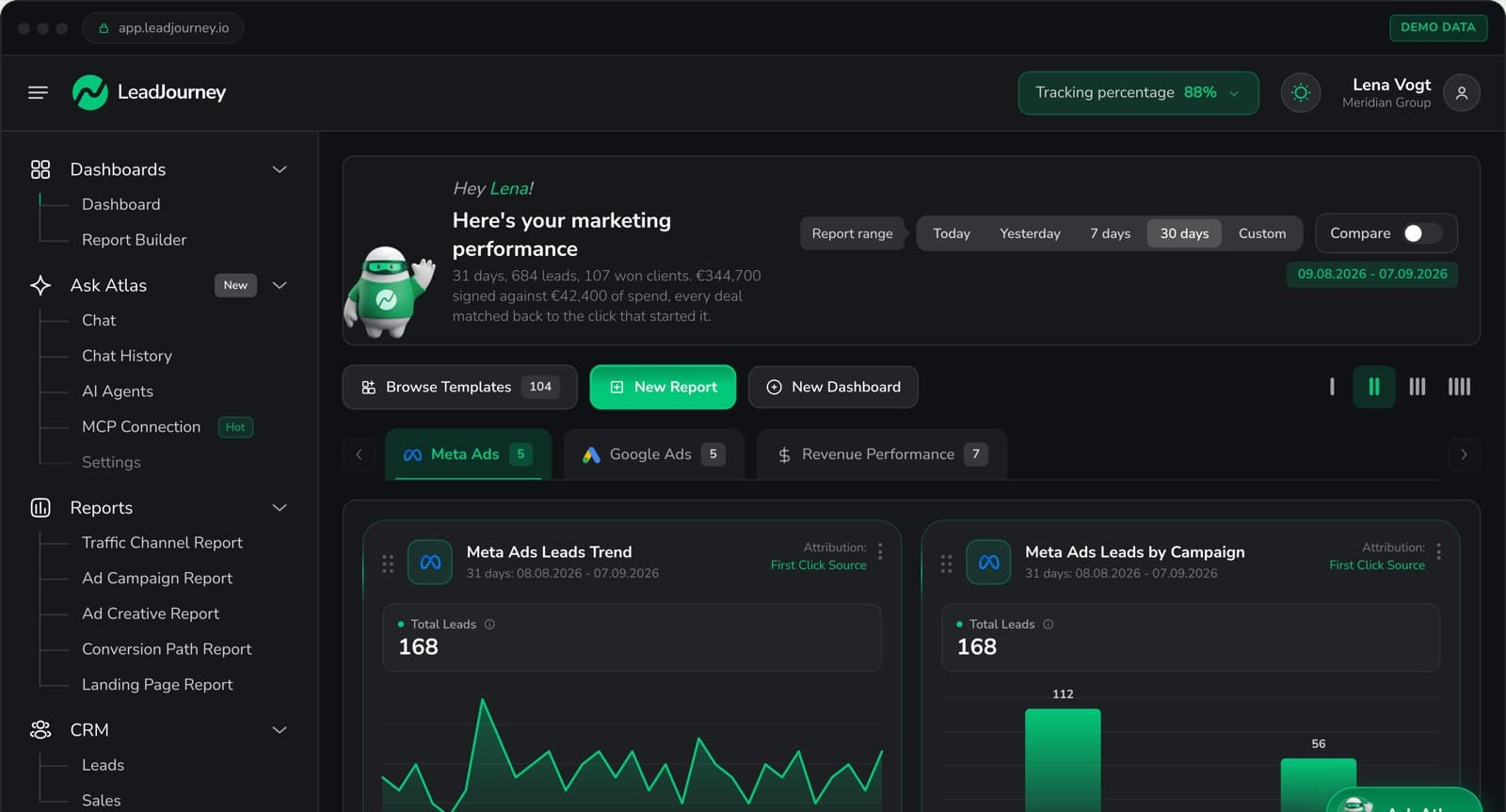
LeadJourney captures the click IDs on the first visit, server-side on your own domain at 95%+ accuracy: gclid, gbraid and wbraid, fbclid, li_fat_id and msclkid, plus the UTMs and the landing page. That anonymous first click is joined to the person at the form fill, call or booking, and the journey then follows the CRM stages to the closed deal. There is no attribution window cutoff in LeadJourney's own reporting: the journey keeps recording until the deal closes, however long that takes, and time to close per channel is a report rather than a spreadsheet exercise.
First click, last click, linear, time decay and position based are switchable without re-tracking, so changing the model is a reporting decision instead of a migration. HubSpot, Salesforce, Pipedrive, Close, Attio, GoHighLevel, ActiveCampaign and Odoo have native integrations, any other CRM connects by webhook or Zapier, and the connection runs both ways: LeadJourney reads stages and deal values, and writes the first touch, campaign, click ID and full journey back onto the contact and the deal, so sales sees the source before the first call.
You map any lifecycle or deal stage onto a conversion action, qualified lead, proposal sent, closed won, or all three, and the event goes server to server with the deal amount and currency attached: to Meta over the Conversions API with event deduplication, to Google Ads as offline conversion imports matched on the gclid, to LinkedIn over its Conversions API and to Microsoft Ads as offline conversions. The honest limit is the one every tool shares. An upload cannot beat a platform's own conversion window, which is exactly why the intermediate stage matters. Setup is one script on the site or in the GTM container, live in about 21 minutes, hosted in Frankfurt with a signed data processing agreement.
Read verified reviews on Trustpilot, G2 and leadjourney.io/testimonials.
Further Reading
Related pages: long sales cycle attribution and the multi-touch attribution guide for B2B. For the platform side, read sending LinkedIn CRM deals back over the Conversions API. For the definitions, see attribution window and time decay attribution, and for the metric a long cycle distorts most, the true cost per lead.
FAQ
Frequently Asked Questions
The questions B2B and SaaS teams ask when the deal closes long after the click.
How do you attribute a deal that closes after nine months?
Not inside the ad platform, which will have forgotten the click. You keep your own journey record: the first touch and its click ID from the first visit, every touch after it with a timestamp, the join from anonymous visitor to CRM contact, and the deal value at close. The platform then receives whichever conversions still fit its window, and your own reporting carries the full nine months.
What is an attribution window?
The period after a click during which a platform will still credit a conversion to it. Google Ads lets you set one per conversion action, currently up to about ninety days; Meta defaults to a seven day click window; LinkedIn offers a selectable range. After it expires the click is no longer in the platform's ledger, so a later upload cannot be matched to it. See attribution window.
Which attribution model is best for a long sales cycle?
Position based is the usual default for B2B, because it credits what opened the deal and what closed it while still showing the middle. Time decay suits teams whose last quarter is the real sales process, and linear is the fairest view of which channels appear in winning journeys. Last click is the one to avoid: in a long cycle it mostly credits branded search for a decision already made.
Can I import a closed deal into Google Ads nine months later?
Usually not against the original click. Offline conversion imports match on the gclid and are only accepted inside the conversion window set on that conversion action. That is why long-cycle accounts send an intermediate stage, such as sales qualified or opportunity created, which lands inside the window, and keep the closed deal for their own reporting and for platforms that match on hashed identifiers rather than the click alone.
Should I attribute at contact level or account level?
Account level, wherever your CRM supports it. A long B2B deal usually involves several people from one company touching different channels, so contact-level credit either splits one deal across four records or hands it to whoever happens to sit on the opportunity. Rolling journeys up to the account by email domain or the CRM account object makes channel comparisons honest, even though free email addresses and subsidiaries still resolve imperfectly.
What should I report on while the deals are still open?
Pipeline created by first-touch cohort, plus time to close per channel. Pipeline created moves with spend and is available now, which makes it the leading indicator you can steer on, while closed revenue is the audit that arrives months later. Report by first-touch month rather than by the current month, and re-read each quarter once its deals have closed without changing the model in between.
Keep reading
More from the blog
 B2B Marketing Attribution
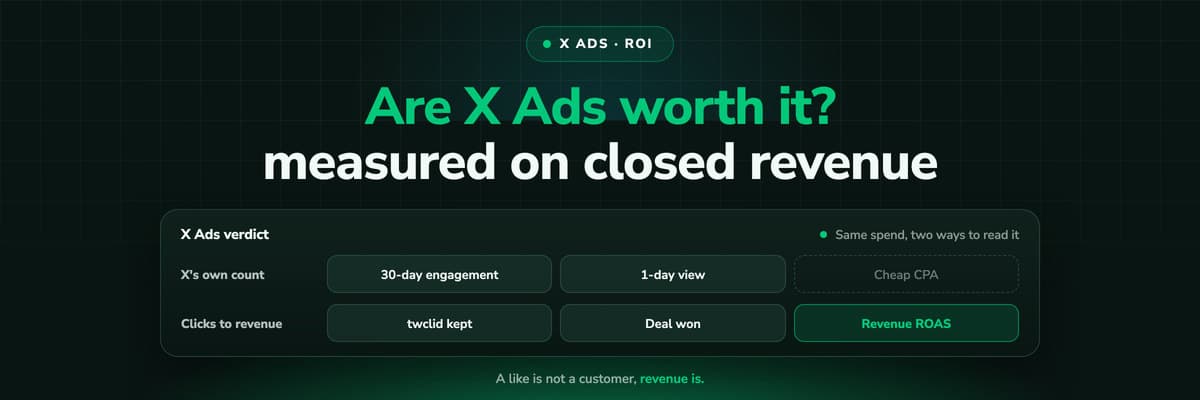
Are X Ads Worth It? Measuring X Ads ROI on Revenue
Whether X Ads are worth it depends on what you measure and on what you sell. How to calculate X Ads ROI and ROAS on closed revenue, what X's own conversion numbers include (a like a month before the purchase counts by default), what a fair test needs, and the traps that make X look better or worse than it is.Read the article16 min read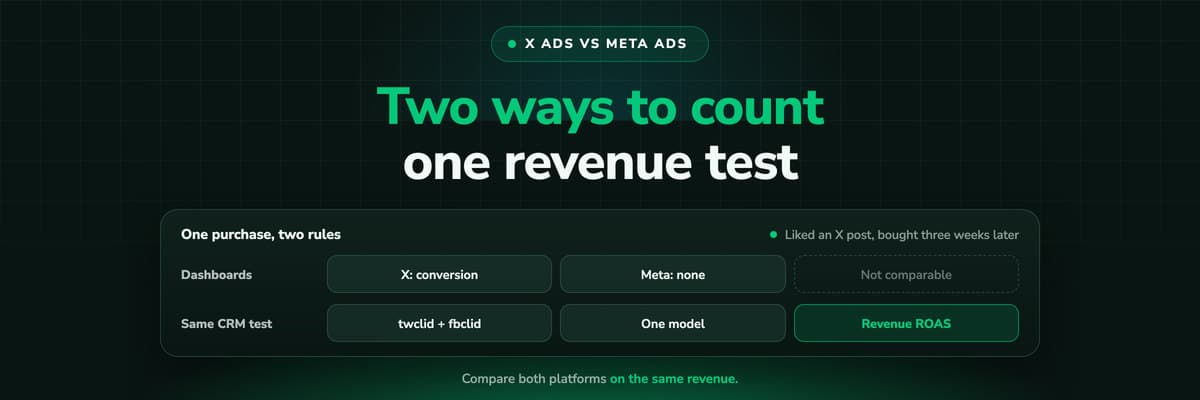 B2B Marketing Attribution
X Ads vs Meta Ads: How Each Counts a Conversion, Compared
X and Meta both report conversions, and the numbers are not the same kind of number. X credits a conversion up to 30 days after a like or a reply by default; Meta counts link clicks for 7 days. A sourced comparison of windows, server events, lead forms and CRM stages, and how to judge the two channels on the same closed revenue.Read the article15 min read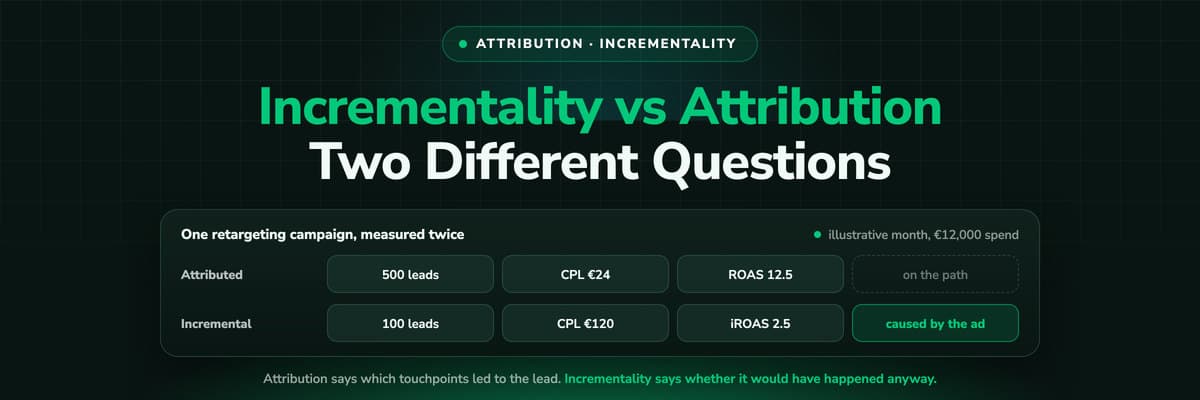 B2B Marketing Attribution
Incrementality vs Attribution: Which Question Each Answers
Attribution tells you which touchpoints led to a lead or a deal. Incrementality tells you whether it would have happened anyway. This guide works one retargeting campaign through both, shows where each belongs, and how to combine them when the outcome lives in your CRM.Read the article17 min read
Long cycles
Ready to credit the deal that closes in month nine?
LeadJourney stores the first touch and its click ID from the first visit and follows the CRM stages to the closed deal with no attribution window cutoff, so a nine month journey stays on one record and every model is switchable without re-tracking.