













BlogTool Comparisons
12 Best Marketing Attribution Tools for Salesforce in 2026
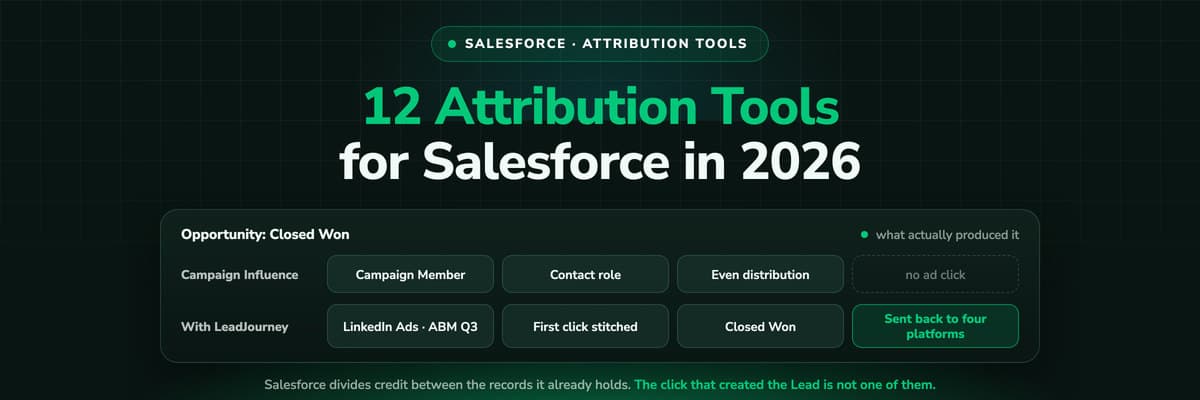
Campaign Influence divides credit between records that are already in Salesforce. The click that created the Lead is not one of them. Twelve tools compared on what each can actually see, with pricing, pros, cons and a verdict.

Contents
Summarise this article with AI
Opens the page with a ready prompt in:


Nothing is sent until you pick a service.
Salesforce knows what your pipeline is worth. It does not know what it cost. Campaign Influence divides an Opportunity's amount between the campaigns on the record, Customizable Campaign Influence adds first touch, last touch and even distribution on top, and both start from Campaign Members somebody created and maintained. The ad click that produced the Lead three months earlier is not a Campaign Member, and Campaign Cost is a field a human types into.
That is the gap every tool on this list is sold into, and they fill it in four different ways. Some are built natively on the Salesforce platform so the reporting never leaves it. Some are CRM agnostic B2B attribution platforms that read Salesforce as one source among many. Some are lead generation tools that capture the click and write it onto the record. And some are dashboards that visualise data somebody else joined.
This guide ranks the 12 best marketing attribution tools for Salesforce in 2026: what each one credits, who it is built for, what it costs, and whether the deal you win ever reaches Meta, Google, LinkedIn and Microsoft as a conversion. LeadJourney leads the list, because it is the only one of the twelve that captures the click server-side, writes the source onto the Salesforce record and sends the closed won amount back to all four platforms.
Quick Summary: Best Salesforce Attribution Tool in 2026
In short
LeadJourney is the best marketing attribution tool for Salesforce in 2026 for teams that buy paid traffic. It tracks every session server-side at 95%+ accuracy before a record exists, stitches the anonymous first click to the Lead at form submit, writes first and last touch onto the Lead, Contact and Opportunity, pulls spend from Meta, Google, LinkedIn and Microsoft Ads, and sends the closed won amount back to all four as an offline conversion. Five attribution models on every plan, live in about 21 minutes, from €129 a month with a 14-day free trial.
The other eleven are each built for a different buyer, and the fit decides more than the feature list. Full Circle Insights and CaliberMind are Salesforce-native enterprise attribution with an implementation project behind them. Adobe Marketo Measure is the Adobe answer for orgs already on Marketo Engage. Dreamdata, HockeyStack and Factors.ai are CRM agnostic B2B platforms that treat Salesforce as one input. Heeet is native to both Salesforce and HubSpot. Ruler Analytics is strongest where leads arrive by phone. Cometly comes from paid social. Marketing Cloud Intelligence is a dashboard, not an attribution model.
Three questions settle most shortlists. Does the tool see the visit before a Lead record exists, or does it start counting at the Campaign Member. Does it pull ad spend automatically, or is cost still a field somebody types in. And does anything travel back out to the ad platforms when the Opportunity is marked Closed Won, because an attribution report nobody acts on is a slide, not a system.
The 12 Best Marketing Attribution Tools for Salesforce (2026)
The 12 best Salesforce attribution tools at a glance
| Tool | What it adds to Salesforce | Best for | Pricing |
|---|---|---|---|
| Rank 1LeadJourney | Server-side click capture, source written onto Lead, Contact and Opportunity, spend and closed won revenue joined, deals returned to four ad platforms | Teams buying paid traffic who need cost per closed deal in Salesforce | From €129/mo, 14-day trial |
| Rank 2Salesforce Campaign Influencevs LeadJourney | First touch, last touch and even distribution across Campaign Members already on the record | Crediting campaigns without buying a second product | Included in Sales Cloud |
| Rank 3Adobe Marketo Measurevs LeadJourney | Enterprise multi-touch attribution across online and offline touchpoints, native to Salesforce and Marketo | Enterprise teams on Marketo Engage with an ops team | On quote |
| Rank 4Full Circle Insights | Campaign attribution and funnel metrics built on the Salesforce platform itself | Salesforce-first marketing ops who want reporting to stay in Salesforce | On quote |
| Rank 5Dreamdatavs LeadJourney | Account-level journeys from first touch to closed won, with audience activation on top | B2B revenue teams modelling the whole buying group | Free plan, paid on quote |
| Rank 6HockeyStackvs LeadJourney | Unified go-to-market data, buyer journeys and pipeline reporting across Salesforce and the rest of the stack | Mid-market and enterprise GTM teams | On quote |
| Rank 7CaliberMind | Multi-touch attribution plus marketing mix modelling, with Salesforce writeback and custom object support | Enterprise marketing ops with a messy Salesforce org | On quote |
| Rank 8Heeet | Native Salesforce and HubSpot attribution with automated CAC and payback | Teams on either CRM wanting attribution inside it | From $790/mo |
| Rank 9Ruler Analyticsvs LeadJourney | First-party tracking with call tracking and dynamic number insertion, revenue synced back to the reports | Businesses whose leads arrive by phone | From £299/mo |
| Rank 10Factors.aivs LeadJourney | Company identification and intent alongside attribution, strong on LinkedIn Ads | Demand gen teams working named accounts | From $199/mo |
| Rank 11Cometlyvs LeadJourney | Server-side tracking and a Conversions API, reconciled against CRM contacts and deals | Paid social teams who want conversions sent back | On quote |
| Rank 12Salesforce Marketing Cloud Intelligencevs LeadJourney | Connectors, harmonisation and dashboards inside the Salesforce family | Enterprise analytics teams reporting on many channels | On quote |


1. LeadJourney: Best Salesforce Attribution Tool for Paid Traffic
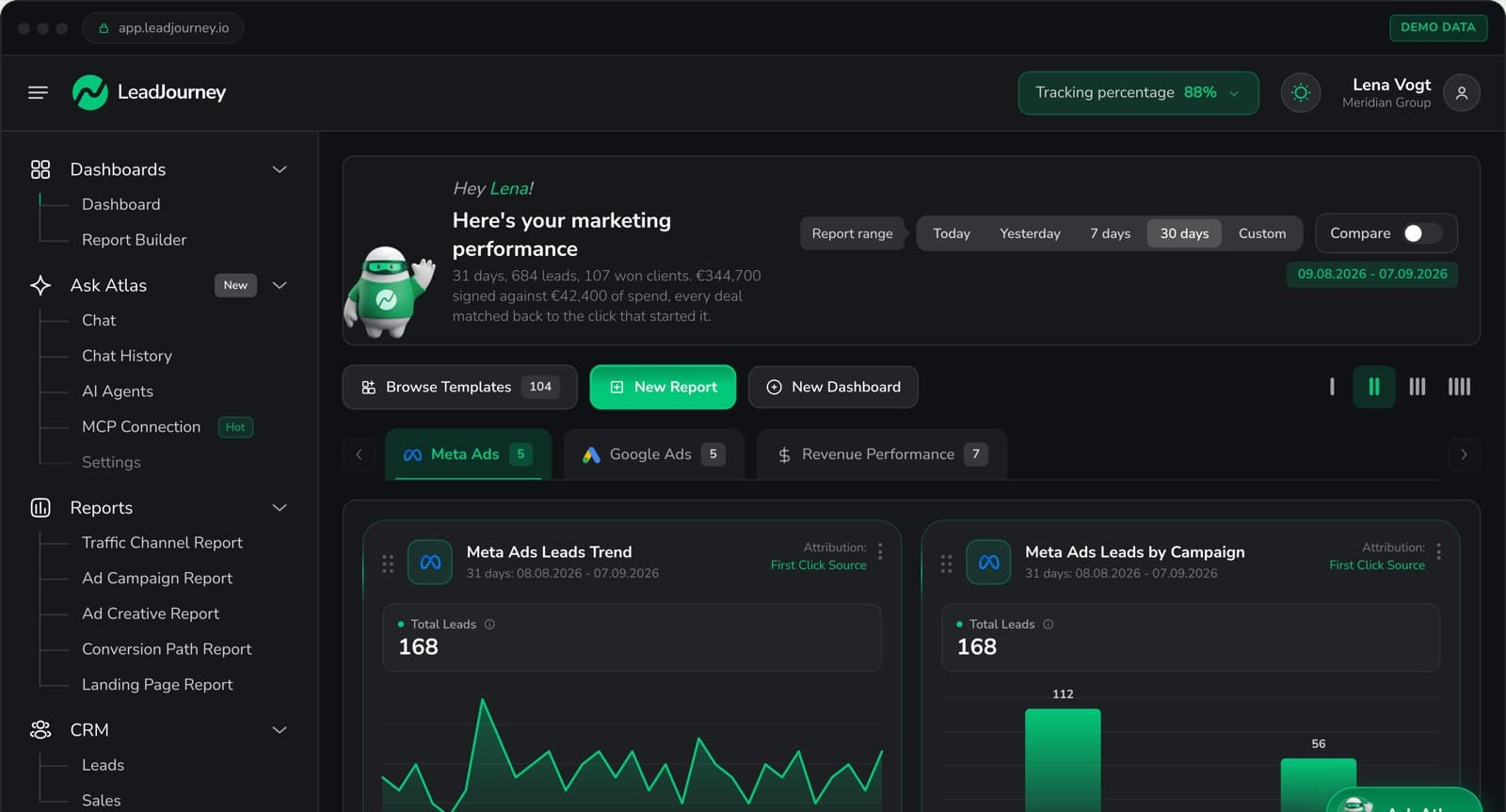
LeadJourney sits underneath Salesforce rather than inside it. Every session is recorded server-side as it happens, on your own domain, at 95%+ accuracy, which means the visit an ad blocker or Safari's tracking prevention would have removed is still in the journey. When the form is submitted, that anonymous history is stitched to the Lead, and it keeps travelling: Lead converted, Contact created, Opportunity opened, Closed Won. The click ID captured at the first visit is what holds the join together months later.
The part no Salesforce-native tool does is the return path. Spend is pulled automatically from Meta, Google, LinkedIn and Microsoft Ads, so ROAS and cost per closed deal are measured rather than estimated, and when an Opportunity is marked Closed Won the amount goes back to the platform that produced it as an offline conversion, matched on the click ID. The algorithms then optimise toward the campaigns that produced signed contracts instead of the campaigns that produced form fills.
Key Features
- Server-side tracking on your own domain at 95%+ accuracy, before Salesforce or any marketing automation cookie is involved
- The anonymous first click stitched to the Lead at form submit, then carried onto the Contact, the Account and the Opportunity
- gclid, fbclid, li_fat_id and msclkid captured at click time, wherever on the site the visitor eventually converts
- Ad spend pulled from Meta, Google, LinkedIn and Microsoft Ads, joined to the Opportunities themselves
- Five attribution models on every plan: first-touch, last-touch, linear, U-shaped and time-decay, switchable without re-tracking anything
- Closed Won amounts sent back to all four platforms as offline conversions, with the deal's own value and currency
- Organic, direct, referral and AI search as first class channels, including ChatGPT, Perplexity, Claude and Gemini
- Atlas, the AI analyst, answering questions like which campaign produced the cheapest closed deal last quarter
- EU processing and first-party collection, which is what keeps the record defensible under GDPR
Pros
- Sees the journey before the Lead exists, which is exactly where Campaign Influence is blind
- Runs on the Salesforce you already have: no additional Salesforce product, no managed package project
- Measured cost per closed deal per channel, campaign, ad set and creative, because the spend is pulled rather than typed
- The only tool on this list that returns closed won revenue to all four ad platforms automatically
- Live in about 21 minutes, no developer, and a 14-day free trial to prove the numbers first
Cons
- Not an ABM platform: intent data and account scoring belong to Dreamdata, Factors.ai or CaliberMind
- Reporting lives in LeadJourney rather than in Salesforce reports, so a team that must report inside Salesforce will prefer a native package
Verdict
If your Salesforce pipeline is fed by paid traffic, LeadJourney is the pick. It answers the question Campaign Influence cannot reach, what the deal cost to buy, and then does something with the answer.
Connected LeadJourney for 2 clients, setup took literally 20 minutes each. The data became more accurate, the reports actually make sense. Now clients look at the dashboard and the 'why don't the numbers match?' questions are gone.
 Alexander SamarPerformance Marketing Agency
Read verified reviews on Trustpilot, G2, Capterra and leadjourney.io/testimonials, or see how the Salesforce integration writes to the record.
2. Salesforce Campaign Influence: Best Free Starting Point
Campaign Influence is already in your org. Every Campaign Member and Opportunity Contact Role on a deal can share the credit for its amount, and Customizable Campaign Influence lets you look at first touch, last touch and even distribution, including side by side. For a team running events, webinars and outbound sequences as Salesforce Campaigns, that is a genuine attribution report at no extra licence cost.
Its limits are structural rather than accidental. Influence starts once a record exists, so the ad click that created the Lead is not a touchpoint unless somebody made it one. Campaign Cost is a manual field and no spend is pulled from any ad account, which means ROAS and cost per deal cannot be calculated. And nothing leaves Salesforce: no closed won value ever reaches Meta or Google. Weighted multi-touch models exist in Salesforce, but in Account Engagement and the marketing analytics products, licensed separately.
Verdict
The right place to start and the wrong place to stop. Use it to credit campaigns you run inside Salesforce, and add a measurement layer underneath it for anything you buy.
3. Adobe Marketo Measure: Best for Enterprise Marketo and Salesforce Orgs
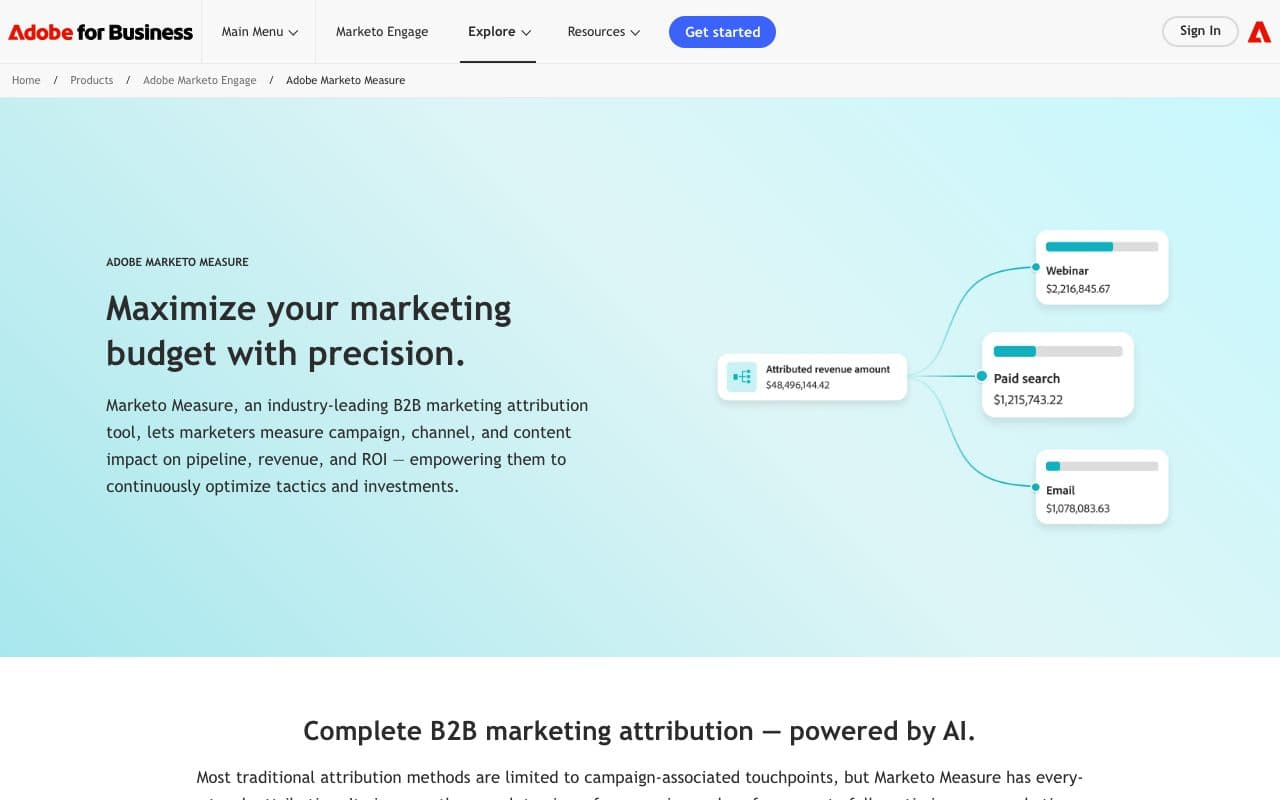
Formerly Bizible, Marketo Measure is the enterprise answer for orgs standardised on Adobe and Salesforce. It writes touchpoints onto Salesforce objects, runs multi-touch models across online and offline interactions, and reports pipeline and revenue in the vocabulary an enterprise demand gen team already uses. Where Marketo Engage runs the programmes, the attribution is genuinely native.
It is also an Adobe contract with an implementation project attached, and Adobe publishes neither a price nor a timeline. Teams without a marketing operations function tend to find the model correct and unused, which is the most expensive outcome of all.
Verdict
The strongest fit for an enterprise already on Marketo Engage and Salesforce. Too much machinery for a team whose main question is what a lead cost.
4. Full Circle Insights: Best Attribution Built Natively in Salesforce
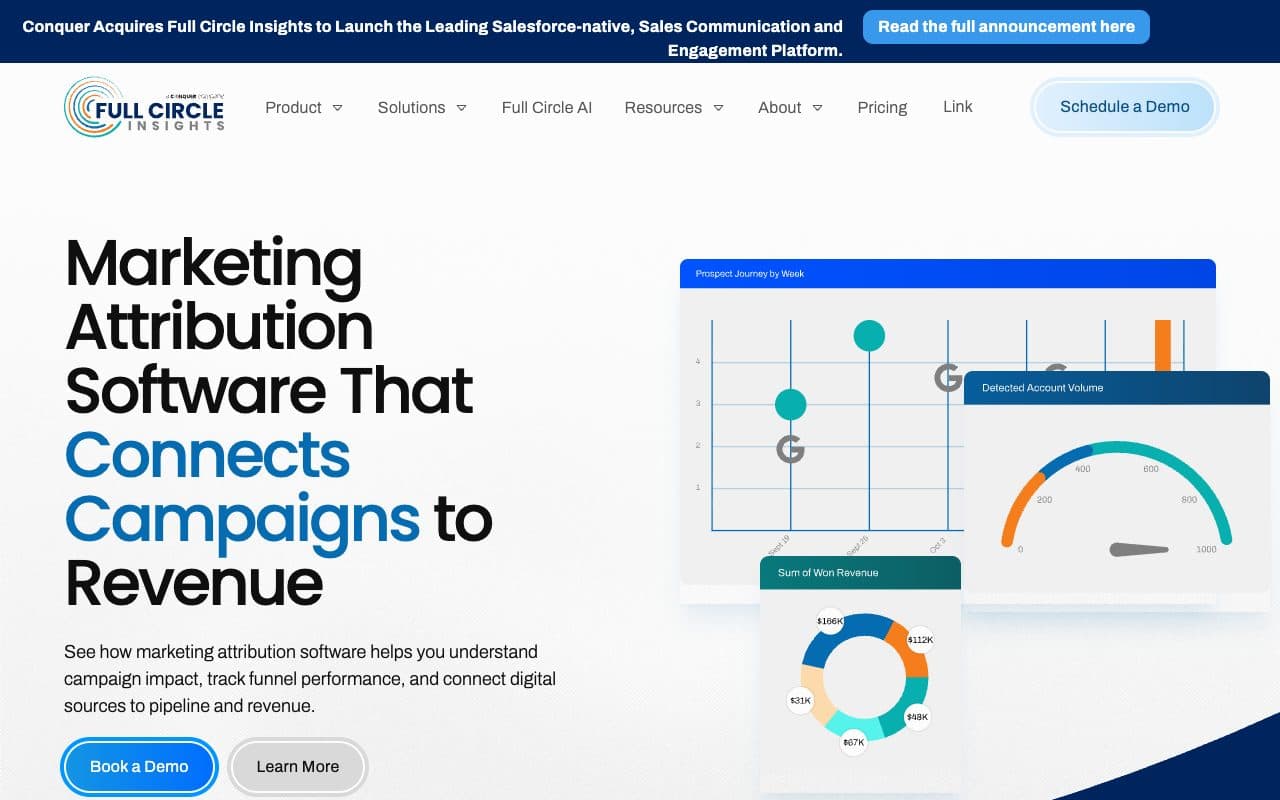
Full Circle Insights runs on the Salesforce platform itself, which is its whole argument: the data model, the reports and the dashboards stay where your operations team already works, and nothing has to be reconciled against a second system. Campaign Attribution handles the multi-touch models, Funnel Metrics measures movement between stages, Digital Source Tracker connects online sources to leads, and ABM Performance covers account engagement.
The trade is the same one every native package makes. What it can attribute is what reaches Salesforce, so the quality of the answer depends on the tracking you put in front of it, and connecting ad platforms or other systems is work somebody has to do. There is no public price and no self-serve entry. One thing to know before a call: Conquer acquired Full Circle Insights in May 2025, and it is now sold as part of a Salesforce-native sales engagement platform rather than as a standalone attribution product.
Verdict
The best choice when the requirement is that reporting must never leave Salesforce. Pair it with real click capture, or it inherits whatever your forms happen to record.
5. Dreamdata: Best for Account-Level B2B Journeys
Dreamdata models the whole account journey rather than a single contact's path: every stakeholder, every touch, from first anonymous visit to Closed Won, with Salesforce as a first class source. For a committee sale where six people from one company each touch three channels, that is the honest unit of analysis, and the audience activation on top turns the model into something a media buyer can use.
It is a data platform, so it rewards a team with the patience to model things properly and the free plan is a real way to test that. Deal values still depend on the CRM being tidy, and the return path to the ad platforms is activation rather than an automatic offline conversion carrying the deal amount.
Verdict
The strongest account-level model on this list. Choose it when the buying group, not the click, is the thing you cannot see.
6. HockeyStack: Best for Enterprise Go-To-Market Reporting
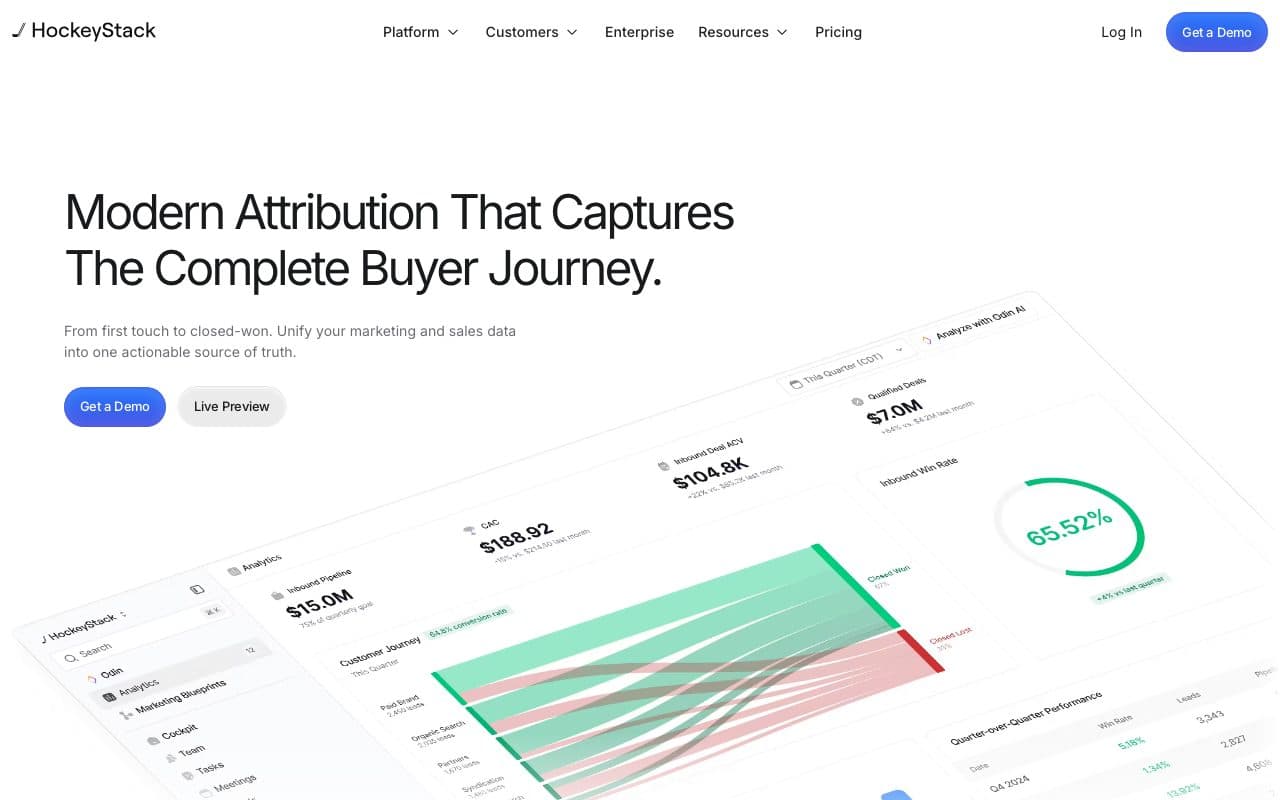
HockeyStack unifies marketing, sales and revenue data for go-to-market teams, pulling Accounts, Contacts, Leads, Opportunities and Campaigns out of Salesforce and joining them to the rest of the stack. The buyer journey views and pipeline reporting are built for a revenue operations audience that has to answer board level questions, and the success team is part of the product.
That also sets the floor. Pricing is on quote, reviewers report a mid four figure monthly entry point, and the implementation is a project. A ten person team buying leads on Meta will get an excellent report and pay enterprise money for it.
Verdict
Right for mid-market and enterprise GTM teams with a RevOps function. Oversized for a lead generation business that needs cost per deal.
7. CaliberMind: Best for Complex Salesforce Orgs
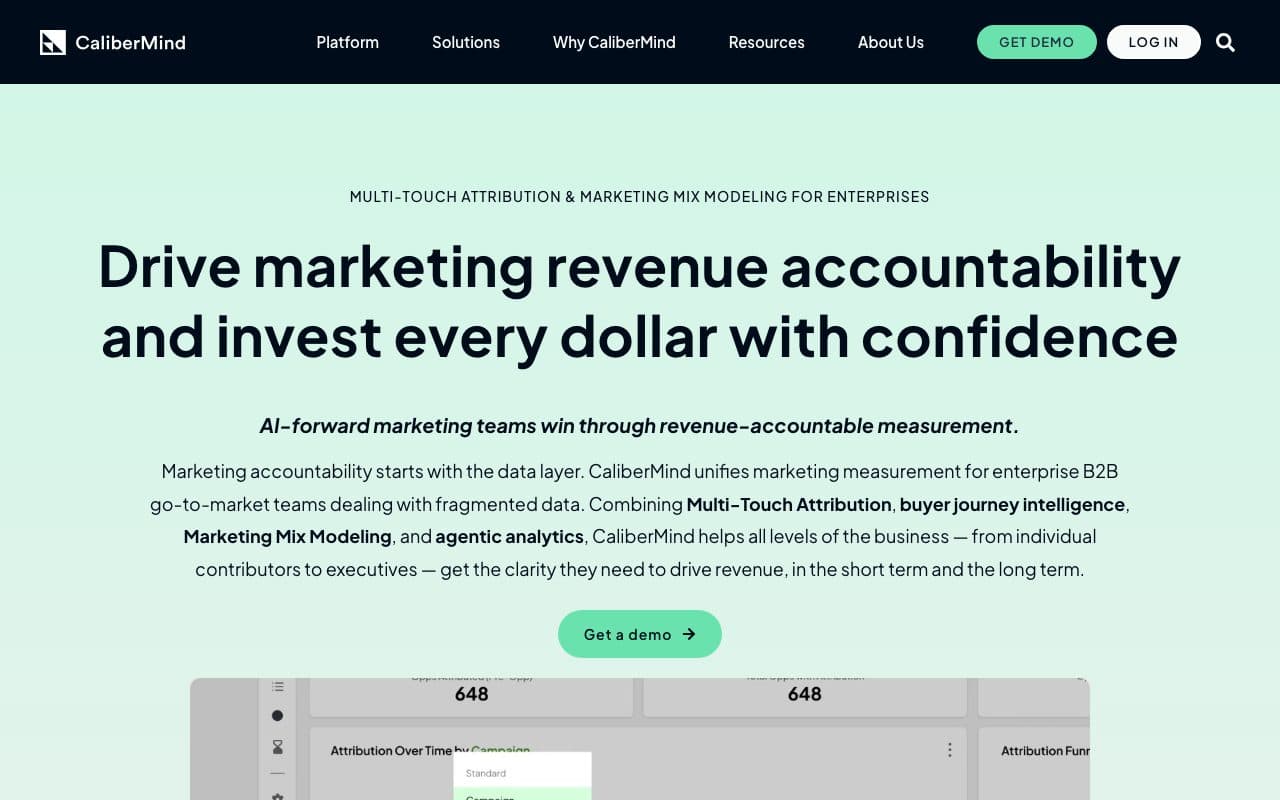
CaliberMind is built for the Salesforce org that has been running for a decade: custom objects that matter, leads that do not match accounts cleanly, and a data model no vendor's default mapping survives. It preserves those custom objects, matches leads to accounts, writes results back, and runs multi-touch attribution alongside marketing mix modelling so brand spend is not simply missing from the picture.
It is an enterprise purchase with no public price, and the modelling is only as good as the data engineering underneath it. Small teams will find the surface area larger than the question they came with.
Verdict
The specialist for messy enterprise Salesforce data. If your objection to every other tool is that it will not understand your org, start here.
8. Heeet: Best Attribution Native to Salesforce and HubSpot
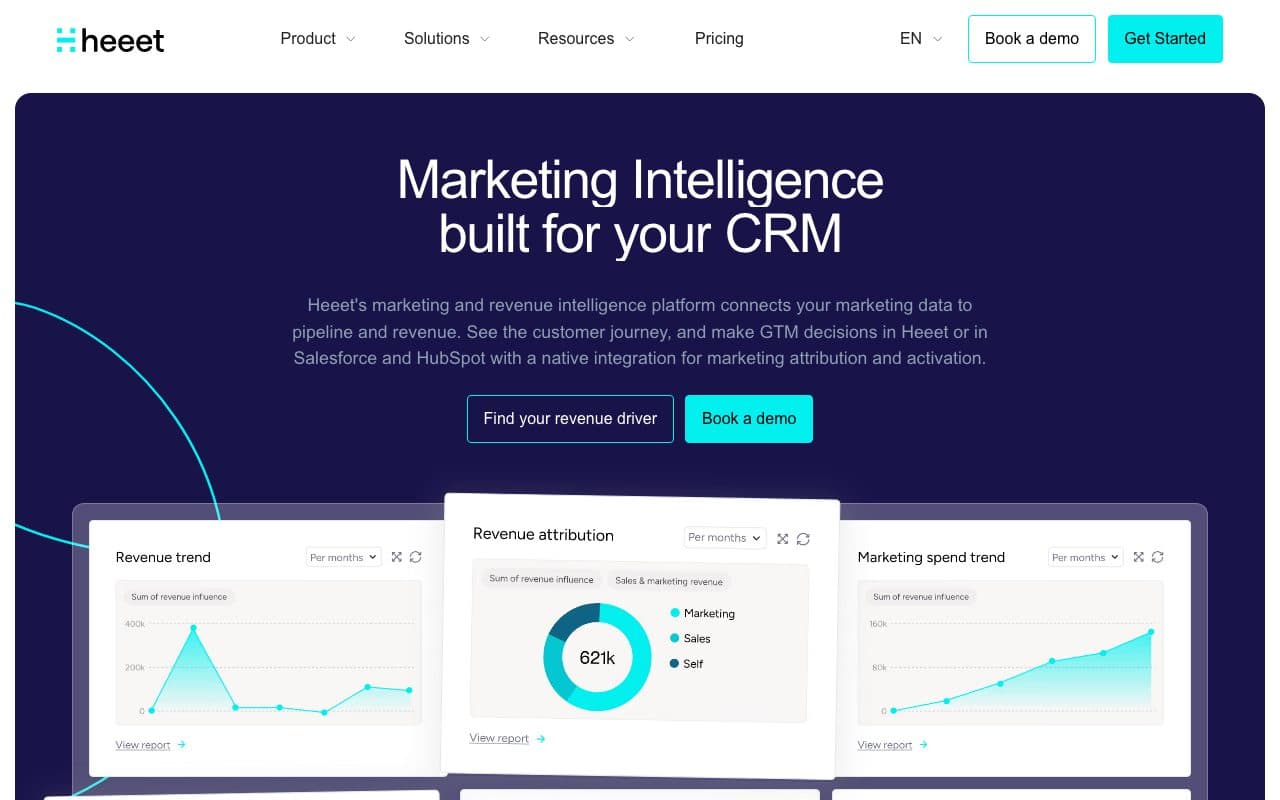
Heeet ties touchpoints to pipeline and revenue inside both Salesforce and HubSpot, with Google Ads, LinkedIn and Meta connected and CAC and payback calculated automatically. For a team running one CRM today and possibly the other after an acquisition, being native to both is a real advantage rather than a marketing line.
Pricing starts at $790 a month for the platform and $1,490 for the native tier, with overage per hundred new leads, so it is priced for a funded B2B team rather than a small advertiser. A 30-day trial makes it easy to test before committing.
Verdict
A strong middle path between a native package and a separate platform. Check the lead volume overage before you sign, because that is where the price moves.
9. Ruler Analytics: Best When Leads Arrive by Phone
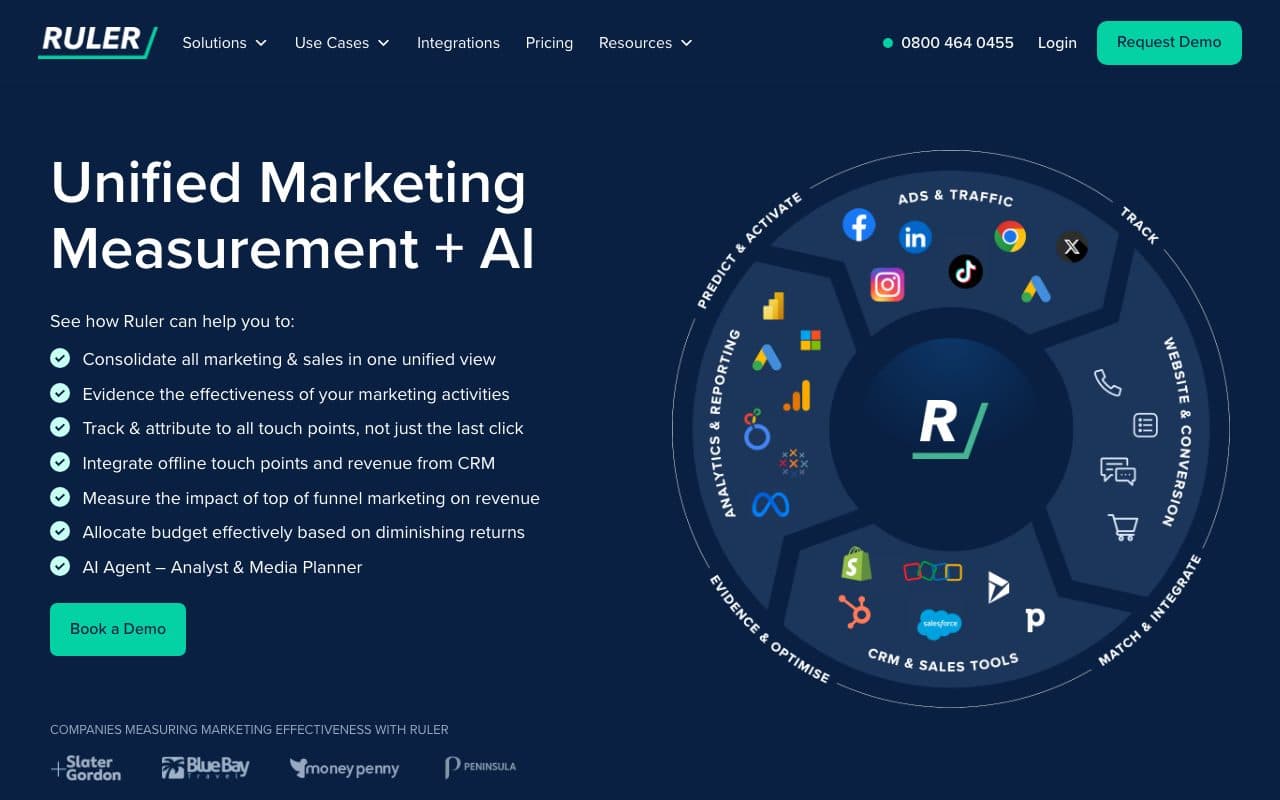
Ruler Analytics does first-party visitor tracking with call tracking and dynamic number insertion in the same product, which matters in every business where the highest intent action is a phone call rather than a form. Revenue from the CRM is synced back into the reports and into the analytics tools, so the call that closed is credited to the campaign that produced it.
Pricing is public and banded by monthly visits, from £299 a month upward, with no free trial. Attribution beyond the call is solid rather than deep, and there is no automatic conversion loop to all four ad platforms.
Verdict
The pick when calls are the conversion. For a paid funnel that ends in a form, the value is thinner than the price band suggests.
10. Factors.ai: Best for Account Intelligence Alongside Attribution
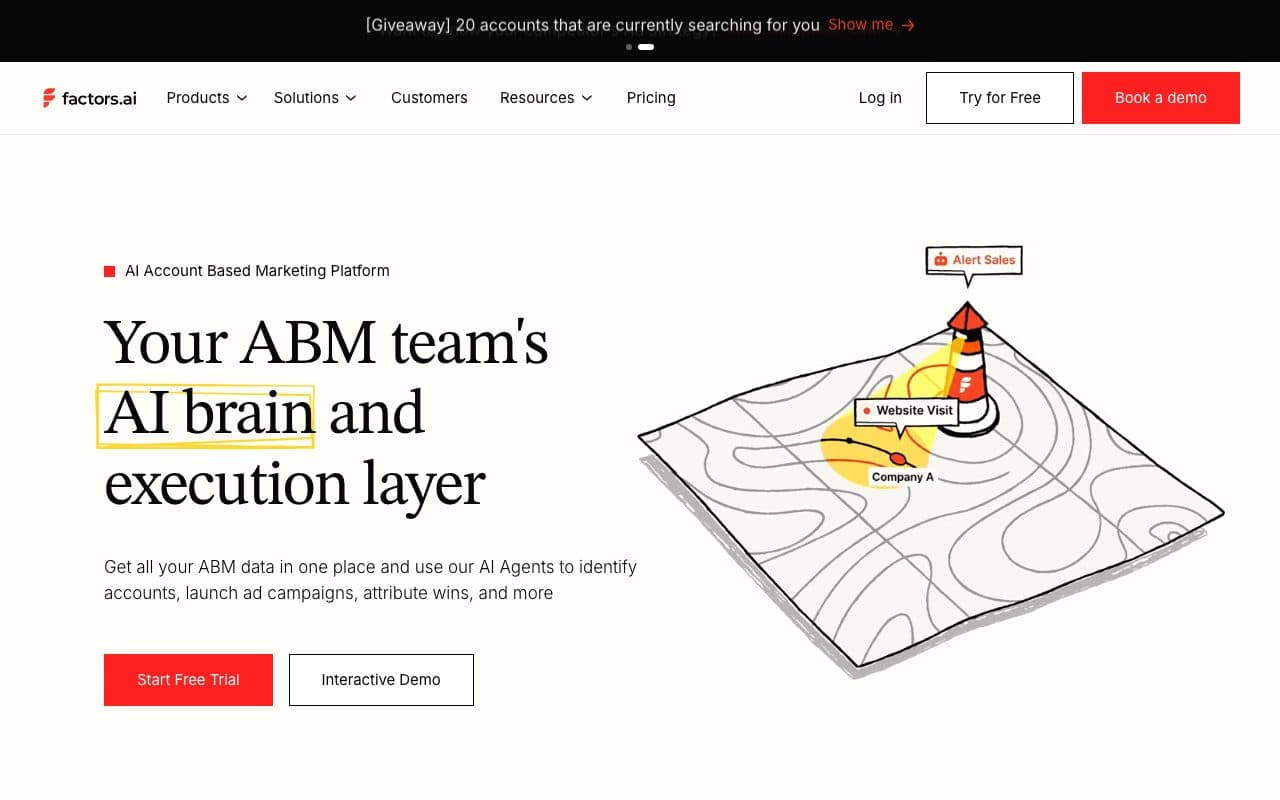
Factors.ai starts from the anonymous company rather than the anonymous person: identify the account on the site, score its engagement, connect it to LinkedIn and Google Ads, and attribute pipeline on top. For a demand gen team working a named account list, seeing which target accounts are on the pricing page this week is often worth more than a perfect model.
The tiers are public and the gap between them is wide, from $199 a month at the entry to five figures a year further up, scaled by tracked users. Attribution is one capability among several rather than the centre of the product.
Verdict
Buy it for intent and company identification, and take the attribution as a bonus. It is not the tool that will tell you what a closed deal cost.
11. Cometly: Best for Paid Social Teams on Salesforce
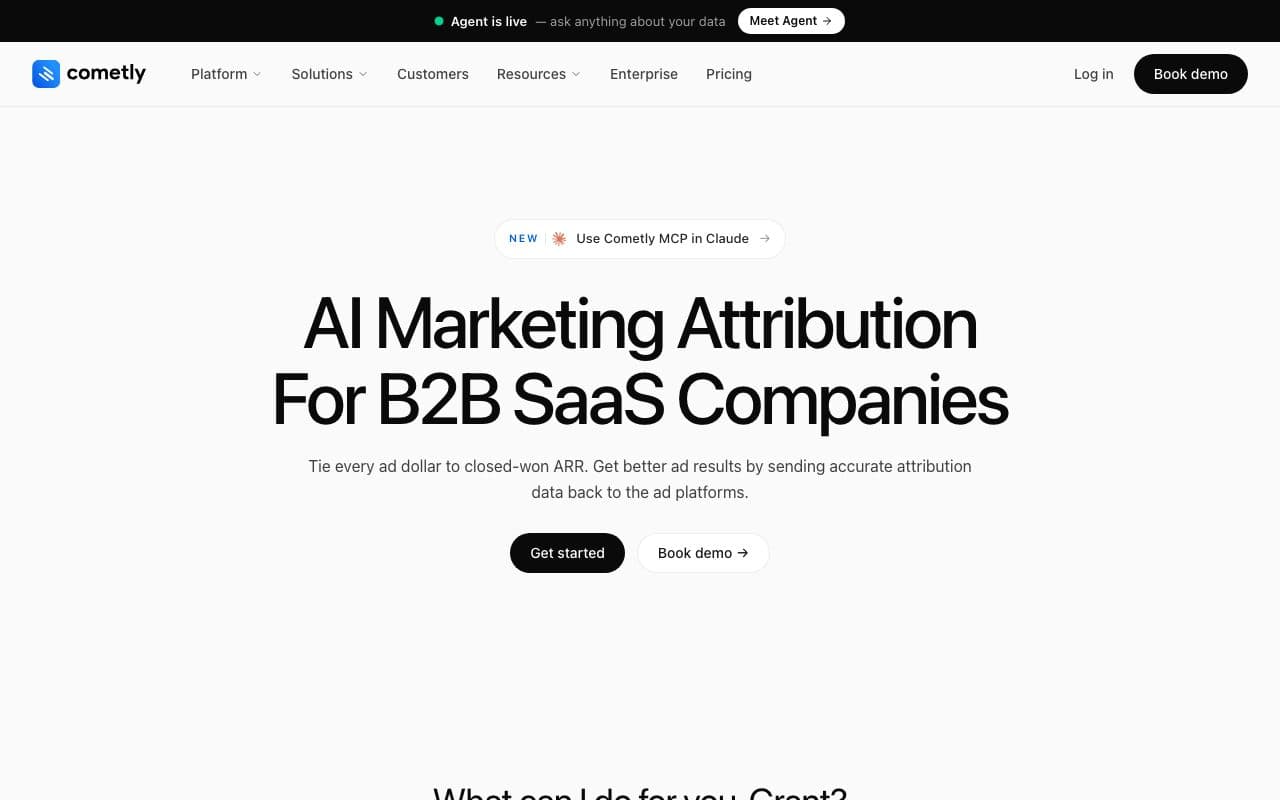
Cometly comes at Salesforce from the ad account rather than from the CRM: server-side tracking, a Conversions API, contact level journeys and an AI ads manager, with Salesforce among the CRMs it reconciles against so leads and opportunities line up one to one. For a team whose main spend is Meta, that is the right direction of travel.
Pricing is usage based on monthly pageviews, quoted after a demo, with no free trial and no public list. The Salesforce depth is a sync rather than a native package, so anyone who needs reporting inside Salesforce reports will be disappointed.
Verdict
A reasonable option for paid social teams. Compare it directly against LeadJourney, which does the same loop across four platforms with a public price.
12. Salesforce Marketing Cloud Intelligence: Best for Enterprise Dashboards
Formerly Datorama, Marketing Cloud Intelligence pulls hundreds of marketing sources into one harmonised model and draws dashboards on it, inside the Salesforce family. For an enterprise team reporting across dozens of channels and agencies, the connector library and the harmonisation layer are the product, and they are good at it.
It is worth being precise about what it is not. Harmonising spend data is not the same as crediting an Opportunity, and a dashboard cannot decide which touch mattered. Editions are on quote, and the implementation is the real cost.
Verdict
A reporting layer, not an attribution model. Include it if the problem is fragmented dashboards, not if the problem is unknown sources.
What Salesforce Attribution Cannot See on Its Own
Every tool above exists because of the same four blind spots. They are worth naming precisely, because a shortlist built on them is much shorter than a shortlist built on feature lists.
- The click before the recordCampaign Influence begins at the Campaign Member. The ad click that produced the Lead weeks earlier was never a record, so it cannot be credited unless something captured it at the time.
- The cost side of the ratioCampaign Cost is a field a human maintains. Without spend pulled from the ad accounts there is no ROAS and no cost per closed deal, only revenue split between campaigns.
- The sessions nobody recordedWhatever tracking sits in front of Salesforce decides what exists. A visit removed by a blocker or by tracking prevention is not a gap in the report, it is credit quietly handed to whatever was left.
- The way back outA model that stays inside Salesforce changes nobody's bidding. Until Closed Won reaches Meta, Google, LinkedIn and Microsoft, the platforms keep optimising toward form fills.
One honest correction
Salesforce does have multi-touch attribution: Customizable Campaign Influence carries three models, and the marketing analytics products add weighted ones. The argument against it is not that the models are missing. It is what the models are allowed to see.
How to Choose a Salesforce Attribution Tool
Four questions in the order that eliminates the most options, asked before any demo.
- Where do your deals come from? Paid traffic makes click capture and the return path decisive. Events, outbound and partnerships make Campaign hygiene and native reporting decisive.
- Who maintains it? A native Salesforce package assumes an admin. A separate platform assumes somebody who will look at a second tool. Buy the one your team will actually operate.
- Does reporting have to live inside Salesforce? If a board pack is built from Salesforce reports, that constraint outranks every feature comparison, and it narrows the list to the native packages.
- What happens after the report? If nothing is sent back to the ad platforms, budget decisions stay manual and monthly. That is the difference between measuring and optimising.
For a longer read on the mechanics underneath all of this, see multi-touch attribution, server-side tracking and how the gclid travels into the CRM.
Further Reading
Compare the wider field in the 15 best B2B attribution software tools and the best lead attribution tools, or read the same question answered for the other two CRMs: attribution tools for HubSpot and attribution tools for Pipedrive.
For the product side, the Salesforce integration shows exactly which fields are written to the Lead, the Contact and the Opportunity, and the live demo is the reporting itself, clickable, without talking to anyone.
FAQ
Frequently Asked Questions
What Salesforce teams ask before they add an attribution layer.
Does Salesforce have marketing attribution built in?
Yes. Campaign Influence shares an Opportunity's amount between the campaigns on the record, and Customizable Campaign Influence adds first touch, last touch and even distribution, viewable side by side. Weighted multi-touch models sit in Account Engagement and the marketing analytics products, which are licensed separately. What none of them do is see the ad click that created the Lead, or pull in what that click cost.
Why does Salesforce show so much pipeline as Direct or Other?
Because the source on the record is only ever as good as whatever wrote it. If the form does not carry the click ID and the UTM parameters, or the visitor came back a week later through a branded search, the record gets whatever the last session happened to look like. Capturing the first click server-side and writing it onto the Lead is what removes that bucket.
Can I calculate ROAS inside Salesforce?
Not without getting spend in. Campaign Cost is a manual field, so any ROAS calculated from it is only as current as the last person who updated it. Tools that pull spend from Meta, Google, LinkedIn and Microsoft Ads automatically are what make cost per closed deal a live number instead of a monthly exercise.
Do I need a Salesforce-native package, or a separate platform?
It depends on one constraint: whether reporting has to happen inside Salesforce reports and dashboards. If it does, Full Circle Insights, CaliberMind and Adobe Marketo Measure are the field. If it does not, a separate platform usually sees more, because it starts tracking before a Salesforce record exists and can send outcomes back to the ad platforms.
How much do Salesforce attribution tools cost?
The native option costs nothing beyond Sales Cloud. At the other end, Full Circle Insights, CaliberMind, Adobe Marketo Measure, HockeyStack and Marketing Cloud Intelligence are all quote-only enterprise contracts with implementation projects. In between there are public prices: Factors.ai from $199 a month, Ruler Analytics from £299, Heeet from $790, and LeadJourney from €129 with a 14-day free trial.
How long does it take to set up attribution for Salesforce?
The range is wide and it is mostly about what the tool needs from you. LeadJourney is live in about 21 minutes because the tracking is a script and the Salesforce connection is an authorisation. Native enterprise packages are implementation projects measured in weeks, because the touchpoint model, the field mapping and the reports all have to be built against your org.
Keep reading
More from the blog
 Tool Comparisons
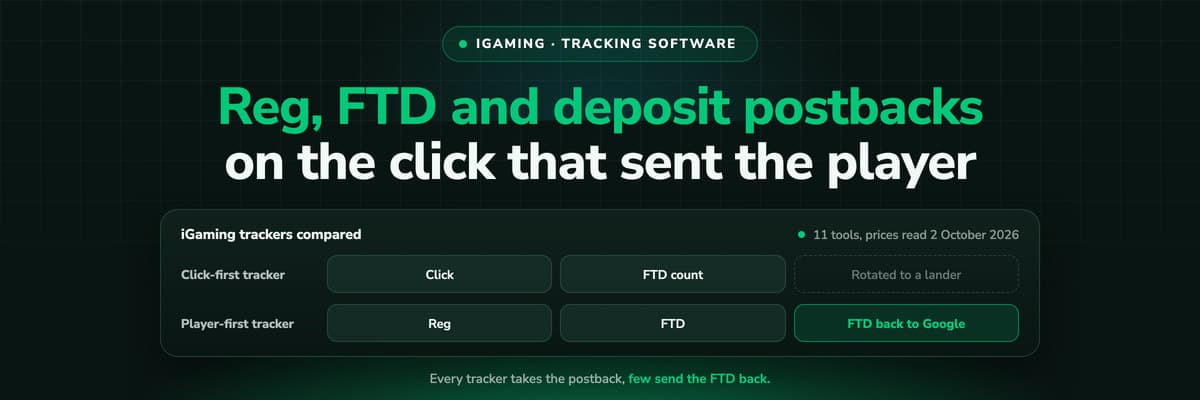
11 Best iGaming Tracking Software Tools in 2026
Every iGaming tracker takes a postback. Fewer split reg, FTD and deposit into stages of one player, and fewer still send the FTD back to Google and Meta. Eleven tools ranked on that, with every price read on the vendor's own page.Read the article18 min read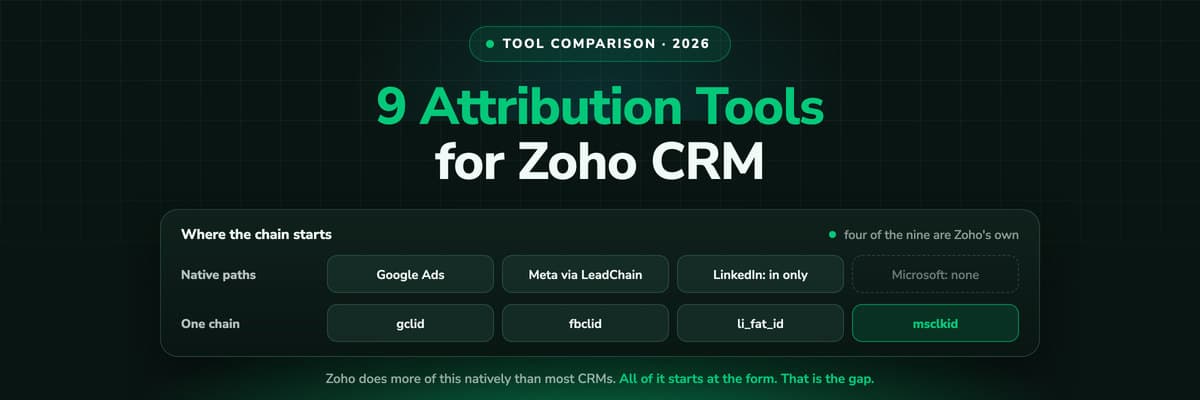 Tool Comparisons
9 Best Marketing Attribution Tools for Zoho CRM in 2026
Four of the best attribution tools for Zoho CRM are Zoho products you may already pay for. Nine options compared on where the tracking starts, which ad platforms they cover, and whether the closed deal ever reaches the algorithm buying your traffic.Read the article13 min read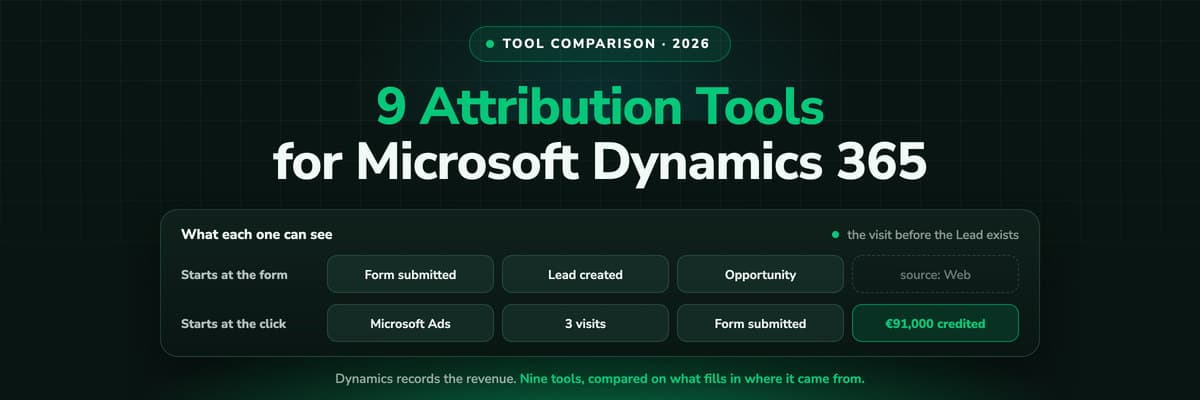 Tool Comparisons
9 Best Marketing Attribution Tools for Microsoft Dynamics 365 in 2026
Dynamics records the revenue and nothing fills in where it came from: Lead Source is a ten-option picklist and campaign spend is typed by hand. Nine tools compared on what each can actually see in a Dynamics environment, with pricing, pros, cons and a verdict.Read the article14 min read
Salesforce attribution
See what every Salesforce Opportunity cost to buy
Server-side tracking at 95%+ accuracy, the first click written onto the Lead and the Opportunity, spend from four ad platforms and Closed Won sent back. Live in 21 minutes.