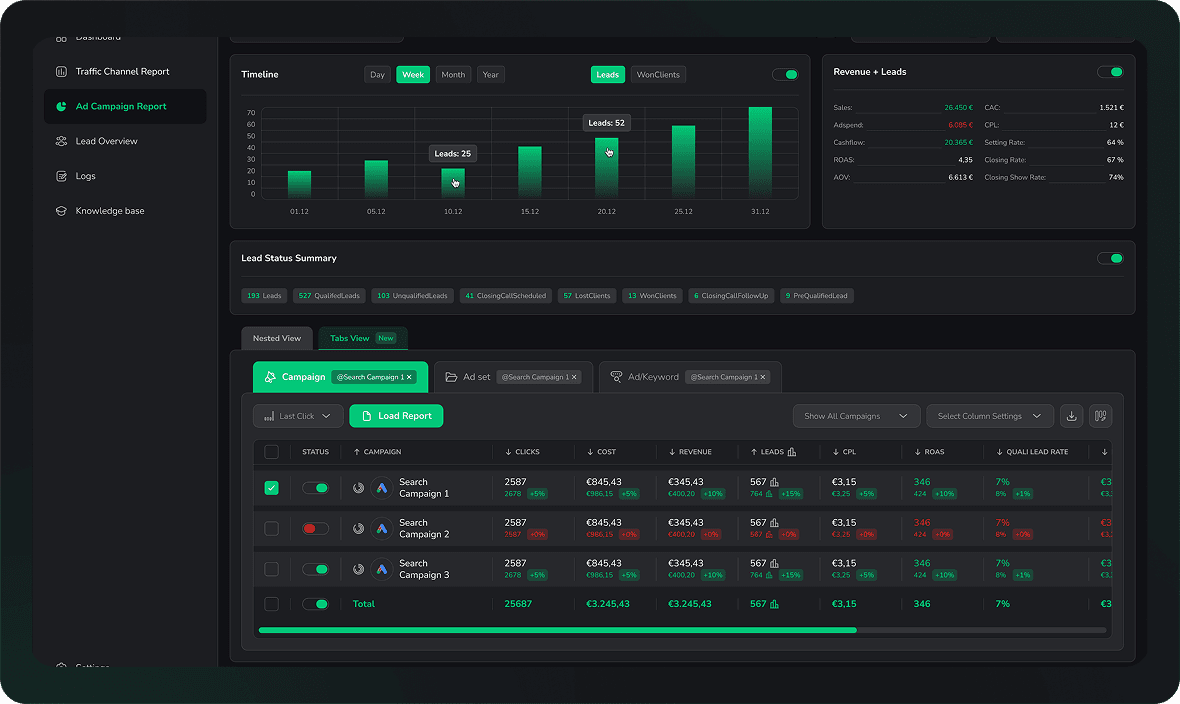















Looker Studio integration
Looker Studio marketing attribution, on the board you already send
Point Looker Studio at the BigQuery dataset LeadJourney fills, or at a Sheet on any plan, and the report keeps its layout while the numbers start naming the campaign behind the revenue.
30-day money-back guaranteeSetup with a tracking expert
- Live in 21 minutes
- 95%+ accuracy, first-party
- Native connector, none to install
Rated by the teams who connected their stack
How the data moves
- Organic search
- Organic social
- AI search
AI Attribution Engine
LeadJourneyServer-side tracking, every channel in one journey- Server-side tracking of every visit
- Multi-touch attribution per lead
- Into BigQuery, or into a Sheet
 Looker StudioWhere the board already lives
- Reports
- Scorecards
- Blends
Looker Studio reads both BigQuery and Google Sheets natively, so there is no connector to install and nothing to maintain between them. What changes is the source the board points at, not the board.
Trusted by 100+ lead generation businesses, agencies and freelancers
The gap
The board is as honest as its sources, and its sources are the ad platforms
Looker Studio will draw anything beautifully. What it draws today is each platform's own account of itself, blended with a session count, and none of it knows which click became a customer.
A Looker Studio board on the usual connectors
Every tile correct, the total impossible
- The Google Ads and Meta tiles each report their own conversions, so the same lead is counted twice and the totals never reconcile.
- The GA4 connector supplies the click side, and GA4 is collected in the browser: ITP, ad blockers and declined banners take their share before the row exists.
- There is no revenue on the board unless somebody exports it from the CRM, so the report ends at conversions and leadership asks the follow-up question in the meeting.
- Blending in Looker Studio joins on a key both sides share, and the ad click and the CRM deal share none.
- Organic, direct, referral and the AI assistants land wherever the analytics source filed them, which is usually not where they belong.
- A partner connector per platform is a licence, a refresh quota and one more thing that breaks quietly.
- The board reads. Nothing on it can tell Meta that the lead it delivered in March closed in June.
The same board on LeadJourney data
One source, already joined, and the layout untouched
- Every visit is captured server-side and first-party on your own domain, at 95%+ accuracy, before any consent tool or ad blocker gets a vote.
- One source instead of six, with the click, the campaign, the CRM stage and the deal value already on the same row, so there is nothing left to blend.
- Revenue is on the board because LeadJourney read it from HubSpot, Salesforce, Pipedrive or a webhook and carried it through.
- Spend is pulled from every connected ad account, so cost per qualified lead and ROAS are fields rather than a calculated field somebody maintains.
- ChatGPT, Perplexity, Claude and Gemini arrive as distinct sources, which is a column no analytics connector offers today.
- Two native routes: the BigQuery dataset on Scale and Enterprise, or a Google Sheet filled by the Zapier app or the API on any plan.
- And the same records go back to Meta, Google, LinkedIn and Microsoft Ads as conversions, which is the half of the job a board was never going to do.
How it works
Two routes onto the board, and both are Google's own connectors
Which one you take depends on whether you run a warehouse, not on what the report can show. The tiles end up reading the same fields either way.
1 The warehouse route: the BigQuery dataset
For the team that already queries BigQuery. Scale and Enterprise.
LeadJourney tracks the journey server-side, joins the CRM stage and the deal value and attributes the revenue.

Clicks, conversions and leads stream into a dataset in your own Google Cloud project as they happen.
Looker Studio's built-in BigQuery connector points at the dataset. No partner connector, no licence, no refresh quota.
The board keeps its layout and its schedule, and every tile now resolves to a campaign and a closed deal.
2 The light route: a Google Sheet, on any plan
For the team without a warehouse, and for the client report due Friday.
The same attributed leads, campaigns and revenue, from the same reports the dashboard shows.

The Zapier app, a webhook or the API writes them into a Google Sheet on the schedule you choose.
Looker Studio reads Sheets natively too, so the board picks the sheet up like any other data source.
One sheet per client on an agency roster, each feeding the report that client already opens.
The return path
A board reports. The same records also go back to the ad account.
Reporting better is worth doing. Reporting better and telling the ad platforms what actually closed is what makes the next month cheaper, and no dashboard tool does the second part.
 MetaConversions API
Qualified leads, booked meetings and won deals, with the deal value
 Google AdsOffline conversion import
Deals matched on gclid, with the revenue for value based bidding
 LinkedIn AdsConversions API
Stage changes and won deals matched on li_fat_id
 Microsoft AdsOffline conversions
Deals matched on msclkid, with the amount
The tile and the ad account agree
The number on the board and the conversion Meta received come from the same record, so nobody spends the meeting reconciling two screens.
You choose what counts
Map any CRM stage to any platform event. Qualified lead, meeting booked, deal won, or all three, each with its own value.
Sent server to server
No pixel to fire, nothing for an ad blocker or a declined cookie banner to remove on the way out.
Reporting
The tiles the board could not draw before
Each of these is a built-in LeadJourney report as well, so you can put it on the board or stop maintaining the board. Most teams do some of both.
Which campaign produced the revenue the CRM closed last quarter, not the conversions the platform claimed?
What does a qualified lead cost per channel, once spend and the CRM stage are on the same row?
Which landing pages start the journeys that end in a won deal?
How much pipeline came from ChatGPT, Perplexity and Gemini?
How does the same month look on first click and on last click?
Which client accounts are profitable this month, on one page, without a tab each?
LeadJourney and Looker Studio's own connectors
Where the connector gallery ends and LeadJourney starts
Looker Studio's connectors are free, native and genuinely good at what they do: they fetch each platform's own report. The gap is that no platform's own report knows what happened after the click.
| Capability | The usual connector stack | With LeadJourney |
|---|---|---|
| Looker Studio marketing attribution | The usual connector stackEach platform's self-reported conversions on its own tile, plus a session count from analytics. The join is a blend that has no shared key. | With LeadJourneyOne source where the click, the campaign, the CRM stage and the deal value are already on the same row. |
| Where the click data comes from | The usual connector stackThe GA4 connector, collected in the browser, so ITP, ad blockers and declined banners take their share first. | With LeadJourneyServer-side and first-party on your own domain, at 95%+ accuracy, with the click IDs stored at the moment of the click. |
| CRM revenue on the board | The usual connector stackOnly if somebody exports it from the CRM into a sheet and keeps doing it. | With LeadJourneyRead from HubSpot, Salesforce, Pipedrive, Close, Attio or a webhook and carried through to the row. |
| Blending sources | The usual connector stackA Looker Studio blend joins on a key both sides share. An ad click and a CRM deal share none, which is why the tile is missing. | With LeadJourneyNothing to blend. The join was made before the data left LeadJourney. |
| Attribution models | The usual connector stackWhatever the source platform used, usually last click, and not switchable on the board. | With LeadJourneyFirst click, last click, linear, position based and time decay, switchable without re-processing anything. |
| AI search as a source | The usual connector stackFiled under referral or direct, depending on how the assistant sent the visit. | With LeadJourneyChatGPT, Perplexity, Claude and Gemini as distinct sources, next to paid and organic. |
| What it costs to run | The usual connector stackFree for the Google sources, a partner connector licence and a refresh quota for the rest. | With LeadJourneyBoth routes use Google's own free connectors. What you pay for is the data, not the pipe. |
| Conversions back to the ad platforms | The usual connector stackOut of scope. A dashboard reads and never writes. | With LeadJourneyEvery stage change and won deal goes back to Meta, Google, LinkedIn and Microsoft Ads from the same records. |
| The people who never open Looker Studio | The usual connector stackGet the scheduled PDF, and ask their question in the meeting anyway. | With LeadJourneyAsk Atlas in plain language, or read the built-in reports, from the same data the board draws. |
Keep the board. Change what it is reading.
Looker Studio stays the place your team and your clients look, with the layout they know and the schedule they expect. LeadJourney replaces six disagreeing sources with one that already knows which click produced which deal, and hands that same record back to the ad platforms on the way past.
MCP server
The question the board did not have a tile for
Every board leaves something out, and building a tile for a one-off question is how boards get to forty pages. Ask in Claude, ChatGPT or Cursor instead, and the answer comes from the same numbers.
LeadJourney MCP connected, try any tab
Which campaigns produced our closed revenue last month?
Based on your LeadJourney data, 3 campaigns produced 148,200 EUR of closed revenue last month:
- Google Ads, Brand
- 38 leads, 9 closed deals, 61,400 EUR. Shortest path to signature.
- LinkedIn, Retargeting
- 21 leads, 6 closed deals, 48,900 EUR. Seven touchpoints on average.
- Meta, Lookalike DACH
- 54 leads, 5 closed deals, 37,900 EUR. Cheapest qualified lead.
Want this as a weekly summary in Slack?
Ask anything about your lead journeys
Where did our three biggest deals this quarter come from?
Your 3 largest deals this quarter all started somewhere the last click never showed you:
- 42,000 EUR
- First touch LinkedIn Ads, closed 63 days later after a webinar signup.
- 28,500 EUR
- First touch Google organic, paid click on day 11, demo on day 19.
- 21,800 EUR
- First touch a Meta video view, form filled from email six weeks on.
Want the full touchpoint list for any of them?
Ask anything about your closed deals
Which landing pages turn LinkedIn traffic into qualified leads?
3 pages take your LinkedIn traffic, and the qualified rate between them runs from 4% to 18%:
- /demo/attribution
- 18% qualified from 214 visits. Highest intent page on the site.
- /guide/server-side
- 9% qualified from 612 visits. Most journeys stall after the download.
- /pricing
- 4% qualified from 488 visits. Second most traffic, lowest intent.
Want the same breakdown for Google Ads traffic?
Ask anything about your landing pages
What did each channel cost per qualified lead last week?
3 channels spent budget last week. Cost per qualified lead ran from 41 EUR to 187 EUR:
- LinkedIn Ads
- 41 EUR per qualified lead. 2,300 EUR spent, 56 qualified.
- Google Ads
- 88 EUR per qualified lead. 4,400 EUR spent, 50 qualified.
- Meta Ads
- 187 EUR per qualified lead. 3,740 EUR spent, 20 qualified.
Want an alert the moment a channel passes 120 EUR?
Ask anything about your cost per lead
What do the journeys that close have in common?
3 signals show up in most of your closed deals and in almost none of the lost ones:
- Pricing page, 2+ visits
- In 71% of closed deals. In 12% of the ones that never closed.
- Demo within 14 days
- In 64% of closed deals. Median 9 days from the first click.
- Second contact
- In 58% of closed deals. A colleague of the lead arrives on site.
Want these three scored onto every lead in your CRM?
Ask anything about your lead journeys
Setup
From the first click to a board reading real revenue
No partner connector, no licence and no refresh quota. Both routes use connectors Google ships.
- 1About 21 minutes
Add a single line of code
Paste the LeadJourney script into your site or your GTM container, and connect the ad accounts you buy on and the CRM your deals live in. This is what produces the data the board has been missing.
- 2About 5 minutes
Pick your route out
On Scale and Enterprise, switch the BigQuery export on in the Apps tab with a service account key. On any plan, point the Zapier app or the API at a Google Sheet instead.
- 3Same day
Point Looker Studio at it
Add the dataset or the sheet as a data source with Looker Studio's own connector, and map it onto the tiles the board already has. The layout, the filters and the schedule stay exactly as they are.
Original reviews
What our customers wrote, word for word
4.9 out of 5 across 11 public reviews. Quoted as they were left, shortened only by dropping whole sentences.
- 5 out of 5 starsGoogle
“Before LeadJourney, we had no reliable tracking concept for our five-figure ad spend. We were manually building spreadsheet and CRM reports, inaccurate and time-consuming. Within two days, everything was set up. For the first time, I know exactly what I pay per lead and which campaigns actually bring in the best-qualified prospects.”
 Florian BuckCEO, Klickkraft GmbH
 “With LeadJourney we are able to track all our leads and connect them with sales and attribution data to make better decisions. In the first month of using it we scaled from 0 to 100k revenue from paid ads only.”
 GetreachBacklinks Marketplace (SaaS)
- 5 out of 5 starsG2
“LeadJourney finally fixed my Marketing Analytics. It goes way beyond basic Ad Tracking Software. The Customer Journey Report saves hours of digging, and capturing everything from Offline Conversions to AI Search Tracking makes it the Best B2B Attribution Platform available.”
Sascha LenzMarketing Manager
- 5 out of 5 starsTrustpilot
“Connected LeadJourney for 2 clients, setup took literally 20 minutes each. The data became more accurate, the reports actually make sense. Now clients look at the dashboard and the 'why don't the numbers match?' questions are gone.”
 Alexander SamarPerformance Marketing Agency
 - 5 out of 5 starsGoogle
“With LeadJourney, we have finally found a tool that provides us with the data we need to scale our performance marketing campaigns. The most important KPI is no longer lead price but cost per qualified lead.”
 Steffen SiesingCEO, Bilanzmanufaktur GmbH
- 5 out of 5 starsG2
“The ability to track both online and offline conversions in one unified dashboard has given us insights we never had before. Our ROI has improved dramatically since we started integrating LeadJourney with our CRM. We're finally able to see the full customer journey, and it's been a game changer for our strategy.”
 Andre WitzelFounder, Trading.de
 - 5 out of 5 starsTrustpilot
“The ability to seamlessly integrate data from multiple channels and see real-time insights has significantly improved our campaign results. We now focus on metrics that truly matter, like ROI and qualified leads.”
 Nikita YatsunCEO, RLV Media GmbH
Read the reviews where they were left
FAQ
What Looker Studio teams ask first
If yours is not here, our team answers in the chat within a few minutes.
Is there a LeadJourney connector in the Looker Studio gallery?
No, and you do not want one. A partner connector is a licence, a refresh quota and a dependency on somebody else's uptime. Instead the data lands in BigQuery or in a Google Sheet, and Looker Studio reads both of those with connectors Google ships for free.
Which route should we take?
If your team already queries BigQuery, take the export: it streams, it holds the full history, and the board reads it directly. If you have no warehouse, or you want one report per client without a Google Cloud project, fill a Sheet with the Zapier app or the API. The board looks the same either way.
Do I have to rebuild the report?
No. The usual path is to add the new source next to the existing ones and repoint tiles one at a time, starting with the ones leadership asks about. The layout, the filters, the branding and the email schedule are untouched.
Can we keep the GA4 and Google Ads connectors alongside it?
Yes, and plenty of teams do for the first month, precisely so they can see where the two disagree. That comparison is usually the moment the project justifies itself: the platform tiles double count, and the LeadJourney figure is the one the CRM can confirm.
Does the BigQuery route need the Scale plan?
The BigQuery export is on the Scale and Enterprise plans, alongside API access. The Sheets route runs on the Zapier app, which is on every plan, so a board on real attribution data does not depend on the tier.
How fresh are the numbers?
On the BigQuery route the rows stream in as the clicks, conversions and stage changes happen, and Looker Studio reads whatever is there when the report loads. On the Sheets route the sheet is as current as the schedule you set the Zap or the API caller to.
We are an agency with thirty client boards. Does this scale?
That is the case the Sheets route was made for: one workspace per client, one sheet per client, one board per client, each reading only its own. On the BigQuery route each workspace exports to its own dataset, which is the same separation with the warehouse behind it.
What about Looker, the enterprise product?
Looker reads BigQuery too, so the export lands in front of it the same way. What this page describes is Looker Studio, the free reporting tool that used to be called Data Studio, because that is what most teams asking this question mean.
Is this GDPR compliant?
The data lands in your own Google Cloud project or your own Google Sheet, under your agreement with Google. On our side, LeadJourney processes and stores data in the EU, signs an Art. 28 data processing agreement, and tracks first-party and server-side so consent decisions are respected rather than worked around.
More integrations
More data and BI integrations
The export lands in BigQuery, and these read BigQuery natively. No connector to install and none written by us.
Keep the board. Change the source.
Put real attribution on the Looker Studio report you already send
Connect your ad accounts and your CRM, choose the BigQuery export or a Sheet, and the tiles start naming the campaign behind the revenue.
30-day money-back guaranteeSetup with a tracking expert