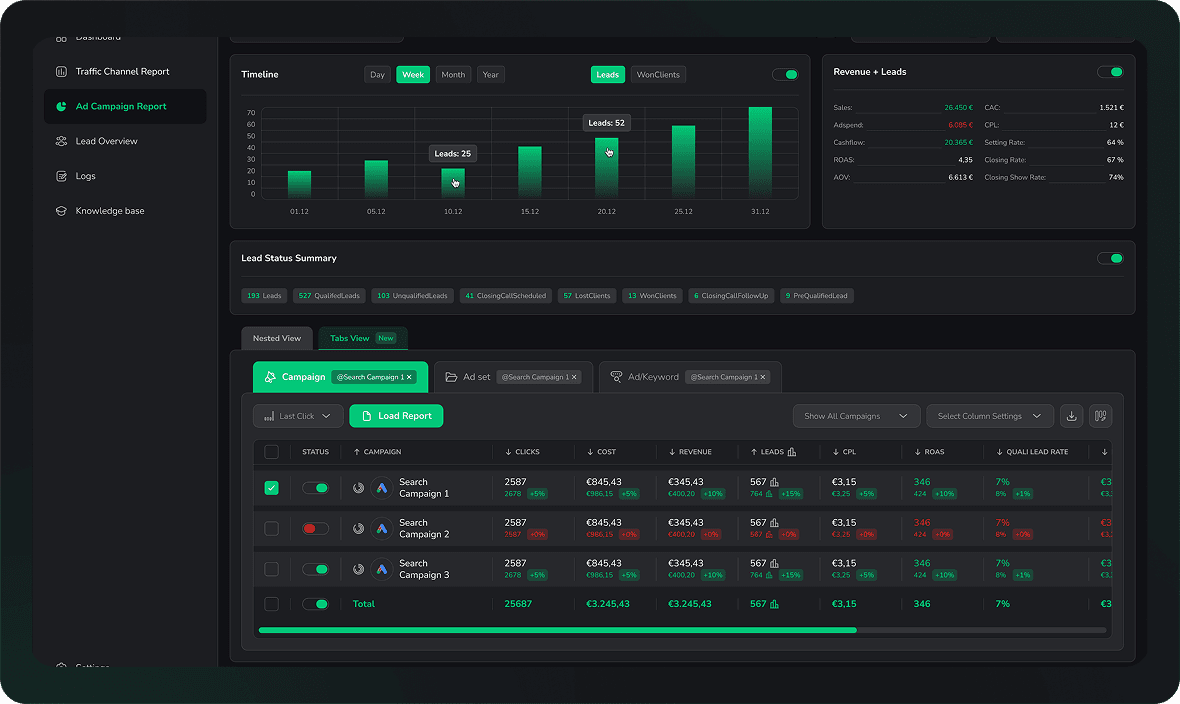
















BlogTool Comparisons
The Best Lead Attribution Tools Compared (2026)
Hyros, RedTrack, Voluum, AnyTrack, Cometly, ClickFlare, AdsFox and WhatConverts were each built for a different audience, and only some of them for lead generation. The strengths, weaknesses and ideal use case of each, so you can pick by category fit rather than feature list.


Contents
Summarise this article with AI
Opens the page with a ready prompt in:


Nothing is sent until you pick a service.
Every lead gen marketer eventually comes to the same crossroads: which attribution platform actually fits a lead generation business? Hyros, RedTrack, Voluum, AnyTrack, Cometly, ClickFlare, AdsFox and WhatConverts each get recommended in the same threads, and each was built for a different audience.
Three of them are affiliate trackers with a lead gen page on the website. Two are single-purpose tools that do one part of the job very well. One is priced for advertisers spending six figures a month. Only a few were designed around the thing a lead gen business actually needs: a form fill that becomes a CRM record, a CRM record that becomes a qualified lead, and a qualified lead that becomes a closed deal with a number attached.
We've broken down the strengths, weaknesses, and ideal use cases of every major lead attribution tool in 2026 so you can choose the right one without 40 hours of research. Every price below was read on the vendor's own pricing page in September 2026.
Quick Summary: The Best Lead Attribution Tool in 2026
In short
LeadJourney is the best lead attribution tool in 2026 for businesses that generate leads rather than sell carts. It captures every click ID server-side on your own domain at 95%+ accuracy, carries it into the CRM record, and follows that record through every pipeline stage to the closed deal, so the report answers cost per qualified lead and cost per close rather than cost per form fill. Meta, Google, LinkedIn and Microsoft sit in one dashboard, and when a deal closes the revenue goes back to all four over the Conversions API automatically. 21-minute setup, no developer. 14-day free trial, no credit card. The eight alternatives below are ranked by how well they fit a lead gen funnel, not by feature count.
The 9 best lead attribution tools at a glance
| Tool | Key features | Best for | Pricing |
|---|---|---|---|
| Rank 1LeadJourney | Server-side tracking at 95%+; Meta, Google, LinkedIn & Bing in one dashboard; CRM stage and closed-deal attribution; automated 4-platform CAPI loop; Atlas AI analyst | Lead gen businesses, B2B and B2C, needing revenue attribution | From €129/mo, 14-day free trial |
| Rank 2Hyrosvs LeadJourney | Server-to-server tracking, long attribution windows, multi-touch and LTV reports, AIR ad optimisation | High-ticket info products and coaching businesses | From $69/mo by tracked revenue |
| Rank 3RedTrackvs LeadJourney | Affiliate network integrations, traffic source templates, Conversions API, AI Copilot | Media buyers who also run lead gen | From $69/mo |
| Rank 4Voluumvs LeadJourney | Sub-second real-time reporting, Traffic Distribution AI, Automizer rules, anti-fraud kit | Affiliates and media buyers, not lead gen | From $119/mo |
| Rank 5Cometlyvs LeadJourney | Server-side tracking, Conversions API, AI ads manager, contact-level journeys | B2B SaaS wanting one attribution view | On quote, demo required |
| Rank 6AnyTrackvs LeadJourney | 90+ integrations, real-time CAPI sync and deduplication, event routing | Routing conversion data, not lead gen reporting | Free plan, paid from $100/mo |
| Rank 7ClickFlarevs LeadJourney | Traffic routing AI, affiliate network integrations, search arbitrage tracking | Affiliates, search arbitrage and iGaming | From $69/mo |
| Rank 8AdsFoxvs LeadJourney | CRM stage changes as offline conversions to Meta, Google, TikTok and LinkedIn | Lead qualification signals only, no reporting layer | From $294/mo |
| Rank 9WhatConvertsvs LeadJourney | Call tracking with dynamic number insertion, recording, transcription, form and chat tracking | Agencies and local businesses whose leads arrive by phone | From $30/mo |


Pick Your Tool by Use Case, Not Feature List
Don't pick a tool because of one feature. Pick it because the platform was designed for businesses like yours. Attribution tools look interchangeable on a feature grid, and they are not: the grid hides the assumption each one makes about what a conversion is, and that assumption decides whether the tool will fight you for the next two years.
There are three families on this list, and knowing which one you are shopping in eliminates most of the shortlist before you book a single demo.
Affiliate trackers
Voluum, ClickFlare and RedTrack. A conversion is a postback from a network, arriving seconds after the click. Superb at traffic routing, rules and fraud. No CRM pipeline, so nothing knows what a lead is worth six weeks later.
Single-purpose tools
AdsFox sends CRM stage changes to the ad platforms. WhatConverts tracks phone calls. AnyTrack routes events between systems. Each is excellent at its one job and is not a reporting platform.
Attribution platforms
LeadJourney, Cometly and Hyros. A conversion is a person who enters a pipeline and changes stage over weeks. Tracking, attribution model, dashboards and the loop back to the ad platforms in one product.
The mismatch that costs the most is the first one. An affiliate tracker will happily fire on your form submit, and everything downstream (which of those leads the sales team qualified, which closed, what they were worth) stays outside the tool. You end up optimising Meta towards form fills, and Meta obliges by finding you more people who fill in forms and never buy. The category fit matters more than any single feature.
1. LeadJourney: Best Lead Attribution Tool for CRM Revenue Attribution
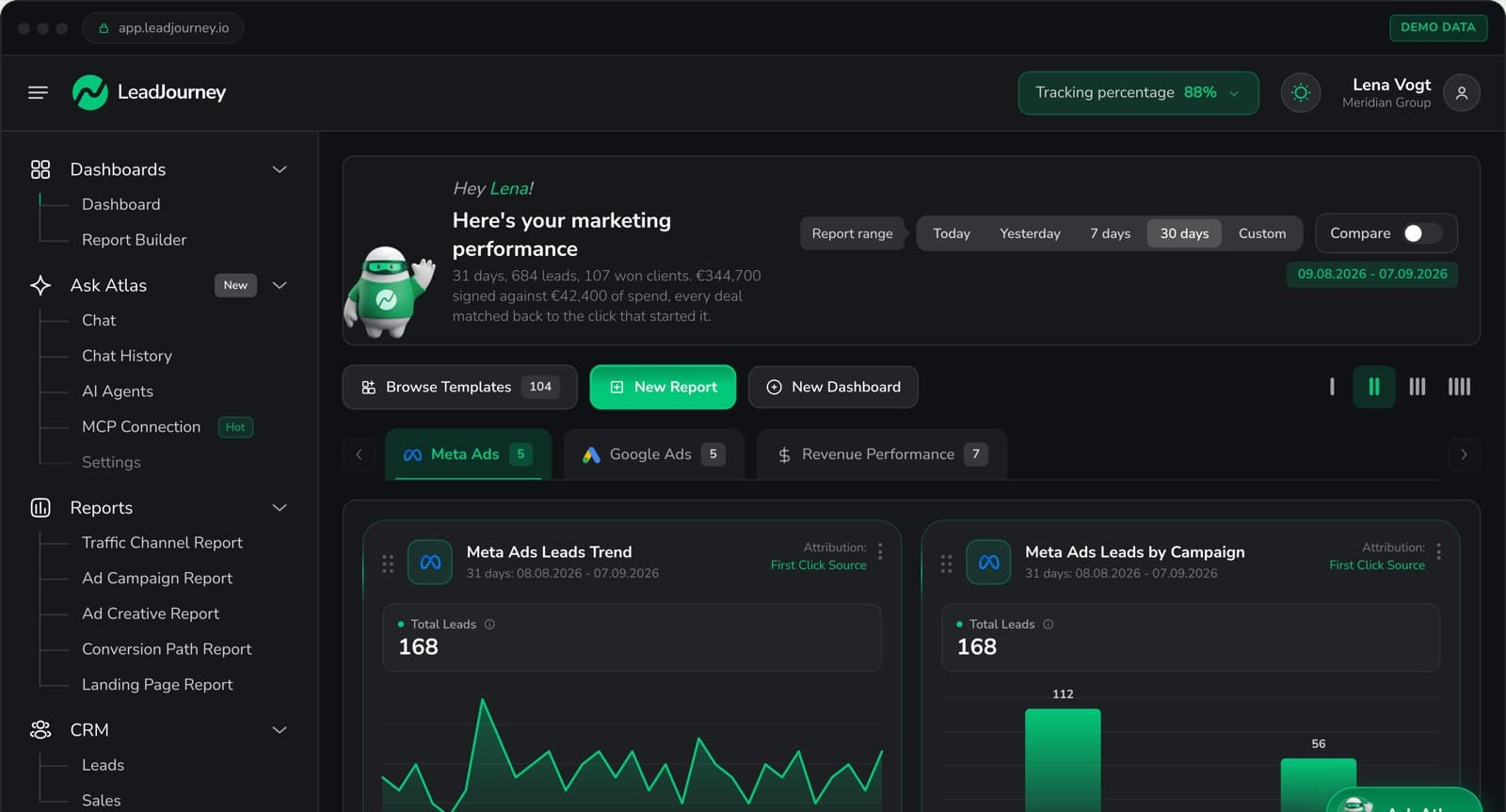
LeadJourney is the only platform on this list built exclusively around the lead generation funnel. The tracking runs server-side on your own domain, so the gclid, fbclid, li_fat_id and msclkid are captured at the moment of the click rather than read out of a browser that iOS, Safari's ITP, an ad blocker or a consent banner may have already closed. That is where the 95%+ figure comes from, and it is the difference between a report that is directionally right and one you can put in front of a board.
What happens next is the part the affiliate trackers have no place for. The click ID is written into the CRM record, so the lead arrives at the sales team already carrying its origin. Every stage change after that (marketing qualified, sales qualified, proposal sent, closed won) is a conversion LeadJourney can attribute, which means the campaign report shows cost per qualified lead and cost per close next to cost per click. Native integrations cover HubSpot, Salesforce, Pipedrive, Close and more; Shopify orders come in the same way for teams that run both.
And the attribution does not stop at the dashboard. When a deal closes, LeadJourney sends that revenue back to Meta, Google, LinkedIn and Microsoft over the Conversions API at the same time, so all four algorithms learn on real buyers rather than on form fills. Attribution stops being a monthly report and starts being an input to the next campaign.
For agencies, each client sits in its own workspace with its own tracking, models and reports, and one overview sits above all of them. Setup takes about 21 minutes per workspace and needs no developer: one script, the CRM connected by OAuth, the ad accounts authorised.
What LeadJourney does that the others don't
- Four ad platforms in one attribution model: Meta, Google, LinkedIn and Microsoft, plus organic search, organic social, email, direct and AI search engines like ChatGPT and Perplexity as first-party sources.
- CRM pipeline stages as conversions, not just the form submit, so a qualified lead and a closed deal are reportable events with the campaign still attached.
- The closed loop to all four platforms at once. Every other tool on this list either does not send revenue back or sends it to a subset.
- Five attribution models on every plan, so first click, last click and the multi-touch models sit side by side instead of behind an enterprise tier.
- Static and dynamic call tracking numbers as an add-on, so phone leads carry the same campaign data as form leads.
- Atlas, the AI analyst, answers questions about the account in plain language and is available over MCP, so the data is reachable from the tools your team already uses.
Pros
- Built for the lead gen funnel rather than adapted to it: qualified-lead and closed-deal reporting are the default view, not a workaround.
- Server-side capture on your own domain, so the accuracy holds through iOS, ITP, ad blockers and consent tooling.
- One automated CAPI loop to Meta, Google, LinkedIn and Microsoft, so attribution improves the next campaign instead of only describing the last one.
- 21-minute setup with no developer, and no GTM server container to host and maintain.
- 14-day free trial, no credit card, and public pricing rather than a demo gate.
Cons
- Not an affiliate tracker. If you need offer rotation, lander split tests, postback chains to a dozen networks or an anti-fraud kit, Voluum and ClickFlare are the right category.
- E-commerce runs through the Shopify integration or a manually connected shop system (ROAS and customer origin), without product-level catalogue analytics.
Verdict
The best lead attribution tool in 2026 for any business whose conversions land in a CRM. It answers the question the rest of this list mostly cannot: which campaign produced the deals, not which campaign produced the forms.
What Real Users Say About LeadJourney
Honestly the best B2B attribution platform I've used. The Customer Journey Report finally shows us which touchpoints drive results, and the ad tracking software is rock solid. Being able to pull in offline conversions plus the AI search tracking makes our marketing analytics way more accurate.
Hands down the best B2B attribution platform for agencies.
Read verified reviews on Trustpilot, G2, Capterra, and Software Advice.
2. Hyros: Best for Big-Budget High-Ticket Advertisers
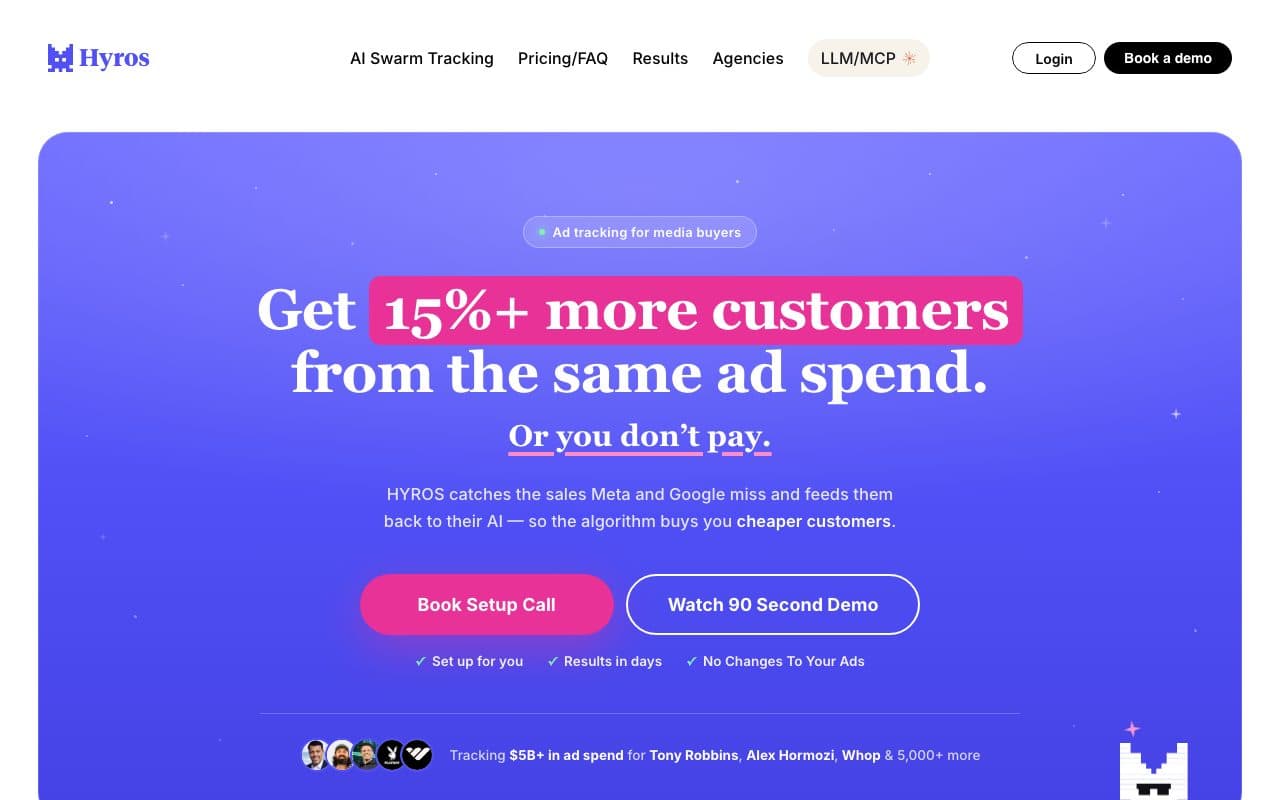
Hyros is the best-known name in this category and earned it on tracking precision. It runs server-to-server with first-party identifiers, stitches sessions across devices, and holds attribution over the long windows a high-ticket offer needs, which is exactly the case where a browser pixel gives up. Calls and emails come into the same model, and the AIR layer pushes optimisation suggestions back at the ad accounts.
The catch is fit rather than quality. Hyros was built around info products, coaching and high-ticket e-commerce, mostly in the US, and the reporting speaks that language: revenue and lifetime value per ad, not pipeline stages per campaign. Pricing is tied to the revenue you track, so it starts low and climbs steeply with the business, and there is a demo before you can buy rather than a trial you can start.
Pros
- Genuinely strong cross-device, call and email tracking with long attribution windows.
- Lifetime value reporting per ad, which suits a high-ticket offer with a long consideration period.
Cons
- Built for info products and high-ticket e-commerce, so B2B pipeline stages are not a native concept.
- Priced on tracked revenue and sold through a demo, with no free trial to test it on your own data first.
Verdict
A strong fit if you spend heavily on a high-ticket offer and need premium tracking precision. For a lead gen business reporting on qualified leads and closed deals, LeadJourney covers the same accuracy with a funnel model that matches yours.
3. RedTrack: Strong Affiliate Heritage, Lead Gen Second
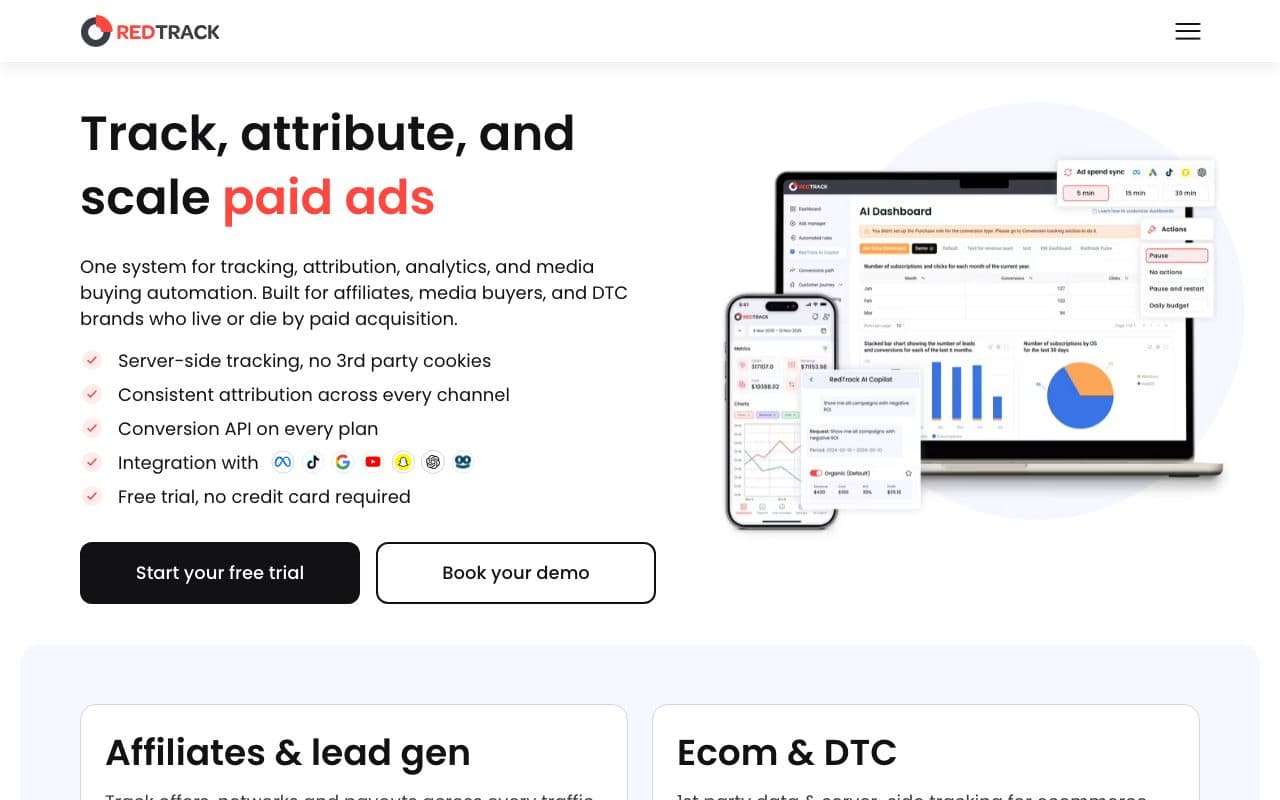
RedTrack started in affiliate marketing and has expanded steadily since: server-to-server conversion tracking, templates for a long list of traffic sources, a Conversions API for Meta, TikTok and Google, cost sync down to five minutes, and an AI Copilot that answers dashboard questions. It is a capable, actively developed tracker and it is cheap for what it does.
For lead generation specifically, the affiliate roots still show. The mental model is campaign, traffic source and offer rather than lead, stage and deal, so getting a qualified-lead report out of it means bending the tool. The plan families make the point themselves: one set for affiliates and lead gen media buyers, another for e-commerce, and nothing shaped around a CRM pipeline. Affiliates and media buyers love it; lead gen businesses tend to outgrow it once sales starts asking which campaigns closed.
Pros
- Excellent value: the entry plan covers two million events and there is a 14-day trial.
- Wide traffic source coverage and a Conversions API that keeps Meta, TikTok and Google fed.
Cons
- Reporting is organised around campaigns and offers, not pipeline stages, so lead quality stays invisible.
- No native CRM revenue model, which is the thing a lead gen business is buying attribution for.
Verdict
One of the better trackers if you buy media at volume and think in offers. If your conversions land in a CRM and get qualified by a human, it is the wrong shape.
4. Voluum: Built for Affiliates, Not Lead Gen
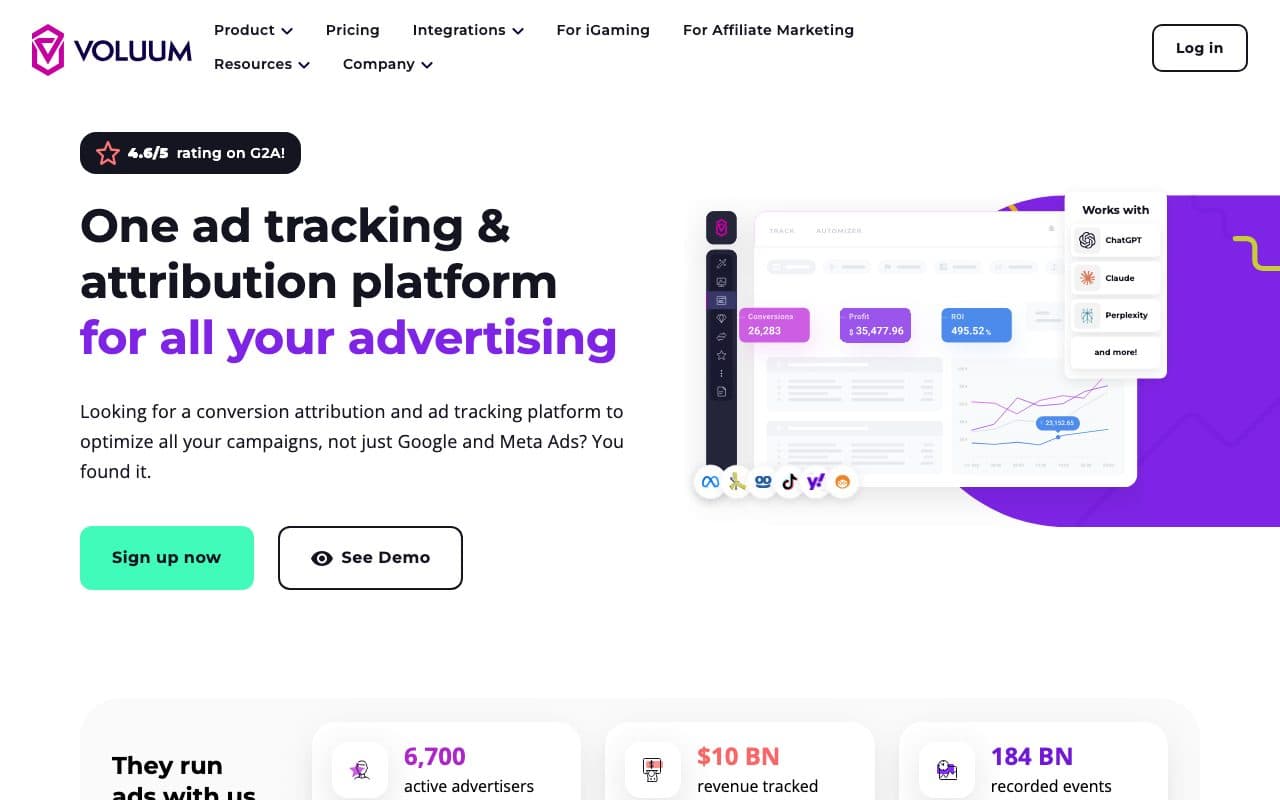
Voluum is the standard the affiliate world measures against, and its G2 rating reflects it. Cookieless postback and API tracking, Traffic Distribution AI that moves budget between landers and offers on its own, Automizer rules that act against traffic sources around the clock, and an anti-fraud kit. Everything is fast and everything is polished.
None of it is aimed at you if you generate leads. There is no native CRM integration, no lead-to-revenue attribution and no unified view of Meta, Google, LinkedIn and Microsoft as one account. A conversion in Voluum is a postback that arrives seconds after the click, which is the correct design for an affiliate offer and the wrong one for a lead that gets qualified three weeks later. For lead generation, it is the wrong category of tool rather than a weak tool.
Pros
- Best-in-class traffic routing, automation rules and fraud detection.
- Sub-second reporting at very high event volumes.
Cons
- No CRM integration and no lead-to-revenue attribution.
- Does not unify the four major ad platforms into one attribution model.
Verdict
The right answer for affiliates and media buyers, and a category error for a lead gen business. Nothing in it knows what a qualified lead is.
5. Cometly: The Closest Feature Match
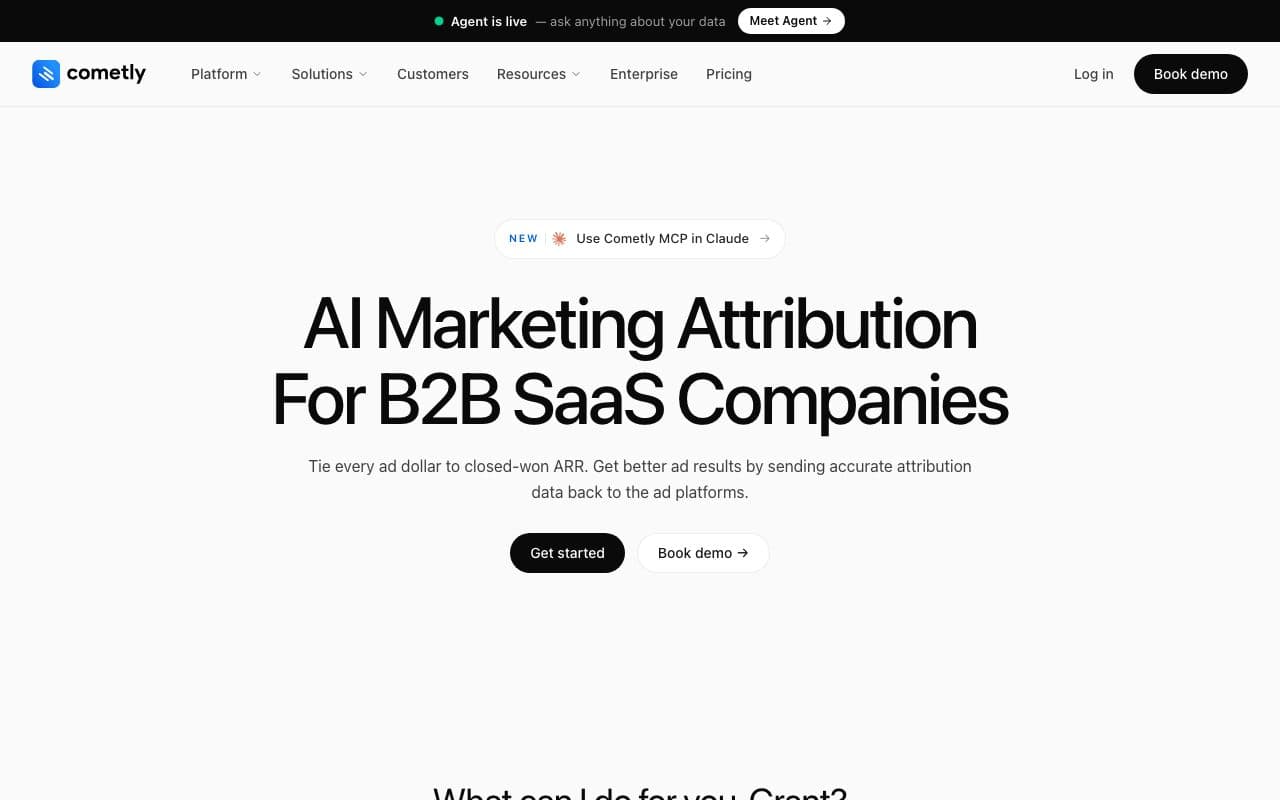
Cometly is the closest competitor to LeadJourney on features: server-side tracking, a Conversions API, an AI ads manager across platforms, contact-level journeys and multi-touch attribution across the funnel. It is a real attribution platform rather than a tracker with an attribution tab, and it is well rated by the teams using it.
The difference is focus. Cometly serves B2B SaaS, e-commerce and lead gen broadly, and the product reflects the compromise: the journey view is strong, the lead-funnel depth (qualified-lead stage reporting, appointment attribution, the CRM-to-CAPI loop across all four platforms) is less specific. Pricing is usage-based on monthly pageviews and quoted after a demo, with no free trial, so evaluating it on your own data takes a sales cycle rather than an afternoon.
Pros
- Genuine server-side tracking and multi-touch attribution with contact-level journeys.
- AI ads manager that acts across platforms rather than reporting on them separately.
Cons
- Multi-vertical focus, so lead gen funnel depth is shallower than a purpose-built tool's.
- Quote-only pricing after a demo and no free trial.
Verdict
The strongest alternative on this list if you are a B2B SaaS business. If your funnel ends in a CRM pipeline rather than a signup, LeadJourney goes deeper on the part that matters.
6. AnyTrack: Data Routing, Not Lead Gen Reporting
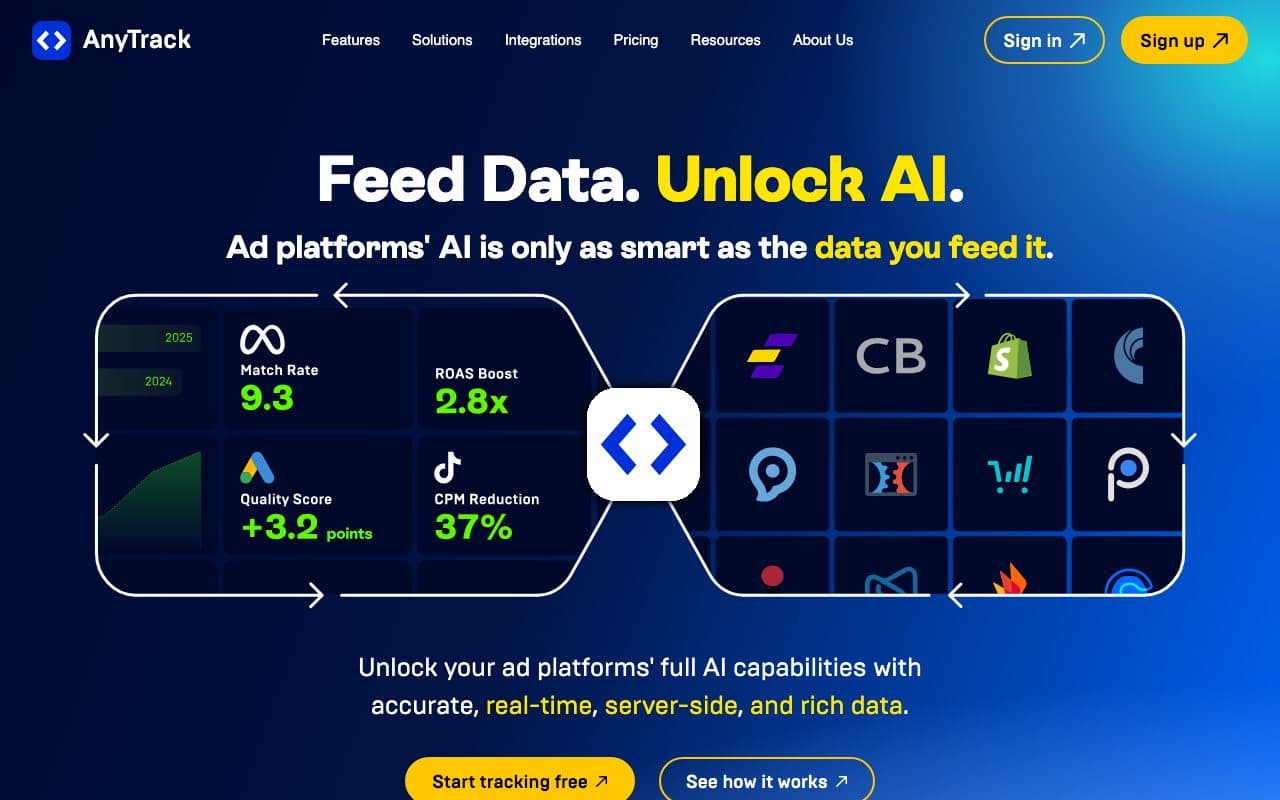
AnyTrack is a conversion data platform, and it is good at that job. It collects conversions from affiliate networks, funnel builders and CRMs, deduplicates them and pushes them to the ad platforms in real time over the Conversions API, across more than ninety integrations. The free tier goes to 5,000 sessions, so it is genuinely testable before you commit.
What it is not is a reporting layer for a lead gen business. The attribution it offers is first and last ad click, the pipeline is a destination rather than a subject, and the value is in moving events between systems rather than in explaining which campaign produced revenue. If you also run e-commerce or affiliate offers alongside lead gen, that breadth is worth a lot. If you are pure lead gen, you will still need something to answer the reporting question afterwards.
Pros
- Very broad integration coverage and reliable real-time CAPI sync with deduplication.
- A free tier that lets you prove the plumbing works before paying.
Cons
- First and last click only, so no multi-touch model to reason about a long funnel.
- Built as a data pipe, not as the report a lead gen team reads on Monday morning.
Verdict
Excellent event plumbing for a mixed affiliate, e-commerce and lead gen setup. Not a substitute for an attribution platform if lead gen is the whole business.
7. ClickFlare: Affiliate and Search Arbitrage
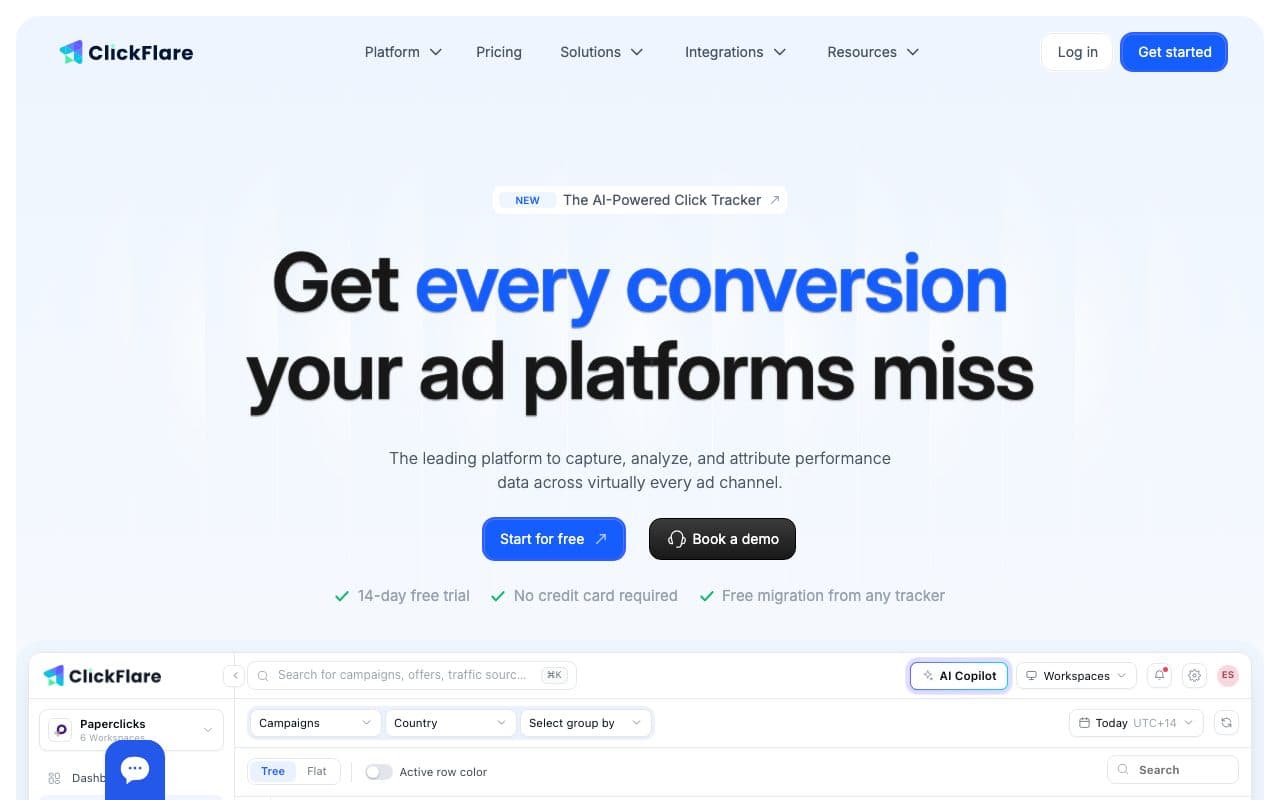
ClickFlare is fast, well built and priced in clear bands by event volume. Server-side event tracking, postbacks, a Conversions API covering Facebook, Google, TikTok, Snapchat and Reddit, an AI copilot and AI traffic routing. For affiliates, media buyers and search arbitrage campaigns it is a serious tool, and iGaming operators use it heavily.
Its own site names lead gen companies among its customers, and the honest reading is that a lead gen business running paid traffic to a landing page can make it work. What it cannot do is the second half: there is no CRM integration to carry the click into the sales pipeline, no unified paid media dashboard across the four platforms a B2B account actually runs, and no qualified-lead reporting. You get the click side of the story very well and the revenue side not at all.
Pros
- Fast, stable and transparently priced in flat bands rather than by tracked revenue.
- Strong Conversions API coverage including TikTok, Snapchat and Reddit.
Cons
- No CRM integration, so a lead's value after the click is outside the tool.
- Reporting is built for offers and traffic sources, not for a sales pipeline.
Verdict
A strong affiliate and arbitrage tracker. For lead generation it stops exactly where the interesting question starts.
8. AdsFox: Lead Qualification Signals Only
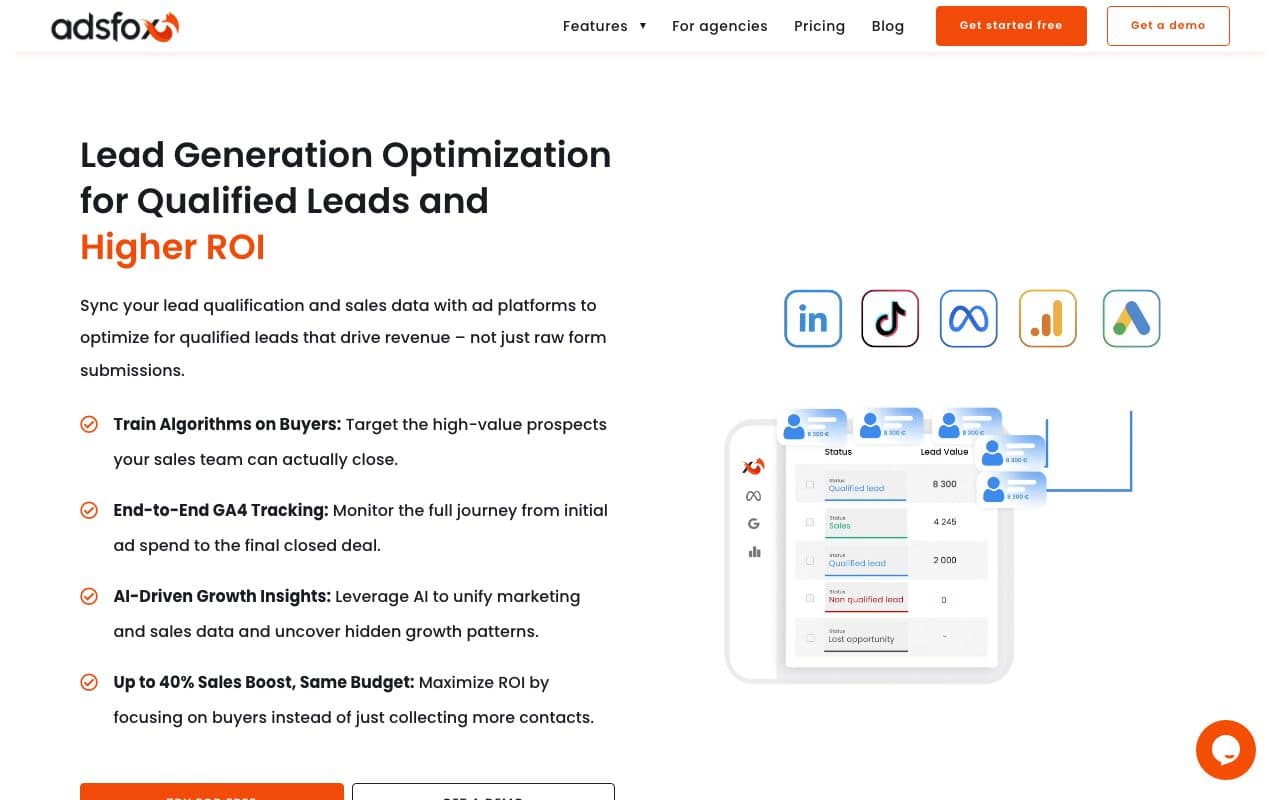
AdsFox does one thing and does it deliberately: it turns CRM stage changes into deduplicated offline conversions and sends them to Google, Meta, TikTok and LinkedIn, so the algorithms optimise towards qualified leads instead of raw form submissions. Server-side event tracking, a GA4 lead-to-sale journey, Typeform and Calendly conversion tracking and a cookie banner come with it. If signal transmission is the whole of what you need, it covers the basics properly.
It is not the reporting stack. There is no unified ads dashboard across your platforms, limited visibility of the full lead journey, no custom report builder and no AI analyst. Pricing is also the highest entry point on this list outside the enterprise tools, banded by ad spend and sold through a demo, which is a lot to pay for one half of the loop. LeadJourney sends the same signals to the same four platforms and is the attribution platform around them.
Pros
- Clean, purpose-built CRM-to-CAPI signal transmission across four ad platforms.
- Useful extras for a lead gen site: GA4 journey, Typeform and Calendly tracking, consent banner.
Cons
- No unified ads dashboard, custom reporting or AI analysis: it is a pipe, not a platform.
- Entry pricing from $294 a month and a demo gate, for a subset of the job.
Verdict
The right tool only if you already have your reporting elsewhere and want the signal loop alone. Otherwise you are paying platform prices for one feature.
9. WhatConverts: Specialist Call Tracking
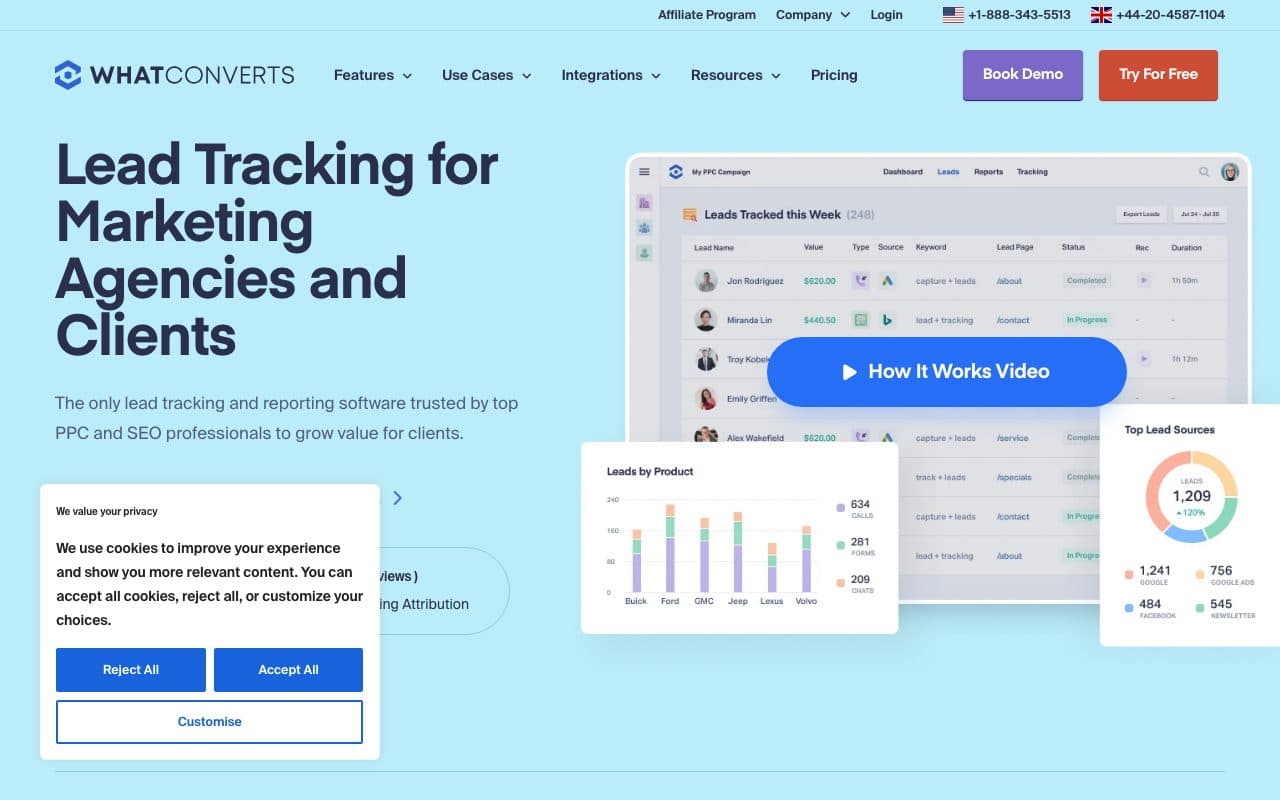
WhatConverts has the deepest call tracking in this category and the reviews to match: dynamic number insertion, recording, transcription, call flows, plus form and chat tracking, and a lead manager where a human can mark a lead qualified and attach a value. For agencies, franchises and local businesses whose leads arrive by phone, it is genuinely best in class, and it starts at $30 a month.
The limits are the other side of that focus. There is no server-side tracking of the kind that survives iOS and ITP on the click side, no CRM revenue connection, and multi-click attribution only appears on the top tier. It is a lead capture and qualification tool, not a performance marketing platform: it will tell you the phone rang and who was on it, and much less about which campaign paid for the call. Many agencies run it alongside an attribution platform rather than instead of one.
Pros
- The strongest call tracking on this list, with recording, transcription and dynamic number insertion.
- Low entry price and a lead manager built for humans qualifying leads by hand.
Cons
- No server-side click capture and no CRM revenue attribution.
- Multi-click attribution is gated to the highest tier.
Verdict
Choose it if call tracking with recording is the primary need. If you need the campaign behind the call as well, LeadJourney covers call tracking as an add-on inside the attribution model.
Why an Affiliate Tracker Cannot Do Lead Attribution
Three of the nine tools above are affiliate trackers, and they keep appearing on lead attribution shortlists because on paper they do everything: click tracking, server-side events, a Conversions API, multi-channel dashboards. The reason they still do not work is not a missing feature. It is that they define a conversion differently from the way your business does.
In an affiliate model the conversion is final at the moment it fires. A postback arrives, the payout is known, the campaign is either profitable or it is not, and the whole loop closes inside a day. Every design decision in Voluum, ClickFlare and RedTrack follows from that: real-time reporting, rules that act within minutes, offer rotation, fraud detection on the click.
In a lead gen model the conversion is the start of the process. A form fill is an unknown quantity until a salesperson has spoken to the person behind it. Some of those leads are worth nothing, one of them is worth €40,000, and which is which only becomes clear weeks later, in a CRM, at a stage change nobody's pixel is watching. Optimise on the form fill and you are optimising on the wrong event. The ad platforms will do exactly what you asked and find you more people who fill in forms.
That is the whole argument for CRM-connected attribution. The click ID has to survive into the CRM record, the stage changes have to come back out as conversions, and the closed deal has to reach the ad platforms as revenue rather than as a count. A tool without a CRM model cannot do any of the three, however good its click tracking is.
How to Choose: Five Questions That Decide It
Feature grids are the least useful way to pick an attribution tool, because every vendor ticks every box at some level of depth. These five questions separate them in about ten minutes.
- Where does a conversion live in your business?If the answer is a CRM record that changes stage over weeks, you need a platform with a CRM model. If it is a postback, you are shopping for an affiliate tracker.
- Is the tracking server-side, on your domain?Browser pixels lose 30 to 40% of conversions to iOS, ITP, ad blockers and consent tooling. Ask where the click ID is captured, not whether the word appears on the pricing page.
- Does revenue go back to the ad platforms, and to how many?Reporting on the past is half the value. Sending closed-deal revenue back to Meta, Google, LinkedIn and Microsoft is what changes the next campaign.
- How do your leads actually arrive?If half of them phone, call tracking is not optional. Decide whether you want it inside the attribution model or as a second tool alongside it.
- Can you test it without a sales cycle?A free trial on your own data settles in two weeks what a demo cannot settle at all. Quote-only pricing is a real cost, not just an inconvenience.
Quick Decision Guide
- Pure lead generation business, B2B or B2C: LeadJourney (purpose-built, CRM stages and closed deals as conversions).
- Lead gen and SaaS or e-commerce hybrid: Cometly for the attribution view, AnyTrack for the event routing.
- Affiliate marketing, media buying or search arbitrage: Voluum, ClickFlare or RedTrack.
- High-ticket info product or coaching with a long consideration window: Hyros.
- Heavy phone-call lead flow that needs recording and transcription: WhatConverts, alongside an attribution platform.
- You already have reporting and only want the CRM signal loop: AdsFox, or LeadJourney if you would rather have both in one.
In the glossary
FAQ
Frequently Asked Questions
The questions teams comparing lead attribution tools ask most.
What is the best lead attribution tool in 2026?
LeadJourney, for any business whose conversions land in a CRM. It captures every click ID server-side on your own domain at 95%+ accuracy, carries it into the CRM record, treats pipeline stage changes and closed deals as conversions, and sends that revenue back to Meta, Google, LinkedIn and Microsoft over the Conversions API automatically. Cometly is the closest alternative for B2B SaaS, and Hyros is the better fit for a high-ticket info product with a very long consideration window.
Can I use an affiliate tracker like Voluum or RedTrack for lead generation?
You can track the clicks, but not the leads. Affiliate trackers treat a conversion as final at the moment it fires, which is correct for a postback and wrong for a form fill that gets qualified weeks later in a CRM. Without a CRM model there is no qualified-lead reporting, no cost per close, and no way to send real revenue back to the ad platforms, so you end up optimising towards form fills instead of buyers.
What does lead attribution software cost?
The range on this list runs from $30 a month for WhatConverts' single-account call tracking to $294 a month for AdsFox and quote-only enterprise pricing for Cometly. Affiliate trackers start around $69 to $119 a month at annual rates. LeadJourney starts at €129 a month with public pricing by marketing spend and a 14-day free trial, no credit card. Prices here were read on each vendor's own pricing page in September 2026.
Do I need a developer to set up lead attribution tracking?
Not any more. The traditional server-side setup meant a Google Tag Manager server container, a cloud project to host it, event mapping and API tokens, which is a multi-week engineering job. LeadJourney's setup is one script on the site, the CRM connected by OAuth and the ad accounts authorised, which takes about 21 minutes. Tools that still require a GTM server container are the exception rather than the rule in 2026.
How is lead attribution different from ad tracking?
Ad tracking tells you what happened up to the click and the conversion event on your site. Lead attribution carries that click into the CRM and follows the person through qualification to the closed deal, so the report shows cost per qualified lead and cost per close rather than cost per form fill. Every tool on this list does ad tracking. Only some of them do lead attribution.
Keep reading
More from the blog
 Tool Comparisons
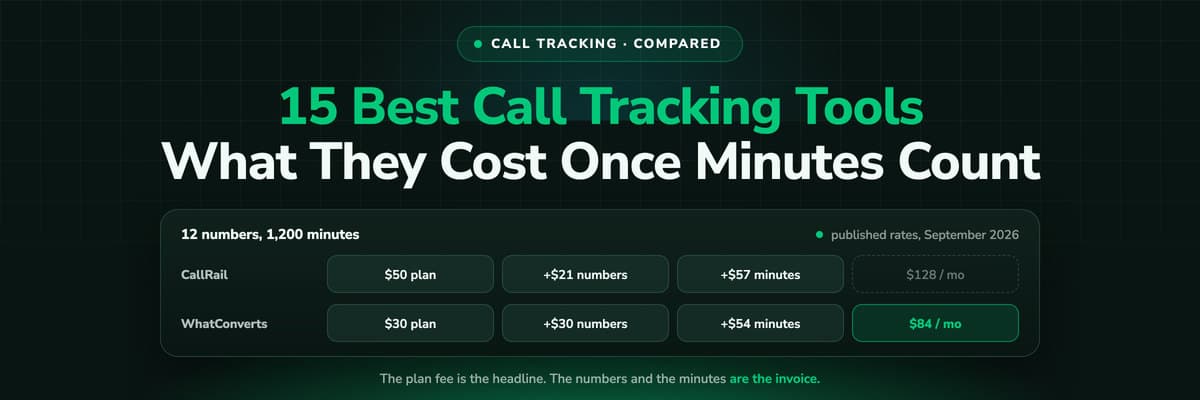
15 Best Call Tracking Software Tools in 2026
Every call tracking tool ties a call to a source. Far fewer follow that call to the booked job, and almost none send the qualified one back to the ad platform that produced it. Fifteen tools ranked on that, with the numbers and the minutes counted into every price.Read the article17 min read Tool Comparisons
CallRail Pricing 2026: What the Four Plans Really Cost
CallRail's plans start at $50 a month and include 5 numbers and 250 minutes. Every tier, every published usage rate, and the arithmetic on three real setups, because the plan fee is rarely the invoice.Read the article10 min read Tool Comparisons
12 Best Cross-Channel Attribution Tools in 2026
Meta says 71, Google 58, LinkedIn 19, Microsoft 7. The CRM has 122 leads. Twelve cross-channel attribution tools compared on how they close that gap, record, model or move, with pricing, pros, cons and a verdict on who each one is built for.Read the article24 min read
All-in-one attribution
Choose the all-in-one attribution platform
Done researching attribution tools? LeadJourney is the only platform built exclusively for lead generation businesses: deep CRM attribution, unified ads dashboard, qualified-lead reporting, and AI-powered insights.