















BlogB2B Marketing Attribution
SAP Attribution: What Sales Cloud Records, and What It Never Sees
SAP splits the customer into three systems and the ad click lives in none of them. What the Source field on a lead actually records, what engagement scores measure, what the Marketing Cloud sunset changes, and how to get the campaign behind the revenue onto the record.

Contents
Summarise this article with AI
Opens the page with a ready prompt in:


Nothing is sent until you pick a service.
Attribution questions inside an SAP landscape start with a naming problem. There is no product called SAP CRM any more in the sense most people mean it: the sales record is SAP Sales Cloud, now on version 2, the marketing engagement platform was SAP Emarsys and has been SAP Engagement Cloud since February 2026, SAP Marketing Cloud is a third thing whose support ends in December 2026, and the money usually settles in S/4HANA. Four systems, three of which claim part of the customer.
That matters because attribution is a join, and a join needs one place where the pieces meet. This is what each SAP system records about where a customer came from, which piece none of them holds, and what it takes to put the campaign behind a closed opportunity onto the record your sellers already open.
Quick Summary: Attribution in an SAP Landscape
In short
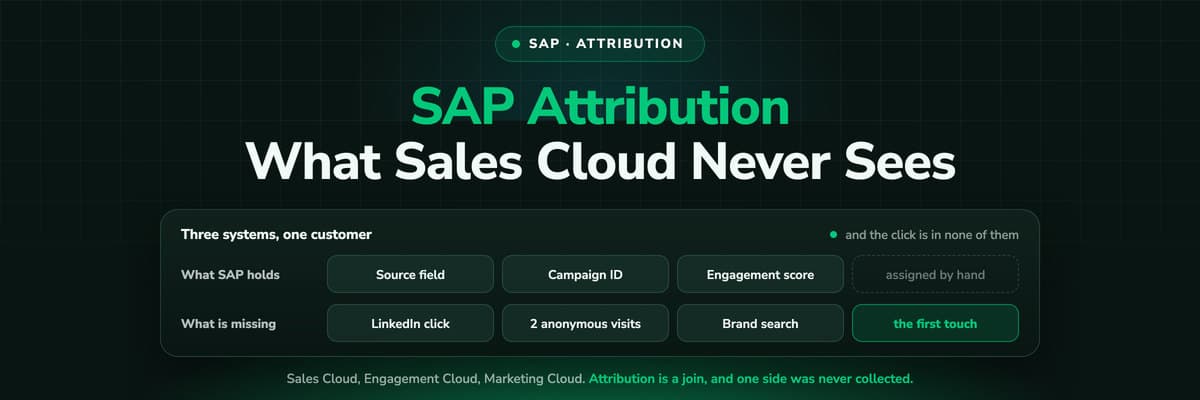
SAP Sales Cloud records where a lead came from in a Source field that a person sets, with values of the kind telephony inquiry, email campaign, trade fair and social media, and it assigns a campaign ID when the lead was created as part of a campaign. SAP Engagement Cloud measures the engagement it produced itself: opens, clicks, form submissions, which roll up into an engagement score. What no SAP system records is the anonymous web session before any of it, which is where the ad click, the organic search and the AI answer live. That is the piece the join is missing.
What follows is each system in turn, the migration that is happening right now underneath all of it, and the two honest ways to close the gap.
Which SAP Are You Actually Asking About?
Nine out of ten attribution conversations in an SAP organisation stall here, because two people are talking about two different products. The current names, as of September 2026:
SAP Sales Cloud
The CRM, previously SAP Cloud for Customer and still called C4C by everybody who has run it for years. Leads, accounts, opportunities, the sales process. Now on version 2, which is a rewrite rather than a release.
SAP Engagement Cloud
The marketing engagement platform. It was SAP Emarsys Customer Engagement until 19 February 2026. Journeys, email, personalisation, the engagement data that feeds lead scores.
SAP Marketing Cloud
A third product, and the one on the clock: support ends in December 2026, with Engagement Cloud named as the successor. More than 2,000 companies are in that migration now.
S/4HANA and SAP Analytics Cloud
Where the invoice and the reporting usually end up. Attribution questions often get pushed here, which is how a marketing question becomes a data warehouse project.
Why the names decide the answer
An attribution requirement written against SAP Marketing Cloud in 2025 is being rebuilt today, because that platform is going away and the migration is a replacement rather than a lift and shift. If you are scoping attribution now, scope it against Sales Cloud and Engagement Cloud, and assume anything built on Marketing Cloud's data model has a deadline on it.
What SAP Sales Cloud Records About a Lead's Origin
Two fields carry the whole answer, and both are filled in by a human or by a rule somebody wrote.
- Source, in the Lead Information sectionA single value denoting where the lead originated: telephony inquiry, email campaign, trade fair, social media and whatever else your administrator added. One value per lead, chosen at creation.
- The campaign IDAssigned to the lead when it was created as part of a campaign, for identification and reporting. Assigned, not observed: a lead that arrives any other way carries no campaign.
Now look at how leads actually get into Sales Cloud. SAP documents five ways: created manually from the quick create icon or the Sales Campaign work center, imported from Microsoft Excel, uploaded through the Cloud for Customer APIs, scanned from a business card on a mobile device, or copied from an existing lead. Not one of those five is a web session. Whatever the visitor did on your website before becoming a lead is, as far as Sales Cloud is concerned, something that happened to somebody else.
This is not a criticism of the product
SAP Sales Cloud is a sales execution system for organisations with territories, complex pricing and an ERP behind them, and it is very good at that. Recording anonymous web sessions was never its job. The mistake is expecting the field named Source to answer a marketing question it was never fed the data for.
What SAP Engagement Cloud Measures
Engagement Cloud is where the marketing interactions live, and it measures them properly: link clicks, email opens, form submissions and other interactions between your company and a contact, rolled up into an engagement score that can drive a lead qualification level. Cross an engagement score of seventy and marketing operations can have the lead marked hot and routed for follow up.
Read that list again and the shape is the same one every marketing automation platform has. Every interaction it counts is one it produced itself. An email it sent and somebody opened. A form it hosts and somebody submitted. A link in its own message. The LinkedIn ad that made the person search your brand three weeks before any of that is not an interaction Engagement Cloud can have a score for, because nothing told it the visit happened.
So the engagement score is a good measure of how warm a known contact is, and a poor measure of which channel bought them. Those are different questions and an enterprise reporting request usually conflates them.
The Piece Nothing in SAP Holds
Line the three systems up against a normal B2B journey and the hole is obvious. Somebody clicks a LinkedIn ad, reads two pages and leaves. Two weeks later they search your brand, read a case study and leave again. A week after that they fill in a form.
- Sales Cloud gets a lead with Source set to whatever the form mapping says, probably Web or Social Media, and a campaign ID if somebody wired one in.
- Engagement Cloud starts counting at the form submission, because that is its first interaction with a person it can name.
- Neither holds the LinkedIn click, the two anonymous visits, the brand search or the case study, so the channel that opened the journey is credited to nothing and the channel that happened to be last takes the whole record.
- And nothing goes back out. When the opportunity closes as won, no conversion travels to LinkedIn, Google, Meta or Microsoft, so the platforms keep optimising toward form fills rather than toward the deals your sales organisation actually signed.
For an enterprise the last point is usually the expensive one. Media budgets at this size are optimised by algorithms, and an algorithm optimises toward the signal it receives. Feed it form fills and it will find you more form fills, including from the segments that never buy.
Two Ways to Close It
Building it inside the SAP stack, or measuring the click side directly
| Approach | What it gives you | What it asks for |
|---|---|---|
| Build it in the SAP stack | Web behaviour into Engagement Cloud, interactions and lead data into SAP Analytics Cloud or a warehouse beside it, a model built on top | An integration project, a data model somebody owns, and a web data source that still has to identify the anonymous visit before any of it works |
| First-party tracking in front of the CRM | The channel, campaign, ad and click ID observed at the first visit, carried to the lead when it is created, ad spend joined to closed revenue, and conversions sent back to the platforms | A script on the website, a connection into Sales Cloud, and the discipline to report on the observed fields rather than on the Source picklist |
The first is the route most SAP organisations reach for, because it stays inside the estate and inside the existing vendor relationship. It is also the route that turns a marketing question into a two quarter data project, and it does not solve the underlying problem: the anonymous sessions still have to be recorded by something before any model can use them.
How LeadJourney Fits Beside SAP
Being direct about what exists today: LeadJourney has no native SAP Sales Cloud connector. HubSpot, Salesforce, Microsoft Dynamics 365, Pipedrive, Attio, Close and GoHighLevel connect natively; every other CRM, SAP included, connects through the webhook and the open API, or through Zapier and Make for the middle layer. That is a real integration and it is how several customers run, but it is a webhook, not a one click connector, and anybody scoping this for an enterprise landscape should know that before the architecture review, not after it.
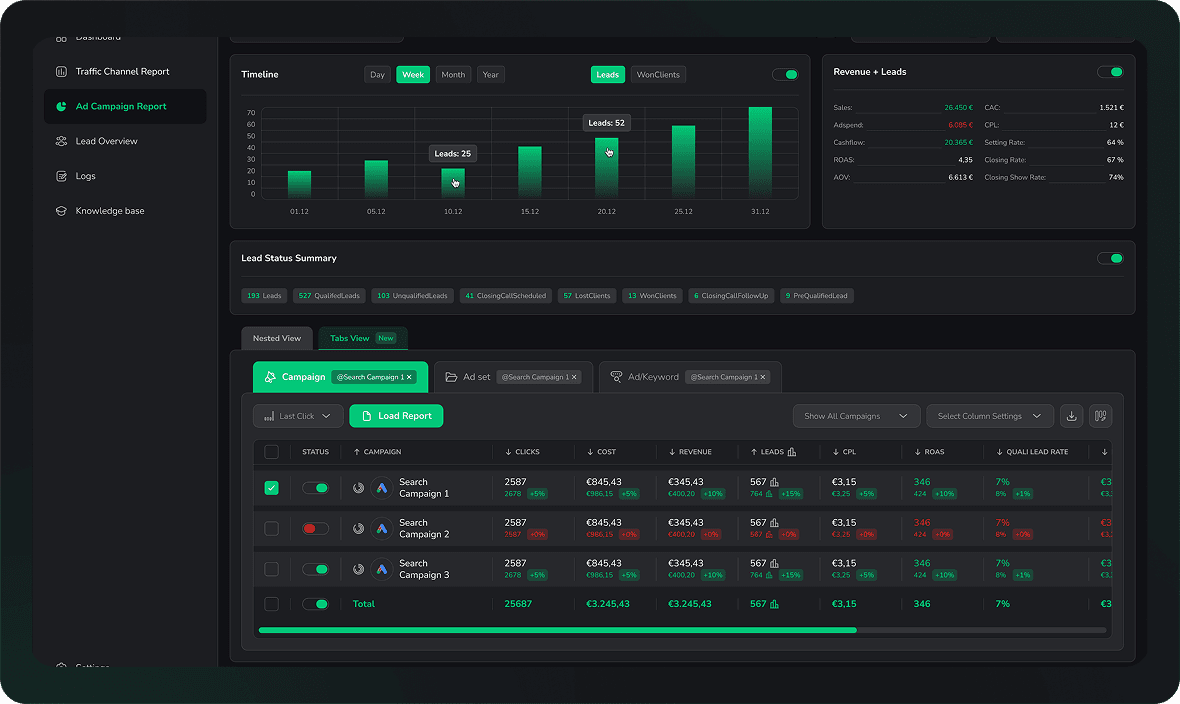
What LeadJourney brings to that connection is the half SAP does not collect. One script on your site, live in about 21 minutes, recording every visit server-side on your own domain at 95%+ accuracy. At the first click it captures the click ID from each platform, gclid with gbraid and wbraid, fbclid, li_fat_id and msclkid, plus the UTMs and the landing page, and it holds them first-party until the visitor identifies themselves. When the lead is created, that whole anonymous history is joined to it.
From there the loop closes in both directions: spend is pulled from Meta, Google, LinkedIn and Microsoft Ads and joined to the opportunities themselves, so cost per closed opportunity is measured rather than modelled, and when the opportunity closes the amount goes back to the platform that produced the first click, matched on that click ID. Every attribution model, first click, last click, linear, time decay and position based, runs on the same tracked events.
Two limits worth naming for an enterprise reader. Tracking is first-party and respects consent decisions rather than working around them, so a visitor who declines is not measured. And we hold no SOC 2 Type 2 report today, which for some procurement processes is the end of the conversation; the data is processed and stored in the EU under a data processing agreement, and that is what we can put in writing.
Further Reading
Keep going with what SAP campaign management actually tracks, and the same analysis for the CRMs that connect natively: Microsoft Dynamics 365, Salesforce and HubSpot. For the wider picture, B2B marketing attribution and the multi-touch attribution models behind it.
In the glossary
FAQ
Frequently Asked Questions
What enterprise marketing and sales operations teams ask about attribution in SAP.
Does SAP Sales Cloud do marketing attribution?
It records an origin rather than attributing one. A lead carries a Source field, a single value of the kind telephony inquiry, email campaign, trade fair or social media, and a campaign ID when the lead was created as part of a campaign. Both are set by a person or a rule. Sales Cloud records no web sessions, connects to no ad account and distributes credit across no touchpoints, so the question of which campaign produced the revenue has to be answered somewhere else.
What is the difference between SAP Sales Cloud, SAP Engagement Cloud and SAP Marketing Cloud?
Sales Cloud is the CRM, previously SAP Cloud for Customer and still widely called C4C, now on version 2. Engagement Cloud is the marketing engagement platform, renamed from SAP Emarsys Customer Engagement on 19 February 2026. SAP Marketing Cloud is a separate, older product whose support ends in December 2026, with Engagement Cloud named as its successor. If somebody in your organisation says SAP Marketing, ask which of the three they mean before agreeing to anything.
What happens to SAP Marketing Cloud in December 2026?
Support ends. SAP has named SAP Engagement Cloud as the successor for marketing automation in the customer experience portfolio, and because the two platforms have different data models it is a replacement rather than a migration: there is no out of the box tool that moves you across. More than 2,000 companies run Marketing Cloud, so if your attribution reporting is built on its data model, it has the same deadline the platform does.
Can SAP send a closed opportunity back to Google or LinkedIn as a conversion?
Not natively. There is no connection from Sales Cloud to an ad account, so the won opportunity stays inside SAP and the ad platforms never learn which clicks produced revenue. Doing it by hand means capturing each platform's click ID on your landing page, storing it on the lead, and uploading conversions inside each platform's own window, which for Microsoft Advertising is documented as the last 90 days. A B2B sales cycle is routinely longer than that window.
Does LeadJourney integrate with SAP?
Not natively today. HubSpot, Salesforce, Microsoft Dynamics 365, Pipedrive, Attio, Close and GoHighLevel have native connectors; SAP connects through the webhook and the open API, or through an integration layer such as Zapier or Make. The tracking side, which is the part SAP does not collect, works the same either way: the script records every session first-party and holds the click IDs until the lead exists. If a native SAP connector would decide a project for you, tell us on the call, because that is how the native list has grown so far.
We already have SAP Analytics Cloud. Why would we need anything else?
Because a reporting layer can only model the data it is given, and the anonymous sessions before a lead exists are not in any SAP system to be given. SAP Analytics Cloud is the right place to bring the model together once those touchpoints are being recorded somewhere; it is not a substitute for recording them. Teams that skip that step end up building a well engineered report on the last touch, which is the number that flatters brand search and buries the channel that started the journey.
Keep reading
More from the blog
 B2B Marketing Attribution
Dynamics 365 Customer Insights Attribution: What It Actually Measures
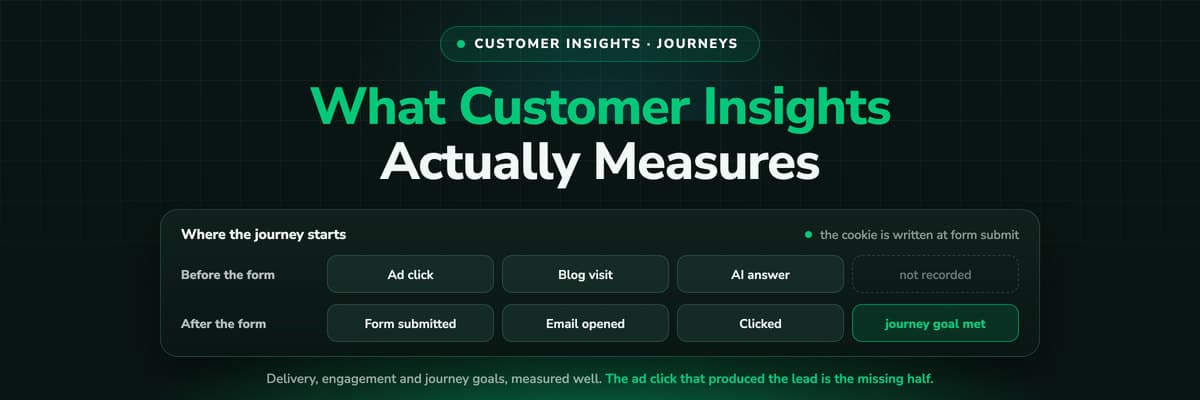
Customer Insights - Journeys measures delivery, engagement and journey goals: opens, clicks, form submissions and where people fell out of a journey. What it does not measure is the ad click that produced the lead. The rename explained, the analytics listed, and the gap named.Read the article13 min read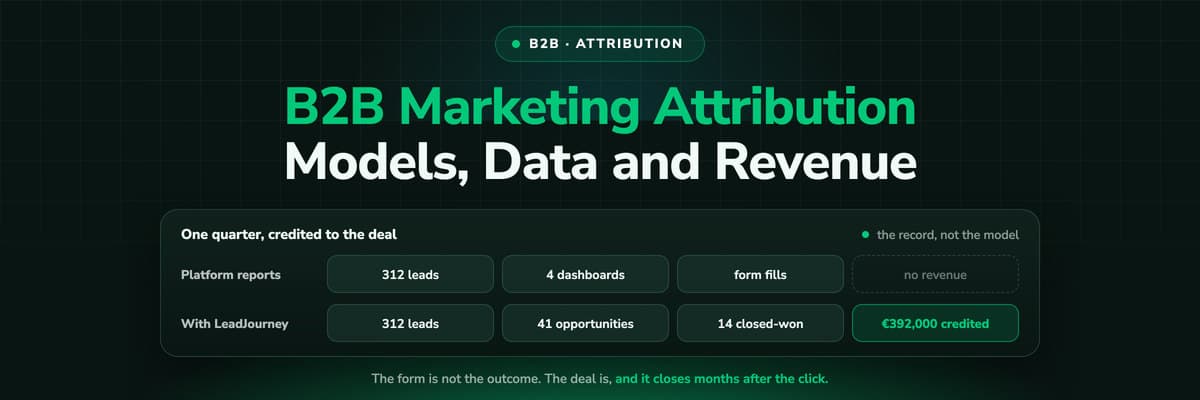 B2B Marketing Attribution
B2B Marketing Attribution: Models, Data and Revenue (2026)
A B2B deal closes months after the click, is bought by a committee and is recorded in the CRM rather than in any ad platform. This guide covers the whole discipline: what B2B marketing, revenue and sales attribution each credit, lead-level against account-level architecture, pipeline stages as conversions, what your CRM does on its own, build or buy, and a seven step implementation.Read the article22 min read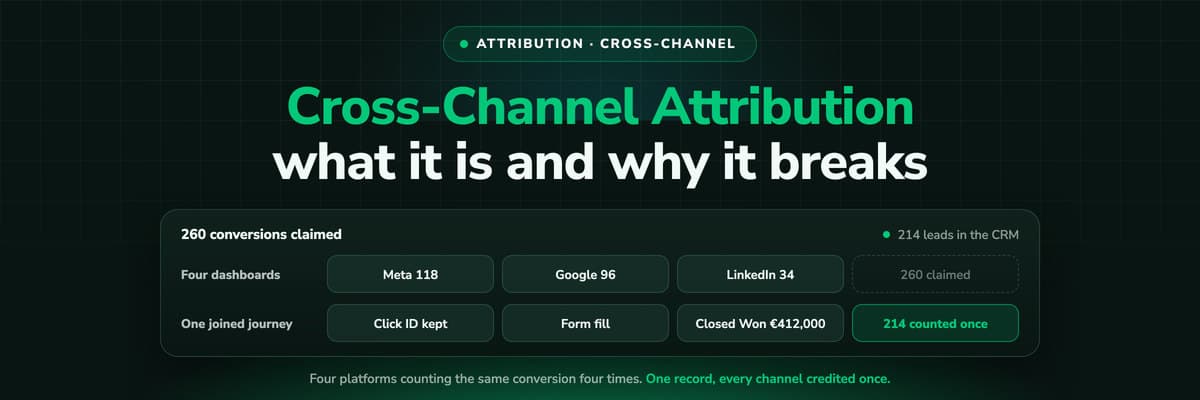 B2B Marketing Attribution
Cross-Channel Attribution: What It Is and Why It Breaks
Meta claims 118 conversions, Google claims 96, LinkedIn 34 and Microsoft 12. The CRM has 214 leads. Cross-channel attribution is the work of turning four honest, incompatible answers into one, and this guide covers the four methods that try it, what each of them can and cannot see, and the setup that decides whether any of them holds.Read the article14 min read
The half SAP does not collect
Ready to see which campaigns produced your SAP pipeline?
LeadJourney records every visit server-side before a lead exists, joins the first click to the record when it is created, and sends the won opportunity back to Meta, Google, LinkedIn and Microsoft. Live in 21 minutes, 14-day free trial.