














BlogHow To Guides
Pipedrive Website Tracking: The Web Visitors Add-on and Beyond
Pipedrive's Web Visitors add-on tells you which companies visited your site. It does not tell you which person, which ad or which campaign. What it records, what Outfunnel added before Pipedrive bought it, and how to get the visits onto the deal.


Contents
Summarise this article with AI
Opens the page with a ready prompt in:


Nothing is sent until you pick a service.
Ask what Pipedrive knows about your website and the answer depends on which add-on and which app the account runs. Out of the box, it knows when a web form or a chatbot created a record. Add Web Visitors and it knows which companies have been on the site. Add an app like Outfunnel and it knows which known contacts came back and what they read.
Those are three different questions, and buyers of one often think they have bought another. This is what each of them records, where the line between a company and a person sits, what Pipedrive's acquisition of Outfunnel does and does not tell you yet, and what it takes to put the whole website journey, ads included, onto the deal.
Quick Summary: Website Tracking in Pipedrive
In short
Pipedrive's own website tracking is the Web Visitors add-on, powered by Leadfeeder: a script that identifies which companies visit your site, filterable by country, Google Ads campaign and pages, and paid on every plan. It does not identify people, and it writes no campaign or click ID onto a person or a deal. Person level visit tracking has come from marketplace apps, most of all Outfunnel, which logs a known contact's visits as activities. Pipedrive bought Outfunnel in August 2026 and plans to rebuild its core capabilities natively, without saying which. Neither route measures the anonymous ad clicks before a form fill, joins them to the deal, or sends the won deal back to the ad platforms.
What the Pipedrive Web Visitors Add-on Does
Web Visitors is genuinely useful for the job it was built for, which is account based prospecting: a list of companies showing interest, before any of them fills in a form.
Companies, not people
A tracking script on your site reports which organisations visited. Pipedrive says plainly that it is powered by Leadfeeder. Contact persons at those companies come from Prospector credits, not from the visit.
Filters worth having
Visitors can be filtered by country, by Google AdWords campaign and by pages visited, so a sales rep can see which accounts read the pricing page this week.
One click to a record
A visiting company can be turned into a lead, a deal or an organization. Its Source origin then reads Web visitors, which keeps those records apart from form leads in reports.
Priced by companies identified
The feature page lists €49 a month for up to 200 identified organizations, €99 for 201 to 500 and €299 for 501 to 2,000, with a 14-day trial. It is a paid add-on on every plan, not included in any.
It is not the Dealfront platform
Dealfront's own help centre is clear that Pipedrive's Leadfeeder feature does not give access to the Dealfront platform: no Lists, no custom feed automations, no other Dealfront products. If those are what you were sold on, you need a Dealfront account as well.
Company Identification Is Not Visit Tracking
The phrase website tracking covers two jobs that share a script tag and very little else.
- Who is looking: company identificationMatches a visit to an organisation from its network. Good for outbound and for spotting buying signals at accounts you already know. It cannot tell you which of the twelve people at that company read the page, and it says nothing about a visitor on a home connection.
- What this person did: visit trackingFollows one browser from visit to visit and joins its history to a contact once they identify themselves. This is what attribution needs, because the campaign that paid for the first click belongs to a person, and the deal belongs to that person too.
Web Visitors does the first. We could not find a Pipedrive feature of its own that does the second, which is why the marketplace filled the gap.
Outfunnel's Visitor Tracking, and Pipedrive Buying It
Outfunnel has been the best known answer to person level tracking for Pipedrive. Its script sets an anonymous cookie ID, identifies the visitor when they fill in a form or click a link in one of your emails, and writes their visits into the CRM as Activities or Tasks with the lead source, country, pages and session length. Its lead scoring adds web visits, email events, Pipedrive activities and custom fields together, and Outfunnel says it works on any Pipedrive plan, where Pipedrive's own Scores is Premium and higher and scores deals only.
On 5 August 2026 Pipedrive announced that it had acquired Outfunnel. The announcement says Outfunnel will keep operating during a transition period with no disruption to existing customers, and that Pipedrive plans to rebuild the platform's core capabilities natively over the coming months. It does not say which capabilities. Web tracking, lead scoring and engagement sync are all candidates, and none is named.
What to do if you run Outfunnel today
Nothing urgent: the service is running and existing customers were promised no disruption. Keep an eye on Pipedrive's product updates for what arrives natively, and before you build reports on Outfunnel's activity data, note which fields they depend on, so a move to a native equivalent is a mapping exercise rather than a rebuild.
Other Ways Teams Track Website Visits Into Pipedrive
GA Connector
Its Google Analytics Connector app runs its own script and writes UTMs, first and last click, the GA4 client and session IDs and gclid into Pipedrive fields at the moment a lead is created. Source fields rather than a visit history.
Your own script and the API
Capture parameters and pages yourself, then write them through a form connector or the Pipedrive API into custom fields. Full control, and somebody has to keep it working. Our guide to Pipedrive UTM parameters walks through it.
Google Analytics beside the CRM
GA4 knows the sessions and Pipedrive knows the deals, and nothing native joins them. See Pipedrive and Google Analytics for what the join takes.
What Website Tracking in Pipedrive Still Misses
- The ad click that started it. Company identification records that a company came, and visit tracking records what a known contact read. Neither puts the campaign, the ad and the click ID of the very first visit onto the person and the deal.
- The visits before identification are thin. A cookie based script can only join visits that happened in the same browser, while the cookie lasted, and before anything blocked it. A buyer who researched on their phone and converted on a laptop shows up with half a history.
- Activities are not attribution. A list of page views on a contact is useful to a salesperson and hard to report on: there is no credit per channel, no revenue by campaign, and no way to compare first click with last click.
- No ad spend. Pipedrive Insights has no cost data, so even a perfect visit history cannot produce a cost per deal or a return on ad spend inside Pipedrive.
- Nothing goes back to the ad platforms. Meta and Google keep optimising on whatever conversion their pixel saw, usually the form fill, because no part of this setup tells them which leads turned into revenue.
Choosing a Setup: Five Questions to Answer First
- Is the goal prospecting or attribution? Prospecting wants companies; attribution wants people and campaigns. Many teams need both, and they are different purchases.
- Do you need the first touch or only recent activity? A salesperson calling tomorrow wants the last three visits. A budget owner wants the click that started the journey months ago.
- Where must the data live in Pipedrive? Activities on a contact are read by people; fields on the deal are read by reports. Decide which you need before choosing a tool.
- What happens to ad clicks? Check whether the setup records gclid, fbclid and the other click IDs, and whether a won deal is ever sent back.
- How is consent handled? Every option here places a script. Know what each one does when a visitor declines, and say it in your privacy policy.
How LeadJourney Tracks the Website Journey Into Pipedrive
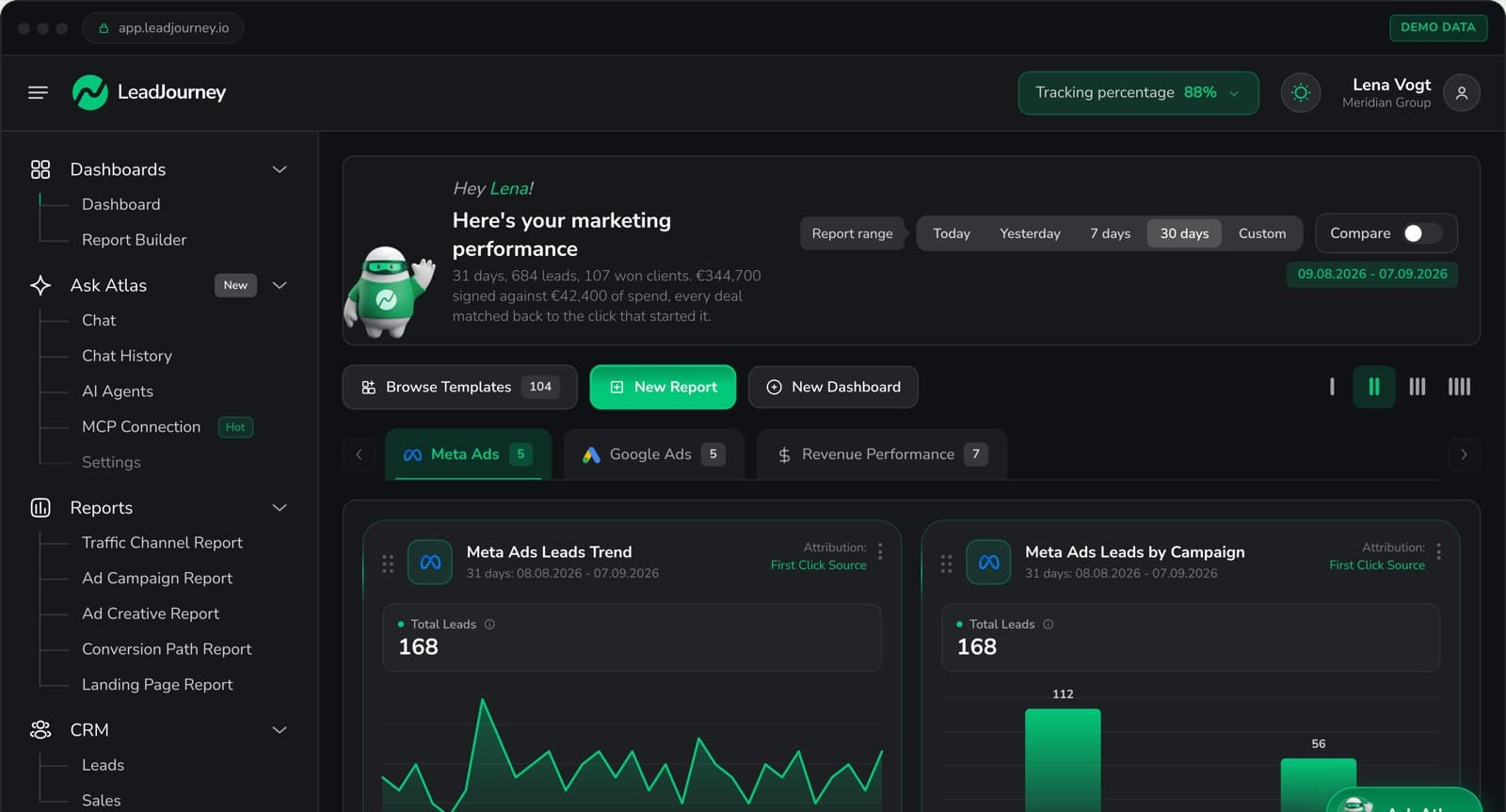
LeadJourney is person level visit tracking built for attribution rather than for prospecting. One script on your site or in your GTM container records every visit server-side on your own domain, first-party, at 95%+ accuracy, and captures the click ID at the click: gclid with gbraid and wbraid, fbclid, li_fat_id and msclkid. The anonymous history is joined to the person at the form fill, the call or the booking, and there is no attribution window on the journey, so the ad clicked in spring is still attached when the deal closes in autumn.
The Pipedrive integration is native: a one click sign in and a field mapping screen, live in about 21 minutes with no developer. It writes the source, campaign, ad, click ID, UTMs, landing page and a link to the full journey onto the Person, and the attributed channel, campaign and credit onto the Deal, in dedicated LeadJourney custom fields that leave your existing source fields untouched. It reads stage changes and won deals as they happen.
Spend is pulled from the ad platforms and joined to the deals, so cost per deal and return on ad spend are real numbers. Won deals go back with their value: to Meta through the Conversions API, to Google Ads as an offline conversion import on gclid, to LinkedIn through its Conversions API and to Microsoft Ads on msclkid. Five attribution models run on the same events.
The limits: tracking respects consent, so a visitor who declines is not measured, and a lead who never touched your website still needs a source typed in by a person. It does not name anonymous companies, so if account identification is the job, Web Visitors and LeadJourney sit side by side.
Further Reading
The cluster starts at Pipedrive lead source tracking. For the parts that feed it, Pipedrive UTM parameters, Pipedrive and Google Ads and building a Pipedrive reporting dashboard. On the method, customer journey tracking, server-side tracking and the first-party data glossary entry. Comparing tools: the attribution tools that work with Pipedrive.
In the glossary
FAQ
Frequently Asked Questions
What Pipedrive users ask before they put a tracking script on their site.
Does Pipedrive have website tracking?
Yes, as the Web Visitors add-on. It places a tracking script on your site and reports which companies visited, powered by Leadfeeder, with filters for country, Google Ads campaign and pages viewed. It is paid on every plan and identifies organisations, not individual people. Tracking what a known contact did on your site has come from marketplace apps, most of all Outfunnel, which Pipedrive acquired in August 2026. We could not find a native person level visit tracker in Pipedrive itself.
How much does the Pipedrive Web Visitors add-on cost?
Pipedrive's feature page lists three tiers by the number of organizations identified per month: up to 200 for €49 a month, 201 to 500 for €99 and 501 to 2,000 for €299, with a 14-day trial. It is an add-on on every plan rather than part of any. Prices change and vary by billing period and currency, so check the feature page for your account before you budget.
Can Pipedrive Web Visitors identify individual people?
No. It identifies companies from their visits. To reach people at a visiting company, Pipedrive points you to Prospector credits, which find contacts at the organisation rather than the person who actually visited. If you need to know what a specific contact read, or which ad brought them, you need person level tracking that joins a browser's visits to a contact when they fill in a form or click an email link.
What happens to Outfunnel now that Pipedrive owns it?
Pipedrive announced the acquisition on 5 August 2026 and said Outfunnel will keep operating during a transition period with no disruption to existing customers, while Pipedrive rebuilds the platform's core capabilities natively over the coming months. It has not said which capabilities, so nobody outside Pipedrive can tell you yet whether web tracking or lead scoring will arrive in Pipedrive itself, or when. Existing setups keep running in the meantime.
Is Pipedrive Web Visitors the same as Leadfeeder or Dealfront?
It is powered by Leadfeeder, but it is not the Dealfront platform. Dealfront's help centre says the Pipedrive feature gives no access to Lists, custom feed automations or other Dealfront products. You can connect a separate Dealfront account to Pipedrive if you need those, which is a second subscription rather than an upgrade of the add-on.
Can I see which ad a Pipedrive deal came from?
Not natively. Web Visitors can filter companies by Google Ads campaign, but it writes no campaign or click ID onto a person or a deal, and Pipedrive has no UTM fields. You need a script that captures the campaign and click ID at the first visit, joins it to the person when they convert, and writes it into custom fields on the deal. Sending the won deal back to the ad platform is a further step on top.
Keep reading
More from the blog
 How To Guides
Incrementality Testing for Lead Gen: Run a Test on CRM Revenue
A lift test is only as good as the outcome it reads, and for lead generation the platforms read form fills. This guide compares the methods, lists what Google and Meta require for a lift study, and walks through a geo holdout read on qualified leads and deals from your CRM, with a worked example that adds up.Read the article19 min read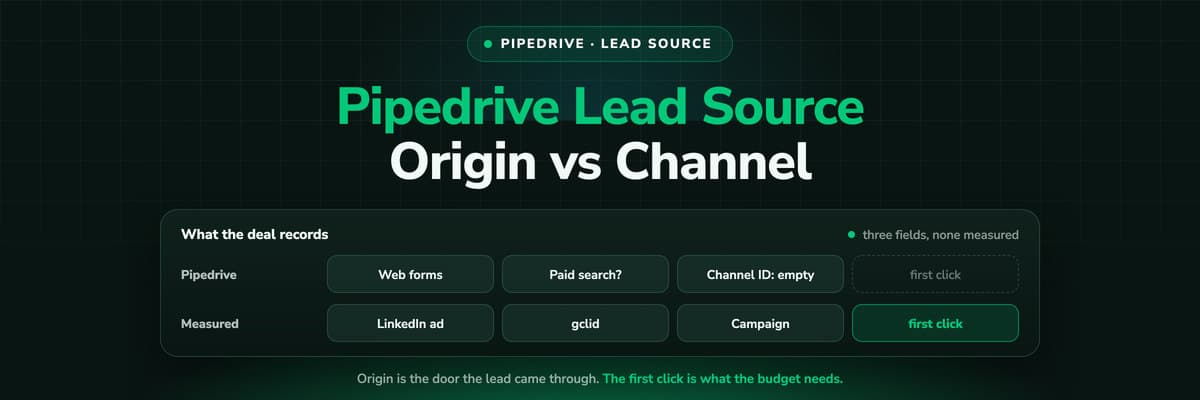 How To Guides
Pipedrive Lead Source Tracking: Source Origin vs Source Channel
Pipedrive gives every lead and deal three source fields: an origin the system sets, a channel a person picks and a free text ID. What each one records, the five ways the report still goes wrong, and how to put a measured first touch on the deal.Read the article11 min read How To Guides
Pipedrive UTM Parameters: Hidden Fields, Web Forms and Deals
Pipedrive has no UTM field and its Web Forms documentation says nothing about hidden fields. How teams get utm_source and the click ID onto the Lead and the Deal anyway, the naming that keeps it reportable, and why first touch needs its own fields.Read the article11 min read
Website to won deal
Ready to see the website journey behind every Pipedrive deal?
LeadJourney records every visit from the first ad click, server-side on your own domain, joins it to the person and the deal, and sends won revenue back to Meta, Google, LinkedIn and Microsoft. Live in 21 minutes, 14-day free trial.