













BlogTool Comparisons
AgencyAnalytics vs Whatagraph (2026): Price, Reports, Fit
AgencyAnalytics charges per client, Whatagraph per connected account on an annual contract. Both build white-label client reports. Here is where each one is ahead, what three real rosters cost on both, and what neither report can tell a client.

Contents
Summarise this article with AI
Opens the page with a ready prompt in:


Nothing is sent until you pick a service.
AgencyAnalytics and Whatagraph turn up on the same agency shortlist for the same reason: both connect a client's ad, SEO, social and analytics accounts and turn them into a branded report the client opens without asking. They differ in what they charge for, how deep the data work goes, and how you start. One sells a flat rate per client you can trial in an afternoon, the other an annual plan priced by the accounts you connect.
This comparison is for the agency owner or head of reporting choosing between the two. Every price and feature below was read on agencyanalytics.com and whatagraph.com on 25 October 2026, and where a page does not say something, the post says so rather than guessing.
AgencyAnalytics vs Whatagraph in Short
In short
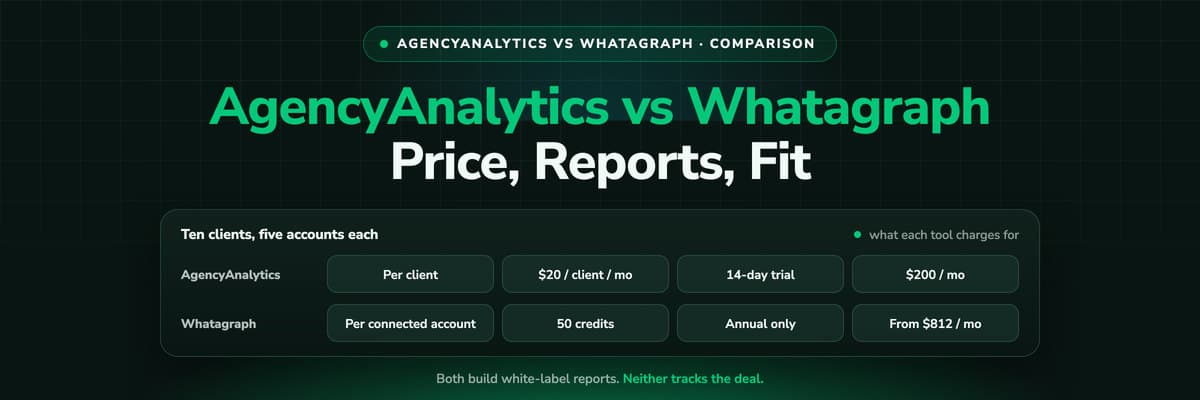
AgencyAnalytics fits the agency that wants every feature at a flat $20 per client a month (billed annually, $25 monthly), a 14-day trial without a card and the widest SEO, local and call tracking coverage. Whatagraph fits the agency with fewer, larger clients and a lot of data work: blends, transformations and a governed data layer, on an annual Max plan from €699 ($812) a month with 50 source credits. Both build white-label reports well. Neither publishes an attribution model, a lead-level journey or a way to send closed deals back to the ad platforms.
AgencyAnalytics vs Whatagraph at a glance, as both sites showed them on 25 October 2026
| AgencyAnalytics | Whatagraph | |
|---|---|---|
| Built for | Agencies reporting to many clients; 7,000+ agencies by its count | Agencies and multi-location brands with high-volume reporting; 1,000+ by its count |
| Priced by | Client (one business relationship) | Source credit (one connected account) |
| Entry price | $20 per client / mo billed annually, $25 monthly | Max from €699 ($812) / mo, billed annually, 50 credits |
| Integrations | 93 listed under "85+": 26 PPC, 13 SEO, 13 social, 11 local, 10 call tracking | 68 native: 29 paid advertising, 8 SEO, 7 social, plus Sheets, BigQuery, custom API |
| CRM sources | HubSpot, Salesforce, HighLevel, Keap | HubSpot, Salesforce, GoHighLevel |
| White-label reports | Yes, plus client portal, custom domain and email | Yes; custom report domain as a Prime add-on |
| Data blending | Custom metrics, roll-ups across clients | Blends, source groups, custom transformations, storage |
| AI and MCP | AI summary, Ask AI, AgencyAI insights, MCP for ChatGPT and Claude | Whatagraph IQ, IQ Agents, Whatagraph MCP; IQ+ on Prime |
| Attribution of leads to revenue | Not published | Not published |
| Trial and refund | 14-day trial, no card; 30-day money-back guarantee | Demo on the page; offer markup lists a 14-day Max trial, no card |
| Contract | Monthly, or annual with a 1-year commitment | Annual only on both plans |
| Data location | Not published on the pricing page | EU Data Center on both plans |
Who Each Tool Is Built For
The two pricing models describe two different agencies. AgencyAnalytics charges for each client, which its pricing FAQ defines as one business relationship you manage, and connects as many of its integrations to that client as you like. The bill is the roster times the rate, so a twenty-client SEO shop and a twenty-client paid media shop pay the same.
Whatagraph charges for each connected data account. One Facebook Ads account is one credit, one GA4 property is another, and blends, new reports and copies use none. Max starts at 50 credits, and extra credits can be bought until the next plan threshold, at which point the page says it is time to upgrade. A client with nine accounts costs nine times what a client with one does.
- Many small clients, a few accounts each: per-client pricing stays predictable and the credit count climbs fast. AgencyAnalytics.
- Fewer, larger clients with heavy data work: a flat platform fee with 50 credits and a success manager is easier to justify. Whatagraph.
- Freelancer or a five-client agency: $100 a month on AgencyAnalytics against an annual plan from €699 a month on Whatagraph is not close.
Who wins it: AgencyAnalytics for small and mid-sized rosters, Whatagraph only once the clients are big enough that the data work, not the client count, is the cost.
Integrations and Data Sources
Both catalogues cover the accounts an agency reports on most: Google Ads, Meta, LinkedIn, Microsoft, TikTok, GA4, Search Console, Shopify. The differences are in the long tail.
Integration catalogues by category, read on both integrations pages on 25 October 2026
| Category | AgencyAnalytics | Whatagraph |
|---|---|---|
| Paid advertising | 26 | 29 |
| SEO | 13, plus its own Rank Tracker add-on | 8 |
| Social | 13 | 7 |
| Local and reviews | 11 (Google Business Profile, Yelp, BrightLocal, Birdeye...) | Not a separate category |
| Call tracking | 10 (CallRail, CallTrackingMetrics, WhatConverts...) | Listed: CallRail, CallTrackingMetrics, WhatConverts |
| 14 | 6 | |
| Analytics | 11 | 7 |
| E-commerce | 5 | 5 |
| Databases and warehouses | 5 (BigQuery, Snowflake, MySQL, Redshift...), an optional add-on | Google Sheets, BigQuery, Snowflake and a custom API as sources |
AgencyAnalytics is ahead for SEO, local and call tracking agencies, the three categories where it lists the most and where Whatagraph is thinnest. Whatagraph is ahead on paid advertising by a few platforms, and its premium integrations on Prime (Display & Video 360 and Adobe Analytics among them, per its plan overview) reach enterprise ad stacks. Both list HubSpot and Salesforce, so CRM figures can sit in the report next to the ad figures.
Who wins it: AgencyAnalytics on breadth for SEO, local and call tracking work; Whatagraph for paid media agencies on enterprise platforms.
Reports, Dashboards and White Label
This is what both tools are for, and both do it well. The differences are in the workflow around the report.
- AgencyAnalytics includes report scheduling and approvals, version history, roll-up reports and dashboards across clients, agency markup, bulk operations, a white-labeled client portal, a custom domain and email, and unlimited staff and client users, all on the one plan.
- Whatagraph includes linked report templates (change one, update every report built from it), pre-made themes, version history, automated emails with a PDF, custom branding and unlimited users and reports. A custom report domain is a Prime add-on.
For an agency that sends forty near-identical monthly reports, linked templates and roll-ups are the features that save the most hours, and each tool has one of them. For an agency whose clients log in rather than read a PDF, the AgencyAnalytics client portal on its own domain is the more finished product.
Who wins it: AgencyAnalytics for the client-facing portal and approval workflow; Whatagraph for report templates that stay in sync across a large roster.
Data Blending and Cross-Channel Analysis
Whatagraph positions itself as a governed data layer more than a report builder. Both plans carry pre-made and custom transformations, custom metrics and dimensions, source tags, currency exchange, custom aggregations, source groups and blended sources, and Whatagraph Storage, which loads widgets from pre-synced data instead of querying each API live.
AgencyAnalytics covers the everyday version of the same need: custom metrics, roll-up tables across clients, a Google Sheets integration for anything the catalogue lacks, and database connectors (MySQL, BigQuery, Redshift and others) as a paid add-on or on volume pricing. It has no published equivalent of Whatagraph's blends and transformation layer.
Who wins it: Whatagraph, clearly, for an agency that merges five ad platforms into one cross-channel view per client and wants the numbers normalised before anyone looks at them.
AI Features and MCP
Both vendors moved quickly on AI in 2026, and both now let an agency query its client data from ChatGPT or Claude.
- AgencyAnalytics: an AI summary that writes the report commentary, Ask AI and metric insights on the dashboard data, AgencyAI analysis, a Client Knowledge feature that gives the AI context per client, and MCP access for ChatGPT and Claude, all on the one plan. The AI Tracker add-on monitors brand visibility, sentiment and citations in AI search engines from $20.83 a month per 250 credits.
- Whatagraph: Whatagraph IQ (report creation, chat, summaries) and IQ Agents, which the page describes as agents that set up sources, build blends and ship reports, on both plans; IQ+ with custom prompts on Prime; and Whatagraph MCP for Claude, ChatGPT and other MCP clients.
Who wins it: a draw on access, with AgencyAnalytics ahead on price (everything included) and Whatagraph ahead on agents that do setup work rather than only commentary.
Data Location, Exports and Security
- Data location: Whatagraph lists an EU Data Center on both plans. AgencyAnalytics does not publish a hosting region on its pricing page.
- Single sign-on: Whatagraph has Google login on Max and SAML as a Prime add-on. AgencyAnalytics lists custom permissions; SSO is not on its pricing page.
- API and exports: AgencyAnalytics includes API access on the one plan. Whatagraph sells its public API and the BigQuery transfer as Prime add-ons, with Looker Studio transfer included on Prime.
Who wins it: Whatagraph for an EU agency whose clients ask where the data sits; AgencyAnalytics for an agency that wants API access without an enterprise contract.
Setup, Trial and Contract
AgencyAnalytics is self-serve: start a 14-day trial without a card, connect a client, build from templates, and book the free onboarding call if you want one. Monthly plans cancel any time, annual plans commit for a year at 20% off, and a 30-day money-back guarantee covers the first purchase.
Whatagraph's pricing page offers one button, Get a demo, on both plans. The same page's offer markup lists a 14-day trial with full Max access and no card, so ask for it on the demo. Both plans are billed annually, every Max and Prime customer gets a dedicated success manager, and Prime adds tailored onboarding. Whatagraph's help centre has said renewals are automatic, need notice at least 30 days before the renewal date, and that payments are non-refundable.
Who wins it: AgencyAnalytics, for the agency that wants to try before it talks to sales and keep the option of paying monthly.
AgencyAnalytics vs Whatagraph Pricing
AgencyAnalytics pricing, US dollars, read on 25 October 2026; also billed in CAD, AUD, NZD, GBP and EUR
| Plan or add-on | Billing basis | Billed annually | Billed monthly |
|---|---|---|---|
| Core (every feature) | Per client | $20 / mo | $25 / mo |
| Volume pricing, 25+ clients | Per client, discounted | Quote | Quote |
| AI Tracker (beta) | Per 250 credits | $20.83 / mo | Not printed |
| Rank Tracker | Per 500 keywords | $41.67 / mo | Not printed |
| Database connectors | Add-on | Quote | Quote |
Whatagraph pricing, read on 25 October 2026; priced in euros, US dollars from the page's currency data
| Plan | Billing basis | Price | Billing |
|---|---|---|---|
| Max | From 50 source credits | From €699 ($812) / mo | Annual only |
| Max, more credits | Per credit, up to the next threshold | Not published | Annual only |
| Prime | 100+ credits, premium integrations | Custom quote | Annual only |
| Prime add-ons | Custom domain, BigQuery, public API, SAML | Quote | Annual only |
Three rosters, priced on both
The table assumes five connected accounts per client (say Google Ads, Meta, GA4, Search Console and one more), which sets the Whatagraph credit count. The LeadJourney column, explained further down, assumes $5,000 of managed ad spend and 50 leads and sales per client a month.
Monthly cost by roster size, US dollars, annual billing (monthly billing in brackets where offered)
| Roster | AgencyAnalytics | Whatagraph | LeadJourney |
|---|---|---|---|
| 5 clients, 25 accounts | $100 ($125) | From $812 (Max, 50 credits) | $343 ($429), Starter |
| 10 clients, 50 accounts | $200 ($250) | From $812 (Max, 50 credits) | $418 ($524), Starter + 5 workspaces |
| 25 clients, 125 accounts | $500 ($625) at list, volume quote available | Past the Max threshold: Prime quote | $1,088 ($1,364), Growth + 15 workspaces |
For reporting alone, AgencyAnalytics is the cheapest of the three at every size here, by a wide margin at five and ten clients. Whatagraph's fixed entry price only makes sense once the data work is worth it, and past roughly 50 connected accounts it becomes a conversation with sales. LeadJourney costs more than AgencyAnalytics at every size and is a different purchase, covered below.
Which One Should You Choose?
AgencyAnalytics
Pros
- Flat $20 per client billed annually, every feature included
- 14-day trial without a card, monthly billing available
- Deepest SEO, local and call tracking coverage
- Client portal on your domain, approvals and roll-ups
- MCP access and API on the one plan
Cons
- No blends or transformation layer like Whatagraph's
- Database connectors cost extra
- Hosting region not published on the pricing page
Whatagraph
Pros
- Blends, source groups, transformations and storage on every plan
- Linked templates keep a large roster's reports in sync
- EU Data Center, dedicated success manager on Max
- IQ Agents that do setup and report work
Cons
- Annual contract only, from €699 ($812) a month
- Price climbs with every connected account
- Public API, BigQuery transfer and SAML only as Prime add-ons
- The pricing page leads with a demo, not a trial
Verdict
Pick AgencyAnalytics if you have many clients and want every feature at a predictable per-client rate; pick Whatagraph if you have fewer, larger clients and the cross-channel data work is the real job.
When Neither Fits: LeadJourney
Both tools present numbers that other platforms produced. When a client asks what the budget returned in closed deals, the report can only repeat what Meta, Google and the CRM each say on their own, with each platform's attribution and no line from the click to the deal. Neither pricing page publishes an attribution model, a lead-level journey or a way to send a closed deal back to the ad platforms.
That gap is what LeadJourney is built for. It is an all-in-one attribution platform, lead generation first (B2B and B2C) with e-commerce through Shopify beside it, and for agencies it runs one workspace per client:
- Tracks the lead itself, server-side and first-party on the client's domain, live in 21 minutes with 95%+ tracking accuracy.
- Joins it to the CRM deal: native with HubSpot, Salesforce, Pipedrive, Close, Attio, GoHighLevel, ActiveCampaign, Odoo, Zoho CRM and Microsoft Dynamics 365, so the report shows cost per closed deal and revenue per campaign.
- Sends the result back to Meta, Google, LinkedIn, Microsoft, Reddit, X, Taboola and Outbrain Ads server-side, so the platforms optimise on deals rather than form fills.
- Reports per client: channel, campaign, landing page and conversion path reports, a cross-client overview, scheduled client email reports on every plan, unlimited client logins, a custom report builder from Growth, and Atlas AI chat on every plan.
- Prices by managed spend and tracked leads: Starter $429 a month with five client workspaces, Growth $1,079 with ten, Scale $2,159 with twenty, Enterprise from $3,239 with forty, $19 per further workspace, 20% off yearly. MCP is included from Growth and a $105 add-on on Starter; API access and the BigQuery export come with Scale.
- Starts with help: every plan begins with a one hour onboarding call with a tracking expert and 14 days of setup support, and a 30-day money-back guarantee. Hosted in Frankfurt.
Where LeadJourney is not the right pick: an SEO or social agency whose clients measure rankings and followers needs a reporting tool, not attribution, and AgencyAnalytics or Whatagraph is the better and cheaper buy. LeadJourney also does not change budgets or bids in the ad platforms, and many agencies keep their reporting tool for the dashboard and put LeadJourney under the accounts where the client asks about revenue. The row-by-row detail is on LeadJourney vs AgencyAnalytics and LeadJourney vs Whatagraph.
Further Reading
- AgencyAnalytics pricing: what $20 a client costs across a roster, and the tiers it replaced.
- Whatagraph pricing: plans, credits, contract terms and real costs.
- The best AgencyAnalytics alternatives and the best Whatagraph alternatives.
- The best agency reporting software: the wider field, compared.
- LeadJourney vs AgencyAnalytics and LeadJourney vs Whatagraph: the full comparisons.
- Agency reporting software: client workspaces, reports and the cross-client overview.
- Multi-touch attribution and offline conversion tracking: what sits under a revenue report.
- LeadJourney pricing: every agency plan, in five currencies.
FAQ
Frequently Asked Questions
The questions agencies ask when AgencyAnalytics and Whatagraph are both on the shortlist.
Is AgencyAnalytics better than Whatagraph?
It depends on the roster. AgencyAnalytics is better value for agencies with many clients: $20 per client a month billed annually, every feature included, a 14-day trial without a card and the widest SEO, local and call tracking coverage. Whatagraph is stronger for agencies with fewer, larger clients that need blends, transformations and an EU data centre, on an annual plan from €699 ($812) a month.
How does AgencyAnalytics pricing compare to Whatagraph pricing?
AgencyAnalytics charges $20 per client a month billed annually or $25 monthly, with volume pricing from 25 clients. Whatagraph charges by source credit, one per connected account: Max starts at €699 ($812) a month billed annually with 50 credits, and Prime is a custom quote. Ten clients with five accounts each cost $200 a month on AgencyAnalytics and from $812 on Whatagraph, as both sites showed on 25 October 2026.
Does Whatagraph have a free trial?
The visible pricing page offers only a demo. The same page's structured offer data, read on 25 October 2026, lists a 14-day trial with full Max access and no credit card, with everything built during the trial kept in the account. Ask for it on the demo call. AgencyAnalytics offers a 14-day trial without a card directly from its pricing page.
Can I use AgencyAnalytics and Whatagraph together?
You can, but there is little reason to: both connect the same ad, analytics and social accounts and produce the same kind of white-label report, so running both doubles the cost for overlapping output. A more common pairing is one reporting tool on top and an attribution platform underneath, which supplies the tracked leads and closed revenue the report cannot produce on its own.
Which tool has more integrations?
AgencyAnalytics lists 93 integrations under its "85+" headline, with 26 PPC, 13 SEO, 13 social, 11 local and 10 call tracking integrations. Whatagraph lists 68 native integrations, 29 of them paid advertising, plus Google Sheets, BigQuery and a custom API as sources. AgencyAnalytics is broader for SEO and local agencies; Whatagraph has a few more ad platforms and premium enterprise integrations on Prime.
Do AgencyAnalytics or Whatagraph track leads to revenue?
Neither publishes it. Both read what each platform and CRM already reports and put it side by side, so a lead counted by Meta and a deal in HubSpot appear in the same report without a line between them. Neither pricing page describes an attribution model of its own, a lead-level journey or sending closed deals back to the ad platforms. That requires tracking on the client's site joined to the CRM.
What is the best alternative to AgencyAnalytics and Whatagraph?
For pure reporting, DashThis and Databox are the usual alternatives. For an agency whose clients ask what the budget returned in closed deals, LeadJourney tracks leads server-side on the client's domain, joins them to the CRM deal and reports revenue per campaign per client workspace, from $429 a month with five workspaces, with expert onboarding and a 30-day money-back guarantee.
Keep reading
More from the blog
 Tool Comparisons
Hyros vs Cometly (2026): Which Attribution Tool Fits?
Hyros is built around high-ticket sales, info products and calls; Cometly around B2B SaaS pipeline. Both quote prices on a call. A fair, dated comparison of tracking, CRM depth, AI, security and cost, and who should pick which.Read the article14 min read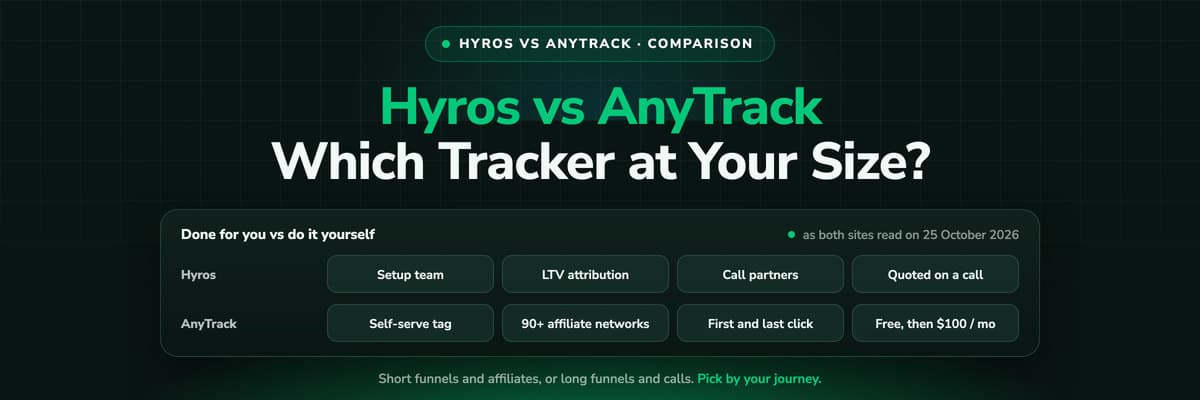 Tool Comparisons
Hyros vs AnyTrack (2026): Which Tracker at Your Size?
AnyTrack is a self-serve conversion router with a free plan and public prices from $100 a month. Hyros is a done-for-you attribution platform quoted on a call. A fair, dated comparison of tracking, attribution, affiliates, calls and cost.Read the article14 min read Tool Comparisons
Triple Whale vs Northbeam (2026): Which Fits Your Store
Triple Whale and Northbeam both measure e-commerce marketing, and they are built for different stores. Attribution, measurement, AI, setup and both price lists side by side, read on 25 October 2026, and which brand each one fits.Read the article13 min read
AgencyAnalytics vs Whatagraph
Give every client report the number it is missing
LeadJourney tracks each client's leads from the first click to the closed deal and reports revenue per campaign, a workspace per client. Book a demo: a tracking expert sets it up with you, with a 30-day money-back guarantee.
30-day money-back guaranteeSetup with a tracking expert