
















Conversion Tracking
The process of measuring the user actions that complete a business goal (form fills, calls, purchases, signed contracts) and attributing them back to the marketing source that drove them.

Summarise this article with AI
Opens the page with a ready prompt in:


Nothing is sent until you pick a service.
In short
Conversion tracking is the process of measuring user actions that complete a meaningful business goal (form submissions, calls, sign-ups, purchases, signed contracts) and attributing those actions back to the marketing source that drove them. It is the foundation of every modern performance marketing strategy, because without accurate conversion data ad platforms cannot optimize and marketers cannot allocate budget intelligently.
In simpler terms: conversion tracking tells you which ad clicks turned into business outcomes. That sounds basic, but in 2026 doing it accurately requires substantially more than dropping a Meta Pixel on your thank-you page.
Why Conversion Tracking Matters
Without conversion tracking you have no way to evaluate whether a campaign is working. Click-through rate and CPM tell you about reach and engagement; only conversion data tells you whether the campaign generated revenue or pipeline. Ad platforms like Meta, Google and LinkedIn rely on conversion signals to train their optimization algorithms. When those signals are missing or inaccurate, the algorithms can only optimize for surface-level metrics like clicks, which often have no relationship to actual revenue.
For lead generation businesses specifically, conversion tracking is even more important because the meaningful conversions usually happen offline: on a sales call, in a contract review, weeks after the original click. Those events never reach the ad platform unless they are explicitly sent back via API.
Types of Conversion Tracking
- Client-side (browser) tracking: the traditional method using JavaScript pixels like the Meta Pixel, Google Tag and LinkedIn Insight Tag. Easy to set up but increasingly unreliable due to iOS privacy, ad blockers and cookie consent.
- Server-side tracking: conversion events are sent server-to-server from your domain to the ad platform's API. Bypasses browser limitations entirely and is now the standard for accurate tracking in 2026.
- Offline conversion tracking: sends events that happen outside the browser (CRM stage changes, phone calls, signed contracts) back to ad platforms. Essential for lead generation businesses where revenue happens after the form fill.
- Hybrid tracking: most modern setups combine all three: browser pixels for fast feedback, server-side for accuracy, and offline events for revenue attribution.
How Modern Conversion Tracking Works
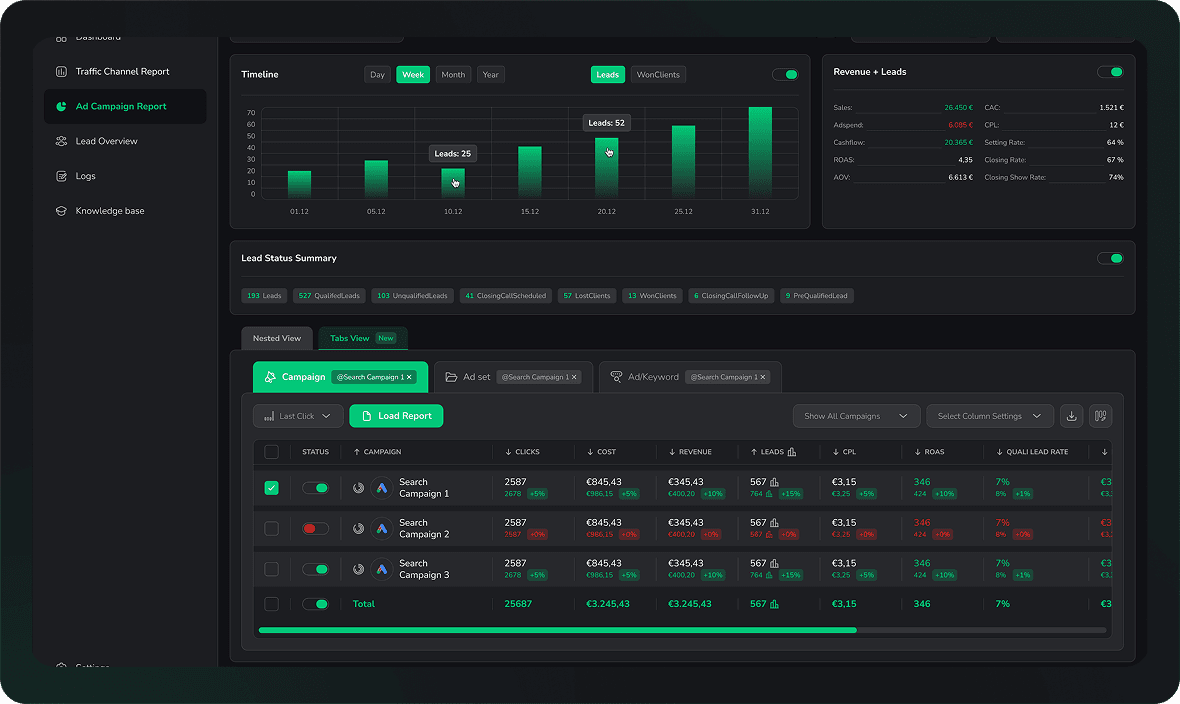
A complete conversion tracking system captures three things: the original ad click (via click IDs like FBCLID and GCLID), the conversion event itself (timestamp, value, identifying user data) and the channel attribution (which campaign, ad set and creative drove the click). When all three are connected through a unified attribution platform, you can answer questions like 'which ad set drove our highest-value closed deals last quarter?', which is the question that actually matters for lead generation businesses.
Common Conversion Tracking Mistakes
- Counting form fills as the final conversion. Form fills are intent signals, not customers. Your conversion tracking should capture qualified leads, booked calls and closed deals separately.
- Relying only on browser pixels. iOS, ad blockers and consent management routinely strip 30-40% of pixel data. Server-side tracking is no longer optional in 2026.
- Not deduplicating events. When the same conversion fires via both pixel and API without deduplication, you get inflated numbers and confused algorithms.
- Ignoring offline events. If your sales happen on the phone or via contract, your conversion tracking is incomplete without offline conversion uploads.
Conclusion
Conversion tracking is the bedrock of performance marketing, but in 2026 the bar is significantly higher than it was even three years ago. Modern conversion tracking means server-side data flows, offline event integration and unified attribution across browser, server and CRM. Done right, it is the difference between scaling what works and quietly bleeding budget into channels that look good in the dashboard but never actually drive revenue.
Keep exploring
Related glossary terms
Server-Side Tracking
Capturing conversion events on a first-party server and forwarding them to ad platforms via API, instead of relying on browser pixels that iOS, ad blockers and consent banners strip away.
Read the definition7 min read
Offline Conversion Tracking
Sending conversions that happen outside the browser (phone calls, CRM stage changes, signed contracts) back to the ad platforms, so their algorithms learn from buyers instead of form fillers.
Read the definition6 min read
Attribution Window
The period after an ad click or view during which a conversion is still credited to that ad. The setting that quietly decides which campaigns get credit for revenue.
Read the definition8 min read
95%+ data accuracy, even with ad blockers and iOS
See which ads really created your
Connect your ad accounts and your CRM once, and every lead arrives with the campaign that created it already attached.