

















BlogHow To Guides
What Does GTM Mean? Go-to-Market and Google Tag Manager
GTM means go-to-market in one half of a company and Google Tag Manager in the other, and nobody says which. Here is each one in plain language, how to tell them apart in a sentence, and the place where the two actually meet.

Contents
Summarise this article with AI
Opens the page with a ready prompt in:


Nothing is sent until you pick a service.
GTM is one of the few acronyms in business that means two unrelated things to two groups of people who sit in the same meeting.
To a sales, marketing or product person it is go-to-market: how a company gets a product in front of buyers and sells it. To an analytics, web or paid media person it is Google Tag Manager: the tool that loads tracking scripts on a website.
Nobody says which one they mean, because in their part of the building it has only ever meant one thing. Here is each, how to tell them apart in a sentence, and the one place where they genuinely meet.
What does GTM stand for?
In short
GTM stands for go-to-market or Google Tag Manager, depending on who is talking. Go-to-market is the plan for selling a product: who the buyer is, what you say to them, what it costs and which channels reach them. Google Tag Manager is a free Google product that loads tracking tags on a website without a developer touching the code. Sales, marketing leadership and product mean the first. Analytics, web and paid media teams mean the second.
There is a third thing people are sometimes looking for when they search this: GMT, Greenwich Mean Time, with the two middle letters swapped. If you arrived here from a calendar invitation rather than a meeting, that is the one you want.
How to tell which GTM someone means
You almost never have to ask. The words around it give it away.
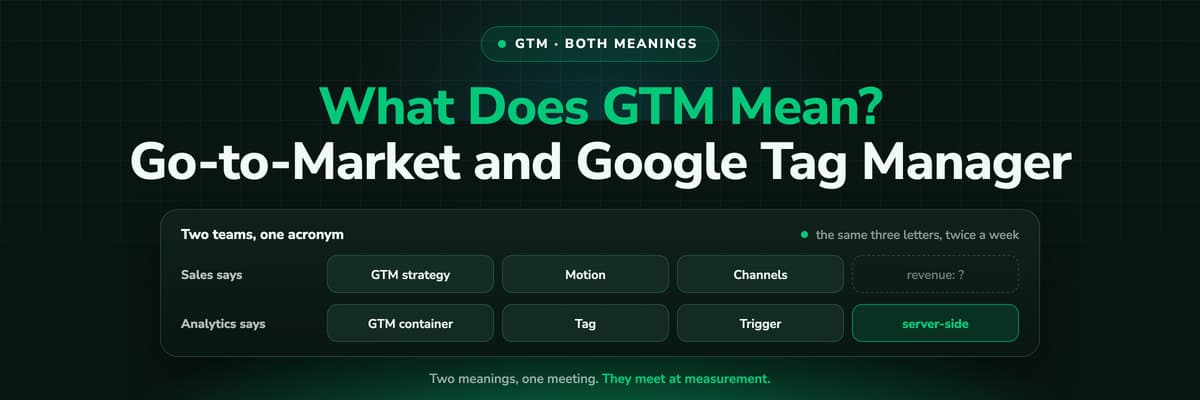
GTM strategy, GTM motion, GTM team
Go-to-market. Strategy, motion, plan, launch and team only ever attach to the business sense.
GTM container, GTM tag, GTM snippet
Google Tag Manager. Container, tag, trigger, variable, data layer and snippet are all its own vocabulary.
Who is speaking
A CEO, a product marketer, a founder or a head of sales means go-to-market. An analyst, a web developer or a media buyer means the tag manager.
Is it a thing or a plan?
If it can be installed, published or broken, it is the tag manager. If it can be agreed, funded or missed, it is go-to-market.
GTM as go-to-market: what it actually covers
A go-to-market strategy is the set of decisions that turn a product into revenue. Not a document, whatever the templates suggest: a handful of choices that every other decision follows from.
- Who the buyer isThe segment, the company profile and the person inside it who has the problem and the budget. The narrower this is, the cheaper everything after it gets.
- What you sayThe positioning: which problem you solve, what you are an alternative to, and why someone should switch. This is the piece that most often is not actually decided.
- What it costsPricing and packaging, which is a go-to-market decision rather than a finance one, because it decides who can buy and how they are sold to.
- Which channels reach themPaid, outbound, partners, content, community or a sales team. Usually two that work rather than six that are tried.
- The motionSelf-serve, product-led, inside sales, field sales or partner-led. It has to match the price: nobody runs a field sales team on a forty euro subscription.
- How you know it workedThe numbers the plan is judged on, and the measurement that produces them. This is the one that gets written last and fails first.
"Our GTM" in a meeting is usually shorthand for all six at once. "A GTM motion" is the fifth one alone. "The GTM team" is everyone whose work touches a buyer: marketing, sales, customer success and the operations people behind them.
GTM roles: ops, engineers and everyone else
Because go-to-market covers several departments, the titles built on it describe scope rather than a discipline.
- GTM team: every function that touches a buyer. Marketing, sales, customer success and the operations behind them, as one group rather than three.
- GTM ops: the operations function when it spans all of those rather than sitting inside one. The newer name for what overlapping parts of RevOps and marketing ops already did. See what RevOps and GTM ops own.
- GTM engineer: the person who builds the systems the team runs on, from enrichment and signal triggers to the automations between the CRM and everything else. See what a GTM engineer does.
- GTM strategy or GTM lead: usually product marketing, owning positioning, packaging and launches.
- GTM tools or GTM software: the stack all of the above run on, which is a category of its own. See the 12 best GTM tools.
GTM as Google Tag Manager: what it actually is
Google Tag Manager is a free Google product that sits between a website and every tracking script that wants to run on it. Instead of a developer adding the analytics snippet, the ad platform pixels and the chat widget to the code one by one, the site carries one container snippet and everything else is added through a web interface.
Its vocabulary is small and worth knowing, because it is how you recognise this GTM in a sentence:
- Container: the one snippet on the site, holding everything else. It has an ID that looks like GTM-XXXXXXX.
- Tag: a script it can fire, such as an analytics page view or an advertising pixel.
- Trigger: the condition that fires a tag, such as a page load or a click on a button.
- Variable: a value a tag or trigger reads, such as the page URL or a transaction value.
- Data layer: the structured object a site pushes information into so tags can read it reliably.
- Server-side GTM: the same container running on a server you control instead of in the visitor's browser.
That last one is where this GTM has been moving for years. Browsers cap or delete third-party cookies, ad blockers remove scripts before they run, and iOS strips parameters, so a browser-side container reports less than actually happened. Server-side tracking moves the collection to a server, which is why the phrase "server-side GTM" turns up in every conversation about tracking accuracy. See also first-party tracking and consent mode.
One thing Google Tag Manager is not
It is not analytics. It fires other people's tags and holds no reports of its own. A team saying "the numbers are in GTM" means the tags it fires, and that distinction is the first thing to clear up in any tracking conversation.
The one place both GTMs meet
The two meanings are unrelated, right up to the last decision in a go-to-market plan: how you know it worked. That question is answered by tracking, and tracking is the other GTM's job. Which is how a company ends up with a go-to-market team that cannot prove which channel produced the revenue, and an analytics team that measures every click and has never seen the CRM.
- One side records clicksSessions, page views and form fills, the moment they happen, and the report ends at the submission.
- The other side records moneyDeals, stages and closed revenue, weeks later, with no idea which ad or campaign started the conversation.
- Nothing joins the twoSo the go-to-market plan is judged on leads, and the leads that turned into customers are invisible to the channel that produced them.
Closing that gap is what attribution software does: capture the click with its platform click ID, carry it into the CRM record, and send the closed deal back to the ad platform that produced it. It is the only part of a go-to-market plan that both meanings of GTM are responsible for at the same time. See multi-touch attribution and offline conversion tracking.
GTM outside business
Outside a work context the acronym has no standard meaning. People invent local ones in chat, and none of them is established enough to be worth planning around. If you saw GTM in a professional message, it is one of the two meanings above, and the words around it will say which.
The genuinely common mix-up is GMT, Greenwich Mean Time, the time zone. The letters are the same three, transposed, so a meeting invitation saying GTM almost certainly means the time zone and not a go-to-market review.
FAQ
Frequently asked questions
The questions people ask after hearing GTM in a meeting.
What does GTM stand for?
Go-to-market, or Google Tag Manager. In sales, marketing and product it is go-to-market: the plan for getting a product to buyers. In analytics and paid media it is Google Tag Manager: the container that loads tracking tags on a website. The words next to it tell you which. A GTM strategy is the first; a GTM container is the second.
What does GTM mean in business?
In business GTM almost always means go-to-market: who the buyer is, what you say to them, what it costs, which channels reach them, how they are sold to and how you know it worked. "Our GTM" usually means all of it at once, and "a GTM motion" means the way the product is sold, such as self-serve or field sales.
Is GTM the same as marketing?
No. Marketing is one part of a go-to-market plan, alongside pricing, positioning, the sales motion and customer success. A go-to-market strategy decides who is being sold to and how; marketing executes the part of that which reaches buyers. This is why a GTM team includes sales and customer success, not only marketers.
What is a GTM strategy?
A set of decisions rather than a document: the target buyer, the positioning, the pricing and packaging, the channels, the sales motion and the measurement. Most templates cover the first four well and the last one badly, which is why so many launches cannot say afterwards which channel actually worked.
Is Google Tag Manager the same as Google Analytics?
No. Google Tag Manager fires tags, including the Google Analytics one, and holds no reports of its own. Analytics collects and reports the data. A site can use Analytics without Tag Manager and can use Tag Manager for a dozen other tools without Analytics.
What is server-side GTM?
The same Google Tag Manager container running on a server you control instead of in the visitor's browser. The browser sends one request to your own domain and the server forwards the data to the tools that need it, which survives ad blockers, cookie limits and stripped parameters far better. See server-side tracking.
Does GTM mean Greenwich Mean Time?
No, that is GMT, with the middle two letters the other way round. It is a common transposition, so if you met the acronym in a calendar invitation rather than a business meeting, the time zone is almost certainly what was meant.
Keep reading
More from the blog
 How To Guides
What Is a GTM Engineer? The Role, the Stack, the Reality
GTM engineer is the newest title in B2B revenue teams and the least agreed on. Here is what the job actually owns, how it differs from RevOps, the stack it runs on, and the gap every one of these builds eventually hits.Read the article13 min read How To Guides
Google Ads Call Tracking: Every Method and What Each One Sees
Google Ads has call tracking built in, free, and most accounts run one method without knowing what it cannot see. All five, what each records, where they conflict with a call tracker, and how to send the qualified call back.Read the article12 min read How To Guides
Does Call Tracking Hurt Your SEO? What Actually Puts NAP at Risk
The fear is old and the answer is boring: dynamic number insertion does not hurt rankings when the real number stays in your source, your schema and your listings. The mistakes that do cause damage are all about where you put the tracking number.Read the article9 min read
Where both GTMs meet
Know which channel produced the revenue, not just the leads
LeadJourney captures every click server-side, carries it into your CRM record, and sends closed deals back to Google, Meta, LinkedIn and Microsoft. 21-minute setup, no developer, 14-day free trial.