
















Offline Conversion Tracking
Sending conversions that happen outside the browser (phone calls, CRM stage changes, signed contracts) back to the ad platforms, so their algorithms learn from buyers instead of form fillers.

Summarise this article with AI
Opens the page with a ready prompt in:


Nothing is sent until you pick a service.
In short
Offline conversion tracking is the practice of sending conversions that happen outside the browser (phone calls, in-person sales, CRM stage changes, signed contracts) back to your ad platforms. Without it, ad platform algorithms only learn from form fills and never optimise for buyers. For lead generation businesses, this is the difference between scaling cheap leads and scaling actual revenue.
Most meaningful conversions for lead gen happen days or weeks after the ad click, on a sales call or contract signing. Browser pixels never see those events. Offline conversion tracking is the bridge between the ad click and the closed deal.
Why Offline Conversion Tracking Matters
If your tracking stops at the form fill, you optimise for form fillers, not buyers. The Meta and Google algorithms get very good at finding cheap form submissions, but those form fillers do not become customers. Lead quality decays predictably until the algorithm is retrained on real-buyer data. Offline conversion tracking is how that retraining happens.
In practical terms: a campaign with €20 CPL based on form fills can have a €400 cost per closed deal once you exclude no-shows, unqualified leads and ghosters. Until your ad platforms see closed deals, they cannot tell the difference between the campaign that drives €20 form fills and the one that drives €20 form fills that close.
How Offline Conversion Tracking Works
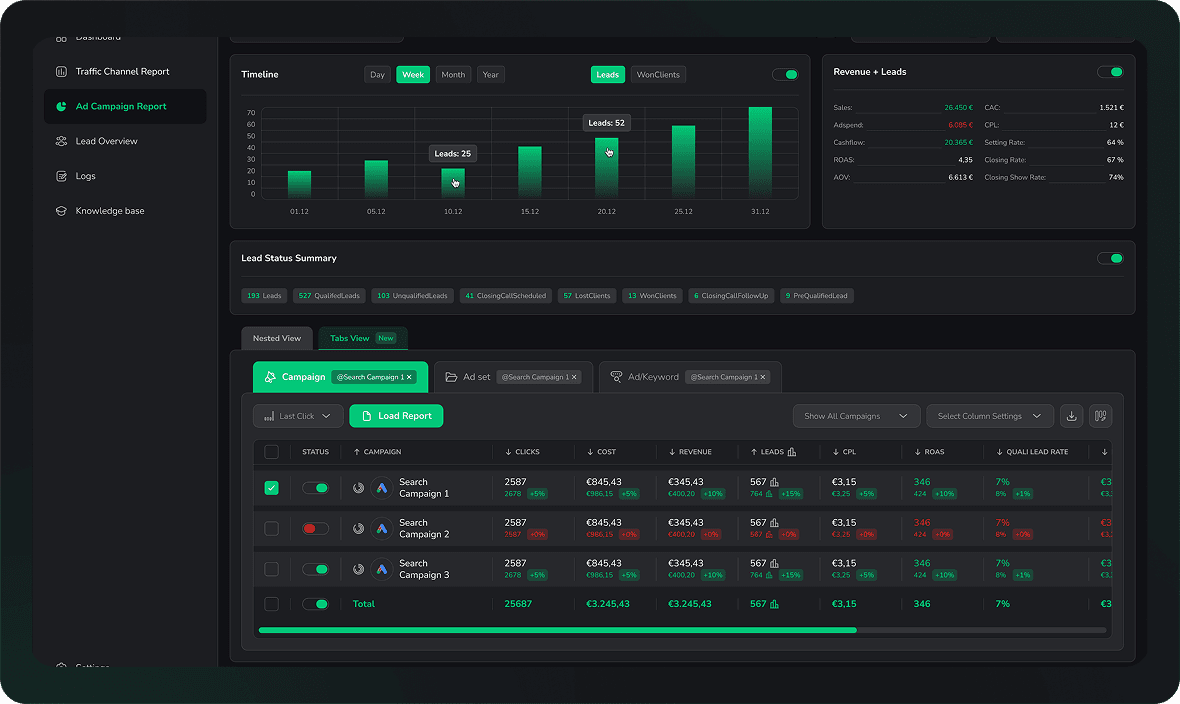
- Click ID capture: FBCLID, GCLID, MSCLKID and LinkedIn click IDs are captured at the moment of click and stored in a first-party cookie.
- Form submission: when the prospect submits a form, the click ID is passed through as a hidden field and stored on the CRM lead record.
- CRM stage change: every time the lead progresses (qualified, booked, closed, etc.), the system fires a webhook with the original click ID attached.
- Server-side API delivery: the matching conversion event (Lead, Schedule, Purchase) is sent to Meta CAPI, Google Enhanced Conversions and LinkedIn Conversion API, typically within 60 seconds of the CRM update.
What Counts as an Offline Conversion?
Anything that happens outside the browser and matters to the business. Booked calls, qualified-lead status changes, signed contracts and revenue are the four most common offline events for lead generation. Phone-call conversions can also be tracked when call data is connected back to a click ID via dynamic number insertion or CRM logging.
Results to Expect
Once Meta and Google receive real closed-deal signals from the CRM, their algorithms learn what an actual buyer looks like, not just a form filler. Lead quality typically improves within 2-3 weeks of activation. Cost per qualified lead drops in months 2-3. Cost per closed deal compounds downward over a full quarter, often by 20-40%.
Conclusion
Offline conversion tracking is what separates lead gen attribution from eCommerce attribution. eCommerce conversions happen in the browser; lead gen revenue happens on a call or in a contract. Without offline conversion uploads, your ad platforms are flying blind on the events that actually matter, and your reported CPL is disconnected from your real cost per closed deal.
Keep exploring
Related glossary terms
Conversion Tracking
The process of measuring the user actions that complete a business goal (form fills, calls, purchases, signed contracts) and attributing them back to the marketing source that drove them.
Read the definition7 min read
Server-Side Tracking
Capturing conversion events on a first-party server and forwarding them to ad platforms via API, instead of relying on browser pixels that iOS, ad blockers and consent banners strip away.
Read the definition7 min read
Multi-Touch Attribution
A measurement approach that distributes credit for a conversion across every touchpoint a customer interacted with, not just the last click before the sale.
Read the definition6 min read
95%+ data accuracy, even with ad blockers and iOS
See which ads really created your
Connect your ad accounts and your CRM once, and every lead arrives with the campaign that created it already attached.