

















BlogHow To Guides
What Is a GTM Engineer? The Role, the Stack, the Reality
GTM engineer is the newest title in B2B revenue teams and the least agreed on. Here is what the job actually owns, how it differs from RevOps, the stack it runs on, and the gap every one of these builds eventually hits.


Contents
Summarise this article with AI
Opens the page with a ready prompt in:


Nothing is sent until you pick a service.
Two years ago nobody had this title. Now it is on job ads at Anthropic, OpenAI, Clay and most Series B software companies, and the people who hold it came from sales ops, from marketing ops, from growth, and in a few cases from actual software engineering.
That is why no two definitions of the role agree. It is not a discipline with a curriculum, it is a job that appeared because the go-to-market stack got programmable and somebody had to program it.
This is what the job owns in practice, how it differs from RevOps and marketing ops, the stack it runs, the skills it takes, and the gap that almost every GTM engineering build eventually runs into.
What is a GTM engineer?
In short
A GTM engineer builds the systems a go-to-market team runs on, rather than operating them by hand. In practice that means turning signals into plays: watching for a job change, a hiring post, a funding round or a visit to the pricing page, enriching the person behind it, routing them to the right sequence or the right rep, and wiring the CRM so the result is recorded. The job sits between sales, marketing and operations, it is measured on pipeline rather than on tickets closed, and its tools are Clay, an enrichment stack, a sequencer, the CRM's API and increasingly an LLM in the middle of all of it.
The shortest honest description: a GTM engineer is the person who can answer "could we build something that does that automatically?" with a yes and a working version by Friday.
What a GTM engineer actually does
Strip away the job ad language and the work falls into five jobs. Very few people do all five well, which is most of why the title means different things at different companies.
Build the data layer
Lists, enrichment waterfalls and the rules that decide what an ICP account actually is, usually in Clay over three or four providers.
Turn signals into triggers
A job change, a hiring post, a funding round, a competitor mention, a pricing page visit: each one becomes an automation rather than a report somebody reads.
Wire the tools together
Webhooks, APIs, Zapier, Make or n8n between the enrichment tool, the sequencer, the CRM and the calendar, so nothing waits on a human paste.
Put an LLM in the loop
Research, qualification, first-draft copy and classification, where a model is cheaper than a contractor and good enough for the step it owns.
Keep it all running
Every one of those APIs changes, every provider's coverage drifts, and a broken play does not error, it quietly produces less.
The last one is the part job ads skip and the part that decides whether the role works. A GTM engineer who ships ten plays a quarter and maintains none of them has built a liability, not a machine.
GTM engineer vs RevOps vs marketing ops vs sales engineer
These four titles overlap enough that companies swap them freely, and the distinction that actually holds is what each one is measured on.
The four adjacent roles, by what they own and how they are judged
| Role | Owns | Measured on |
|---|---|---|
| GTM engineer | The plays: signals, enrichment, sequences, the automations between tools | Pipeline created by the systems they built |
| RevOps | The stack itself: the CRM, the funnel definitions, the forecast, the reporting | Whether the numbers agree and the process holds |
| Marketing ops | The marketing automation platform, the forms, the lists, the campaign plumbing | Campaign delivery and lead flow quality |
| Sales engineer | The product in front of the customer: demos, technical objections, proofs of concept | Deals won where the technical answer was the blocker |
So a GTM engineer builds inside the stack that RevOps owns. In a company of fifty that is one person wearing both hats; at two hundred they are different people who argue about whose field it is. See what RevOps and GTM ops actually own for the operations side of the same picture.
And GTM ops?
GTM ops is the newer name for the operations function when it covers marketing, sales and customer success together rather than one of them. It is a scope, not a different job. The engineer builds, the ops team owns.
The stack a GTM engineer runs
Ask ten GTM engineers what they use and you get ten lists with the same shape. Six layers, one tool each, and the connections between them mattering more than any single choice.
- Data and enrichmentClay over a waterfall of providers, or Apollo where the budget is per seat and the volume is small.
- SignalsUnify, Common Room or Warmly, depending on whether the signal is a job change, a community post or a visit to your own pricing page.
- ExecutionSmartlead for email at volume, HeyReach for LinkedIn across many senders, both driven by API rather than by hand.
- The recordHubSpot, Salesforce, Attio or Pipedrive. Whatever it is, it is the thing every play writes to and reads from.
- The gluen8n, Make or Zapier for the connections nobody wants to host, and real code for the ones that matter.
- MeasurementThe layer that says which of the five above produced revenue. This is the one most stacks are missing.
The full comparison, with what each of those tools costs at list price, is in the 12 best GTM tools.
Three plays, as they are actually built
The work is easier to recognise as plays than as a job description. These three cover most of what a GTM engineer ships in a first quarter.
1. The job change play
A champion who used your product at their last company moves. The signal tool sees the change, the enrichment step finds their new work email and confirms the new company is in ICP, an LLM writes the first line from what the account already knows, and the sequencer sends it the same week. The whole thing is four steps and it is the highest-converting outbound most teams ever run, because the buyer already knows the product works.
2. The inbound routing play
A demo form is submitted. Enrich it, decide in the same second whether it is ICP, route it to the right rep by territory and segment, and put a calendar in front of the visitor before they close the tab. Every minute of delay costs conversion, which is why this play is usually the first one a new GTM engineer is asked for.
3. The closed-won feedback play
A deal closes in the CRM. Its revenue goes back to the ad platform that produced the original click, so the algorithm learns from customers rather than from form fills, and the same event updates the account's record everywhere else. This one is the hardest to build by hand, because the click that started it happened ninety days and four systems ago. See offline conversion tracking.
What the job actually takes
The job ads ask for "technical curiosity" and leave it there. The concrete version:
- APIs and webhooks as a default instinct. Not writing a service, but reading a reference, authenticating, posting JSON and handling the case where the call fails.
- A data model in your head. What a contact, an account, a deal and an opportunity mean in your CRM, and which of them a given play is allowed to create.
- Enough SQL or spreadsheet logic to answer a question about your own data without asking anyone.
- Deliverability as a discipline. Domains, warmup, sending limits and why a clever play that burns the domain costs more than it made.
- Prompting as plumbing. Where a model is reliable enough to be a step in an automation, and where its output has to be checked by a rule.
- Enough attribution to know what you cannot claim. Which is where most of these builds are weakest, and the reason for the next section.
Notice what is not on that list: a computer science degree. The people doing this well mostly came from a sales or marketing seat and learned the tools because the alternative was doing the work by hand.
The gap every GTM engineering build hits
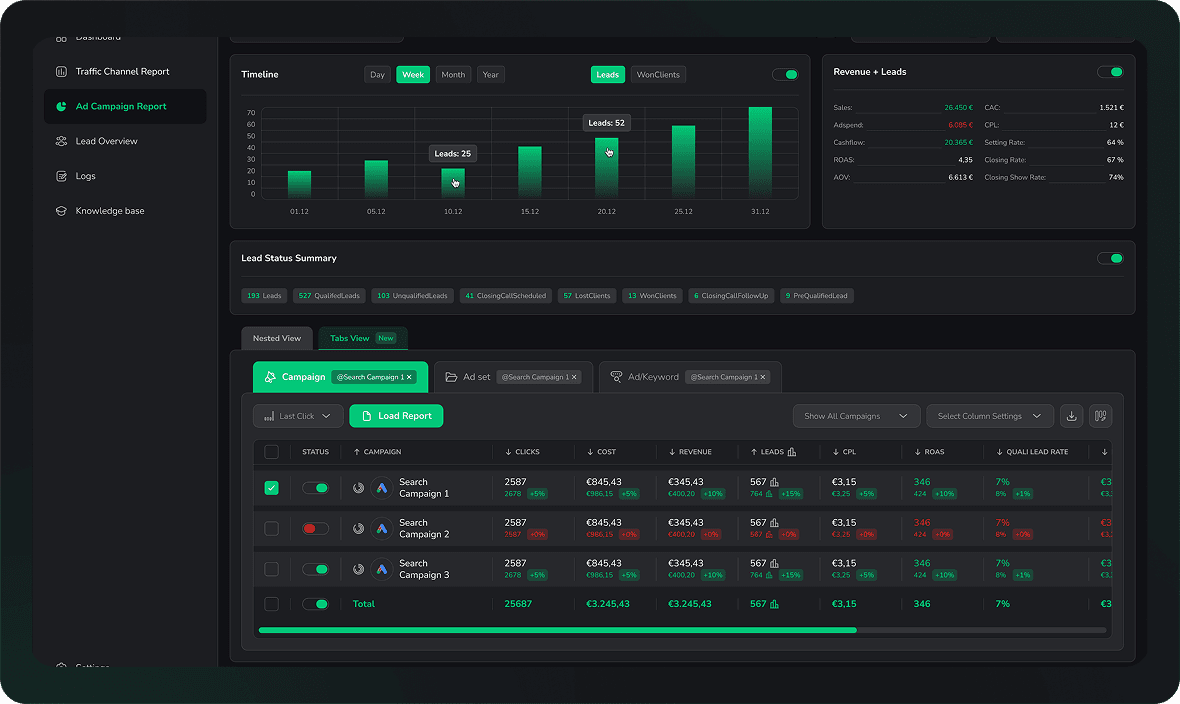
Here is the pattern. A GTM engineer ships six plays in a quarter. Pipeline goes up. Somebody asks which of the six did it, and the honest answer is that nobody knows, because each tool in the chain reports on its own step and none of them can see the others.
- The CRM records the last thing it sawA nine-touch journey that started on a paid ad closes as Direct, or as the sequence that sent the email before the meeting was booked.
- The signal is long gone by closeSixty or ninety days later the job change, the ad and the first visit are three systems away from the closed-won record.
- The ad platforms learn from the wrong eventThey optimise on the form fills you send them, not on the small share of those forms that ever became customers.
- So plays get ranked by volumeThe play that produces four hundred leads keeps its budget and the one that produced ninety leads and most of the revenue has to argue for its own.
The usual response is to build the join yourself: a warehouse, an identity table, a scheduled script and a modelling argument. It works, and it is another system with your name on it forever. The alternative is a measurement layer that already does it and still has an API: every click captured server-side on your own domain, one journey per person however they arrived, leads from your own plays posted in and joined to the journey that already existed, the source written onto the CRM record, and closed revenue sent back to Google, Meta, LinkedIn and Microsoft.
How to become a GTM engineer
There is no certification worth having, and the people hiring know it. What they look at is whether you have built something that ran without you.
- Pick one play and build it end to end, in your own company or for one client. The job change play is the usual first one because the signal is public and the result is measurable.
- Learn one data tool properly rather than four badly. Clay is the default, and being genuinely good at it is a hireable skill on its own.
- Learn your CRM's object model and its API, not just its UI. This is the difference between someone who automates and someone who breaks things.
- Build one thing with a real API and no automation platform in the middle, so you understand what the platform is doing for you.
- Measure something. Being the person who can say what a play earned, not just what it sent, is the rarest part of the skill set.
Coming from sales ops, marketing ops or a BDR seat is an advantage rather than a gap: the hard part of this job is knowing which plays are worth building, and that knowledge comes from having done the work manually first.
What GTM engineers are paid
We are not going to quote a range here, and the reason is the useful part of the answer. The salary aggregators that rank for this question disagree with each other by roughly a factor of two, because they are averaging a title that is two years old and covers a contractor building Clay tables, a RevOps hire with automation in the job description, and a staff-level engineer inside a go-to-market team. An average across those three is not a number anyone should negotiate with.
What actually sets the number is narrower: whether the role owns pipeline targets or only builds for people who do, whether it is inside RevOps or reporting to a CRO, whether equity is part of the package, and which market you are hiring in. Price it against the RevOps and sales engineering bands in your own market and your own stage, and check live job ads in your city rather than an aggregate across all of them.
Hiring one: what the job description should say
Most GTM engineer job ads are a tool list, which is how companies end up hiring someone who knows the tools and cannot tell which plays are worth building. A better ad names the outcome, the systems and the constraint.
- The outcome: pipeline created by systems they build, with a number attached and a quarter to reach it.
- The systems they inherit: the CRM, the data tools and the automations that already exist, including the broken ones.
- Who owns the stack: whether this person reports into RevOps, marketing or sales, and who decides when the two disagree.
- The measurement: how the company will judge whether a play worked, which forces the honest conversation about whether it currently can.
- The constraint: budget for credits and seats, because a GTM engineer with no data budget is a person writing emails.
And one question worth asking every candidate: tell me about a play you switched off. The ones who have an answer are measuring; the ones who do not are shipping.
The job, in one line
A GTM engineer turns go-to-market from a set of activities into a set of systems. The title will probably not survive in this form, because in five years most of this will simply be what a revenue team does. The work will.
If you hold the job today, the part worth fixing first is the one nobody advertises: being able to say which of your systems produced the money. The page for GTM engineers is what we built for exactly that, and the 12 best GTM tools covers everything else in the stack.
FAQ
Frequently asked questions
What people ask about the newest job in B2B revenue teams.
What does a GTM engineer do?
A GTM engineer builds the systems a go-to-market team runs on instead of operating them by hand: enrichment and list building, signal-triggered automations, sequences, routing rules, and the connections between the CRM, the ad platforms and everything else. They are measured on pipeline created by what they build, not on tickets closed.
Is a GTM engineer the same as RevOps?
No, though one person often does both in a smaller company. RevOps owns the stack, the funnel definitions and whether the numbers agree. A GTM engineer builds plays inside that stack. When the two are separate people, RevOps decides what the systems are allowed to do and the engineer decides how they do it. See what RevOps and GTM ops own.
Do you need to code to be a GTM engineer?
Not in the software engineering sense. You need to read an API reference, authenticate, post JSON, handle a failed call and understand your CRM's object model. Most of the work happens in Clay, n8n, Make or Zapier. People who can also write a script have more options, but the binding skill is knowing which plays are worth building.
What tools do GTM engineers use?
Clay or Apollo for data, Unify, Common Room or Warmly for signals, Smartlead and HeyReach for execution, HubSpot, Salesforce or Attio as the record, n8n or Make as the glue, and a measurement layer to tell them which of it worked. The full list with prices is in the 12 best GTM tools.
How much do GTM engineers earn?
The published ranges disagree by roughly a factor of two, because the title is new and covers everything from a Clay contractor to a staff engineer inside RevOps, so an aggregate across them is not a number worth negotiating with. Price the role against RevOps and sales engineering bands in your own market and stage, and read live job ads rather than an average.
What is GTM engineering?
GTM engineering is the practice: treating go-to-market as a system to be built and maintained rather than a set of activities to be staffed. It became possible when the data providers, the CRMs and the sending tools all got usable APIs, and it became popular when LLMs made the research step cheap enough to automate.
Keep reading
More from the blog
 How To Guides
What Does GTM Mean? Go-to-Market and Google Tag Manager
GTM means go-to-market in one half of a company and Google Tag Manager in the other, and nobody says which. Here is each one in plain language, how to tell them apart in a sentence, and the place where the two actually meet.Read the article9 min read How To Guides
Google Ads Call Tracking: Every Method and What Each One Sees
Google Ads has call tracking built in, free, and most accounts run one method without knowing what it cannot see. All five, what each records, where they conflict with a call tracker, and how to send the qualified call back.Read the article12 min read How To Guides
Does Call Tracking Hurt Your SEO? What Actually Puts NAP at Risk
The fear is old and the answer is boring: dynamic number insertion does not hurt rankings when the real number stays in your source, your schema and your listings. The mistakes that do cause damage are all about where you put the tracking number.Read the article9 min read
For GTM engineers
Build the plays. We will tell you which ones closed.
LeadJourney joins closed CRM revenue back to the campaign, ad and play that started the journey, and sends it on to the ad platforms. Server-side capture, an API your automations can call, 21-minute setup, 14-day free trial.