














BlogTool Comparisons
Supermetrics vs Funnel.io (2026): Which Data Pipeline?
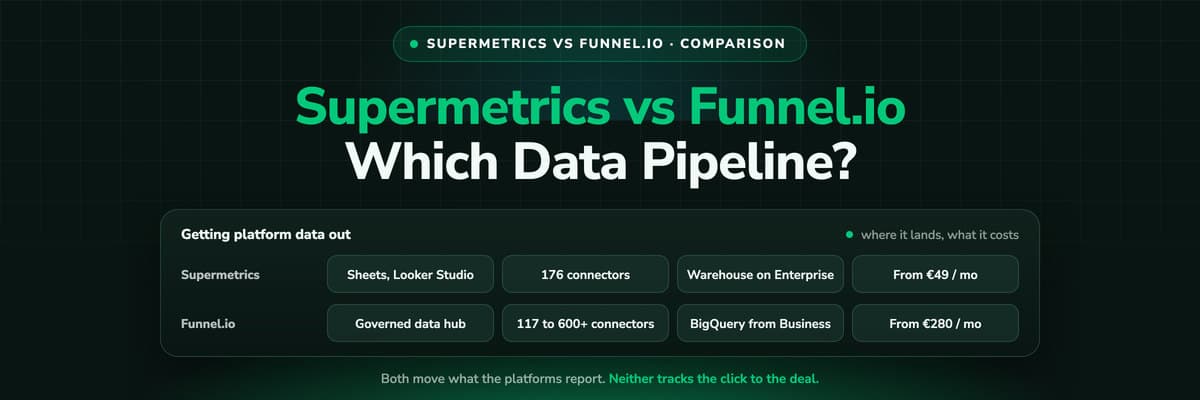
Supermetrics lands marketing data where an analyst already works; Funnel builds a governed data hub for a data team. Where each one is ahead, what three real setups cost on both, and the question no pipeline answers.

Contents
Summarise this article with AI
Opens the page with a ready prompt in:


Nothing is sent until you pick a service.
Supermetrics and Funnel solve the same first problem: the numbers live in a dozen ad, analytics and CRM platforms, and somebody spends Monday morning copying them into one place. Both connect those platforms and deliver the data to Sheets, Looker Studio, a BI tool or a warehouse. They differ in who they are built for, how much data work happens inside the tool, and how the price is counted.
This comparison is for the marketing ops lead, analyst or agency data team choosing between the two. Every price and feature below was read on supermetrics.com and funnel.io on 25 October 2026. Where a page does not publish something, the post says so instead of filling the gap.
Supermetrics vs Funnel.io in Short
In short
Supermetrics fits the marketer or analyst who reports in Google Sheets, Looker Studio, Excel or Power BI and wants data there from €49 a month (€39 yearly), with a 14-day trial and warehouses on Enterprise. Funnel fits the team that wants a governed data hub: storage, harmonised fields, unlimited users, 579 connectors and warehouse exports from €560 (or $600) a month billed annually, plus MMM and multi-touch attribution as a paid add-on. Both move what the platforms report. Neither tracks a visitor on your site or joins a click to the CRM deal it produced.
Supermetrics vs Funnel.io at a glance, as both sites showed them on 25 October 2026
| Supermetrics | Funnel.io | |
|---|---|---|
| Built for | Marketers and analysts landing data in their own tools; 200,000+ companies by its count | Marketing and data teams at brands and agencies that want one governed hub |
| Priced by | Plan plus data sources, accounts, destinations and users | Plan plus flexpoints (capacity for connectors, accounts, destinations) |
| Entry price | €49 / mo monthly, €39 yearly | From €280 ($300) / mo, billed annually |
| Connectors | 176 listed | 117, 579 or 600+ by plan |
| Destinations | Sheets, Looker Studio, Excel, Power BI, Studio, AI chats; warehouses on Enterprise | 13, 46 or 47 by plan; BigQuery and S3 from Business, Snowflake on Enterprise |
| Data preparation | Transformations and storage on Enterprise | Storage, harmonisation and semantics on every plan |
| Attribution | Not published | Funnel Measure add-on: MMM, MTA, incrementality, from €1,350 / mo |
| Data back to ad platforms | Campaign management from AI chats (move spend, pause, launch) | Conversion API uploads to Google Ads, Facebook Ads and others |
| Users | 1 or 2, more as extras | Unlimited on every plan |
| AI and MCP | AI chats, Studio, MCP server and APIs | Funnel AI and Funnel MCP on every plan |
| Trial | 14 days, no payment details | 30-day Data Hub trial, no card |
| Data location | Data residency and region control on Enterprise | EU Data Center available |
Who Each Tool Is Built For
Supermetrics started as a Google Sheets add-on and still thinks from the destination backwards: pick the tool you already work in, pick the sources, schedule the refresh. Its Starter plan is one user, one destination and two sources, which is a marketer's reporting setup rather than a data platform. The warehouse, transformations and storage arrive on Enterprise.
Funnel thinks from the data outwards. Every plan stores the data, maps fields across platforms, carries your own budgets and targets as context, and has dashboards of its own, with unlimited users from the start. You buy capacity and spend it on connectors, accounts and destinations as you like. The pricing page names marketing teams, data teams and agencies, and the plan descriptions get more technical as they climb.
Who wins it: Supermetrics for one or two people who live in Sheets or Looker Studio; Funnel for a team that wants the data cleaned and governed in one place before it goes anywhere.
Connectors and Destinations
Both cover every ad platform, analytics tool and major CRM a marketing team is likely to name. The counts differ because they count differently.
Connector and destination coverage, read on both pricing pages on 25 October 2026
| Supermetrics | Funnel.io | |
|---|---|---|
| Connectors on the entry plan | Any 2 of 176 (up to 3 with extras) | 117 to choose from |
| Connectors on the middle plan | Any 7 of 176 (up to 15 with extras) | 579 to choose from |
| Top plan | All sources | 600+ (590 in the comparison table) |
| CRM and sales sources | HubSpot Contacts, Salesforce, Pipedrive, Close, Zoho, Odoo, Gong, CallRail, Stripe | Salesforce, HubSpot and others in the catalogue |
| Destinations | One core destination per plan, more as extras | 13 on Starter, 46 on Business, 47 on Enterprise |
| Custom sources | Custom data import (1 on Growth), Connector Builder | Custom connectors on request, Business and up |
On a small setup Supermetrics is the more flexible choice of sources, since any two or seven of the full catalogue are allowed. Funnel's Starter limits you to a 117 connector subset, while its Business plan opens the long tail and, per the page, a data guarantee to connect any source and send to any destination.
Who wins it: Supermetrics for a few sources from a wide menu; Funnel for many sources and many destinations at once.
Data Preparation and Storage
Funnel includes the work that makes cross-platform data comparable on every plan: data storage, built-in field mapping and harmonisation, currency conversion, semantics for your business logic and naming convention rules. Workspaces and client portals with custom branding open up on Business.
Supermetrics delivers the data as each platform reports it on Starter and Growth and leaves the shaping to the destination, a sheet formula or a Looker Studio blend. Data transformations (custom metrics, dimensions, currency conversions, blends) and Supermetrics Storage are Enterprise features.
Who wins it: Funnel, clearly, unless your team prefers to do the shaping in the destination it already knows.
Warehouses, BI Tools and Refresh
- Supermetrics: Google Sheets, Looker Studio, Excel, Power BI and its own Studio on every plan. BigQuery, Snowflake, Redshift and other warehouses are Enterprise, as are data residency and region control.
- Funnel: Looker Studio and Google Sheets from Starter, Power BI, Tableau, BigQuery and Amazon S3 from Business, Snowflake on Enterprise. Scheduled exports run daily on Starter and every two hours from Business.
For a team whose analysts work in BigQuery, Funnel is the shorter road on published prices: warehouse exports from the Business plan, against an Enterprise quote on Supermetrics.
Who wins it: Funnel for the warehouse; Supermetrics for the spreadsheet and Looker Studio user who never needs one.
Attribution and Measurement
This is where the two diverge most. Supermetrics publishes no attribution model of its own: it delivers each platform's conversions with that platform's attribution, and any modelling happens downstream.
Funnel sells Funnel Measure as an add-on on Business and Enterprise: marketing mix modelling, machine learning multi-touch attribution across tracked digital touchpoints, and incrementality tests, calibrated against each other. Digital Measurement costs €1,350 a month up to €450,000 of average monthly ad spend and €4,050 at €2.7 to €4.5 million, billed annually, on top of the Data Hub plan. Advanced Measurement, with offline media and offline conversions, is custom.
Funnel also lists Conversion APIs among its exports, uploading data to Google Ads, Facebook Ads and other platforms. Supermetrics went the other way in 2026: its AI chats can move spend, pause campaigns or launch one from Claude, ChatGPT, Copilot or Gemini.
Who wins it: Funnel, for the brand with a budget large enough that MMM is worth €16,000 a year or more; Supermetrics has no measurement product to compare.
AI Features and MCP
Both now treat an AI chat as a destination. Supermetrics lists ChatGPT, Claude and Microsoft Copilot next to Sheets as core destinations, includes 4,000 or 12,000 monthly AI credits for Supermetrics Studio, which builds dashboards from a description, and offers an MCP server and APIs for your own agents. Funnel includes unlimited Funnel AI in its web app and Funnel MCP on every plan.
Who wins it: Supermetrics on reach (more chats, plus campaign actions); Funnel on predictability, with no metered credits.
Trial, Setup and Governance
- Trial: Supermetrics lets you trial any connector or destination for 14 days without payment details. Funnel now offers a 30-day Data Hub trial without a card, with every feature, connector and destination, after which its team helps you pick a plan.
- Contract: Supermetrics bills monthly or yearly at 20% off. Funnel's published prices are annual.
- Users: Supermetrics includes one user on Starter and two on Growth, with extra users at €124 a month on Growth. Funnel includes unlimited users on every plan.
- Single sign-on: SSO on both Supermetrics plans, SAML on Enterprise. Funnel has Google sign-in, with SAML, OIDC and SCIM on Enterprise.
- Data location: Supermetrics offers data residency and region control on Enterprise. Funnel offers an EU Data Center.
Who wins it: Funnel for a team (unlimited users, a longer trial, an EU data centre); Supermetrics for the individual who wants to pay monthly.
Supermetrics vs Funnel.io Pricing
Supermetrics pricing in euros, read on 25 October 2026
| Plan or extra | Includes | Billed monthly | Billed yearly |
|---|---|---|---|
| Starter | 1 destination, 2 sources, 1 user, 2 accounts per source | €49 / mo | €39 / mo |
| Growth | 1 destination, 7 sources, 2 users, 7 accounts per source | €199 / mo | €159 / mo |
| Enterprise | Warehouses, all sources, transformations, storage | Quote | Quote |
| Extra data source | Starter up to 3, Growth up to 15 | €37 / mo | €29 / mo |
| Extra destination | Starter up to 2 / Growth up to 4 | €62 / €187 | €49 / €149 |
| Extra user (Growth) | Up to 5 | €124 / mo | €99 / mo |
| Extra ad account | Starter up to 3, Growth up to 20 | €13 / mo | €10 / mo |
Funnel pricing, read on 25 October 2026: euros as shown to an EU visitor, US dollars from a September 2026 US capture
| Plan or add-on | Billing basis | Price | Billing |
|---|---|---|---|
| Starter | Plan plus flexpoints, 117 connectors | From €280 ($300) / mo | Annual |
| Business | Plan plus flexpoints, 579 connectors | From €560 ($600) / mo | Annual |
| Enterprise | 600+ connectors, SSO, SLA | Custom | Annual |
| Funnel Measure, Digital | Average monthly ad spend, Business and up | €1,350 to €4,050 / mo | Annual |
| Flexpoint weights | Connector 50, account 5, BI destination 150, warehouse 300 | Price per flexpoint not published | Increments of 100 |
Three setups, priced on both
Funnel does not publish how many flexpoints a plan includes, so its column gives the plan's entry price and the flexpoints the setup would use. The LeadJourney column is a different purchase, explained below, priced on the ad spend each setup implies.
Monthly cost of three setups, euros, monthly billing (yearly in brackets where offered)
| Setup | Supermetrics | Funnel.io | LeadJourney |
|---|---|---|---|
| 3 sources, 1 account each, Looker Studio, 1 user; €10,000 ad spend | €86 (€68): Starter + 1 source | From €280, uses 315 flexpoints | €249 (€199), Starter |
| 6 sources, 2 accounts each, Looker Studio and Sheets, 2 users; €40,000 ad spend | €386 (€308): Growth + 1 destination | From €280, uses 660 flexpoints | €499 (€399), Growth |
| 10 sources, 2 accounts each, into BigQuery; €80,000 ad spend | Enterprise quote | From €560 (Business), uses 900 flexpoints | €799 (€639), Scale, BigQuery export included |
Supermetrics is the cheapest way to get a handful of sources into Looker Studio or Sheets, by a wide margin. Funnel's floor is higher, its users unlimited, and its warehouse road the cheaper one on published prices. The LeadJourney column is not a cheaper pipeline: it is the price of tracking and attribution that a pipeline does not include.
Which One Should You Choose?
Supermetrics
Pros
- From €49 a month (€39 yearly), monthly billing available
- Any sources from a 176 connector catalogue
- Lands data in Sheets, Looker Studio, Excel, Power BI and AI chats
- Campaign management from the AI chat
- 14-day trial without payment details
Cons
- Warehouses, transformations and storage only on Enterprise
- One or two users included, extras add up
- No attribution or measurement product
Funnel.io
Pros
- Storage, harmonisation and semantics on every plan
- Unlimited users; workspaces and branded portals from Business
- BigQuery and S3 from Business, exports every two hours
- MMM, MTA and incrementality as an add-on
- 30-day trial without a card, EU Data Center available
Cons
- Annual billing from €280 ($300) a month
- Flexpoint capacity per plan is not published
- Measure adds €1,350 a month or more, Business and up only
Verdict
Pick Supermetrics if one or two people need platform data in the tools they already use; pick Funnel if a team needs a governed hub, a warehouse feed and, at a large budget, MMM.
When Neither Fits: LeadJourney
First, when a pipeline is the right buy: if the job is moving platform numbers into Sheets, Looker Studio or a warehouse for a data team that builds its own models, buy Supermetrics or Funnel. LeadJourney is not a data pipeline, does not connect 176 sources and will not replace either.
The gap shows up one step earlier. A pipeline moves what each platform reports: Meta's conversions with Meta's attribution, the CRM's deals with no click attached. Neither tool publishes a tracking script of its own, so neither records which ad click a lead came from on your site, and no transformation can join a deal to a click nobody captured. If your question is which campaign produced the deals that closed, that join has to be tracked, not piped.
- Tracks the visit and the lead itself, server-side and first-party on your own domain, live in 21 minutes with 95%+ tracking accuracy.
- Joins it to the closed deal in HubSpot, Salesforce, Pipedrive, Close, Attio, GoHighLevel, ActiveCampaign, Odoo, Zoho CRM or Microsoft Dynamics 365, built lead generation first (B2B and B2C), with e-commerce through Shopify.
- Attributes it with every rule-based model, switchable without re-tracking, and sends the result back to Meta, Google, LinkedIn, Microsoft, Reddit, X, Taboola and Outbrain Ads server-side.
- Feeds your pipeline instead of replacing it: the Zapier app on every plan, the API from Growth and the BigQuery export from Scale, so the attributed data can sit next to the Supermetrics or Funnel data in your warehouse.
- Prices by ad spend: Launch €129 a month up to €5,000, Starter €249 up to €15,000, Growth €499 up to €50,000, Scale €799 up to €100,000, Enterprise from €999; 20% off yearly. MCP is included from Growth and a €49 add-on below it.
- Starts with help: a one hour onboarding call with a tracking expert and 14 days of setup support on every plan, a 30-day money-back guarantee, hosted in Frankfurt.
LeadJourney does not run MMM and does not change budgets or bids in the ad platforms. A brand spending millions on TV and retail media needs Funnel Measure or a dedicated MMM vendor, not LeadJourney. The row-by-row detail is on LeadJourney vs Supermetrics and LeadJourney vs Funnel.io.
Further Reading
- LeadJourney vs Supermetrics and LeadJourney vs Funnel.io: the full comparisons, row by row.
- The best Funnel.io alternatives: pipelines and attribution tools teams move to.
- The best marketing data warehouse: where piped and tracked data end up.
- BigQuery marketing attribution: building attribution on warehouse data, and its limits.
- The BigQuery integration: LeadJourney's attributed data in your own dataset.
- Multi-touch attribution, server-side tracking and offline conversion tracking.
- LeadJourney pricing: every plan, in five currencies.
FAQ
Frequently Asked Questions
The questions teams ask when Supermetrics and Funnel are both on the shortlist.
Is Supermetrics better than Funnel.io?
For one or two people reporting in Google Sheets, Looker Studio, Excel or Power BI, Supermetrics is the better fit: from €49 a month, monthly billing, any sources from 176 connectors. For a team that wants data stored, harmonised and governed in one hub, with unlimited users, warehouse exports from the Business plan and an optional MMM and attribution add-on, Funnel is stronger.
How does Supermetrics pricing compare to Funnel pricing?
Supermetrics Starter is €49 a month billed monthly or €39 yearly, Growth €199 or €159, Enterprise on quote, with extras per source, destination, user and ad account. Funnel Starter starts from €280 ($300) a month and Business from €560 ($600), billed annually, plus flexpoint capacity whose included amount is not published. Funnel Measure adds from €1,350 a month. Prices as read on 25 October 2026.
Does Funnel.io have a free trial?
Yes. Since autumn 2026 (marked new on 25 October 2026) the pricing page has offered a 30-day Data Hub trial without a credit card, with every Data Hub feature, connector and destination, after which Funnel's team helps you choose a plan. Supermetrics offers a 14-day trial of any connector or destination without payment details.
Can I use Supermetrics and Funnel together?
Technically yes, but both move the same platform data, so running both mostly doubles the cost. Teams sometimes keep Supermetrics for an analyst's Sheets reports while a data team runs Funnel into the warehouse. A more useful pairing is a pipeline with a tracking and attribution tool, whose attributed leads and deals land in the same warehouse.
Do Supermetrics or Funnel do attribution?
Supermetrics publishes no attribution model; it delivers each platform's conversions as reported. Funnel sells Funnel Measure as an add-on on Business and Enterprise, combining marketing mix modelling, machine learning multi-touch attribution and incrementality tests, from €1,350 a month. Neither tracks visitors on your site, so neither can tie a CRM deal to the specific ad click that started it.
Which is better for BigQuery?
On published prices, Funnel. BigQuery and Amazon S3 exports are on its Business plan from €560 ($600) a month billed annually, with exports every two hours. Supermetrics offers BigQuery, Snowflake and other warehouses only on its Enterprise plan, which is priced on quote. Both deliver what the platforms report, not tracked leads.
What is the best alternative to Supermetrics and Funnel?
For another pipeline, Fivetran, Adverity and Windsor.ai are the usual names. If the real question is which campaign produced the deals that closed, a pipeline cannot answer it. LeadJourney tracks leads server-side on your domain, joins them to the CRM deal, sends the result to the ad platforms and exports to BigQuery, from €129 a month, with a 30-day money-back guarantee.
Keep reading
More from the blog
 Tool Comparisons
Hyros vs Cometly (2026): Which Attribution Tool Fits?
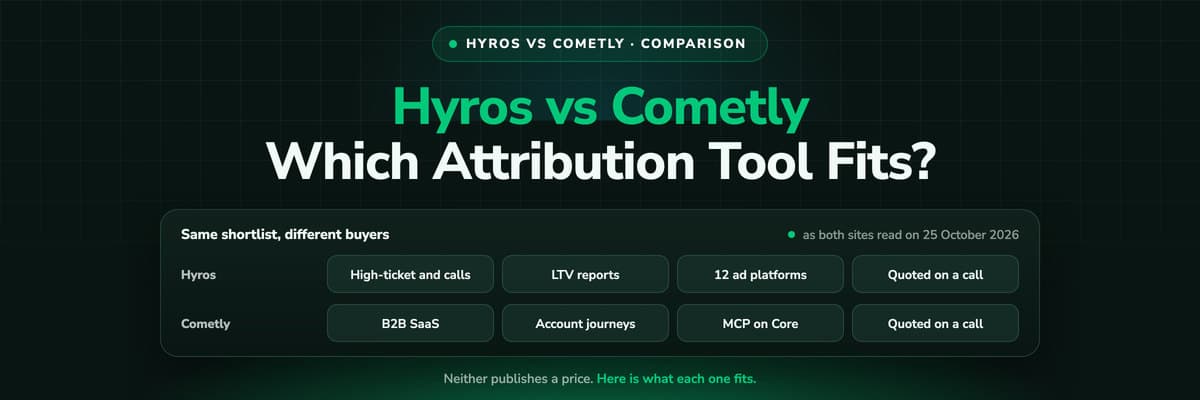
Hyros is built around high-ticket sales, info products and calls; Cometly around B2B SaaS pipeline. Both quote prices on a call. A fair, dated comparison of tracking, CRM depth, AI, security and cost, and who should pick which.Read the article14 min read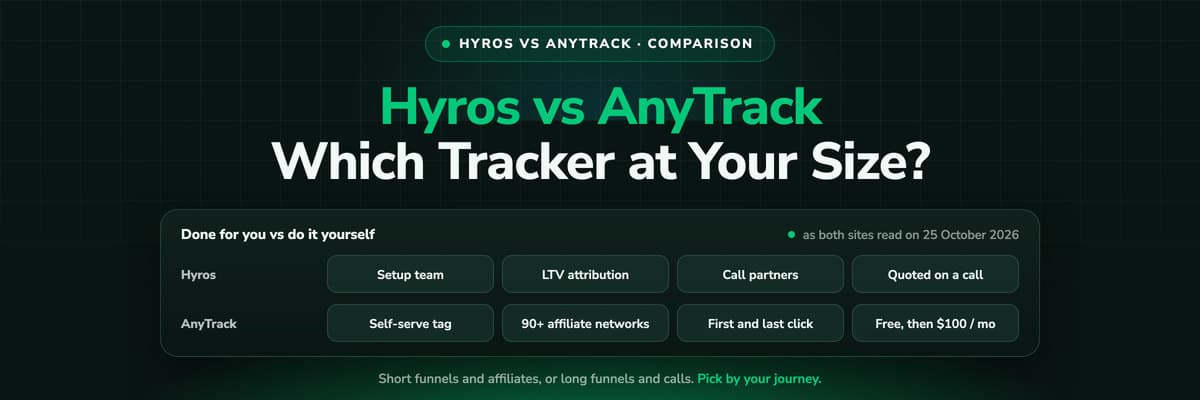 Tool Comparisons
Hyros vs AnyTrack (2026): Which Tracker at Your Size?
AnyTrack is a self-serve conversion router with a free plan and public prices from $100 a month. Hyros is a done-for-you attribution platform quoted on a call. A fair, dated comparison of tracking, attribution, affiliates, calls and cost.Read the article14 min read Tool Comparisons
Triple Whale vs Northbeam (2026): Which Fits Your Store
Triple Whale and Northbeam both measure e-commerce marketing, and they are built for different stores. Attribution, measurement, AI, setup and both price lists side by side, read on 25 October 2026, and which brand each one fits.Read the article13 min read
Supermetrics vs Funnel.io
A pipeline moves the numbers. Track the one it cannot.
LeadJourney follows every lead from the first click to the closed deal in your CRM, attributes it and sends it back to the ad platforms, priced by ad spend. Book a demo: a tracking expert sets it up with you, with a 30-day money-back guarantee.
30-day money-back guaranteeSetup with a tracking expert