













Customer Journey
The full sequence of touchpoints a person passes through on the way to becoming a customer, in the order they happened: ads, searches, visits, the form, the call and the closed deal. Analytics tools show the last step; the journey is everything before it.

Summarise this article with AI
Opens the page with a ready prompt in:


Nothing is sent until you pick a service.
In short
A customer journey is the complete sequence of interactions a person has with a business between first contact and purchase, in the order they happened: the ad that introduced the brand, the search that brought them back, the pages they read, the form they submitted, the call they took and the contract they signed. Each interaction is a touchpoint; the journey is the ordered path through them.
Almost every business has a version of this path in its head and a different version in its reports. The reports show conversions, each credited to the session it happened in. The journey shows why the conversion happened, which is the thing a marketing budget is actually spent on.
What a Journey Is Made Of
Take a €8,000 consulting engagement. The founder saw a LinkedIn post in March, searched the consultant's name in April and read two articles, clicked a Meta retargeting ad in May, attended a webinar the following week, submitted the contact form the day after, took a discovery call, and signed in June. Seven touchpoints over three months. The parts of that journey fall into four kinds.
- TouchpointsAny recorded contact with the business: an ad click, an organic visit, an email open, a webinar, a call, a chat, a proposal. Each carries a source and a time.
- SessionsThe visits the touchpoints arrive in. A journey with seven touchpoints usually spans several sessions, weeks apart, sometimes on different devices.
- IdentificationThe moment the anonymous visitor becomes a known person: a form with an email address, a call from a known number, a login. Everything before it has to be joined to everything after.
- CRM stagesWhat happened once the person was known: qualified, meeting held, proposal sent, won, and the deal value. This is where the journey gets its revenue.
Why Analytics Shows the Conversion and Not the Path
Web analytics and the ad platforms were built around the session and the conversion, not the person and the path. Four properties of those tools hide the journey.
- One conversion, one credit. GA4 assigns each conversion to a source through its reporting attribution model, data-driven or last click, and shows the result per channel. The other touchpoints appear in an exploration at best, and never with a deal value from the CRM.
- Each platform grades its own work. Meta credits the conversion to the Meta ad within its window, Google to the Google click within its window. Add the platform reports up and the total exceeds the leads you actually received.
- The journey ends at the form. The tools stop when the visitor converts on the site. The qualified lead, the meeting and the signed contract happen in the CRM, which the analytics tool never sees.
- Cookies are per browser and per device. The March LinkedIn visit on a phone and the June form on a laptop are two anonymous visitors until something joins them, and Safari's seven-day cap on JavaScript cookies breaks even same-device journeys that pause for a week.
The result is a report in which the last search click, usually a brand search, collects the credit for a journey that LinkedIn and Meta started. The long sales cycle use case shows what that does to budget decisions over a quarter.
How a Journey Is Stitched
- A first-party visitor ID is set on the first visit, on your own domain, by a script that records the source, the UTM parameters and any click ID in the URL.
- Every later visit is appended to that ID with its own source, so the retargeting click and the webinar registration land on the same record as the LinkedIn visit.
- Identification joins the histories. When the person submits a form, books a call or is recognised by phone number, the anonymous record is tied to the contact, and any other device where the same person identified is merged in. This is the step cross-device tracking depends on.
- The CRM adds stages and revenue. Qualified, meeting, won and the deal value are written back against the journey as they happen, weeks after the visits.
- An attribution model divides the credit across the touchpoints, first touch, last touch, linear or position based, so the deal value can be reported per channel and campaign.
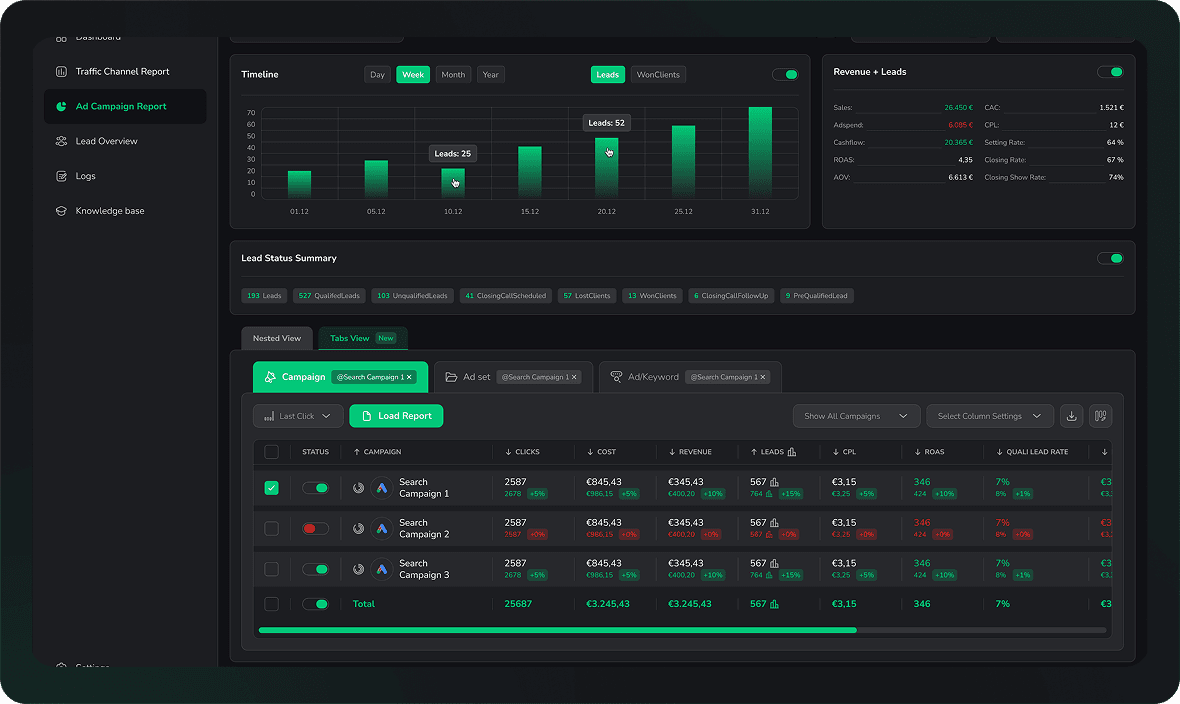
Done this way the journey is measured rather than remembered. It is the difference between asking a new customer "how did you hear about us?" and reading the seven touchpoints with their dates. Customer journey tracking is the product category built around exactly this record.
The ability to track both online and offline conversions in one unified dashboard has given us insights we never had before. Our ROI has improved dramatically since we started integrating LeadJourney with our CRM. We're finally able to see the full customer journey, and it's been a game changer for our strategy.
 Andre WitzelFounder, Trading.de
What a Journey Report Answers
Where customers start
The first touch of the deals that closed, which is rarely the channel that gets the last click. The channel that introduces buyers is the one you cannot cut.
What assists
The touchpoints in the middle: the retargeting ad, the case study, the webinar. Invisible in a last-click report, present in most journeys that end in a deal.
How long it takes
Days from first touch to form and from form to signature, by channel. It sets the attribution window and tells you when a campaign's results are actually in.
Which mix closes
The combinations of channels that appear in won deals versus lost ones, so the budget follows the paths that end in revenue rather than the paths that end in forms.
Conclusion
The customer journey is the unit marketing actually buys: not a click, not a session, but a sequence of contacts that ends in a customer. Analytics tools report the last step of it because that is what a cookie and a conversion tag can see. Recording the journey means a first-party visitor record, an identification step that ties it to a person, and a CRM connection that adds the outcome. With those three in place the question shifts from "which campaign got the form?" to "which path produced the revenue?", and multi-touch attribution has something to divide.
Keep exploring
Related glossary terms
Multi-Touch Attribution
A measurement approach that distributes credit for a conversion across every touchpoint a customer interacted with, not just the last click before the sale.
Read the definition6 min read
Cross-Device Tracking
Recognising that a visit on one device and a conversion on another belong to the same person, so the journey and the credit are not split in two.
Read the definition5 min read
Attribution Model
The rule set that decides how much credit each marketing touchpoint gets for a conversion or a deal. It turns a recorded customer journey into a channel report, and the choice of model can change that report more than the campaigns did.
Read the definition7 min read
95%+ data accuracy, even with ad blockers and iOS
See which ads really created your
Connect your ad accounts and your CRM once, and every lead arrives with the campaign that created it already attached.