














BlogTool Comparisons
15 Best Marketing Intelligence Tools in 2026
Most marketing intelligence tools aggregate what the ad platforms report, so every dashboard inherits the gaps iOS 14 and ad blockers leave behind. Fifteen tools compared, from data aggregators to attribution platforms that connect spend to CRM revenue.


Contents
Summarise this article with AI
Opens the page with a ready prompt in:


Nothing is sent until you pick a service.
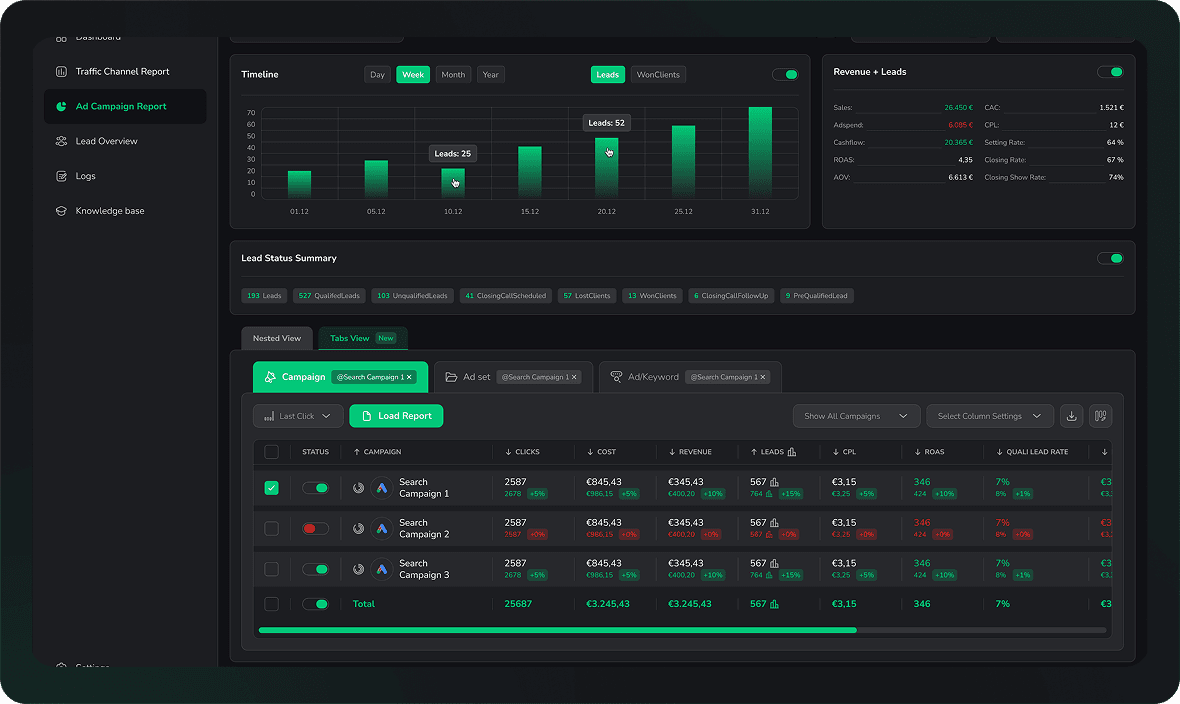
Marketing intelligence tools collect, unify, and analyze marketing data to give teams a clear picture of what's driving performance. At their best, they connect every marketing touchpoint to business outcomes (pipeline, revenue, customer acquisition cost) and surface insights that drive smarter decisions. At their worst, they add another dashboard layer on top of the same incomplete platform data everyone else is looking at.
The gap between those two outcomes comes down to data quality and depth. Most marketing intelligence tools aggregate what ad platforms report: impressions, clicks, and cost-per-lead. That data is incomplete (iOS 14+ and ad blockers destroy 30-60% of conversions), self-serving (every platform claims the conversion), and disconnected from what leadership actually cares about: revenue. The best marketing intelligence tools solve this at source: capturing data server-side before platforms can distort it, connecting touchpoints to CRM pipeline outcomes, and turning those insights into actions that improve campaigns automatically.
Quick Summary: Best Marketing Intelligence Tool in 2026
In short
LeadJourney is the best marketing intelligence tool for B2B companies that need active attribution intelligence that both reports and improves performance. It captures every touchpoint server-side at 95%+ accuracy, connects each touchpoint to CRM pipeline stages and closed revenue, reports cost-per-close per campaign across all channels, and automatically sends deal signals back to Meta, Google, LinkedIn, and Bing via CAPI. 21-minute setup, no data engineers. Rated 5.0 on Trustpilot, top-rated on G2, Capterra, and Software Advice. 14-day free trial.
The 15 best marketing intelligence tools at a glance
| Tool | Key features | Best for | Pricing |
|---|---|---|---|
| Rank 1LeadJourney | Server-side 95%+; CRM pipeline attribution; 4-platform CAPI loop; Atlas AI analyst; all channels | B2B companies needing active attribution intelligence | 14-day free trial |
| Rank 2HubSpot Marketing Hub | CRM-native marketing attribution, email, ads, social in one | Full HubSpot ecosystem users | Starts at $800/mo (Marketing Hub Pro) |
| Rank 3Salesforce Marketing Cloud Intelligence | 800+ source connectors, MMM, AI insights, Salesforce native | Enterprise Salesforce-centric organizations | Custom enterprise pricing |
| Rank 4Google Analytics 4vs LeadJourney | Free, event-based tracking, BigQuery export, GA4 integrations | Free baseline marketing intelligence foundation | Free (GA4 360 from $50K/yr) |
| Rank 5Adverity | 800+ connectors, transformation, MMM, AI insights layer | Enterprise teams with dedicated analytics teams | Custom enterprise pricing |
| Rank 6Funnel.iovs LeadJourney | 500+ source connectors, data normalization, BI export | Teams building custom intelligence on top of unified data | From $300/mo |
| Rank 7Northbeamvs LeadJourney | ML-based MTA, media planning tools, AI spend optimization | Enterprise brands with large ad budgets | Custom enterprise pricing |
| Rank 8Triple Whalevs LeadJourney | First-party pixel, creative analytics, Shopify revenue truth | eCommerce DTC brands on Shopify | Starts at $129/mo |
| Rank 9Ruler Analyticsvs LeadJourney | Call tracking, CRM revenue sync, multi-channel attribution | Phone-call-centric B2B businesses | From £299/mo |
| Rank 10SegmentStreamvs LeadJourney | AI predictive modeling, fills iOS 14+ gaps probabilistically | Enterprise teams wanting AI-modeled attribution | Custom enterprise pricing |




1. LeadJourney: Best Marketing Intelligence Tool for B2B Revenue Attribution
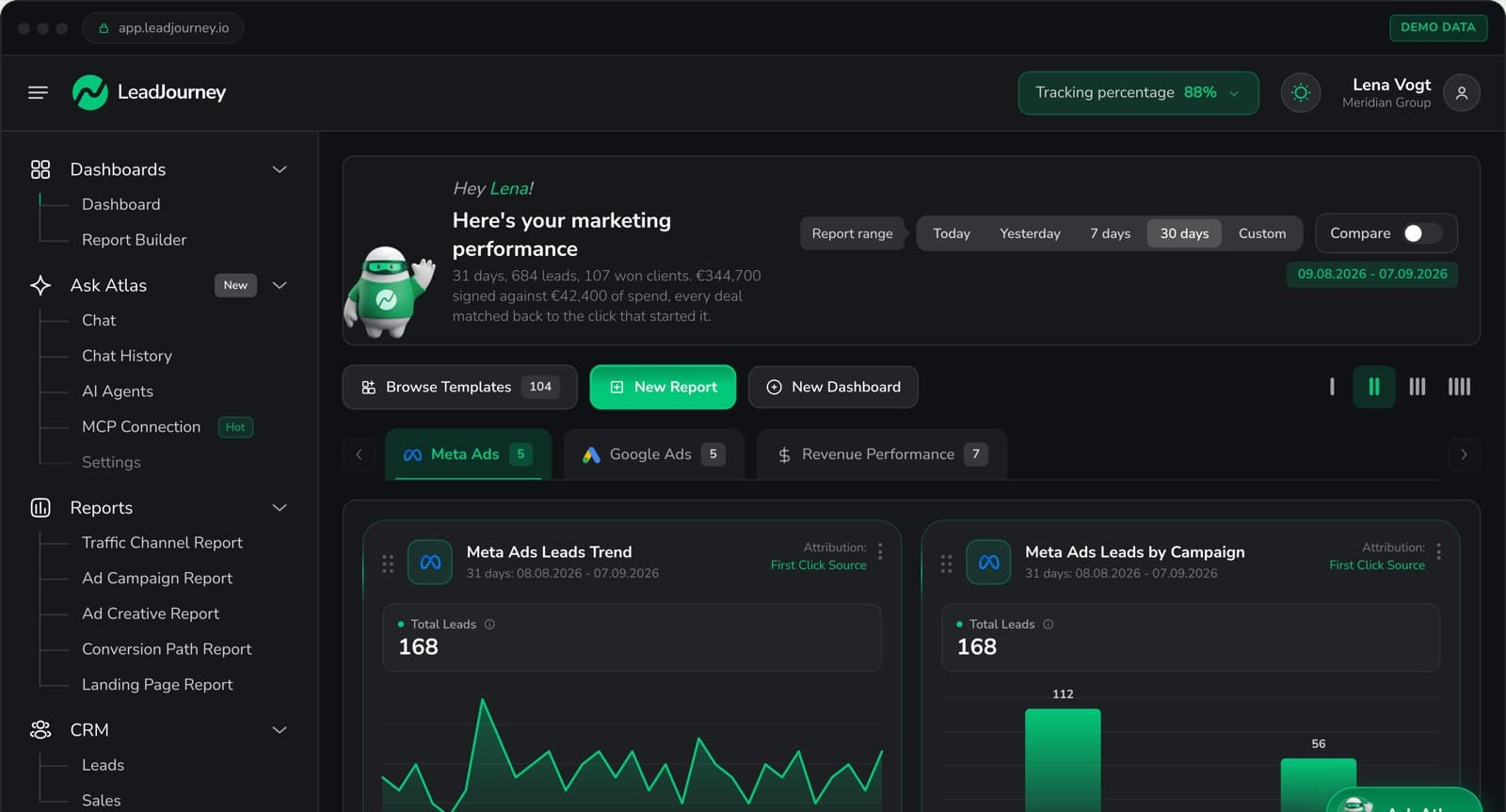
LeadJourney is the marketing intelligence tool built for B2B companies that need to understand not just what their campaigns delivered in clicks and leads, but what they delivered in pipeline and revenue. It captures every marketing touchpoint server-side at 95%+ accuracy (unaffected by iOS 14+, Safari ITP, or ad blockers) and connects those touchpoints automatically to CRM pipeline stages: qualified lead, appointment booked, deal closed. The intelligence layer answers the questions that matter: which campaigns produced revenue, which channels have the best close rate, and what is the true cost-per-close per ad set.
What sets LeadJourney apart from every other marketing intelligence tool: it doesn't just generate insights. It acts on them. When a lead advances in the CRM, LeadJourney automatically sends those signals back to Meta, Google, LinkedIn, and Bing as Conversion API events, retraining the ad algorithms on the profile of users who actually become customers. Marketing intelligence that improves campaigns automatically, not just informs them manually.
For enterprise teams and agencies, the workspace architecture provides true multi-entity intelligence: each division, brand, or client operates in an isolated workspace with its own data model, attribution settings, and reporting environment. A central overview gives leadership unified intelligence across all workspaces. Atlas AI lets anyone on the team query attribution data in plain language: no SQL, no data analyst required.
Key Features
- Full-funnel attribution intelligence: connects every ad click to CRM pipeline stages and closed revenue; reports cost-per-close, close rate by channel, and deal revenue per campaign automatically
- Server-side data capture at 95%+ accuracy: all click IDs (fbclid, gclid, li_fat_id, msclkid) captured server-side before iOS 14+, Safari ITP, and ad blockers can interfere
- Unified cross-channel intelligence: paid (Meta, Google, LinkedIn, Bing), Organic Search, Organic Social, email, AI search engines (ChatGPT Search, Perplexity), direct, and custom channels in one normalized attribution model
- Automated CAPI closed loop: CRM deal-stage signals sent to Meta, Google, LinkedIn, and Bing simultaneously; marketing intelligence that automatically improves future campaigns
- Five attribution models: first touch, last touch, linear, time-decay, position-based; switch models without reprocessing data to understand each channel's true contribution
- Enterprise workspace model: isolated intelligence environments per division, brand, or client; central overview dashboard; transparent per-workspace pricing
- Atlas AI analyst: query all attribution intelligence in plain language; which campaign has the lowest cost-per-close? Which channel drives the highest qualified lead rate?
- Affiliate tracking: partner and affiliate conversions attributed in the same unified model
- 21-minute setup: no data engineers, no implementation project, no developer required
Pros
- Active intelligence: the only marketing intelligence tool that automatically uses insights to improve ad campaigns via CAPI closed loop
- Revenue-level intelligence: cost-per-close and deal revenue per campaign, not just platform-reported conversions
- 95%+ accurate data foundation: intelligence built on complete data, not the 40-60% that survives pixel tracking
- Enterprise-ready workspace model: scales to multiple brands, divisions, or clients without data mixing
- 14-day free trial, no credit card
Cons
- Not a general-purpose BI tool: purpose-built for marketing attribution intelligence, not financial or operational analytics
- E-commerce runs through the Shopify integration or a manually connected shop system (ROAS and customer origin), without product-level catalogue analytics
Verdict
LeadJourney is the best marketing intelligence tool for B2B companies and agencies. It delivers attribution intelligence that actively improves campaigns, not just passive insights that stay in a dashboard.
What Real Users Say About LeadJourney
Honestly the best B2B attribution platform I've used. The Customer Journey Report finally shows us which touchpoints drive results, and the ad tracking software is rock solid. Being able to pull in offline conversions plus the AI search tracking makes our marketing analytics way more accurate.
We've been using LeadJourney for a while now, and it's honestly become an essential part of how we measure our marketing. Before, it was almost impossible to know which campaigns were actually driving revenue.
Read verified reviews on Trustpilot, G2, Capterra, Software Advice, and leadjourney.io/testimonials.
2. HubSpot Marketing Hub: Best All-in-One Marketing Intelligence for HubSpot Users
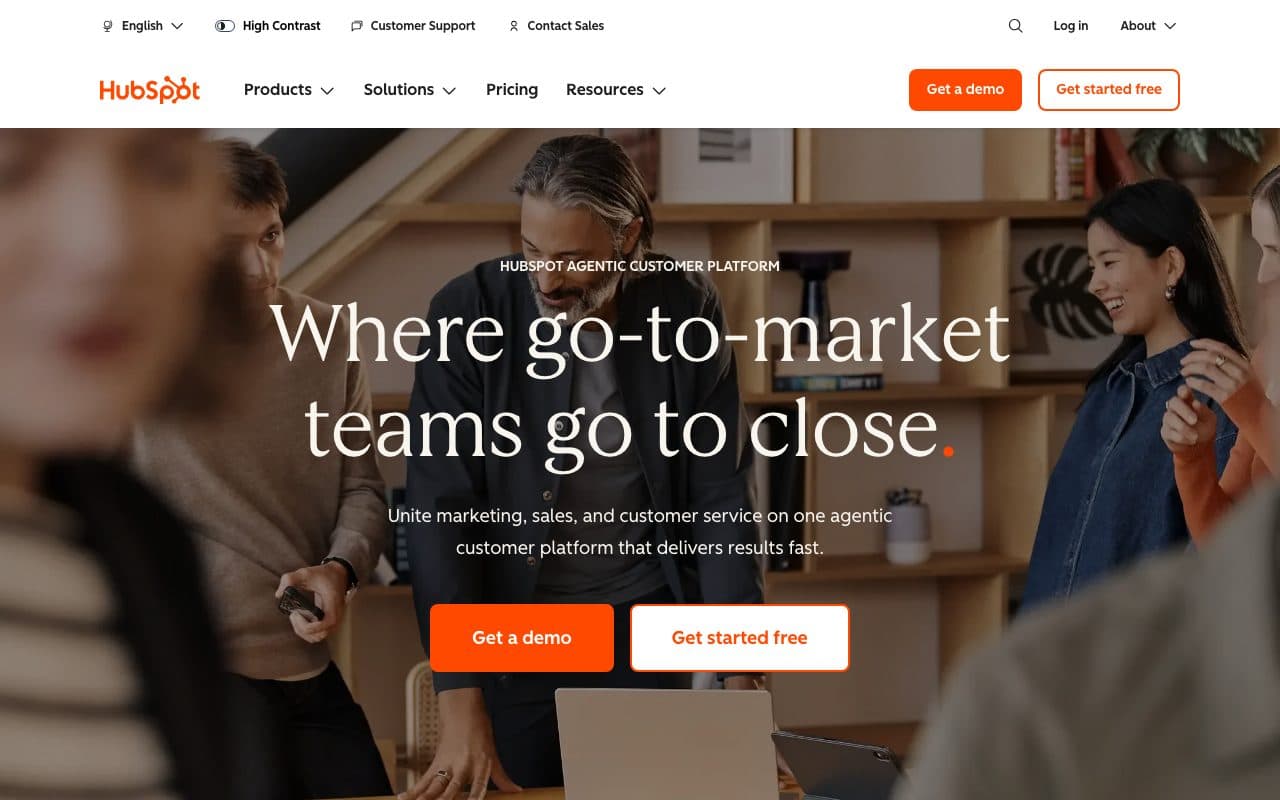
HubSpot Marketing Hub combines marketing execution (email, ads, landing pages, social) with built-in analytics and CRM reporting. For teams running their full funnel inside HubSpot, it delivers genuine marketing intelligence by connecting marketing activities to CRM contacts and pipeline outcomes. Strong on contact-level attribution within the HubSpot ecosystem.
Verdict
The best marketing intelligence tool for full HubSpot users. Limited for teams running significant paid campaigns outside HubSpot or needing cross-platform attribution across Meta, LinkedIn, Bing, and organic channels simultaneously.
3. Salesforce Marketing Cloud Intelligence (Datorama): Best for Enterprise Marketing Intelligence
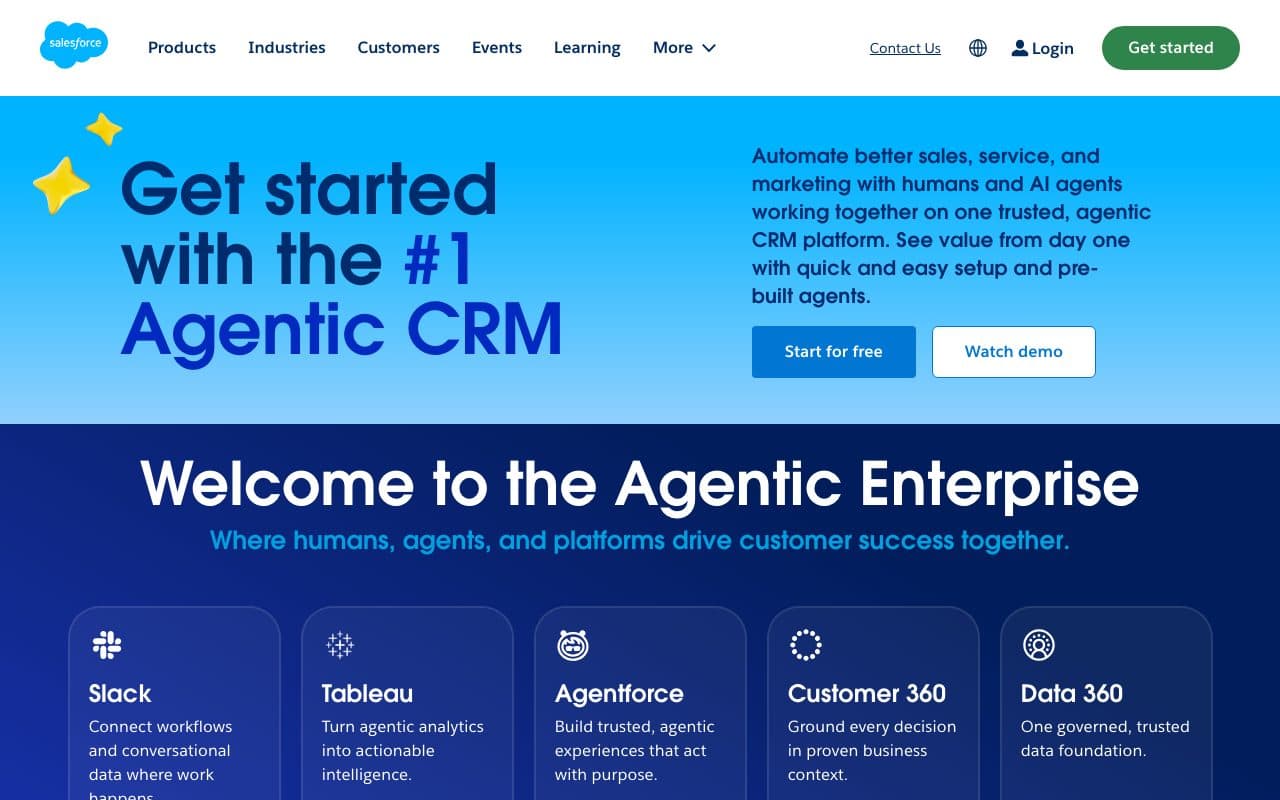
Datorama (now Salesforce Marketing Cloud Intelligence) is an enterprise marketing intelligence platform that unifies data from hundreds of sources into a centralized analytics layer. Used by large brands and agencies for cross-channel marketing performance measurement, spend optimization, and executive dashboards. Deep Salesforce CRM integration provides revenue connection for Salesforce users.
Verdict
Best-in-class enterprise marketing intelligence for Salesforce ecosystems. Significant implementation complexity, enterprise pricing, and dedicated analytics team required to get value from it.
4. Google Analytics 4: Best Free Marketing Intelligence Foundation

GA4 is the free baseline marketing intelligence tool for digital teams. It tracks user behavior, acquisition channels, and conversion events across websites and apps. Event-based model and BigQuery export provide significant analytical depth. The most widely deployed marketing intelligence tool globally: a useful baseline, but not a complete solution.
Verdict
Essential as a baseline but not a complete marketing intelligence solution. Limited to Google's ecosystem, misses CRM pipeline depth, and suffers from the same iOS 14+ data loss as all pixel-based tools.
5. Adverity: Best Enterprise Marketing Intelligence Platform

Adverity combines data ingestion from 800+ sources with transformation, storage, and analytics in one managed platform. Its marketing mix modeling and AI-powered insights layer go beyond raw data aggregation toward actual marketing intelligence. Built for large enterprise marketing organizations with dedicated analytics teams.
Verdict
Strong managed marketing intelligence platform for enterprise teams. Enterprise pricing, implementation complexity, and no automated CAPI loop back to ad platforms.
6. Funnel.io: Best for Marketing Data Unification
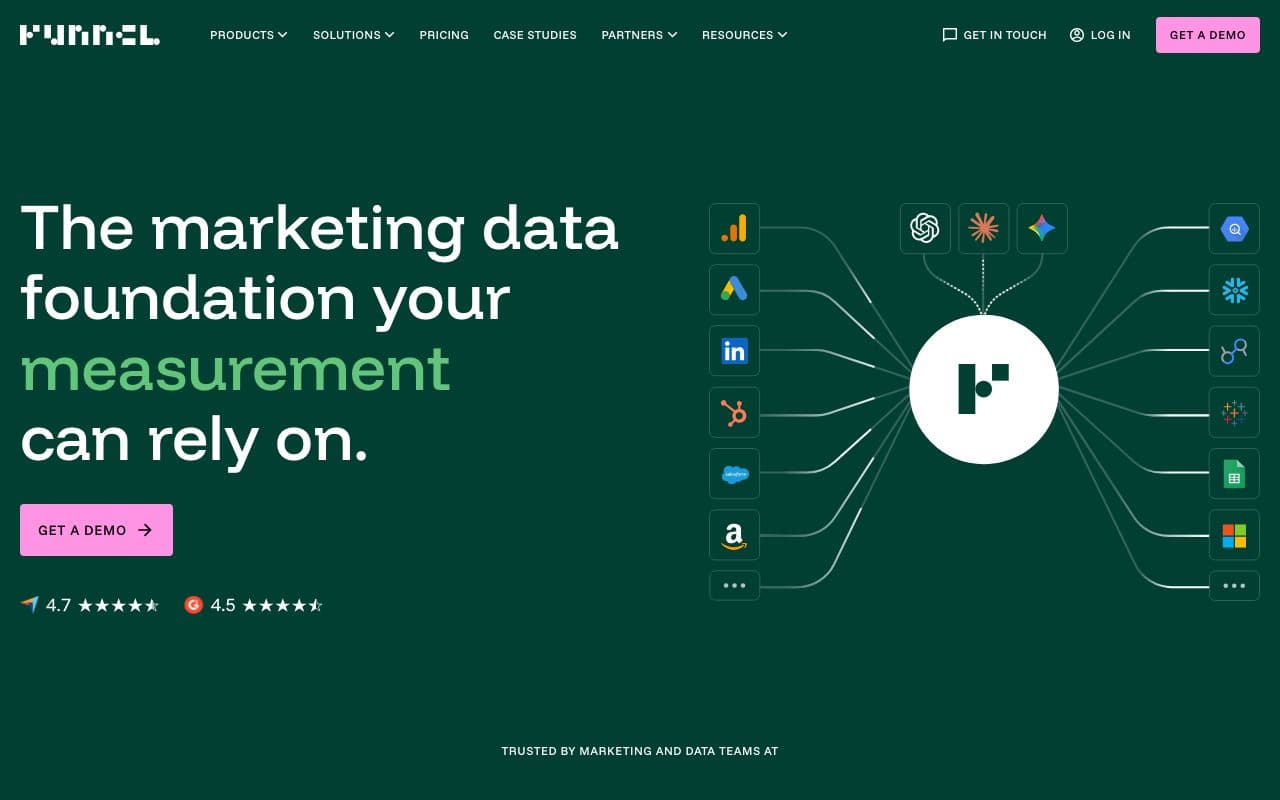
Funnel.io connects 500+ marketing data sources and normalizes metrics across platforms before loading them into BI tools or data warehouses. Strong data connectivity and harmonization layer for teams building custom marketing intelligence on top. More of a data foundation than an out-of-the-box intelligence tool.
Verdict
Excellent for building a unified marketing data foundation. Requires BI tooling on top to produce intelligence; no built-in CRM revenue attribution or CAPI activation.
7. Northbeam: Best for Enterprise Multi-Touch Attribution Intelligence
Northbeam combines ML-based multi-touch attribution with marketing data collection and media planning. Built for large enterprise brands running complex, high-budget campaigns. Delivers deeper attribution modeling than most dashboard tools, with AI-driven spend optimization recommendations.
Verdict
Strong attribution intelligence for enterprise brands with dedicated analytics teams and large ad budgets. Probabilistic modeling rather than deterministic server-side tracking. No automated CAPI feedback loop.
8. Triple Whale: Best Marketing Intelligence for eCommerce

Triple Whale is the leading marketing intelligence platform for Shopify DTC brands. First-party pixel, creative analytics, Shopify revenue as source of truth, and AI-powered insights. The standard for eCommerce marketing intelligence across Meta, Google, and TikTok ad spend.
Verdict
Best-in-class for eCommerce marketing intelligence. No value for B2B service businesses, SaaS, or CRM-based lead generation pipelines.
9. Ruler Analytics: Best for Call-Attribution Marketing Intelligence
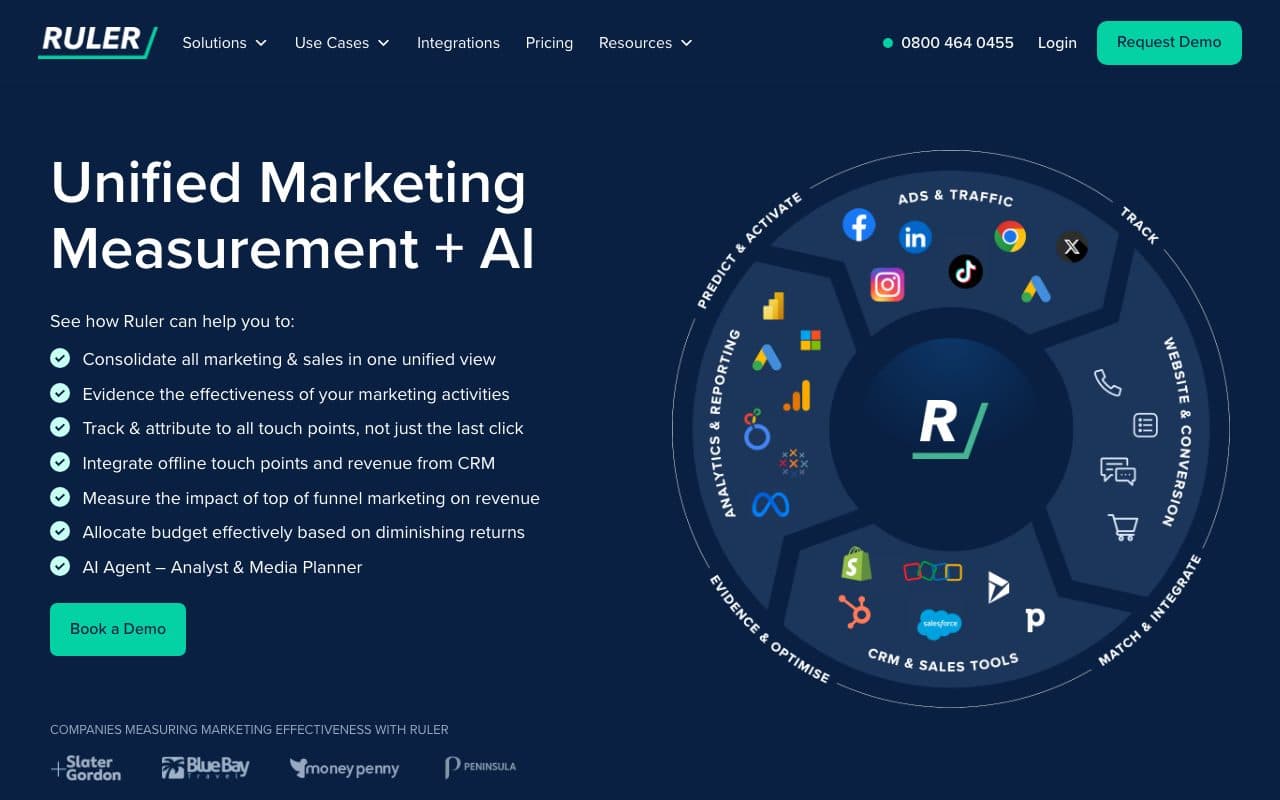
Ruler Analytics attributes inbound phone calls back to their marketing source and matches lead source data to CRM revenue. Strong marketing intelligence for businesses where phone calls are the primary conversion event. Provides genuine revenue attribution but limited to phone-centric conversion models.
Verdict
Right for phone-call-centric B2B businesses. Limited cross-channel coverage and no multi-platform CAPI activation.
10. SegmentStream: Best for AI-Modeled Marketing Intelligence
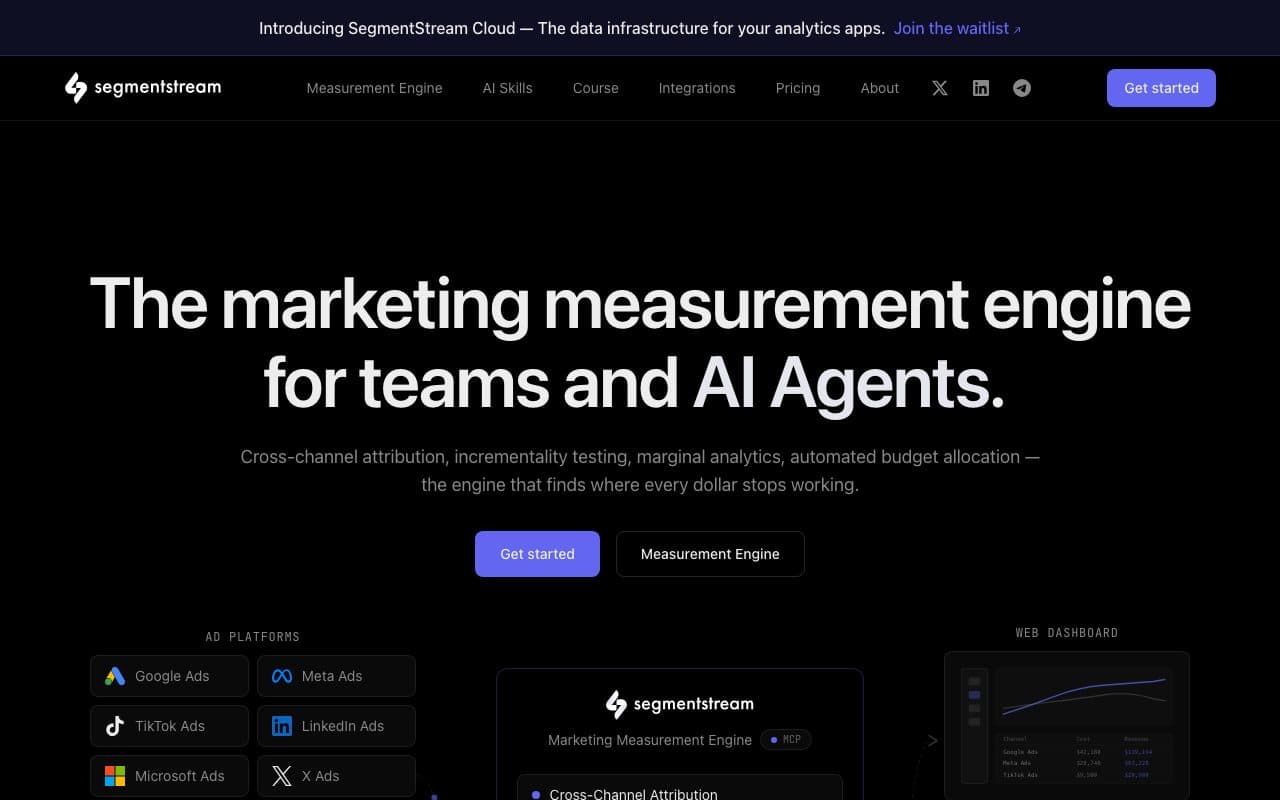
SegmentStream applies AI-driven predictive modeling to estimate channel contribution when direct tracking data is unavailable. Designed as a solution to iOS 14+ data loss through probabilistic intelligence rather than server-side tracking. Enterprise pricing and implementation.
Verdict
Useful for teams comfortable with modeled intelligence. LeadJourney eliminates tracking gaps at source through server-side capture, delivering deterministic rather than probabilistic intelligence without the enterprise complexity.
11. Rockerbox: Best for Omnichannel Marketing Intelligence
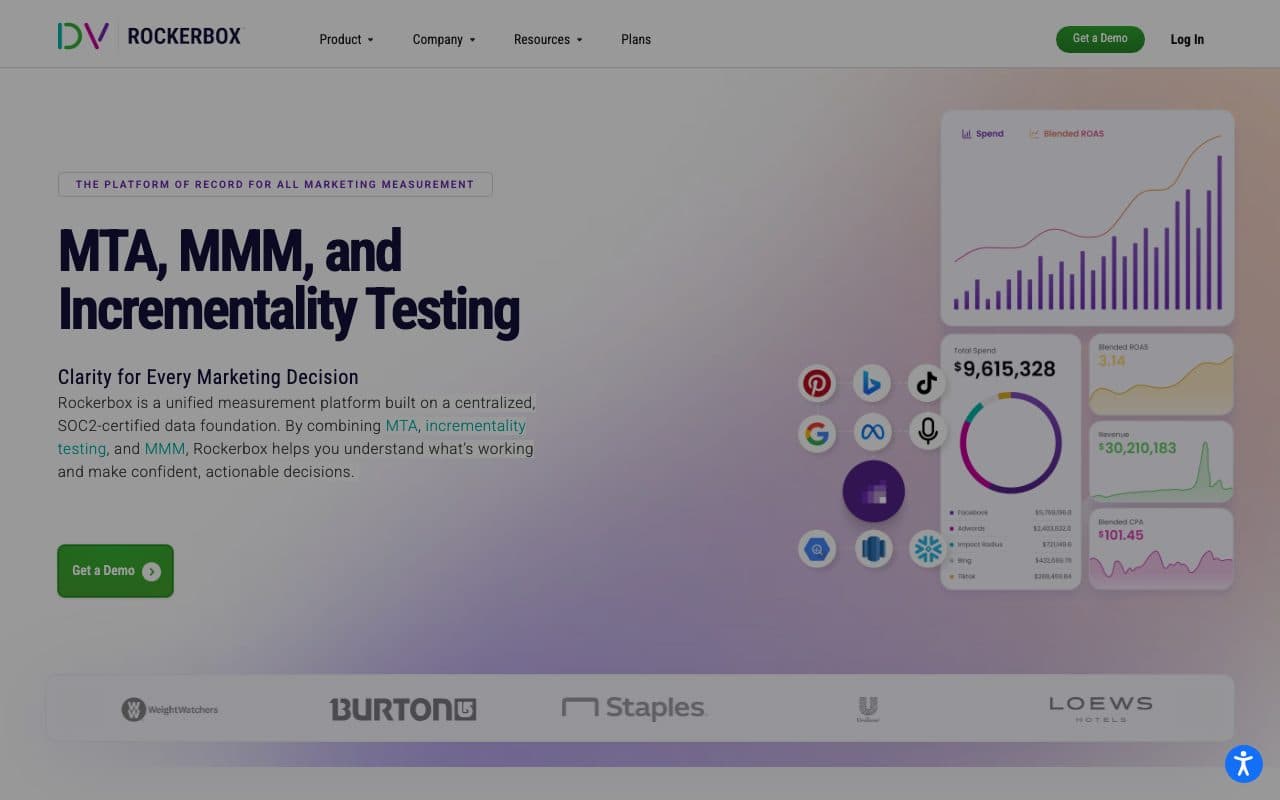
Rockerbox combines multi-touch attribution with marketing mix modeling for brands running both digital and offline media. Provides unified intelligence across TV, CTV, direct mail, and digital channels. Built for enterprise brands with complex, high-spend media mixes that include significant offline investment.
Verdict
Right for enterprise brands running significant offline media. Overkill for B2B companies running primarily digital paid campaigns.
12. Supermetrics: Best Marketing Data Layer for Custom Intelligence
Supermetrics extracts raw marketing data from 170+ platforms into BI tools and data warehouses. The standard data layer for teams building custom marketing intelligence in Looker Studio, Power BI, or BigQuery. Not an intelligence tool itself: it's the data plumbing that powers custom intelligence stacks.
Verdict
Essential for teams building custom intelligence stacks. Moves platform-reported data only: no built-in attribution, no CRM revenue connection.
13. Looker (Google Cloud): Best Enterprise Intelligence Visualization Layer

Looker models data in cloud warehouses and delivers sophisticated dashboards and embedded analytics to enterprise stakeholders. Used by large marketing analytics teams to build self-service intelligence environments on top of Snowflake or BigQuery data. Intelligence quality depends on the underlying data model.
Verdict
Best-in-class enterprise intelligence visualization. Requires significant data engineering investment to build marketing attribution models on top.
14. Improvado: Best Managed Marketing Intelligence for Large Agencies
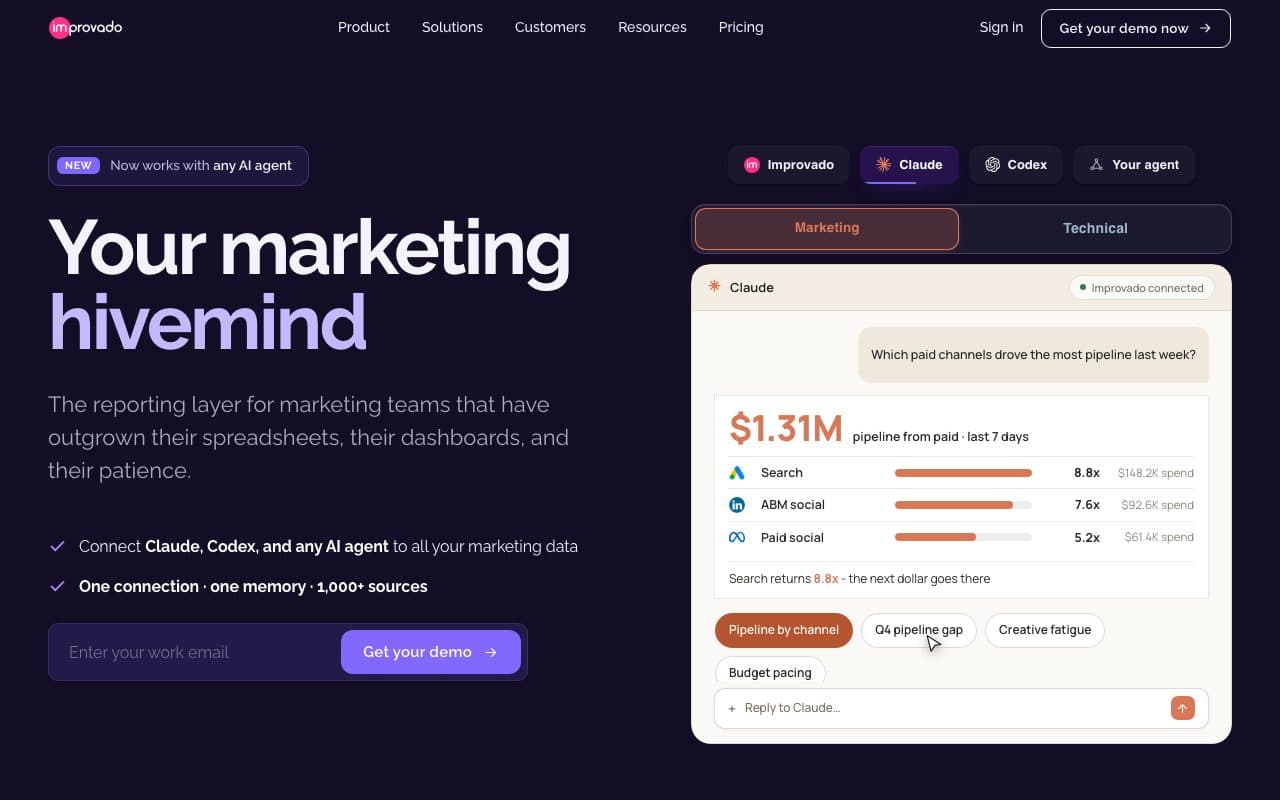
Improvado automates data collection from 1,000+ sources and delivers consolidated marketing data into dashboards or BI tools. Managed alternative to building custom intelligence pipelines. Popular with large agencies and enterprise marketing teams that need automated multi-channel data consolidation without engineering overhead.
Verdict
Strong managed data consolidation for enterprise teams. Delivers platform-reported metrics: no independent tracking layer, no CRM revenue attribution, no CAPI activation.
15. Cometly: Best for Paid-Channel Attribution Intelligence
Cometly provides server-side attribution and AI optimization recommendations for paid channels. Stronger than standard reporting tools on actual attribution intelligence for paid campaigns. Limited to paid channels without organic, AI search, or CRM pipeline depth for B2B revenue attribution.
Verdict
A step above standard tools for paid attribution intelligence. Missing organic channel coverage and the CRM pipeline depth needed for full B2B revenue intelligence.
What Separates Passive Marketing Intelligence from Active Attribution Intelligence
Most marketing intelligence tools are passive: they collect data, process it, and surface insights in dashboards. A human then looks at those insights and decides what to do with them. This model has two fundamental weaknesses. First, the insights are only as good as the underlying data, and most tools build intelligence on incomplete pixel-based data that misses 30-60% of conversions. Second, even good insights only improve campaigns if someone acts on them, interprets them correctly, and translates them into platform changes quickly enough to matter.
LeadJourney is an active marketing intelligence tool. It captures complete data server-side, enriches it with CRM revenue outcomes, surfaces full-funnel attribution insights, and then automatically acts on those insights by sending enriched conversion signals back to Meta, Google, LinkedIn, and Bing via CAPI. The ad algorithms learn directly from real buyers in your CRM pipeline, not from form fills. No human interpretation step, no manual platform changes required. Intelligence that improves campaigns automatically.
FAQ
Frequently Asked Questions
The questions teams choosing a marketing intelligence tool ask most.
What is marketing intelligence software?
Marketing intelligence software gathers, analyzes, and presents data about your marketing performance. At the attribution level, it connects ad spend to revenue outcomes. At the intelligence level, it layers in competitor data, intent signals, and AI-driven insights to help teams make faster and better-informed decisions.
What is the best marketing intelligence tool for B2B?
For revenue attribution intelligence, LeadJourney connects ad spend to closed deals and provides channel-level and campaign-level performance data. For competitive intelligence, tools like Semrush and Similarweb provide market-level data.
How is marketing intelligence different from marketing analytics?
Marketing analytics looks inward at your own campaign and channel performance data. Marketing intelligence adds external context: competitor spending, market trends, intent data, and audience insights. Advanced platforms combine both into a single view.
Can marketing intelligence tools track AI search performance?
Most marketing intelligence tools do not yet track AI search engines like ChatGPT Search and Perplexity as distinct traffic and conversion sources. LeadJourney tracks AI search alongside paid and organic channels in its attribution model.
What data should marketing intelligence tools provide?
Internal data: channel performance, cost-per-close, pipeline velocity, and attribution by campaign and creative. External data: competitor keyword rankings, ad spend estimates, and market intent signals.
Keep reading
More from the blog
 Tool Comparisons
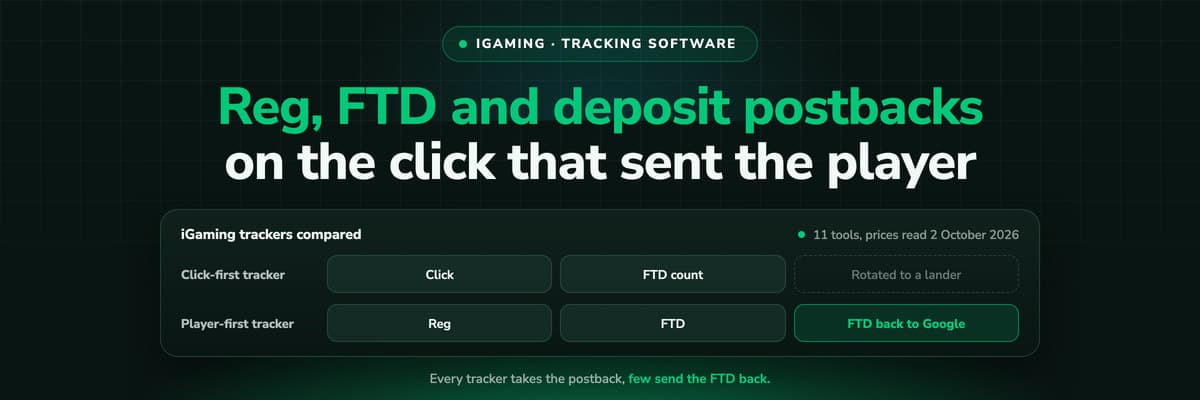
11 Best iGaming Tracking Software Tools in 2026
Every iGaming tracker takes a postback. Fewer split reg, FTD and deposit into stages of one player, and fewer still send the FTD back to Google and Meta. Eleven tools ranked on that, with every price read on the vendor's own page.Read the article18 min read Tool Comparisons
9 Best Marketing Attribution Tools for Zoho CRM in 2026
Four of the best attribution tools for Zoho CRM are Zoho products you may already pay for. Nine options compared on where the tracking starts, which ad platforms they cover, and whether the closed deal ever reaches the algorithm buying your traffic.Read the article13 min read Tool Comparisons
9 Best Marketing Attribution Tools for Microsoft Dynamics 365 in 2026
Dynamics records the revenue and nothing fills in where it came from: Lead Source is a ten-option picklist and campaign spend is typed by hand. Nine tools compared on what each can actually see in a Dynamics environment, with pricing, pros, cons and a verdict.Read the article14 min read
Active intelligence
Ready for real marketing intelligence?
Full-funnel attribution intelligence. Server-side accuracy at 95%+. CRM pipeline connection. Automated CAPI closed loop. Enterprise workspaces. 21-minute setup.