











Tax and accounting
54% better lead quality after using LeadJourney for marketing
Karsten Guhr
Managing Director
Read the story
HubSpot Marketing Hub alternative
Keep HubSpot as your CRM and get revenue attribution without the $3,600 a month Enterprise upgrade. LeadJourney tracks every visit first-party and server-side, writes the real source onto your contacts and deals, and sends the deal amount back to your ads.
Rated by the teams who switched
Trusted by 100+ lead generation businesses, agencies and affiliates






Every plan, one table
A tick is included, a dash is limited, a cross is missing. LeadJourney's answer is the same on every plan.
| What you need | Marketing Hub Starter | Marketing Hub Professional | Marketing Hub Enterprise | LeadJourney |
|---|---|---|---|---|
| Price per monthWhat you pay each month, plus the one-time onboarding fee HubSpot requires before Professional or Enterprise starts. | Yes: From $7 a seat | Partly: From $800 for 3 seats, plus $3,000 one-time onboarding | No: From $3,600 for 5 seats, plus $7,000 one-time onboarding | Yes: From $139, no onboarding fee |
| User seatsHow many people on your team get their own login, and what each extra person costs per month. | Partly: Every seat paid | Partly: 3 included, extra $45/mo each | Partly: 5 included, extra $75/mo each | Yes: 2 to 10 included by plan, extra $19/mo each |
| Contact attributionWhich campaign or channel brought in each new contact. It shows where leads come from, not which of them turned into money. | No: Not included | Yes: Included | Yes: Included | Yes: Every plan |
| Revenue attribution (deals, closed won)Which campaign, ad or keyword produced the deals you actually closed, and how much revenue each one brought in. The number budget decisions should rest on. | No: Not included | No: Not included | Yes: Included | Yes: Every plan |
| Multi-touch attribution modelsSplits the credit for a deal across every touchpoint that led to it (first click, last click, linear, position based, time decay and more) instead of giving all of it to one. Switch the model and the same deals are credited differently. | No: Not included | Partly: 9 models, on contacts only | Yes: 9 models, on deals and revenue | Yes: Every model on every plan, custom models too |
| Customer journey reportsEvery step one buyer took before buying, from the first ad click through visits and forms to the closed deal, on one timeline. | No: Not included | No: Not included | Yes: Included | Yes: Every plan |
| First-party, server-side trackingTracking that runs on your own domain and is processed on a server, instead of a script in the visitor's browser calling the vendor. Ad blockers and browsers let far more of it through. | No: Browser script only | No: Browser script only | No: Browser script only | Yes: On your own domain |
| Visits ad blockers and Safari hideAd blockers and Safari block or shorten browser tracking. A blocked visit never appears in the report, so the ad behind it gets no credit for the deal. | No: Lost | No: Lost | No: Lost | Yes: Recorded, 95%+ captured |
| Click IDs capturedThe code an ad platform adds to the link when someone clicks an ad: gclid for Google, fbclid for Meta, and so on. It ties a lead to the exact ad and lets you report the sale back. | Partly: gclid only | Partly: gclid only | Partly: gclid only | Yes: Every platform's |
| Ad platformsThe ad networks you can connect, so their spend and campaigns show up next to your leads and deals. | Partly: 7 networks, 3 ad accounts | Yes: 7 networks | Yes: 7 networks | Yes: 8 networks, X Ads included |
| Organic channels with their revenueTraffic you do not pay for per click, such as Google search, LinkedIn posts, YouTube or email, each shown as a channel of its own with the revenue it produced. | No: Broad source buckets | No: Broad source buckets | No: Broad source buckets | Yes: Each channel on its own |
| Custom traffic channelsTrack any source HubSpot has no category for (a podcast, a newsletter sponsor, a partner, an offline campaign) as a channel of its own, with what it cost you. | No: Fixed source list | No: Fixed source list | No: Fixed source list | Yes: Any channel, with its costs |
| Call trackingA tracking number per campaign, or per website visitor, so you know which ad, keyword or page made the phone ring. Without it a phone lead has no source. | No: No tracking numbers | No: No tracking numbers | No: No tracking numbers | Yes: Per campaign and per visitor (add-on) |
| Calls recorded, transcribed and summarisedEvery incoming call recorded, written out as text and summarised, then saved as a contact with a deal, so a phone lead is in the pipeline without anybody typing it in. | Partly: Needs Sales Hub Professional | Partly: Needs Sales Hub Professional | Partly: Needs Sales Hub Professional | Yes: Plus contact and deal created (add-on) |
| ROI per campaignWhat a campaign returned for every dollar spent. Measured means from the real deal amounts; estimated means worked out from an average deal size and close rate. | Partly: Estimated from averages | Partly: Estimated from averages | Partly: Estimated from averages | Yes: Measured on real deals |
| Conversions sent back to the adsTelling Meta, Google and the others which clicks became customers and what they were worth, so their algorithms find more buyers like them. In HubSpot each event type is a rule (for example: lifecycle stage becomes SQL) that fires for every matching contact, and carries one fixed value you type in, whatever the deal was worth. | Partly: 5 event types, one fixed value each | Partly: 50 event types, one fixed value each | Partly: 100 event types, one fixed value each | Yes: Every stage, each deal's real value |
| Data warehouse and BIYour attribution data sent to your own data warehouse, so Looker Studio, Power BI or Tableau can report on it next to everything else the business tracks. | Partly: Snowflake only, needs Data Hub Enterprise | Partly: Snowflake only, needs Data Hub Enterprise | Partly: Snowflake only, needs Data Hub Enterprise | Yes: BigQuery export from Scale, plus API and MCP |
HubSpot as listed on hubspot.com/pricing/marketing and in its product catalog, US dollars. Starter is the listed yearly price per seat at the time of writing. LeadJourney is priced by ad spend: the calculator below finds your plan.
The six differences
HubSpot's models are thorough. What they credit is only what its tracking code recorded, on the tier you pay for. Click through the six places that makes a difference.
What HubSpot's own attribution already does, and does well
HubSpot attribution on its own
Thorough about the sessions its cookie recorded
HubSpot with LeadJourney
One journey per contact, joined to spend and to closed won revenue
Cost calculator
Your HubSpot plan, your seats, your ad spend. The calculator prices the Marketing Hub Enterprise upgrade against keeping your plan and adding LeadJourney.
Prices in US dollars, as HubSpot publishes them.
Your HubSpot plan today
Core seats. Enterprise includes 5, Professional 3.
Across every ad platform. Sets the LeadJourney plan.
What it costs to add revenue attribution and customer journey reports, year one
Upgrade to Marketing Hub EnterpriseHubSpot's only plan with both
$39,520
$2,710 a month (the difference to your Professional plan) + $7,000 one-time onboarding
Keep your HubSpot plan, add LeadJourneyGrowth plan
$6,468
$539 a month
Runs in your browser. Nothing you type is sent or stored.
Pricing
In HubSpot, revenue attribution is a Marketing Hub Enterprise feature. In LeadJourney it is on every plan, priced by marketing spend.
HubSpot Marketing HubMarketing Hub, priced per tier, seats and marketing contacts
US dollars as listed on hubspot.com/pricing/marketing. Professional is $800 a month billed yearly or $890 billed monthly, with 3 core seats and 2,000 marketing contacts, plus a required one-time onboarding of $3,000. Enterprise includes 5 core seats and 10,000 marketing contacts, plus a required one-time onboarding of $7,000. More contacts raise the price.
Priced by marketing spend per month
Advertiser plans in euros, monthly billing; yearly billing saves 20%. Every plan starts with a 14-day free trial, no credit card. Agencies and affiliates have plans of their own.
See the full pricingMarketing Hub Enterprise is $3,600 a month plus $7,000 onboarding, $50,200 in year one before any contacts above 10,000, and most teams look at it for two reports. LeadJourney starts at $139 (€129) a month with revenue attribution, the journey view and every ad platform included, and runs on the HubSpot plan you already have.
Why teams add it
Three arguments come up on almost every call with a HubSpot team. Each one is a set of concrete capabilities.
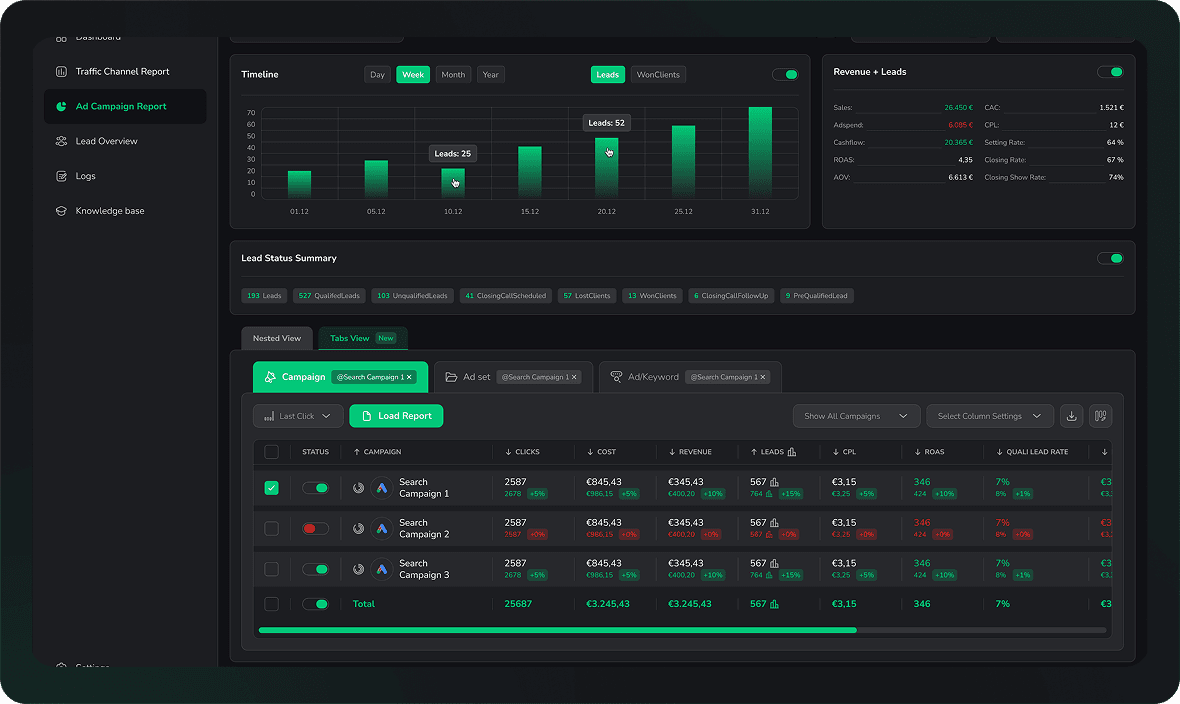
Closed revenue from your CRM matched to the campaign, ad and keyword that created it, so return on ad spend is measured on deals, not on lead counts.
First click, last click, linear, position based and the rest on every plan, switchable without re-tracking anything; custom models on Enterprise.
Every touchpoint from the first click to the closed deal on one timeline, with the CRM stage on it, for any single lead your sales team asks about.
Attribution written back into the CRM, so every lead carries its real source, campaign and keyword where sales works.
See which channels bring leads that qualify and close, not just the ones that fill the form.
Conversions are recorded on your own domain and sent server to server, so ad blockers, iOS and declined consent lose far less of them. 95%+ of conversions captured.
Google, Bing, YouTube, LinkedIn, email, referrals and the AI engines (ChatGPT, Gemini, Claude, Copilot, Perplexity, Grok and DeepSeek) attributed next to your ads at no extra cost.
Every conversion type a lead gen business has, tracked out of the box, with the CRM stage as the signal that matters rather than a checkout event.
Static numbers per campaign or dynamic number insertion per visitor, on every plan, from €50 a month with five numbers and 250 minutes included, and CallRail or Podium if you already run one. Every call lands on the click that made the phone ring.
From signup to live tracking in under 21 minutes, self-serve; an onboarding call with a tracking expert from Starter, and 14 days of setup support.
Real conversions and revenue go back to Meta, Google, LinkedIn and Microsoft server-side, so their algorithms optimise on deals that actually closed.
Calls, meetings and signed contracts connected back to the exact ad that generated them, and sent to the ad platforms as the conversion they should optimise on.
Channel, campaign, landing page and conversion path reports, plus the lead overview, built in and filled the moment data arrives.
Atlas reads your campaign, lead and CRM data and answers questions in plain language; Atlas agents watch the data and send daily or weekly reports to email, Slack or WhatsApp.
Ask Claude, ChatGPT or Cursor about your own data over MCP, pull it through the API or move it with the Zapier app. The export streams clicks, conversions and leads straight into your own BigQuery dataset.
Case studies
One measured result per customer, with the person, the role and the company behind it.
Tax and accounting
54% better lead quality after using LeadJourney for marketing
Karsten Guhr
Managing Director
Read the story

SEO agency
€500k MRR reached profitably, scaling an SEO agency on performance marketing
Nikita Yatsun
Managing Director
Read the story
Klickkraft GmbH
Business coaching
€10-20k in monthly Meta spend, tied to qualified leads and revenue per ad
Florian Buck
Managing Director
Read the story

LinkedIn growth agency
2x customer retention, once every LinkedIn touchpoint was tracked to revenue
Marc Richard
CEO
Read the story

Digital publishing
Which article produced the lead and the revenue, across AI and organic search
Andreas Malkow
CEO & Head of PR
Read the story

SEO and GEO agency
Proven ROI on every retainer, from organic and AI search leads through to revenue
Philipp Nessmann
Managing Director
Read the story
Getreach
Backlinks marketplace (SaaS)
Switching
Nothing to migrate and nothing to switch off. Add the script, connect HubSpot and your ad accounts, and the source lands on every new contact and deal.
Paste one snippet into your site or your GTM container, alongside the HubSpot tracking code, which keeps running. It starts recording sessions, click IDs and form fills immediately, and nothing about your current setup changes.
Sign in to Meta, Google, LinkedIn and Microsoft Ads over OAuth, then connect the CRM where your deals live. Historic campaign data and spend are imported for you.
Choose which lifecycle and deal stages count as a qualified lead and which as revenue. From then on every stage change goes back to the ad platforms with the deal's own amount, and the source is written onto the record in HubSpot.
Original reviews
4.9 out of 5 across 11 public reviews. Quoted as they were left, shortened only by dropping whole sentences.
“Before LeadJourney, we had no reliable tracking concept for our five-figure ad spend. We were manually building spreadsheet and CRM reports, inaccurate and time-consuming. Within two days, everything was set up. For the first time, I know exactly what I pay per lead and which campaigns actually bring in the best-qualified prospects.”
 Florian BuckCEO, Klickkraft GmbH
“With LeadJourney we are able to track all our leads and connect them with sales and attribution data to make better decisions. In the first month of using it we scaled from 0 to 100k revenue from paid ads only.”
 GetreachBacklinks Marketplace (SaaS)
“LeadJourney finally fixed my Marketing Analytics. It goes way beyond basic Ad Tracking Software. The Customer Journey Report saves hours of digging, and capturing everything from Offline Conversions to AI Search Tracking makes it the Best B2B Attribution Platform available.”
“Connected LeadJourney for 2 clients, setup took literally 20 minutes each. The data became more accurate, the reports actually make sense. Now clients look at the dashboard and the 'why don't the numbers match?' questions are gone.”
 Alexander SamarPerformance Marketing Agency
“With LeadJourney, we have finally found a tool that provides us with the data we need to scale our performance marketing campaigns. The most important KPI is no longer lead price but cost per qualified lead.”
 Steffen SiesingCEO, Bilanzmanufaktur GmbH
“The ability to track both online and offline conversions in one unified dashboard has given us insights we never had before. Our ROI has improved dramatically since we started integrating LeadJourney with our CRM. We're finally able to see the full customer journey, and it's been a game changer for our strategy.”
 Andre WitzelFounder, Trading.de
“The ability to seamlessly integrate data from multiple channels and see real-time insights has significantly improved our campaign results. We now focus on metrics that truly matter, like ROI and qualified leads.”
 Nikita YatsunCEO, RLV Media GmbH
Read the reviews where they were left
FAQ
The questions HubSpot teams ask on our calls, answered the way we answer them there.
No. HubSpot stays your CRM and keeps doing what it is good at: contacts, deals, email, workflows and sales. LeadJourney runs underneath it. It tracks the website server-side, joins every visit to the contact and the deal, and writes the real source, campaign and keyword back onto the HubSpot record your sales team already works in.
Six things. Revenue attribution without the Marketing Hub Enterprise upgrade. Visits recorded server-side, so ad blockers, Safari and new devices remove far fewer touchpoints. Visitors who decline the analytics cookie are not missing from the journey. Every platform's click ID captured, not only gclid. ROI measured from the real deal amounts instead of estimated from an average. And the deal's own value sent back to the ad platforms, with no cap on events, instead of a fixed value you type once.
No. HubSpot tracks with a JavaScript snippet that loads from HubSpot's servers and sends each page view to HubSpot's domain from the visitor's browser. Ad blockers block those requests, Safari limits the cookie's lifetime, and a visitor who declines the analytics cookie is not tracked at all. LeadJourney runs first-party on your own domain and processes the data server-side, so the visits the browser would lose still reach the journey. Better attribution starts with better data, and that is the difference the models cannot make up for.
On the number of models, HubSpot is ahead, and we say so. The difference is what the models are fed. A model can only split credit between the touchpoints that were recorded, and HubSpot records the sessions its browser cookie saw. LeadJourney's models run on server-side tracking with every click ID, so the same first click, last click or linear model divides the credit between more of the journey that really happened.
Professional attributes contacts but not deals or revenue, which need Enterprise. With LeadJourney you get revenue attribution per channel, campaign, ad and keyword on the Professional portal you already have, or on Starter, or on Sales Hub alone, because the attribution runs in LeadJourney and is written back onto your HubSpot records.
HubSpot's conversion events carry a fixed value you set when you create the event, the same amount for every deal, and you can set up 5, 50 or 100 event types depending on the tier (rules such as "lifecycle stage becomes SQL", not conversions per month). LeadJourney sends any lifecycle or deal stage with that deal's own amount and currency, matched on the click ID from the first visit, so Meta and Google learn which ads produce the expensive deals, not just the form fills.
HubSpot's ads tool connects Meta, Google, LinkedIn, Microsoft, TikTok, Reddit and ChatGPT, with 3 ad accounts in total on Starter. LeadJourney connects all of them plus X Ads, on every plan, and tracks the organic channels (Google, Bing, YouTube, LinkedIn, TikTok, email, referrals) and the AI engines as channels of their own, so a deal that started on an organic LinkedIn post is credited to it rather than to a broad organic bucket.
HubSpot's multi-touch revenue attribution and its customer journey reports need Marketing Hub Enterprise, from $3,600 a month with 5 core seats and a required $7,000 onboarding, $50,200 in year one before extra contacts. LeadJourney includes both on every plan, priced by marketing spend from €129 a month, after a 14-day free trial without a card. Most HubSpot teams keep the HubSpot plan they have and add LeadJourney instead of upgrading.
About 21 minutes and no developer. Paste one script next to the HubSpot tracking code or into Google Tag Manager, connect HubSpot and your ad accounts over OAuth, and map which stages count as a qualified lead and as revenue. HubSpot keeps running exactly as before.
Keep comparing
The comparisons readers of this page open next. Each one says what the other tool does well and who should pick which.

Ruler Analytics built multi-touch attribution and call tracking for lead generation. LeadJourney adds native AI search tracking, Frankfurt EU hosting, a faster setup and the Atlas AI analyst.
Read the comparison
Dreamdata models the whole B2B account journey from first touch to closed won, with audience activation on top. LeadJourney attributes per lead from the click to the CRM deal, sends the revenue back to the ad platforms and prices by spend, not by quote.
Read the comparison
HockeyStack unifies B2B marketing, sales and product data into account journeys and revenue analytics. LeadJourney does lead-level attribution on your own domain, sends closed deals back to the ad platforms and publishes its prices.
Read the comparisonHubSpot Marketing Hub alternative
Server-side tracking, revenue per campaign written onto your HubSpot deals and the deal value sent back to your ads, live in 21 minutes. Book a demo and see it on your own portal.