













BlogTool Comparisons
15 Best AI Search Tracking Tools in 2026
Standard analytics files ChatGPT, Perplexity and Google AI Overview visits under direct or referral, so nobody knows how many leads AI search produces. Fifteen tools ranked, from Search Console and rank trackers to platforms that follow AI-referred visits through the CRM to a closed deal.


Contents
- Quick summary
- The 15 tools
- 1. LeadJourney
- What users say
- 2. Google Search Console
- 3. Google Analytics 4
- 4. Semrush
- 5. Ahrefs
- 6. ZenABM
- 7. Brandwatch
- 8. Perplexity Analytics
- 9. Ruler Analytics
- 10. Cometly
- 11. Dreamdata
- 12. HubSpot Attribution
- 13. Supermetrics
- 14. Microsoft Clarity
- 15. Whatagraph
- Traffic vs. revenue
- Quick Decision Guide
Summarise this article with AI
Opens the page with a ready prompt in:


Nothing is sent until you pick a service.
AI search is rewriting how prospects discover your business. ChatGPT, Perplexity, Claude, Google AI Overviews, and Microsoft Copilot now answer buying questions directly, and the businesses that appear in those answers are generating leads without a single paid click. But most marketers have no idea how much traffic and how many leads are coming from AI search, because standard analytics tools either misclassify it as direct traffic or don't track it at all.
AI search tracking tools solve this. They identify visits and leads originating from ChatGPT, Perplexity, Google AI Overviews, and other AI answer engines. For lead generation businesses, the critical question is not just 'how much AI search traffic am I getting' but 'how many qualified leads and closed deals is AI search producing, and which AI platforms are sending the best ones.'
LeadJourney leads this list as the only AI search tracking tool that connects AI search traffic to CRM closed deals, tracking every lead from AI source through qualified, booked, and closed, and reporting cost-per-close (or value-per-close) by AI platform alongside your paid channels. This guide ranks the 15 best AI search tracking tools in 2026.
Quick Summary: Best AI Search Tracking Tool in 2026
In short
LeadJourney is the best AI search tracking tool in 2026 for lead generation businesses, because it treats ChatGPT, Perplexity and the other assistants as first-party attribution sources rather than as a slice of direct traffic, and follows a visitor who arrived from one of them through the CRM to the closed deal. Most tools in this category measure visibility (whether you are mentioned, and for which prompts), which is a different and also useful question. 14-day free trial, 21-minute setup.
The category splits cleanly. Google Search Console, Semrush, Ahrefs and Brandwatch answer visibility: are the assistants citing you, for what, and against whom. GA4 and Microsoft Clarity tell you a visitor arrived, with limited ability to say from where. Cometly, Dreamdata, Ruler Analytics and HubSpot Attribution attribute revenue but treat AI referrals as generic traffic.
Both halves are worth having, and they answer different questions. Visibility tools tell you whether to invest in being cited. Attribution tells you what being cited was worth. If you can only do one, start with the one that connects to revenue, because it is what settles the argument about the other.
The 15 Best AI Search Tracking Tools (2026)
The 15 best AI search tracking tools at a glance
| Tool | Key features | Best for | Pricing |
|---|---|---|---|
| Rank 1LeadJourney | AI source attribution (ChatGPT, Perplexity, AI Overviews); CRM pipeline tracking per AI platform | Lead gen businesses connecting AI search traffic to closed deals | 14-day free trial |
| Rank 2Google Search Console | Free, authoritative Google AI Overview data, direct from source | Tracking Google AI Overview impressions and click data | Free |
| Rank 3Google Analytics 4vs LeadJourney | Free, custom channel groupings, referral source analysis | Free baseline for identifying AI-referred traffic | Free |
| Rank 4Semrush | AI Overview tracking, competitive analysis, keyword-level visibility | Monitoring AI Overview keyword appearances | From $117.33/mo |
| Rank 5Ahrefs | Best-in-class backlink analysis, AI Overview tracking in keyword reports | AI content gap analysis and organic AI visibility | From $29/mo |
| Rank 6ZenABM | AI chatbot referral tracking at account level, unified with LinkedIn Ads | B2B account-level AI chatbot referral tracking | Custom |
| Rank 7Brandwatch | Brand mention monitoring in ChatGPT, Perplexity, AI Overviews | Monitoring brand mentions in AI-generated content | Custom enterprise pricing |
| Rank 8Perplexity Analytics (native) | Free for publisher partners, direct Perplexity citation data | Brands with Perplexity publisher accounts | Free (publisher program) |
| Rank 9Ruler Analyticsvs LeadJourney | Multi-channel attribution including AI referrals, CRM revenue matching | Connecting AI search traffic to offline CRM revenue | From £299/mo |
| Rank 10Cometlyvs LeadJourney | Multi-channel attribution including AI sources, AI optimization | Tracking AI search alongside paid channels to pipeline | Custom (demo required) |
| Rank 11Dreamdatavs LeadJourney | Account-level AI search attribution, 18-month lookback | Enterprise B2B account-level AI search attribution | Free plan, paid on quote |
| Rank 12HubSpot Attribution | CRM-native, AI referral attribution within HubSpot ecosystem | HubSpot customers wanting basic AI search traffic visibility | Included in HubSpot Professional |
| Rank 13Supermetricsvs LeadJourney | Unified Search Console + GA4 + paid data extraction | Pulling AI search and organic data into BI tools | From €49/mo |
| Rank 14Microsoft Clarity | Free, session recordings, heatmaps, traffic source filtering | Free session replay to understand AI search visitor behavior | Free |
| Rank 15Whatagraphvs LeadJourney | Automated white-label reports with AI Overview data from Search Console | Agencies producing white-label AI search and organic reports | From €699/mo |





1. LeadJourney: Best AI Search Tracking Tool for Lead Generation Businesses
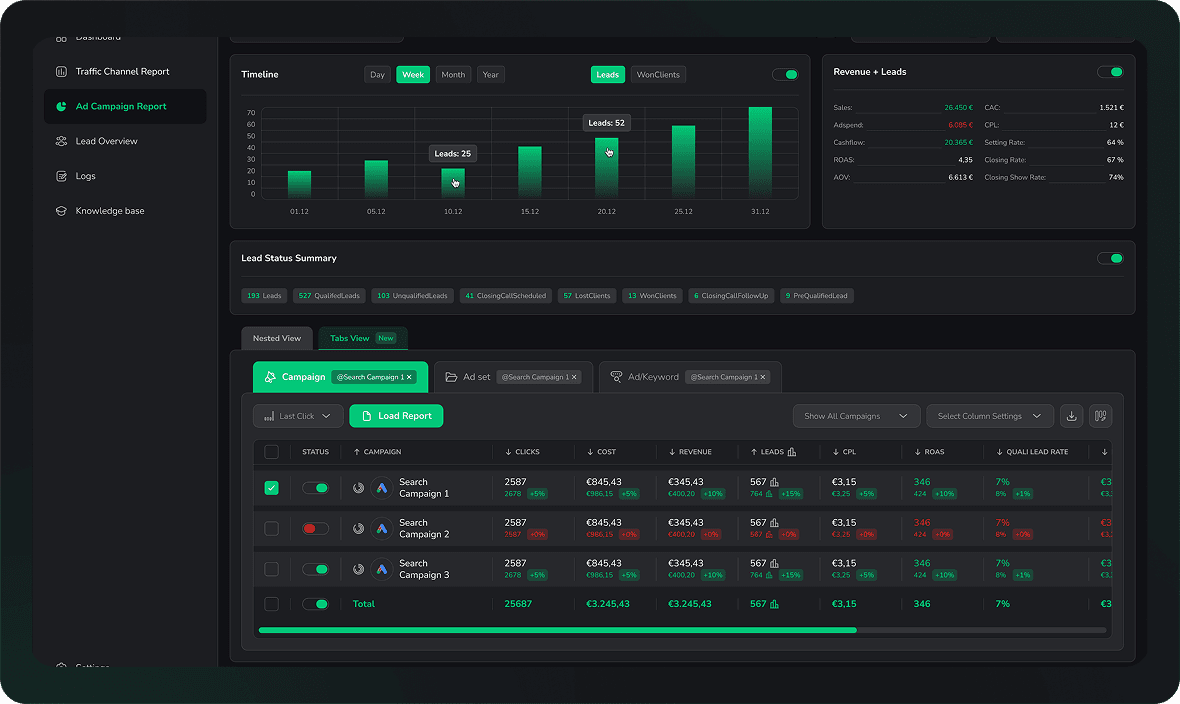
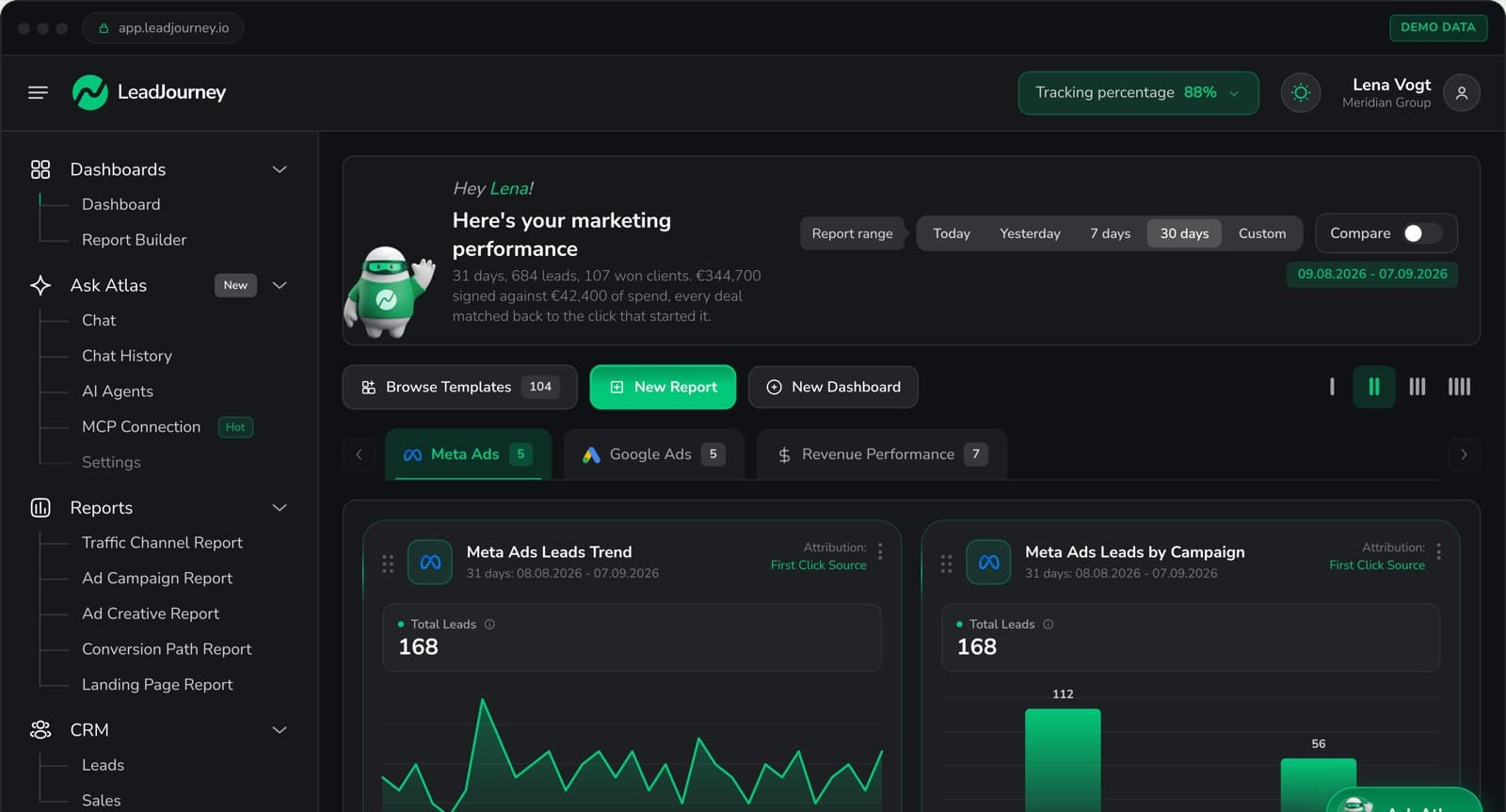
LeadJourney is the only AI search tracking tool that goes beyond identifying AI-referred traffic to connect it to CRM closed deals. When a prospect arrives from ChatGPT, Perplexity, Google AI Overviews, or another AI answer engine, LeadJourney captures the source, tracks that lead through your CRM pipeline (qualified, booked, closed), and reports the lead quality, conversion rate, and revenue contribution of each AI platform: alongside your paid Meta, Google, LinkedIn, and Bing campaigns in one unified dashboard.
This matters because AI search traffic quality varies dramatically by source. Perplexity visitors may close at 3x the rate of ChatGPT visitors. Google AI Overview traffic may produce better-qualified leads than organic search. Without connecting AI search visits to CRM outcomes, you're optimizing your content strategy blind. LeadJourney closes that loop, showing you which AI platforms are producing closed revenue, not just traffic.
Key Features
- AI search source attribution: identifies and segments traffic from ChatGPT, Perplexity, Claude, Google AI Overviews, Microsoft Copilot, and other AI answer engines separately from organic search and direct
- CRM pipeline attribution for AI sources: tracks every AI search lead through qualified, booked, and closed stages; reports conversion rate and close rate by AI platform
- Unified cross-channel dashboard: AI search revenue contribution reported alongside paid Meta, Google, LinkedIn, and Bing campaigns for true cross-channel ROI comparison
- Server-side tracking accuracy: AI search visitor data captured at 95%+ accuracy regardless of browser restrictions or cookie blocking
- Five attribution models: understand whether AI search sources leads or assists conversions that close via paid ads
- Atlas AI analyst: ask plain-language questions: which AI platform produces the most qualified leads? what is the close rate for Perplexity vs. ChatGPT traffic?
- 21-minute setup, no developer required: works with any landing page builder and any CRM
Pros
- The only AI search tracking tool that connects AI-referred traffic to CRM closed deals, not just traffic volume or session counts
- Compares AI search ROI directly against paid channels in one unified dashboard
- 14-day free trial: zero risk to evaluate
Cons
- No AI Overview keyword monitoring: doesn't track which keywords trigger AI Overviews (use Semrush or Ahrefs for that)
- Not an SEO tool: tracks AI-referred visits and their conversion outcomes, not content optimization for AI appearances
Verdict
For lead generation businesses, LeadJourney answers the most important AI search question: which AI platforms are producing closed revenue, not just sessions. No other tool on this list connects AI search traffic to CRM deal outcomes.
What Real Users Say About LeadJourney
LeadJourney is rated 5.0 on Trustpilot by agencies and B2B marketers. Here is what verified users say:
LeadJourney finally fixed my Marketing Analytics. It goes way beyond basic Ad Tracking Software. The Customer Journey Report saves hours of digging, and capturing everything from Offline Conversions to AI Search Tracking makes it the Best B2B Attribution Platform available.
LeadJourney has become one of those tools we don't want to work without anymore. The setup was simple, the data is accurate, and the AI search tracking is a great bonus. Highly recommended for any agency or B2B business that takes marketing analytics seriously.
Read More LeadJourney Reviews
Verified reviews on Trustpilot, G2, Capterra, Software Advice, and leadjourney.io/testimonials.
2. Google Search Console: Best Free Tool for AI Overview Tracking
Google Search Console is the authoritative source for Google AI Overview impression and click data. Its Search Appearance filters let you see which queries triggered AI Overview appearances for your pages, how many impressions those appearances generated, and (where users did click through) what CTR resulted. For any business appearing in Google AI Overviews, Search Console is the non-negotiable free baseline.
Pros
- Free: Google's own data on AI Overview appearances at no cost
- Authoritative: direct from Google, no third-party estimation
Cons
- Google AI Overviews only, no data for ChatGPT, Perplexity, Claude, or other AI platforms
- No CRM attribution: clicks and impressions only; doesn't track what happens to those visitors after they land
Verdict
Essential free infrastructure for any business appearing in Google AI Overviews. Doesn't track ChatGPT or Perplexity traffic, and doesn't connect AI visits to CRM outcomes.
3. Google Analytics 4: Best Free Baseline for AI Traffic Identification
GA4 can identify some AI-referred traffic through custom channel groupings and referral source analysis. Visits from perplexity.ai, chat.openai.com (rare, most ChatGPT traffic appears as direct), and other AI platforms that send referrer data appear in acquisition reports. Custom channel groupings let you segment 'AI search' as a traffic source separate from organic and direct.
Pros
- Free, no cost for the vast majority of use cases
- Custom channel groupings: segment AI referral traffic from known domains (perplexity.ai, etc.)
Cons
- Most AI traffic appears as direct: ChatGPT, Claude, and Copilot typically don't pass referrer data; GA4 misclassifies it
- No CRM integration: tracking stops at website behavior, doesn't connect to pipeline stages or deal closures
Verdict
A partial free solution. Works for Perplexity referral traffic but misses most ChatGPT and Copilot visits. No CRM attribution.
4. Semrush: Best for AI Overview Keyword Monitoring and Visibility Tracking
Semrush has built dedicated AI Overview tracking into its Position Tracking tool, showing which keywords trigger AI Overviews, whether your content appears in them, and how AI Overview appearances correlate with click-through rate changes. For content teams managing organic AI visibility, it's the most comprehensive keyword-level AI tracking tool available.
Pros
- Keyword-level AI Overview tracking: see which queries trigger AI Overviews and whether your pages appear
- Competitive analysis: see which competitors appear in AI Overviews for your target keywords
Cons
- SEO tool: tracks keyword appearances, not actual AI search visits, conversions, or CRM outcomes
- No ChatGPT or Perplexity tracking: focused on Google AI Overviews only
Verdict
The best tool for keyword-level Google AI Overview monitoring and competitive analysis. Not a lead gen conversion or CRM attribution tool.
5. Ahrefs: Best for AI Content Gap Analysis and Organic AI Visibility
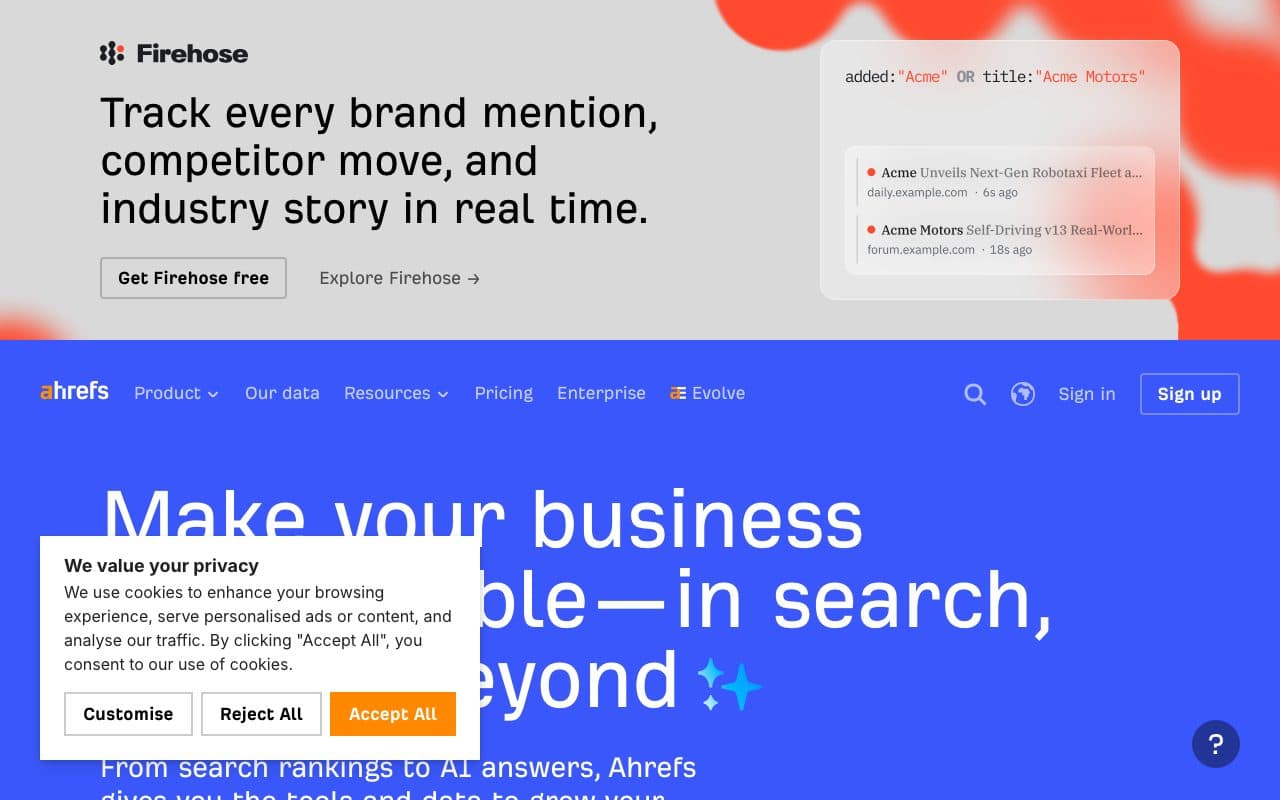
Ahrefs tracks organic keyword rankings alongside AI Overview appearances, helping content teams identify which queries are shifting to AI-generated answers and where their content is (or isn't) being cited. Its content gap analysis reveals topics where AI search engines are answering queries your content could own.
Pros
- Best-in-class backlink and content analysis: identify which content types earn AI citations
- AI Overview tracking in keyword reports: shows SERP features including AI appearances
Cons
- SEO tool: tracks keyword visibility, not visitor behavior or CRM conversion outcomes
- No ChatGPT or Perplexity referral tracking
Verdict
An excellent content strategy and SEO tool for AI search optimization. Not a conversion or attribution solution.
6. ZenABM: Best for B2B Account-Level AI Chatbot Referral Tracking
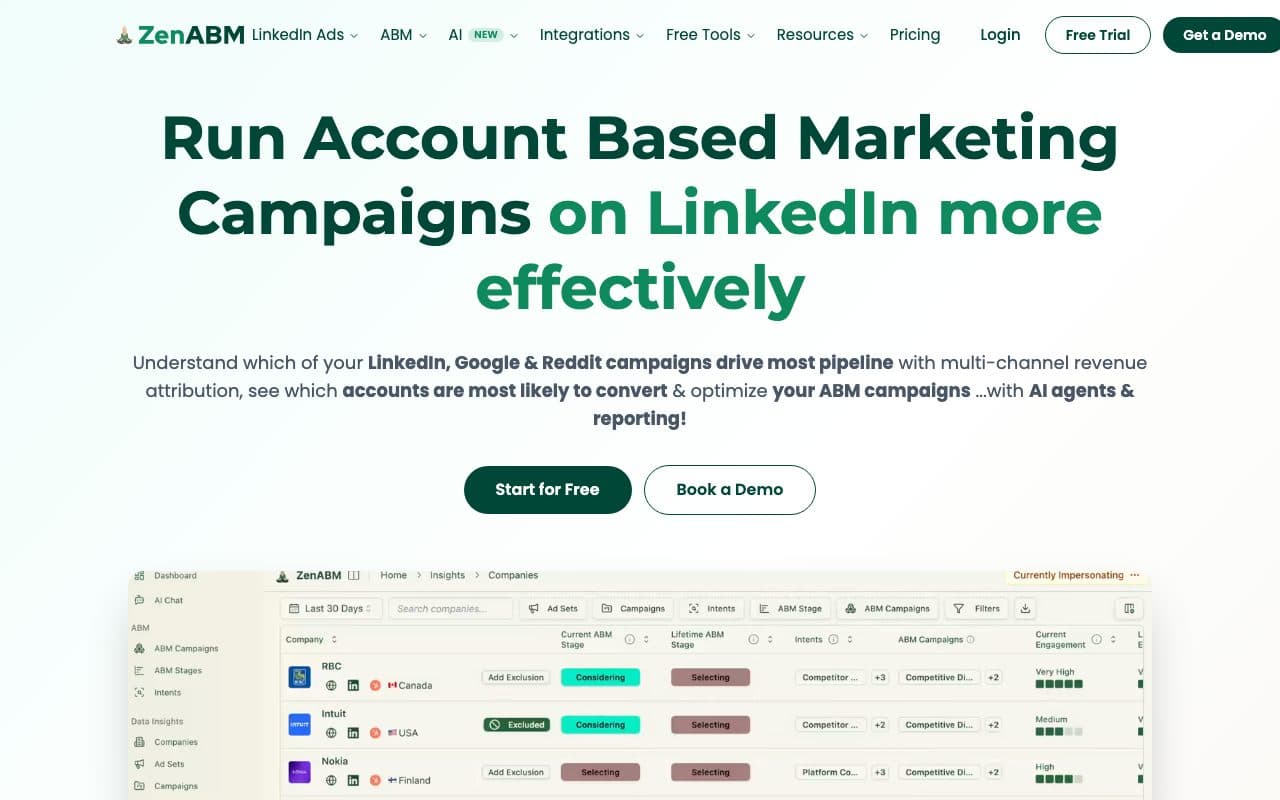
ZenABM tracks AI chatbot referrals (ChatGPT, Perplexity, Claude) as part of its unified company engagement journey alongside LinkedIn Ads, Google Ads, and organic website traffic. It connects AI chatbot referrals to CRM account journeys, showing which companies were influenced by AI search before appearing in your pipeline.
Pros
- AI chatbot referral tracking at account level: connects ChatGPT/Perplexity visits to company CRM journeys
- Unified with LinkedIn Ads and other channels: full multi-channel picture including AI referrals
Cons
- Enterprise ABM platform: designed for complex account-based programs, not SMB lead gen direct-response campaigns
- Pricing not accessible for SMBs
Verdict
A strong option for enterprise ABM teams tracking AI chatbot referrals at the account level. Not suited for SMB lead gen businesses.
7. Brandwatch: Best for Monitoring Brand Mentions in AI-Generated Content
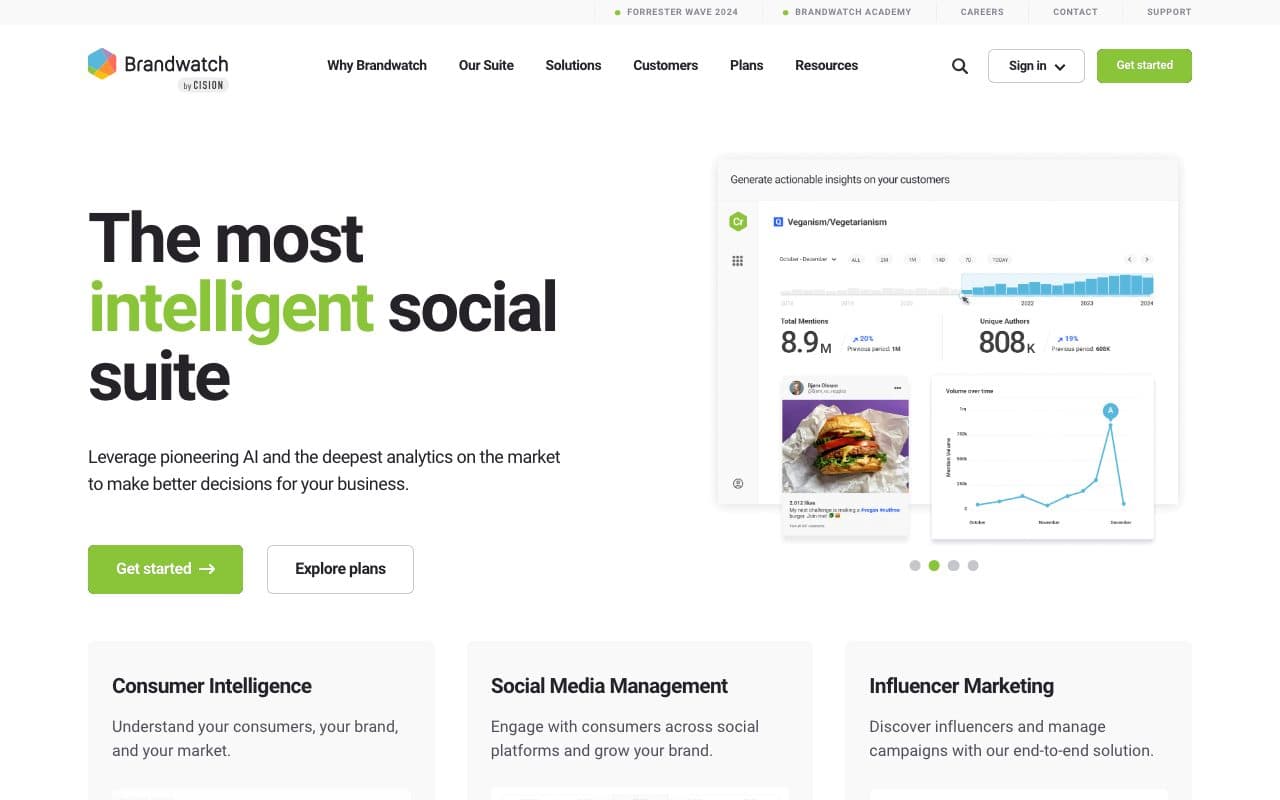
Brandwatch monitors when and how your brand is mentioned in AI-generated content, tracking brand citations in ChatGPT responses, Perplexity answers, and AI Overview summaries. For brands investing in AI Answer Engine Optimization (AEO), it provides visibility into how often your brand appears vs. competitors in AI-generated answers.
Pros
- Brand mention monitoring in AI answers: tracks how often your brand appears in ChatGPT, Perplexity, and AI Overviews
- Competitive AI visibility tracking: compare your brand's AI presence against competitors
Cons
- Brand monitoring tool: tracks mentions, not actual visits, leads, or CRM conversions
- Enterprise pricing, not accessible for most SMB lead gen businesses
Verdict
A strong brand intelligence tool for enterprises tracking AI presence. Doesn't measure actual AI search traffic or conversion outcomes.
8. Perplexity Analytics (Native): Best Free Baseline for Perplexity Publishers
Perplexity's publisher program provides analytics for verified publisher partners, showing how often your content is cited in Perplexity answers, estimated traffic driven from those citations, and the queries that trigger your content. For brands in Perplexity's publisher program, it provides the most direct data available on Perplexity-driven traffic.
Pros
- Direct Perplexity data: citation counts, estimated traffic, and query data from Perplexity's own systems
- Free for publisher partners
Cons
- Perplexity only, no ChatGPT, Claude, Google AI Overviews, or Microsoft Copilot data
- No CRM attribution: doesn't connect Perplexity visits to pipeline or closed deals
Verdict
Valuable for Perplexity publisher partners wanting direct platform data. Not a complete AI search tracking solution.
9. Ruler Analytics: Best for Connecting AI Search Traffic to Offline Revenue
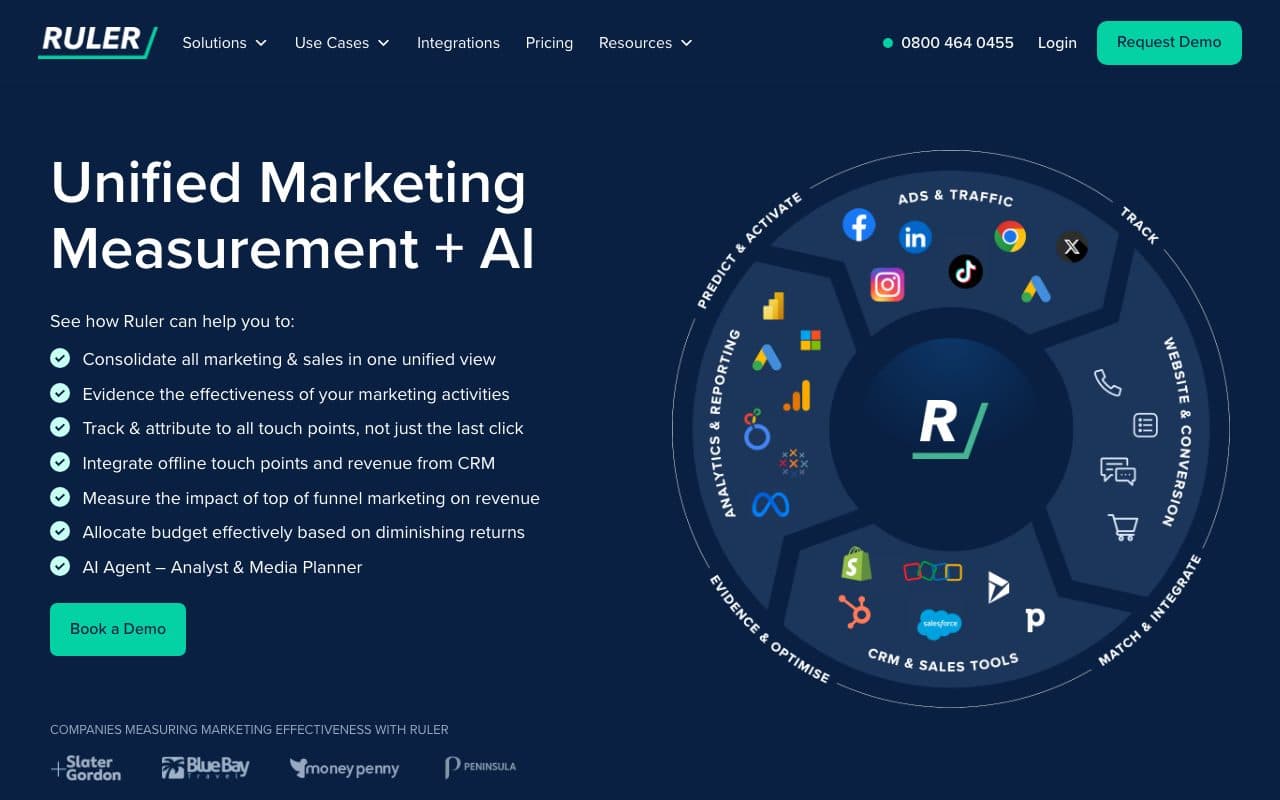
Ruler Analytics tracks the complete journey from anonymous website visitor (including AI search referrals) to closed CRM revenue. It identifies and segments AI-referred visitors, follows them through form fills, phone calls, and chat conversations, and matches the resulting closed revenue back to the AI source that initiated the journey.
Pros
- Connects AI search referrals to CRM closed revenue via call, form, and chat tracking
- Multi-channel: AI search alongside paid campaigns in one attribution view
Cons
- No automated CAPI loop: doesn't send AI-sourced deal signals back to ad platforms
- Limited AI source segmentation: identifies referrals where referrer data is present, misses ChatGPT dark traffic
Verdict
A solid tool for connecting AI search referrals to CRM revenue where referrer data is available. Doesn't capture all AI traffic sources.
10. Cometly: Best for Tracking AI Search Alongside Paid Channels
Cometly's multi-channel attribution includes organic and referral traffic sources alongside paid channels, enabling teams to see AI search's contribution to pipeline relative to Meta, Google, LinkedIn, and Bing spend. Its server-side tracking captures AI search visitors at higher accuracy than pixel-based tools.
Pros
- Multi-channel view including AI search sources alongside paid campaigns
- AI-powered optimization recommendations based on full-funnel data including AI search
Cons
- Multi-vertical focus: lead gen pipeline-stage depth for AI source tracking less specific than LeadJourney
- Custom pricing requires a demo call
Verdict
Strong for B2B SaaS teams wanting AI search in a multi-channel attribution picture. Lead gen businesses will find LeadJourney's CRM pipeline-stage depth more specific.
11. Dreamdata: Best for Enterprise B2B AI Search Account-Level Attribution
Dreamdata's multi-channel B2B attribution includes AI chatbot and organic referral sources alongside paid channels, connecting all touchpoints to account-level pipeline and revenue. For enterprise B2B teams needing to understand AI search's role in complex multi-stakeholder buying journeys, it provides the deepest account-level AI attribution available.
Pros
- Account-level AI search attribution: tracks AI search touchpoints across multiple stakeholders in enterprise deals
- 18-month lookback windows: captures AI search influence in long B2B buying cycles
Cons
- Paid plans on quote: the free plan keeps two months of history, the price of Attribution and Activation is not published
- Complex setup requiring CRM and multi-channel integration
Verdict
The best AI search attribution for enterprise B2B with complex account-based buying journeys. Not accessible for most SMB lead gen businesses.
12. HubSpot Attribution: Best for HubSpot-Native Teams Wanting Basic AI Search Visibility
HubSpot's traffic analytics can identify referral traffic from known AI platforms (perplexity.ai, etc.) within contact and deal source reports. For HubSpot customers who want basic AI search visibility without a separate tool, the native reporting provides a starting point for understanding AI search contribution.
Pros
- CRM-native: AI search referrals connected to HubSpot contact and deal records without third-party tool
- Included with HubSpot Professional, no additional cost
Cons
- Pixel-based: misses ChatGPT dark traffic and data lost to browser restrictions
- No automated CAPI feedback loop or cross-platform paid ads dashboard
Verdict
A practical starting point for HubSpot customers wanting basic AI search attribution. Limited accuracy and no automated ad platform signals.
13. Supermetrics: Best for Pulling AI and Organic Data into BI Tools
Supermetrics can pull Google Search Console AI Overview data, GA4 referral data, and other marketing channel data into unified BI reports, letting analytics teams build custom dashboards that include AI search alongside paid and organic performance. It's a data connector, not an AI tracking tool.
Pros
- Unified data extraction: pulls Search Console, GA4, and paid channel data into one place for custom AI search analysis
- Flexible destinations: Sheets, Looker Studio, BigQuery for custom reporting
Cons
- Data connector only: assembles existing data, doesn't independently track AI search visits or CRM outcomes
- Requires BI build work, not a plug-and-play AI search tracking solution
Verdict
A useful data pipeline tool for analytics teams building custom AI search reports. Not an out-of-the-box AI tracking solution.
14. Microsoft Clarity: Best Free Session Replay for AI Search Visitor Behavior
Microsoft Clarity provides free session recordings, heatmaps, and scroll depth analysis, and can be filtered by traffic source. For teams wanting to understand how AI search visitors behave differently on their site vs. paid traffic (engagement depth, scroll behavior, form completion rates), Clarity provides free behavioral insight without conversion data.
Pros
- Free, no cost for session replay and heatmap analytics
- Traffic source filtering: segment AI search visitor sessions separately from paid and organic
Cons
- Behavioral tool only, no conversion tracking, CRM attribution, or revenue reporting
- Same AI traffic identification limitations as GA4: ChatGPT dark traffic unidentifiable
Verdict
A useful free behavioral complement. Tells you how AI search visitors engage on your site, not what they convert into.
15. Whatagraph: Best for Agencies Reporting on AI Search and Organic Performance
Whatagraph can incorporate GA4 and Search Console data (including AI Overview metrics) into polished white-label client reports. For agencies that need to show clients how their AI search visibility is trending alongside paid performance, it automates what would otherwise be manual monthly report assembly.
Pros
- Automated white-label reports incorporating AI Overview data from Search Console
- 55+ channel connections alongside AI search data
Cons
- Dashboard aggregation only, no independent AI tracking or CRM attribution
- Dependent on source data quality: only as good as the AI tracking in GA4 and Search Console
Verdict
A good reporting layer for agencies showing AI search trends in client reports. Not a tracking or attribution solution.
The Critical Gap in AI Search Tracking: Traffic vs. Revenue
Most AI search tracking tools measure visibility (keyword appearances, brand mentions) or traffic (session counts, referral visits). What almost none of them do (except LeadJourney) is connect AI search visits to CRM qualified leads and closed deals. For lead generation businesses, that connection is the only metric that actually tells you whether your AI search presence is producing revenue or just impressions.
Quick Decision Guide
- Lead generation business wanting to know which AI platforms produce closed revenue: LeadJourney
- Tracking Google AI Overview keyword appearances: Google Search Console + Semrush
- Monitoring brand mentions in AI-generated answers: Brandwatch
- Enterprise ABM teams tracking AI chatbot referrals at account level: ZenABM or Dreamdata
- Free Perplexity publisher analytics: Perplexity Analytics (publisher program)
- Free behavioral analysis of AI search visitors: Microsoft Clarity
FAQ
Frequently Asked Questions
The questions teams tracking ChatGPT, Perplexity and AI Overview traffic ask most.
How do I track traffic from ChatGPT and Perplexity?
The visit arrives with a referrer from the AI platform, and standard analytics either files it under direct or lumps it into referral traffic. Tracking it properly means classifying those referrers as their own channel at the moment the session starts, then keeping the classification with the lead so it survives into the CRM record. Otherwise the AI-sourced pipeline is invisible in every report you run.
Why does AI search traffic show up as direct in GA4?
Some AI answer engines strip or do not send a referrer, and GA4 has no channel group for the ones that do, so the visit falls through to direct. That also means AI search inherits the reputation of direct traffic in your reports: unattributable, assumed to be brand, and quietly ignored when budget is being argued about.
Can I measure revenue from AI search, not just traffic?
Only if the AI source is stored on the lead rather than on the session. Visibility tools such as Semrush and Brandwatch tell you where you appear, Search Console tells you about AI Overview impressions, and none of them know what happened after the click. Carrying the source into the CRM is what turns AI search into a channel with a cost per closed deal next to Meta and Google.
What does AI search tracking cost?
The free layer covers a lot: Google Search Console, GA4, Microsoft Clarity and Perplexity's publisher analytics all cost nothing. Paid visibility tooling starts around $129 to $139 per month for Ahrefs and Semrush, Ruler Analytics at $199, Whatagraph from €699 per month on annual billing, and ZenABM, Brandwatch and Dreamdata quote on request.
Is AI search worth tracking if the volume is still small?
Yes, because the volume is the least interesting part of it. AI answer engines are consulted at the research stage, so the sessions are few but the intent is high, and a channel that converts at several times the rate of paid social is worth knowing about before it becomes large. You cannot argue for the content investment without the closed-deal number behind it.
Keep reading
More from the blog
 Tool Comparisons
9 Best Marketing Attribution Tools for Zoho CRM in 2026
Four of the best attribution tools for Zoho CRM are Zoho products you may already pay for. Nine options compared on where the tracking starts, which ad platforms they cover, and whether the closed deal ever reaches the algorithm buying your traffic.Read the article13 min read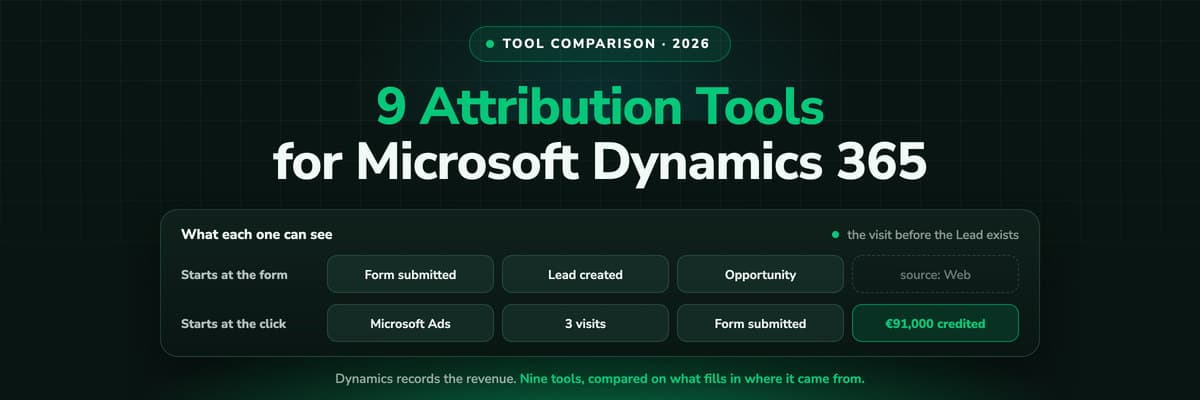 Tool Comparisons
9 Best Marketing Attribution Tools for Microsoft Dynamics 365 in 2026
Dynamics records the revenue and nothing fills in where it came from: Lead Source is a ten-option picklist and campaign spend is typed by hand. Nine tools compared on what each can actually see in a Dynamics environment, with pricing, pros, cons and a verdict.Read the article14 min read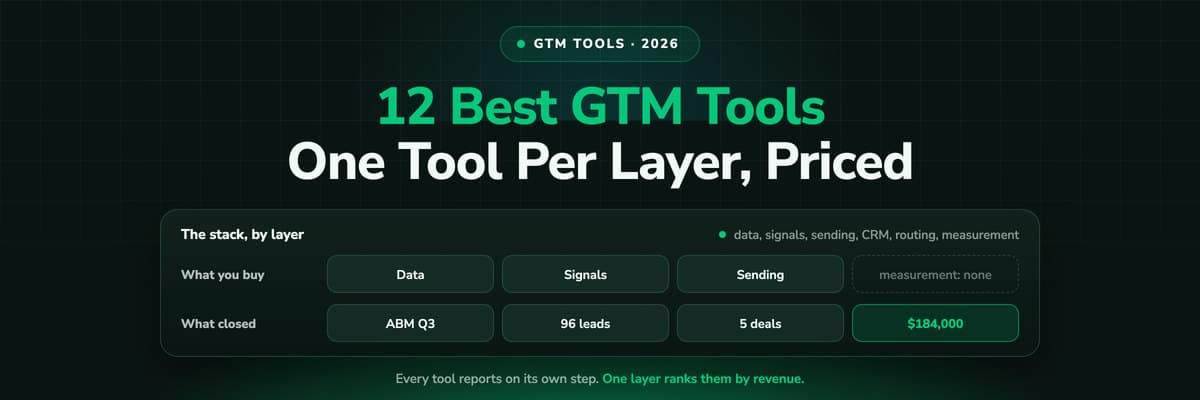 Tool Comparisons
12 Best GTM Tools and Software in 2026
A GTM stack is five or six tools that each report on their own step, which is why nobody can say which play produced the revenue. Twelve tools compared by the layer they own, with prices read this month and a verdict on who each one is for.Read the article16 min read
Beyond AI visibility
Ready to know which AI platforms close deals?
LeadJourney tracks AI search visits from ChatGPT, Perplexity, Google AI Overviews, and Copilot, follows them through your CRM, and reports closed-deal revenue by AI source alongside your paid campaigns. 21-minute setup.