














Qualified Lead (MQL, SQL)
A lead that has met a defined standard of fit and intent, marked as such in the CRM. Marketing qualified (MQL) by behaviour and profile, sales qualified (SQL) by a conversation.

Summarise this article with AI
Opens the page with a ready prompt in:


Nothing is sent until you pick a service.
In short
A qualified lead is a lead that has passed a defined test of fit and intent, and has been marked as such in the CRM. A marketing qualified lead (MQL) has passed marketing's test, usually profile and behaviour: the right company size, the right role, a pricing page visit, a downloaded guide. A sales qualified lead (SQL) has passed sales' test, usually a conversation: budget, authority, need and timing confirmed.
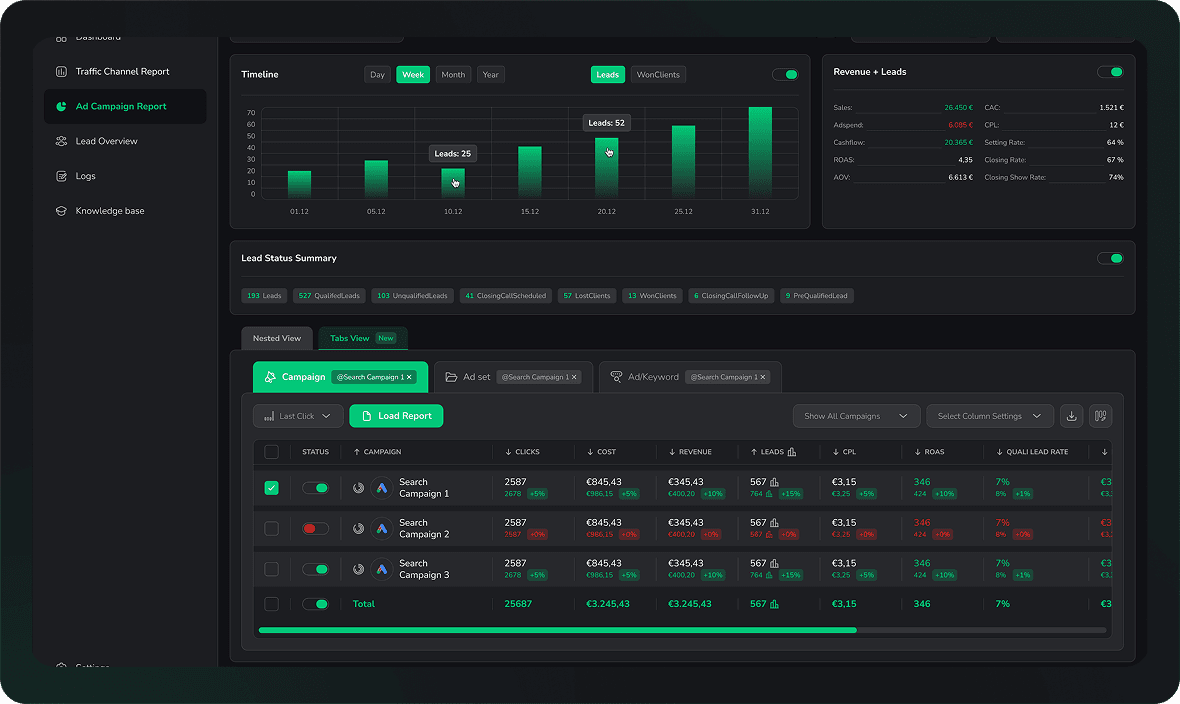
The distinction matters for measurement because the ad platforms count form fills. A campaign that produces 200 form fills and 4 qualified leads looks better in the ads manager than one that produces 60 and 30. Only the CRM knows the difference, which is why the qualified lead, not the form fill, should be the conversion the platforms are taught to find.
MQL and SQL
Marketing qualified lead
Fit and intent inferred from data: industry, company size, job title, pages visited, content downloaded, a booked demo. Set by a scoring rule or by hand in the CRM.
Sales qualified lead
Fit and intent confirmed by a person: a discovery call, budget and timeline discussed, a decision maker involved. The stage at which a lead becomes an opportunity.
The stages in between
Many CRMs add 'contacted', 'meeting booked' or 'proposal sent'. Each is a stronger signal than the last, and each can be a conversion sent back to the ad platforms.
Why Form Fills Are the Wrong Conversion
An ad platform optimises for whatever event you tell it is a conversion. Tell it a form fill and it learns what a form filler looks like, then finds more of them: students, competitors, people who wanted the PDF. The cost per lead falls and the number of customers does not move. Tell it a qualified lead, and it learns what a buyer looks like.
- Send qualification backWhen a lead reaches MQL or SQL in the CRM, send that stage to Meta, Google, LinkedIn and Microsoft as a conversion. See offline conversion tracking.
- Report the qualified share per channelA channel that produces 60 percent qualified leads at €90 beats one that produces 15 percent at €40. Only the CRM join shows it. See lead attribution software.
- Attach the valueA qualified lead with an expected deal size tells the algorithm not just who converts but who is worth converting.
How to Define Qualification So It Can Be Measured
- Pick the stage in your CRM that means 'a real prospect' for your business, and write down the criteria.
- Make sure every lead passes through that stage or is explicitly disqualified, or the qualified share per channel will be wrong.
- Map that stage to a conversion on each ad platform, with a value where you have one.
- Report cost per qualified lead beside cost per lead, and move budget on the former.
The test of a good definition is that sales agrees with it. A qualified lead marketing celebrates and sales ignores is a form fill with a nicer name. See lead quality by channel for how the qualified share changes the budget.
Conclusion
A qualified lead is the first conversion in the funnel that predicts revenue. Define it in the CRM, measure cost per qualified lead per channel, and send it back to the platforms so they optimise on it. Everything upstream of that stage is a cost, not a result.
Keep exploring
Related glossary terms
Cost Per Lead (CPL)
How much a business spends on advertising to acquire a single lead: total ad spend divided by leads generated. Useful only once 'lead' means more than a form fill.
Read the definition6 min read
Cost Per Acquisition (CPA)
Advertising spend divided by the number of conversions it produced. Which action counts as the acquisition decides whether the number means anything.
Read the definition5 min read
Lead Source
The CRM field that records which channel or campaign a lead came from. It is what every revenue-by-channel report groups on, and in most CRMs it is filled by whatever touched the record first, which is why it so often says Direct or Website.
Read the definition7 min read
95%+ data accuracy, even with ad blockers and iOS
See which ads really created your
Connect your ad accounts and your CRM once, and every lead arrives with the campaign that created it already attached.