














BlogTool Comparisons
Ruler Analytics vs WhatConverts (2026): Which to Pick
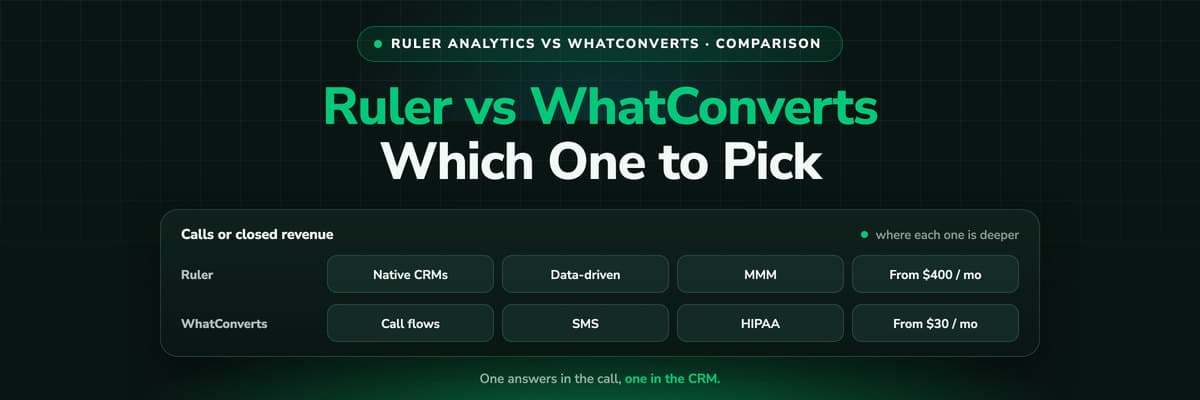
WhatConverts is the deeper call and lead tracker from $30 a month; Ruler is the revenue attribution platform from $400, with MMM on top. Calls, CRMs, ad platform sync, AI and pricing compared, every fact read on 25 October 2026.

Contents
Summarise this article with AI
Opens the page with a ready prompt in:


Nothing is sent until you pick a service.
Ruler Analytics and WhatConverts get compared by the same kind of business: one whose leads arrive as phone calls and form fills rather than checkouts, and an agency that has to prove to a client which campaign produced them. Both track calls, both tie a lead to its source, both send revenue back into the reports. They are still built for different jobs and priced in very different ways.
WhatConverts is a lead tracker with call tracking at its core, priced by features plus usage. Ruler is a revenue attribution platform from Liverpool, priced by website traffic, that has grown into marketing mix modelling. This comparison sets them side by side, axis by axis, and says where each is ahead. Every fact about both products was read on their own sites and help centres on 25 October 2026.
Ruler Analytics vs WhatConverts in Short
In short
WhatConverts fits the local business or agency that lives on the phone: tracking numbers, dynamic number insertion, recording, transcription, call flows with IVR and routing, text messages, and qualified conversions back to Google Ads, Facebook and Bing, from $30 a month plus usage, with a 14-day free trial and HIPAA from Pro. Ruler Analytics fits the marketing team that needs revenue attribution across channels: native CRM integrations, six attribution models including data-driven, revenue and offline conversion IDs back to the ad platforms, and marketing mix modelling with AI agents on its top plan, from $400 a month by website traffic, with white-glove onboarding and data stored in the UK and EEA.
Ruler Analytics vs WhatConverts at a glance, as both sites showed them on 25 October 2026
| Ruler Analytics | WhatConverts | |
|---|---|---|
| Built for | Marketing teams and agencies proving revenue across channels | Local businesses, franchises and agencies proving calls and forms |
| Priced by | Monthly website visits | Feature tier, plus usage per number, minute and lead |
| Entry price | From $400 a month (Small, up to 10k visits) | $30 a month (Call Tracking) with a $30 usage credit |
| Agencies | Agency partner rates on request | Agency plans from $500 a month, unlimited accounts |
| Attribution models | First, last, linear, time decay, position based on every plan; data-driven and impression from Medium | Customer journey and multi-click attribution on Elite |
| Call tracking | Dynamic call tracking, UK and international numbers, recording; or CallRail, CTM, Invoca | The core: local and toll-free numbers, DNI, recording, transcription, call flows, SMS |
| CRM revenue | Salesforce, HubSpot, Dynamics 365, Pipedrive, Zoho and more | HubSpot, Salesforce, Pipedrive, Zoho and six more, mostly through Zapier |
| Back to the ad platforms | Revenue and offline conversion IDs for bidding | Google Ads, Facebook and Bing on every plan; rule-based sending on Elite |
| AI | AI Analyst and AI Media Planner on Advanced, built on MMM | AI rules that read transcripts and qualify leads, on Elite |
| Trial | None on the page; demo and white-glove onboarding | 14-day free trial |
| Data location | UK and/or EEA, UK GDPR | Not published on the pricing page; HIPAA and GDPR options |
Who Each Tool Is Built For
WhatConverts answers one question very well: which marketing produced this call, this form, this chat? Its menus are organised by industry (HVAC, dental, legal, real estate, automotive, plastic surgery) and by role (agencies, franchises, marketers), and its pricing starts at a level a single location can pay. An agency plan covers unlimited client accounts on one bill, with white label at $50 a month.
Ruler Analytics answers a wider one: which marketing produced this revenue, and where should the next pound of budget go? It tracks the visitor across sessions, matches the lead to that history, passes it into the CRM, and pulls the closed revenue back out to attribute it. On top sits marketing mix modelling, which measures channels that never earn a click. Every plan comes with a dedicated CS manager and white-glove onboarding, which is part of why the entry price is higher.
Verdict
WhatConverts is built for lead tracking at local business prices; Ruler is built for revenue attribution and budget planning across a marketing mix.
Calls, Forms and Chats
This is the axis where WhatConverts is clearly the deeper product, and it is the reason most buyers look at it.
- WhatConverts sells local and toll-free numbers in its own app, with dynamic number insertion, keyword-level number pools, recording, greeting and whisper messages, transcription at 2 cents a minute, inbound text messages and call flows (voicemail, IVR menus, a scheduler, geo-routing) from Pro. Form, chat and e-commerce tracking sit beside it, with long lists of form builders and chat tools. Numbers, minutes and leads past the monthly credit are billed per unit.
- Ruler Analytics offers dynamic call tracking with every UK and international number type except mobile numbers, recording behind a pre-connection message, and calls matched to the visitor's earlier sessions. By a help article from 2018, numbers are free unless you need a large amount of premium types, minutes are bundled, and nothing extra is charged without agreement. If you already run CallRail, CallTrackingMetrics, Invoca, Delacon or Infinity, Ruler reads it in instead.
Forms and chats are covered by both. Ruler also tracks offline touchpoints (trade shows, webinars, sales calls, uploaded attendee lists) into the same journey, and e-commerce orders and payments from Stripe, Recurly, Chargebee and Xero.
Verdict
WhatConverts wins on calls, by a distance: routing, SMS, number pools and transcription priced in public. Ruler wins on offline touchpoints beyond the phone.
Attribution Models and the Customer Journey
Both tools record where a lead came from. They differ in how many touches they keep and what they do with them.
- Ruler puts multi-touch attribution on every plan, with first click, last click, linear, time decay and position based models switchable side by side, and adds data-driven and impression attribution from Medium. Its data-driven model blends click paths with impression weightings from MMM to take credit away from direct and brand search. Advanced adds the full marketing mix model, with diminishing returns and a budget scenario planner.
- WhatConverts attributes every lead to its source, campaign and keyword on every plan. The customer journey, pages visited and multi-click attribution, which keeps every attribution point for a visitor, start on Elite at $160 a month.
Verdict
Ruler wins on attribution: more models on every plan, data-driven from Medium and MMM at the top, where WhatConverts keeps multi-click for its highest tier.
CRM Revenue: From Lead to Closed Deal
A call tells you a campaign worked. A closed deal tells you how well. Both tools can bring the deal value back, by different routes.
- Ruler lists Salesforce, HubSpot, Dynamics 365, Pipedrive, Zoho, Monday, Sugar, Capsule, GoHighLevel, Insightly and bespoke or industry CRMs such as Proclaim. The lead goes into the CRM with its marketing data, and opportunity and revenue stages come back to be attributed. Its help centre documents closed deals from Salesforce and won deals from Pipedrive, and manual upload of offline sales.
- WhatConverts documents HubSpot, Salesforce, Pipedrive, Zoho CRM, Capsule, Freshsales, Insightly, OnePageCRM, Pipeline and JobNimbus, all on every plan, plus ServiceTitan, Housecall Pro and Jobber for field service businesses. The four big CRM integrations run through Zapier workflows, by its own help pages: one workflow sends the lead in, another sends the quote or sales value back.
In practice that means a Zapier account and two workflows per CRM with WhatConverts, and a direct connection with Ruler. For a home services business on ServiceTitan or Jobber, WhatConverts is the one that speaks its system.
Verdict
Ruler wins on CRM depth and native connections; WhatConverts wins for field service software and covers the big CRMs through Zapier.
Sending Conversions Back to the Ad Platforms
Both tools now close the loop with the ad platforms, which older comparisons of WhatConverts get wrong.
- WhatConverts sends qualified conversion data to Google Ads, with Enhanced Conversions, and offline conversions (calls, forms, chats) to Facebook with Advanced Matching on hashed email and phone, both on every plan, plus Bing Ads and Search Ads 360. On Elite, Lead Intelligence rules decide which leads go: only quotable leads, calls over a minimum duration, leads with a sales value.
- Ruler captures click IDs and sends offline conversion IDs back to the ad platform for bidding and targeting, and pushes opportunity and revenue signals back, so the platforms optimise on pipeline rather than on form fills. Its integration list covers Google, Microsoft, Facebook, TikTok, LinkedIn, Pinterest, X, Reddit, Snapchat, Taboola, Outbrain, StackAdapt, The Trade Desk and Amazon Ads; the pages read today do not say which of them take conversions back.
Verdict
WhatConverts documents the Google and Meta sync more precisely and puts it on every plan; Ruler sends revenue rather than lead events, which is the stronger signal when the CRM is connected.
AI, Reporting and White Label
- Ruler has two AI agents on Advanced, both built on its MMM: an AI Analyst that monitors performance and explains what changed, and an AI Media Planner that models ROAS and marginal ROAS per channel and campaign and tests budget scenarios before you move money. Reports export to Tableau, Looker Studio, Power BI, Domo and Whatagraph, and to Snowflake, Redshift and BigQuery.
- WhatConverts uses AI on the lead itself: on Elite, AI rules read call transcripts, form messages and chats, answer questions you set ("Was an appointment booked?"), detect intent and sentiment, and qualify and score leads automatically. A custom report builder and scheduled reports come from Pro, and white label puts an agency's brand on the dashboard and the emails.
Verdict
Ruler wins on budget decisions; WhatConverts wins on reading and qualifying individual leads, and on white label for agencies.
Data Hosting, Compliance and Setup
- Ruler is a UK company under UK GDPR. Its client privacy notice, updated in September 2026, says all client and contact data is stored within the UK and/or the EEA and not transferred elsewhere without approval. Its help centre says its controls are aligned with GDPR, HIPAA, ISO and SOC 2, which is not the same as holding the certificates. Setup is white-glove onboarding with a dedicated CS manager on every plan.
- WhatConverts offers HIPAA compliant call, form and chat tracking from Pro and GDPR compliant tracking, with security controls such as IP whitelisting, 2FA and session expiry. The pricing page does not say where the data is hosted. Setup is self-serve with a 14-day free trial; an account setup service and a dedicated account manager are listed under support.
Verdict
WhatConverts wins for US healthcare and a self-serve start; Ruler wins for a UK or EU business that wants the data region in writing.
Ruler Analytics vs WhatConverts Pricing
WhatConverts prints every price and every usage rate. Ruler prints "From" prices by monthly website visits and calls them indicative, scaled by traffic, product, data and integration needs. Both are in US dollars below.
Ruler Analytics plans, by monthly website visits, US dollars per month
| Plan | Monthly visits | Monthly billing | Annual billing |
|---|---|---|---|
| Small | Up to 10,000 | From $400 | From $360 |
| Medium | Up to 50,000 | From $668 | From $601 |
| Large | Up to 100,000 | From $1,326 | From $1,193 |
| Advanced | From 100,000 | From $2,000 | From $1,800 |
WhatConverts plans, US dollars per month, billed monthly
| Plan | Accounts | Price | Usage credit | Notable features |
|---|---|---|---|---|
| Call Tracking | 1 | $30 | $30 | Calls and texts, DNI, recording, API |
| Plus | 1 | $60 | $30 | Adds forms, chats and transactions |
| Pro | 1 | $100 | $30 | Call flows, report builder, HIPAA |
| Elite | 1 | $160 | $30 | Customer journey, multi-click, lead intelligence |
| Agency Plus | Unlimited | $500 | $250 | Plus features, lower usage rates |
| Agency Pro | Unlimited | $800 | $300 | Pro features |
| Agency Elite | Unlimited | $1,250 | $400 | Elite features |
Past the credit, WhatConverts charges $2.50 per local number, 4.5 cents per local minute, 10 cents per form, chat or transaction and 2 cents a minute for transcription, a little less on agency plans. By a 2019 help article Ruler licenses per domain with unlimited users, and its pricing page offers 10% off annual deals.
A worked example at three sizes
The tools meter different things, so each row assumes a lead volume, a visit count and an ad budget at $25 per lead, with three-minute calls. The WhatConverts totals are its own calculator's (four local numbers), Ruler's are its "From" prices, and LeadJourney includes its call tracking add-on. Assumptions, not benchmarks.
Monthly cost at three sizes, US dollars, monthly billing
| Business | Ruler | WhatConverts Plus / Elite | LeadJourney with call tracking |
|---|---|---|---|
| 100 calls, 200 forms, 8,000 visits, $7,500 ad spend | From $400 (Small) | $73 / $173 | $321.50 (Starter) |
| 500 calls, 1,000 forms, 40,000 visits, $37,500 ad spend | From $668 (Medium) | $207 / $307 | $651.50 (Growth) |
| 1,000 calls, 2,000 forms, 90,000 visits, $75,000 ad spend | From $1,326 (Large) | $375 / $475 | $1,056.50 (Scale) |
WhatConverts is the cheapest of the three at every size, and the gap is wide. Ruler costs more because every plan carries native CRM attribution, data-driven models from Medium and a CS manager; whether that is worth $300 to $850 a month more depends on whether your revenue closes in a CRM.
Which One Should You Choose?
Choose WhatConverts if
- Phone calls are your main conversion and you need routing, IVR, text messages and transcription.
- You are a local business, a franchise or an agency with many small clients and want public prices from $30.
- You need HIPAA compliant call and form tracking.
- Google Ads and Meta are your main channels and you want qualified calls sent back to them.
- You run ServiceTitan, Housecall Pro or Jobber.
- You want to try it for 14 days before paying.
Choose Ruler Analytics if
- Your revenue closes in a CRM and you want it attributed across many touches, not only the source.
- You want data-driven attribution, impression modelling or marketing mix modelling.
- You spend on many channels, from LinkedIn and TikTok to The Trade Desk and Amazon Ads.
- You want onboarding done with you and a dedicated CS manager.
- You are a UK or EU business and want the data stored in the UK and EEA.
Verdict
WhatConverts is the better and far cheaper call and lead tracker; Ruler is the better revenue attribution platform. Pick by where the answer you need lives: in the call, or in the CRM.
When Neither Fits: LeadJourney
Some teams need both halves: the call tracked to its click like WhatConverts does, and the deal attributed in the CRM like Ruler does, without a Zapier workflow in between and without a price that climbs with website visits or with every form. That is the reader LeadJourney is built for.
- Server-side, first-party tracking on your own domain, 95%+ of conversions captured, live in 21 minutes, with every attribution model on every plan.
- Forms, calls, bookings, CRM stages and closed deals on one journey per lead, synced natively with HubSpot, Salesforce, Pipedrive, Close, Attio, GoHighLevel, ActiveCampaign, Odoo, Zoho CRM and Microsoft Dynamics 365.
- Call tracking as one add-on: $50 a month for five numbers and 250 minutes with recording and transcripts, $0.05 a minute past that, $3.50 per extra US number. The AI summarises each call; it does not qualify or score it. A qualified call is the lead status your team sets, and that status is what goes back to the ad platforms. CallRail and Podium can feed in instead.
- Closed deals back to the ad platforms on every plan: Meta, Google, LinkedIn, Microsoft, Reddit, X, Taboola and Outbrain Ads.
- Priced by monthly ad spend, never by visits or leads: $139 up to $5,000, $269 up to $15,000, $539 up to $50,000, $869 up to $100,000, from $1,079 above, 20% off yearly. Agencies pay per client workspace, from $429 a month.
- Hosted in Frankfurt. Every plan starts with a one hour onboarding call with a tracking expert, 14 days of setup support and a 30-day money-back guarantee.
Where LeadJourney is not the right pick
LeadJourney has no IVR, call routing or text messages, no AI that qualifies leads for you, no HIPAA BAA and no marketing mix modelling, and for a small business with modest spend WhatConverts costs less. The row by row detail is in LeadJourney vs Ruler Analytics and LeadJourney vs WhatConverts.
Further Reading
- LeadJourney vs Ruler Analytics: two lead generation tools, row by row.
- LeadJourney vs WhatConverts: from lead tracking to full attribution.
- WhatConverts pricing: every plan, every usage rate and the calculator at volume.
- The best WhatConverts alternatives and the best Ruler Analytics alternatives.
- Call tracking software: what a call tracker records and how it joins the journey.
- Offline conversion tracking: sending the closed deal back to the ad platforms.
- Multi-touch attribution: what the models do with the touches first and last touch leave out.
- LeadJourney pricing: every plan and add-on, in five currencies.
FAQ
Frequently Asked Questions
The questions lead generation teams and agencies ask when Ruler Analytics and WhatConverts are on the same shortlist.
Is Ruler Analytics better than WhatConverts?
For revenue attribution, yes: Ruler connects CRMs natively, offers six attribution models including data-driven, and adds marketing mix modelling on its top plan. For call tracking, no: WhatConverts has the deeper call product, with routing, IVR, text messages and transcription, at a fraction of the price. Pick Ruler when the answer lives in the CRM and WhatConverts when it lives in the call.
How much do Ruler Analytics and WhatConverts cost?
WhatConverts costs $30, $60, $100 or $160 a month for one account, each with a $30 usage credit, and $500, $800 or $1,250 for agencies with unlimited accounts, plus usage past the credit. Ruler prints indicative prices by monthly visits: from $400 up to 10,000 visits, $668 up to 50,000, $1,326 up to 100,000 and $2,000 above, 10% less on annual deals.
Does WhatConverts send conversions to Google Ads and Meta?
Yes. Its help centre documents the Google Ads integration on every plan, sending qualified conversions back with Enhanced Conversions, and the Facebook integration on every plan, sending offline calls, forms and chats back with Advanced Matching on hashed email and phone. Bing Ads is covered too. On Elite, Lead Intelligence rules decide which leads are sent, for example only quotable ones.
Which CRMs do Ruler Analytics and WhatConverts integrate with?
Ruler lists Salesforce, HubSpot, Dynamics 365, Pipedrive, Zoho, Monday, Sugar, Capsule, GoHighLevel, Insightly and bespoke CRMs. WhatConverts documents HubSpot, Salesforce, Pipedrive, Zoho CRM, Capsule, Freshsales, Insightly, OnePageCRM, Pipeline and JobNimbus, plus ServiceTitan, Housecall Pro and Jobber; its HubSpot, Salesforce, Pipedrive and Zoho integrations run through Zapier workflows.
Does Ruler Analytics have a free trial?
Ruler's pricing page shows no trial and no self-serve sign-up: every plan starts with a demo, followed by white-glove onboarding with a dedicated CS manager. WhatConverts offers a 14-day free trial on every plan. If you want to see Ruler on your own data first, ask for a proof of concept on the demo call.
Can I use Ruler Analytics and WhatConverts together?
Yes, in one direction. Ruler reads third-party call tracking from CallRail, CallTrackingMetrics, Invoca, Delacon and Infinity; WhatConverts is not on the integration list read today, so pairing the two would go through a webhook or Zapier. Most teams pick one, because both track the same visitor and both want to be the record of where the lead came from.
What is the best alternative to Ruler Analytics and WhatConverts?
For a lead generation team that wants calls and forms tracked server-side and the closed deal attributed in the CRM, LeadJourney combines both, with ten native CRMs, revenue back to eight ad platforms on every plan, call tracking as a $50 add-on and prices by ad spend from $139 a month. For calls alone at the lowest price, WhatConverts stays the cheaper pick.
Keep reading
More from the blog
 Tool Comparisons
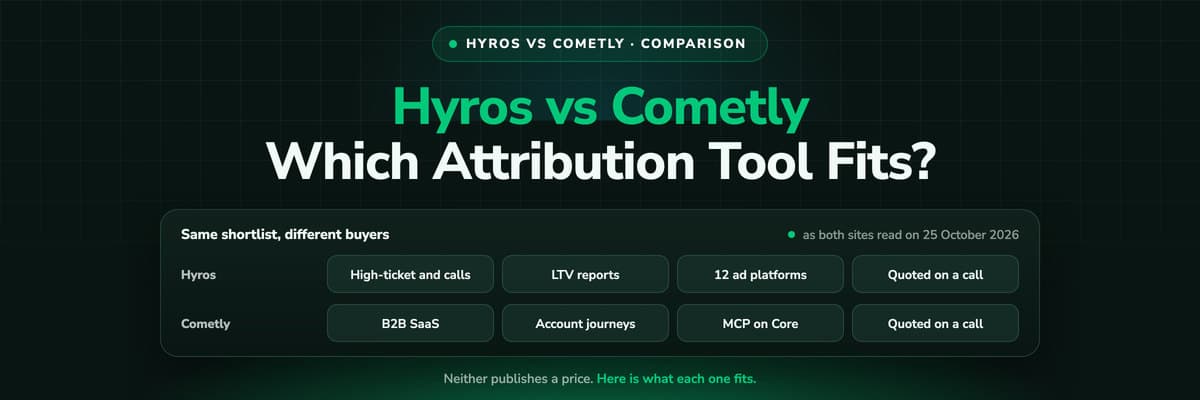
Hyros vs Cometly (2026): Which Attribution Tool Fits?
Hyros is built around high-ticket sales, info products and calls; Cometly around B2B SaaS pipeline. Both quote prices on a call. A fair, dated comparison of tracking, CRM depth, AI, security and cost, and who should pick which.Read the article14 min read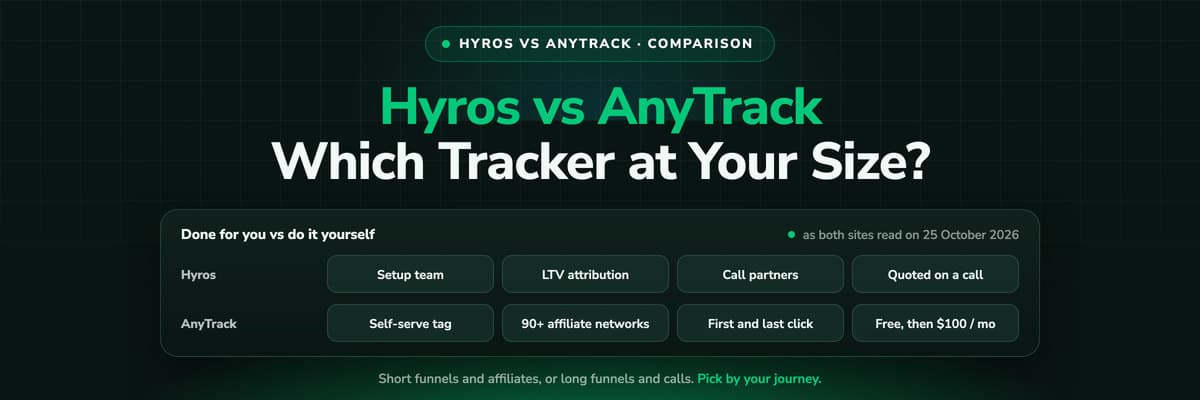 Tool Comparisons
Hyros vs AnyTrack (2026): Which Tracker at Your Size?
AnyTrack is a self-serve conversion router with a free plan and public prices from $100 a month. Hyros is a done-for-you attribution platform quoted on a call. A fair, dated comparison of tracking, attribution, affiliates, calls and cost.Read the article14 min read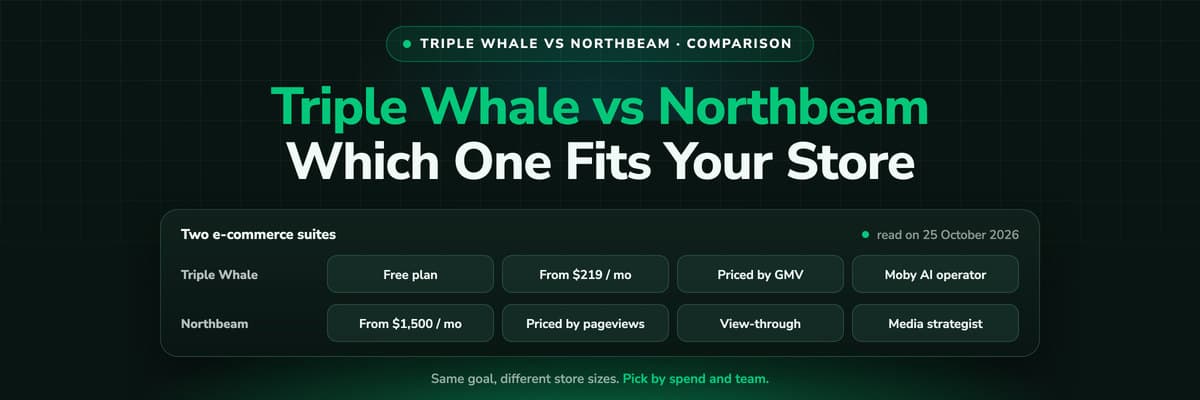 Tool Comparisons
Triple Whale vs Northbeam (2026): Which Fits Your Store
Triple Whale and Northbeam both measure e-commerce marketing, and they are built for different stores. Attribution, measurement, AI, setup and both price lists side by side, read on 25 October 2026, and which brand each one fits.Read the article13 min read
Ruler vs WhatConverts
The call, the form and the closed deal on one journey
LeadJourney tracks every lead server-side from the first click to the closed deal, with call tracking as an add-on, and sends the revenue back to your ad platforms. Book a demo: a tracking expert sets it up with you, with a 30-day money-back guarantee.
30-day money-back guaranteeSetup with a tracking expert