













BlogTool Comparisons
Dreamdata vs HockeyStack (2026): Which B2B Tool Fits
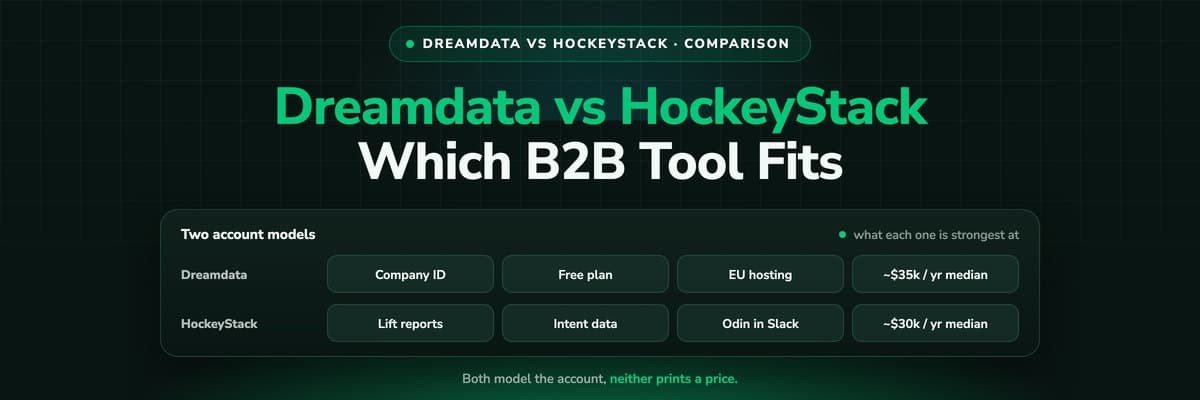
Both model the B2B account journey and both sell on quote. Dreamdata leads on company identification, EU hosting and a free plan; HockeyStack on lift reports, identity resolution and intent data. Every fact read on 25 October 2026.

Contents
Summarise this article with AI
Opens the page with a ready prompt in:


Nothing is sent until you pick a service.
Dreamdata and HockeyStack end up on the same shortlist for the same reason: both promise to show a B2B team which marketing moved an account from the first anonymous visit to closed won, across every stakeholder in the buying committee. Both sell to marketing and RevOps teams with a CRM-led sales cycle, both put an AI analyst on top, and neither prints a paid price.
The differences sit underneath: how each one finds the account, how far the attribution goes, what goes back to the ad platforms, where the data lives and how the quote is built. This comparison takes them one at a time and says where each tool is ahead. Every fact about both products was read on their own sites, documentation and buyer data on 25 October 2026.
Dreamdata vs HockeyStack in Short
In short
Dreamdata fits the B2B team that wants to see which companies are on its site and build audiences from them: company identification of up to 80% of anonymous companies by its own figure, a free plan to start on, conversion syncs to four ad platforms in its Activation add-on, and data hosted in the EU with SOC 2 Type II. HockeyStack fits the larger GTM team that wants one dataset across marketing, sales and intent data: identity resolution across every source, every attribution model with lookbacks and custom weighting, lift reports, account scoring with third-party intent, and Odin, an AI analyst that also answers in Slack. Neither publishes a paid price; buyer data puts the median contract at about $35,000 a year for Dreamdata and about $30,000 for HockeyStack.
Dreamdata vs HockeyStack at a glance, as both sites showed them on 25 October 2026
| Dreamdata | HockeyStack | |
|---|---|---|
| Built for | B2B marketing and RevOps teams, from a free plan to the enterprise | Mid-market and enterprise GTM teams: marketing, sales and RevOps on one dataset |
| Priced by | Monthly tracked users, custom quote | Custom quote; buyers report tracked contacts as the driver |
| Entry price | Free plan at $0; paid plan on quote | No public price; demo first |
| Typical contract (Vendr) | Median $35,440 a year | Median $29,702 a year |
| Attribution models | AI and custom models on the paid plan | Every model, lookbacks, custom weighting, lift reports |
| Finding the account | Company identification, up to 80% of companies by its own figure | Identity resolution across sources, plus intent vendors |
| Conversions back to ad platforms | Google, LinkedIn, Microsoft and Meta in the Activation add-on | LinkedIn and Google natively, others by webhook through Zapier or Make |
| CRMs | HubSpot, Salesforce, Microsoft Dynamics, Pipedrive | Salesforce, HubSpot, Dynamics |
| AI and MCP | Analytics Agent and an MCP server on the paid plan | Odin AI analyst in the app and Slack, an MCP server |
| Trial | Free plan, guided free trial of the paid plan | Interactive demo, no trial |
| Data location | EU data centres on Google Cloud, SOC 2 Type II | Not published; trust centre on request |
Who Each Tool Is Built For
Both tools start from the same premise: in B2B, the unit that buys is a company, not a person, and the journey that matters is the account's. Where they differ is how wide the dataset is meant to be.
Dreamdata calls itself an agentic B2B attribution platform. It is built around its own tracking script and its account-based data model: every stakeholder's touches on one company timeline, the companies behind anonymous visits identified, and audiences built from that model. It reaches down market further than HockeyStack does, with a free plan for B2B web analytics, and up to the enterprise with full onboarding, a dedicated CSM and a technical manager.
HockeyStack sells GTM intelligence. Its data foundation (called Atlas) pulls marketing, sales, product and intent sources into one dataset and resolves identities across them, and three product lines sit on top: Marketing Intelligence for attribution and lift, Account Intelligence for scoring, stakeholder maps and account plans, and GTM workflows that push the result into ad platforms and outreach tools. The customer wall (Rakuten, Mastercard, GitHub, RingCentral, Yext) tells you who it is priced for.
Verdict
Smaller B2B teams and anyone who wants to start free fit Dreamdata; GTM organisations that want marketing, sales and intent data in one model fit HockeyStack.
Tracking and Identity: Who Is on Your Site
Account-level attribution starts with knowing which company a visit belongs to. The two tools solve that differently.
Dreamdata: company identification
Dreamdata runs its own analytics script, tracking with and without cookies, and puts company identification on every plan, the free one included. Its pricing page claims a proprietary IP-to-company engine that identifies up to 80% of companies. Identified companies get an engagement score, feed the audience builder and trigger notifications to sales in Slack or Teams.
HockeyStack: identity resolution across every source
HockeyStack's browser snippet identifies visitors by fingerprinting rather than cookies, with an Enhanced Fingerprinting add-on for VPN and cross-device cases, and its documentation has a page on why that is GDPR compliant. The bigger difference is what happens next: Atlas resolves identities across the CRM, the ad platforms, marketing automation and the intent vendors (6sense, Bombora, Demandbase, G2, Rollworks, Albacross, Vector), so an account is assembled from far more than site visits.
Check consent with your DPO
Fingerprinting and IP-to-company resolution are both ways of identifying a visitor without the visitor filling in a form. Both vendors describe their method as GDPR compliant; whether it fits your consent setup in the EU is a question for your data protection officer, not for a comparison table.
Verdict
Dreamdata wins on seeing which companies visit, out of the box and for free; HockeyStack wins on joining everything else you know about the account to that visit.
Attribution Models and Proof of Lift
Both tools attribute pipeline and revenue to the account journey rather than to a single lead, and both let you change the model without re-tracking.
- Dreamdata puts AI and custom attribution models, revenue and content analytics and custom ROI and ROAS reporting on its paid Attribution and Activation plan. The free plan is analytics: up to three stage models and two months of user history, but not the attribution models themselves.
- HockeyStack offers every attribution model plus lookbacks and custom weighting, and adds lift reports, which estimate the incremental impact of a campaign on pipeline and revenue. Lift is the answer to the question every attribution model leaves open: would this deal have closed anyway?
For a B2B team whose board asks whether LinkedIn spend creates pipeline or only collects credit for it, lift reports are the feature that separates the two. Dreamdata's AI models are a strong default; they do not claim to measure incrementality.
Verdict
HockeyStack wins on attribution depth because of lift reports and custom weighting; Dreamdata is the simpler setup with strong AI defaults.
Sending Conversions and Audiences Back to the Ad Platforms
A B2B ad account optimises on whatever conversion you give it. Give it form fills and it finds more form fillers; give it the opportunity stage and it can learn which clicks become pipeline. Both tools can send the later stage back, with different reach.
Conversion and audience syncs, as documented on 25 October 2026
| Platform | Dreamdata | HockeyStack |
|---|---|---|
| LinkedIn Ads | Conversions API sync, audiences | Conversions API sync per pipeline stage, audiences |
| Google Ads | Enhanced Conversions for Leads, audiences | Enhanced Conversions, audiences |
| Microsoft Ads | Enhanced Conversions, audiences | Webhook through Zapier or Make |
| Meta | Meta Conversions, audiences synced daily | Audiences; conversions by webhook |
| Where it sits | Activation add-on to the paid plan; one sync on the free plan | Native syncs plus GTM workflows |
HockeyStack's LinkedIn sync sends pipeline events from the past 90 days and can take up to 24 hours to push, by its own documentation. Dreamdata covers four platforms natively, but only with Activation, which is an add-on to the paid plan.
Verdict
Dreamdata wins on breadth of native conversion syncs, once you buy Activation; HockeyStack covers LinkedIn and Google natively and the rest through a workflow tool.
Account Intelligence, AI Agents and MCP
Both vendors have moved from dashboards to agents in the last year, and both now offer an MCP server, so you can ask your own Claude or ChatGPT about the data.
- Dreamdata AI is on the paid plan: an Analytics Agent for plain-language questions, AI report summaries, and an MCP server that brings Dreamdata into the LLM you already use. Engagement scoring and notifications to sales are on every plan.
- HockeyStack has Odin, an AI analyst that works in the app and as a Slackbot, with scheduled prompts. Account Intelligence adds custom scoring that combines first-party CRM data with third-party behaviour and intent, stakeholder maps and recommended account plans. Its MCP server reads dashboards, reports and people and can create or update reports. Agent work is metered in credits, per the documentation.
Verdict
HockeyStack wins for sales-facing account intelligence and an analyst in Slack; Dreamdata covers the same questions with less to configure.
Integrations, the Warehouse and Data Hosting
Integrations listed on each vendor's site, 25 October 2026
| Category | Dreamdata | HockeyStack |
|---|---|---|
| CRM | HubSpot, Salesforce, Microsoft Dynamics, Pipedrive | Salesforce, HubSpot, Dynamics |
| Ad platforms | LinkedIn, Google, Meta, Microsoft, Twitter, Capterra, G2, NextRoll, lead form ads | LinkedIn, Google, Facebook, Bing, X, TikTok, Reddit, AdRoll, Capterra, StackAdapt |
| Marketing automation | HubSpot, Marketo, Pardot, Eloqua, Salesforce Marketing Cloud | Marketo, Pardot, HubSpot Marketing Hub, customer.io |
| Intent and ABM | Company identification of its own | 6sense, Bombora, Demandbase, G2, Rollworks, Albacross, Vector |
| Warehouse | Data Warehouse add-on | BigQuery, Snowflake, Databricks, ClickHouse, S3, Azure Blob, as an add-on |
Pipedrive users have one option here: only Dreamdata lists it. Teams that already pay for 6sense or Demandbase get more out of HockeyStack, which reads them in.
Where the data lives
Dreamdata states that it stores data in data centres within the European Union on Google Cloud, holds a SOC 2 Type II report and offers a DPA. HockeyStack is a Delaware company with a DPA on the EU Standard Contractual Clauses; its certifications and hosting region sit in a trust centre you request access to. An archived 2024 copy of its pricing page named AWS in Frankfurt, which the current site does not repeat.
Verdict
Dreamdata wins for EU data residency and for Pipedrive; HockeyStack wins for intent data and warehouse destinations.
Setup, Support and Trial
- Dreamdata can be tried before any call: the free plan is self-serve, needs no credit card, and the paid plan comes with a guided free trial. Paying customers get full onboarding, a dedicated CSM, a technical manager, solutions consulting and data science support, plus SSO and SAML.
- HockeyStack starts with a demo. Every plan includes hands-on support from the success team and custom setups. Its documentation describes self-serve product onboarding with an internal launch by week two or three, and new dashboard builds or extra implementation work subject to an implementation fee.
Verdict
Dreamdata wins on getting started; HockeyStack's setup is a project with a success team, which suits the teams it is priced for.
Dreamdata vs HockeyStack Pricing
Neither vendor publishes a paid price. Dreamdata prints a free plan and "custom pricing" metered by monthly tracked users; HockeyStack prints nothing but a demo form. What buyers report paying comes from Vendr's contract data, last updated February 2026.
What the vendors publish and what buyers report, US dollars
| Dreamdata | HockeyStack | |
|---|---|---|
| Published price | Free plan at $0; paid plan on quote | None |
| Pricing unit | Monthly tracked users | Not published; buyers report tracked contacts or accounts |
| Median contract (Vendr) | $35,440 a year | $29,702 a year, from 33 purchases |
| Reported range | $27,000 to $96,000 | $24,040 to $77,500 |
| Small deployments | $15,000 to $28,000 (under 5,000 accounts) | $12,000 to $24,000 (10,000 to 25,000 contacts) |
| Mid-market | $25,000 to $50,000 (5,000 to 20,000 accounts) | $30,000 to $60,000 (50,000 to 100,000 contacts) |
| Large | From about $50,000, past $75,000 to $100,000 | Past $75,000 to $100,000 (100,000+ contacts) |
| Add-ons | Activation, Data Warehouse, SCIM | Data Warehouse, Enhanced Fingerprinting, agent credits |
| Last public price | Activation from $750 a month (2025) | Growth at $1,399 a month (2023 to 2024) |
A worked example at three sizes
The two vendors meter different things, so the table reads Vendr's bands for each size, and adds LeadJourney, which prices by monthly ad spend, at an ad budget we assumed for each size. The budgets are an assumption, not a benchmark: put in your own.
Reported annual cost by account size, US dollars; LeadJourney at an assumed ad budget, monthly billing (yearly billing)
| Account size | Dreamdata, as reported | HockeyStack, as reported | Assumed ad spend | LeadJourney per year |
|---|---|---|---|---|
| Small B2B team | $15,000 to $28,000 | $12,000 to $24,000 | $10,000 / mo | $3,228 ($2,580), Starter |
| Mid-market | $25,000 to $50,000 | $30,000 to $60,000 | $40,000 / mo | $6,468 ($5,172), Growth |
| Enterprise | From $50,000 | From $75,000 | $150,000 / mo | From $12,948 ($10,356), Enterprise |
Read it as orders of magnitude, not quotes. Dreamdata's free plan costs nothing until you need attribution, and both vendors' quotes are reported to drop 10 to 30% on multi-year terms. Where implementation is charged, the same data puts it at a few thousand to $10,000 or more on Dreamdata and $5,000 to $15,000 or more on HockeyStack.
Which One Should You Choose?
Dreamdata
Pros
- Company identification and engagement scoring on every plan, the free one included
- Native conversion syncs to Google, LinkedIn, Microsoft and Meta in Activation
- Data in EU data centres, SOC 2 Type II, SSO and SAML
- A free plan and a guided trial before any commitment
- Pipedrive and Microsoft Dynamics among the CRMs
Cons
- Attribution models, the AI agent and MCP only on the paid plan, priced on quote
- Activation and the warehouse are add-ons on top
- No lift or incrementality reports
- Fewer intent and ABM sources than HockeyStack
HockeyStack
Pros
- Every attribution model with lookbacks, custom weighting and lift reports
- Identity resolution across CRM, ads, marketing automation and intent vendors
- Account scoring, stakeholder maps and account plans for sales
- Odin in Slack and an MCP server that can create reports
- Wide warehouse support: BigQuery, Snowflake, Databricks, ClickHouse
Cons
- No public price, no free plan and no trial
- Only LinkedIn and Google conversion syncs are native
- Hosting region and certifications behind a trust centre request
- Implementation fees for new dashboard builds, by its own docs
Verdict
Choose Dreamdata if you want to see the companies on your site, keep data in the EU and start free. Choose HockeyStack if you run a large GTM stack with intent data and need lift reports to defend the budget.
When Neither Fits: LeadJourney
Both tools are built for the account. That is the right unit for a buying committee of six, and the wrong one for a business whose revenue arrives as a named lead: a demo request, a booked call, a phone call, a deal in the CRM. For that team the question is not which company visited, but which campaign produced this person and what they closed for. And a quote of $25,000 a year is a lot to spend before you know.
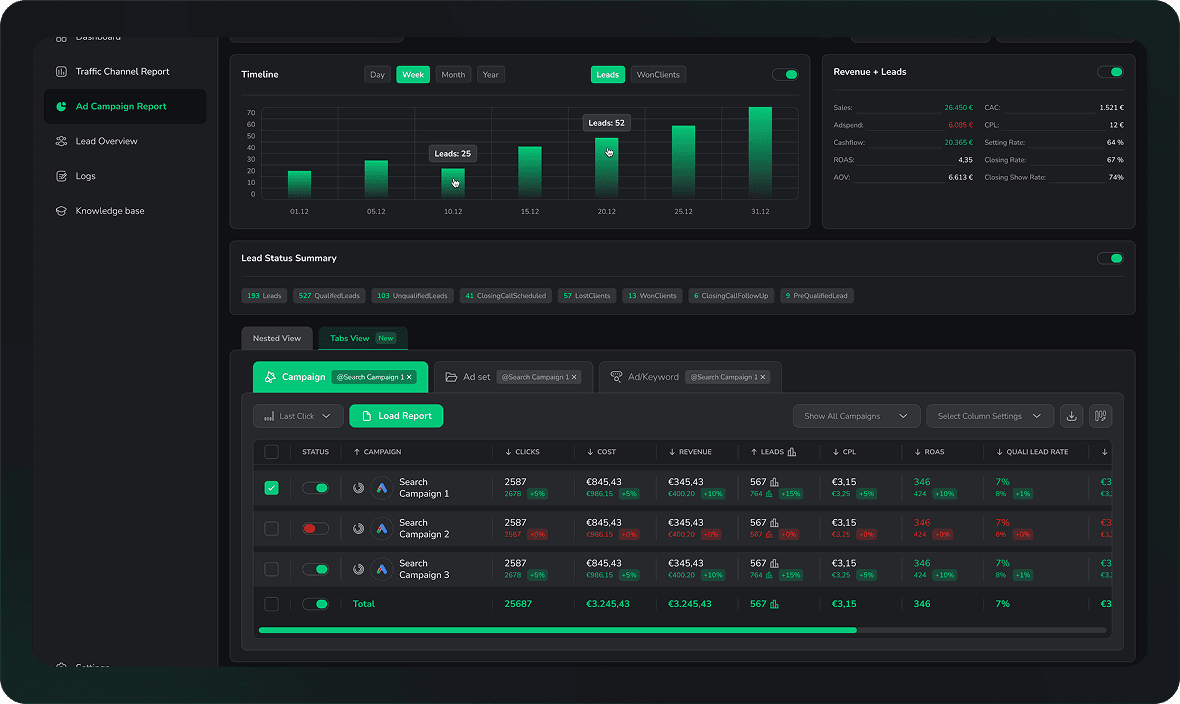
LeadJourney is an all-in-one attribution platform, built lead generation first for B2B and B2C, with e-commerce through Shopify beside it:
- Server-side, first-party tracking on your own domain, 95%+ of conversions captured, live in 21 minutes.
- Every named lead's journey from first click to closed deal, with the CRM stage on it, synced natively with HubSpot, Salesforce, Pipedrive, Close, Attio, GoHighLevel, ActiveCampaign, Odoo, Zoho CRM and Microsoft Dynamics 365.
- Closed deals back to the ad platforms on every plan: Meta, Google, LinkedIn, Microsoft, Reddit, X, Taboola and Outbrain Ads, plus Audience Sync to Meta, Google, LinkedIn and Microsoft.
- ChatGPT, Gemini, Claude, Copilot, Perplexity, Grok and DeepSeek as sources of their own.
- Public prices by monthly ad spend: $139 up to $5,000, $269 up to $15,000, $539 up to $50,000, $869 up to $100,000 and from $1,079 above, 20% off yearly. The MCP connection and the API are included from Growth, the BigQuery export from Scale.
- Hosted in Frankfurt. Every plan starts with a one hour onboarding call with a tracking expert, 14 days of setup support and a 30-day money-back guarantee.
Where LeadJourney is not the right pick
LeadJourney does not identify anonymous companies, has no intent data, no stakeholder maps and no lift reports, and does not hold SOC 2 or ISO 27001 or offer SAML SSO. If your programme runs on account-based targeting of companies that have not raised their hand, Dreamdata or HockeyStack is the tool. The row by row detail is in LeadJourney vs Dreamdata and LeadJourney vs HockeyStack.
Further Reading
- LeadJourney vs Dreamdata: the account model against the named lead, row by row.
- LeadJourney vs HockeyStack: enterprise GTM intelligence against lead attribution with public prices.
- Dreamdata pricing: the free plan's limits, buyer data and the prices the page used to show.
- HockeyStack pricing: what buyers pay, the add-ons and the archived price list.
- The best Dreamdata alternatives and the best HockeyStack alternatives.
- Multi-touch attribution: what the models do with the touches first and last touch leave out.
- Offline conversion tracking: sending the closed deal back to the ad platforms.
- LeadJourney pricing: every plan, in five currencies.
FAQ
Frequently Asked Questions
The questions B2B teams ask when Dreamdata and HockeyStack are on the same shortlist.
Is Dreamdata better than HockeyStack?
It depends on what you need from the account. Dreamdata is ahead on company identification, native conversion syncs to four ad platforms, EU hosting and getting started, with a free plan and a guided trial. HockeyStack is ahead on attribution depth, with lift reports and custom weighting, on identity resolution across intent and CRM sources, and on account intelligence for sales. Smaller B2B teams usually fit Dreamdata, large GTM organisations HockeyStack.
How much do Dreamdata and HockeyStack cost?
Neither publishes a paid price. Dreamdata has a free plan and quotes its paid plan by monthly tracked users; Vendr's buyer data puts the median at $35,440 a year, from $27,000 to $96,000. HockeyStack quotes after a demo; the median Vendr reports is $29,702 a year across 33 purchases, from $24,040 to $77,500. Implementation, where charged, is reported on top of both.
Does Dreamdata or HockeyStack have a free trial?
Dreamdata does: its free plan is self-serve with no credit card, limited to two months of history, five seats and one sync, and its paid Attribution and Activation plan has a guided free trial. HockeyStack has no free plan and no trial on its pricing page; it offers an interactive demo and a demo call, and setup runs with its success team.
Which one sends conversions back to LinkedIn and Google Ads?
Both. Dreamdata syncs to Google Ads Enhanced Conversions for Leads, the LinkedIn Conversions API, Microsoft Enhanced Conversions and Meta inside its Activation add-on. HockeyStack syncs pipeline stages to the LinkedIn Conversions API and to Google Enhanced Conversions natively, and to other platforms through webhooks with Zapier or Make. Both sync audiences to LinkedIn, Google and Meta.
Where do Dreamdata and HockeyStack store data?
Dreamdata states that it stores data in data centres within the European Union on Google Cloud, with SOC 2 Type II and a DPA. HockeyStack does not publish its region on its site; its certifications and hosting details sit in a trust centre you request access to, and its DPA uses the EU Standard Contractual Clauses for international transfers.
Can I use Dreamdata and HockeyStack together?
Technically yes, both run their own script beside others, but few teams pay for two account-level attribution platforms, because both model the same journey and both want to be the source of truth for pipeline. Running both through a proof of concept on the same quarter is the more common use: compare what each attributes to the same closed deals, then keep one.
What is the best alternative to Dreamdata and HockeyStack?
For a team whose revenue arrives as named leads rather than anonymous accounts, LeadJourney tracks every lead server-side from first click to closed deal, syncs the CRM natively, sends closed deals back to eight ad platforms on every plan and publishes its prices by ad spend, from $139 a month. It does not identify anonymous companies, so an account-based programme still needs Dreamdata or HockeyStack.
Keep reading
More from the blog
 Tool Comparisons
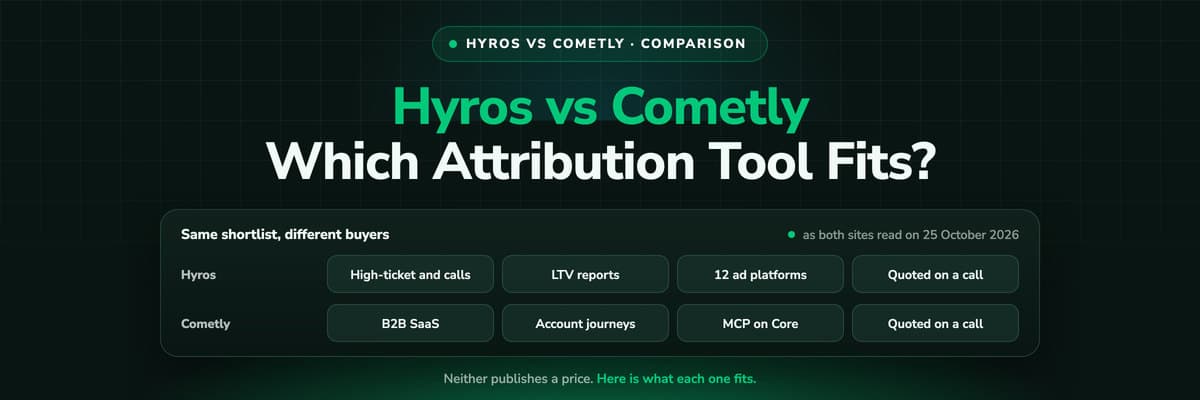
Hyros vs Cometly (2026): Which Attribution Tool Fits?
Hyros is built around high-ticket sales, info products and calls; Cometly around B2B SaaS pipeline. Both quote prices on a call. A fair, dated comparison of tracking, CRM depth, AI, security and cost, and who should pick which.Read the article14 min read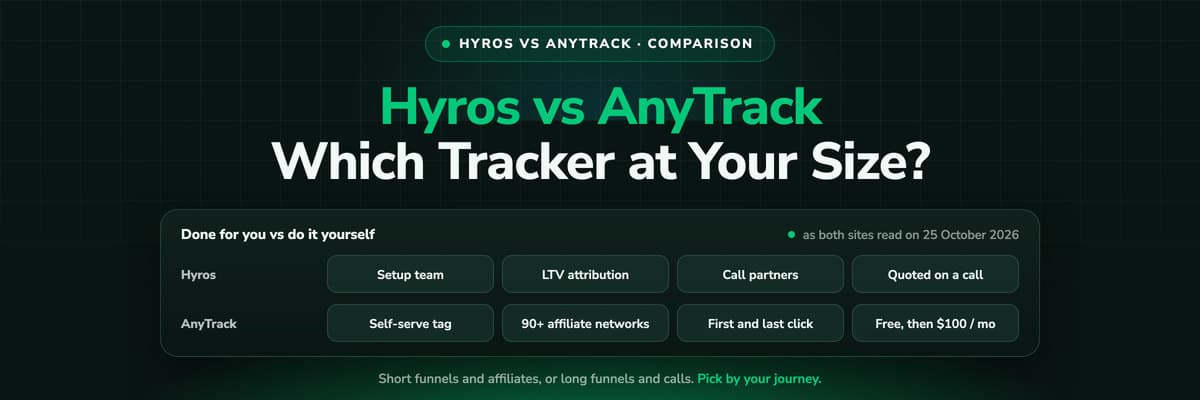 Tool Comparisons
Hyros vs AnyTrack (2026): Which Tracker at Your Size?
AnyTrack is a self-serve conversion router with a free plan and public prices from $100 a month. Hyros is a done-for-you attribution platform quoted on a call. A fair, dated comparison of tracking, attribution, affiliates, calls and cost.Read the article14 min read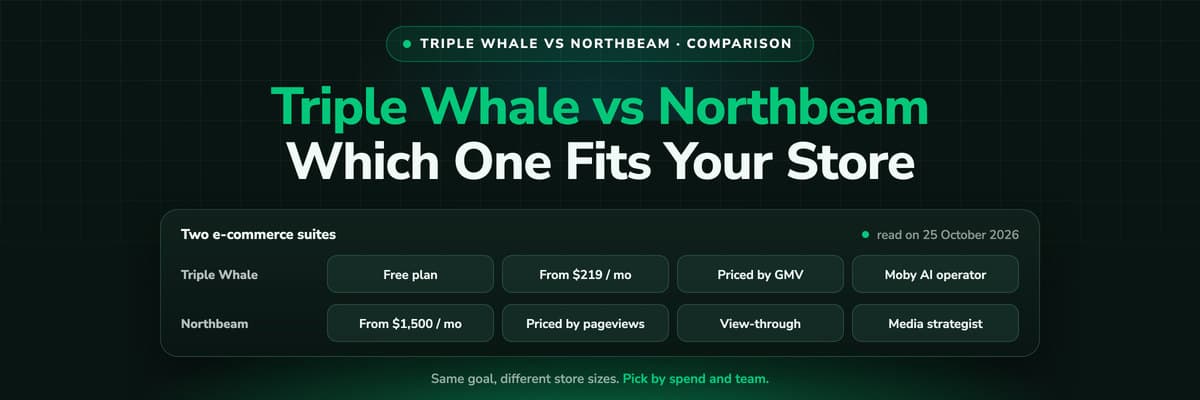 Tool Comparisons
Triple Whale vs Northbeam (2026): Which Fits Your Store
Triple Whale and Northbeam both measure e-commerce marketing, and they are built for different stores. Attribution, measurement, AI, setup and both price lists side by side, read on 25 October 2026, and which brand each one fits.Read the article13 min read
Dreamdata vs HockeyStack
Attribution for the named lead, not the modelled account
LeadJourney follows every lead from the first click to the closed deal and sends the revenue back to your ad platforms, priced by ad spend from $139 a month. Book a demo: a tracking expert sets it up with you, with a 30-day money-back guarantee.
30-day money-back guaranteeSetup with a tracking expert