















BlogTool Comparisons
Dreamdata Pricing 2026: Plans, Real Costs and What Changed
Dreamdata publishes a free plan and "custom pricing". Here is what the free plan leaves out, what buyers report paying for the paid plan, how monthly tracked users drive the quote, and the prices the page showed in 2024 and 2025.

Contents
Summarise this article with AI
Opens the page with a ready prompt in:


Nothing is sent until you pick a service.
Dreamdata's pricing page has two columns. One says $0. The other says "custom pricing" and asks for a demo. Everything a B2B marketing team usually buys Dreamdata for, the attribution models, the AI agent and the audience syncs, sits in the second column.
This guide sets out what each plan includes, how the volume Dreamdata tracks decides the quote, what buyers report paying, and the price lists the page still showed in 2024 and 2025. Every Dreamdata fact below was read on dreamdata.io, its documentation or an archived copy of its pricing page on 13 September 2026.
Dreamdata Pricing in Short
In short
Dreamdata has two plans: a free plan at $0 with two months of history, five seats, three stage models, two notifications and one sync, and Attribution & Activation on custom pricing, which is where the attribution models, the Analytics Agent and the MCP server live. No paid price is published. Buyer data on Vendr puts the median contract at $35,440 a year, with deals from $27,000 to $96,000, sold as annual contracts with implementation fees of $5,000 to $10,000 or more reported on top. The quote follows the volume Dreamdata tracks, not your ad budget. The page used to show prices: Team from $599 and Business from $1,499 a month in 2024, Activation from $750 a month in 2025.
Dreamdata plans as dreamdata.io showed them on 13 September 2026
| Plan | Price | What decides it |
|---|---|---|
| Free | $0 / month | Fixed limits: 2 months of history, 5 seats, 3 stage models, 1 sync |
| Attribution & Activation | Custom pricing | Tracked volume and the add-ons you take, quoted after a demo |
| Activation | Add-on, price not published | Audience and conversion syncs to the ad platforms |
| Data Warehouse | Add-on, price not published | Dreamdata's account model in your own warehouse |
How Dreamdata Pricing Works
The unit behind Dreamdata's price is the monthly tracked user, or MTU. Its pricing page defines it as the number of unique monthly tracked users across all your go-to-market assets, such as your website and your marketing automation system. The documentation is more precise about what counts:
- Website: every visitor, anonymous or identified, who views a page or submits a form, where they have accepted cookies.
- CRM: active contacts with tracked activity, such as form submissions, page views and email clicks.
- LinkedIn: each member who engages with an ad through a click, a like, a comment, a share or a completed video. Impressions do not count.
- Across sources: one person is counted once per calendar month, and anonymous visits merge into one MTU once the person identifies themselves.
Two things follow. The price grows with your reach rather than your results: a bigger website audience, a larger CRM and a more engaging LinkedIn campaign all add MTUs. And connecting another source to get a fuller picture is also connecting another source of billable users.
Tracked users or tracked accounts?
Buyer data on Vendr names the number of tracked companies as the main driver of a Dreamdata contract, followed by the feature set, the contract length and the integrations. Both readings point the same way: the quote follows how much of your market Dreamdata sees, and it is set in a sales conversation.
Why there is no price on the page
The paid column describes itself as advanced plans for larger teams, with a guided free trial available, and the way in is a demo. What it includes is listed in full. What it costs is not, for any volume.
What the Free Plan Includes, and What It Leaves Out
The free plan is real and needs no credit card. In the page's own words it covers:
- B2B web analytics
- Cookie and cookie-less tracking
- Engagement scoring
- Company identification
- Audience builder
- Slack and Teams notifications
- Ad spend report
- B2B benchmarks
Limits on the Dreamdata free plan
| Limit | Free plan |
|---|---|
| User history | 2 months |
| Seats | 5 |
| Stage models | 3 |
| Notifications | 2 |
| Syncs | 1 |
| Onboarding | Self-serve, Slack community, AI support chat |
What it leaves out is the reason most teams look at Dreamdata: the AI-based attribution models, revenue and content analytics, custom ROI and ROAS reporting, the Analytics Agent and the MCP server are all on the paid plan. The free plan tells you which companies are on your site. It does not tell you which campaign earned the pipeline.
Is there a limit on tracked users?
The pricing FAQ says Dreamdata stays free until you exceed the free monthly tracked user limit, and prints no number. An earlier Dreamdata announcement, from when the paid plans were still called Team, Business and Enterprise, said the free plan's 30,000 MTU cap had been removed. Check the current figure in your account's usage and billing dashboard before you build on it.
What the Attribution & Activation Plan Includes
The paid plan unlocks everything Dreamdata sells, some of it as add-ons with a price of their own:
- Attribution: AI-based attribution models, revenue and content analytics, custom reporting on ROI and ROAS, AI-powered report summaries.
- Dreamdata AI: the Analytics Agent for plain-language questions, and an MCP server that brings Dreamdata into the LLM you already use.
- Advanced data controls: event builder, custom UTM mapping, data model scheduler, custom data sources, multiple business units, SSO and SAML login, with SCIM as an add-on.
- Support: full onboarding, a dedicated CSM, a dedicated technical manager, solutions consulting and data science support.
- Activation (add-on): audiences built from the account model and synced to the ad platforms, sales notifications, and conversion syncs to Google Ads, LinkedIn, Microsoft Ads and Meta.
- Data Warehouse (add-on): Dreamdata's account-based model in your own warehouse.
The add-ons matter for the quote. Sending conversions back to the ad platforms, which many teams consider part of attribution, is Activation, and Activation is priced on top.
What Dreamdata Costs in Practice
With no price on the page, the best public evidence is what buyers report paying. Vendr, which negotiates software contracts, publishes a median of $35,440 a year for Dreamdata, with deals from $27,000 to $96,000, and groups them by the number of accounts tracked:
Dreamdata contract values reported by Vendr, updated February 2026
| Company size, by tracked accounts | Annual contract, as reported | First year with implementation |
|---|---|---|
| Under 5,000 accounts | $15,000 to $28,000 | $20,000 to $38,000 |
| 5,000 to 20,000 accounts | $25,000 to $50,000 | $30,000 to $60,000 |
| 20,000 accounts and more | $50,000 to $100,000+ | $55,000 to $110,000+ |
The first year column adds the implementation fees Vendr reports, $5,000 to $10,000 or more. The same data describes annual subscriptions as the standard, monthly billing as generally unavailable for new customers, discounts of 10 to 30% off the first quote depending on deal size, 15 to 30% lower annual pricing on multi-year terms, and renewal escalators of 5 to 10% a year.
Read the ranges as negotiated outcomes, not a price list. They tell you the order of magnitude to expect in the room, and that the first number you hear is rarely the last.
How Dreamdata Pricing Changed
Articles still quote Dreamdata at $599, $1,499 or $750 a month. All three prices were real. Archived copies of the pricing page show them:
dreamdata.io/pricing in June 2024 and July 2025 (archived), and September 2026
| Plan | June 2024 | July 2025 | September 2026 |
|---|---|---|---|
| Free | $0 | $0, 2 months of history, 5 seats | $0, 2 months of history, 5 seats |
| Team | From $599 / mo, billed annually: 30,000 MTUs, 2 years of history, up to 10 seats | Not offered | Not offered |
| Business | From $1,499 / mo, billed annually: 60,000 MTUs, 3 years of history, 20 seats | Not offered | Not offered |
| Activation | Not offered | From $750 / mo: 10,000 MTUs, 2 years of history, 25 seats, 50 syncs | Add-on to the paid plan, price not published |
| Top plan | Enterprise, custom: unlimited seats and MTUs | Activation & Attribution, custom, trial of up to 30 days | Attribution & Activation, custom |
What changed is not only the number but where you learn it. In 2024 a team could budget from the page and see that 30,000 tracked users cost from $7,188 a year. In 2025 the first paid step was $750 a month for 10,000 tracked users. Today the first paid price arrives in a sales conversation, and the buyer data above suggests it lands well above either.
When Dreamdata Is Worth the Price
Dreamdata models the B2B account journey better than almost anyone, and for the right team the contract buys exactly that:
- You sell to buying committees. Every stakeholder's touches land on one company timeline, which is what an account-based programme runs on.
- You need to see anonymous companies. Dreamdata identifies, by its own figure, up to 80% of the companies behind visits, scores their engagement and builds audiences from it.
- You run an enterprise stack. Microsoft Dynamics, Marketo, Eloqua, Snowflake and the BI tools are all connected, with a technical manager to wire them.
- Procurement has a checklist. SOC 2 Type II, EU data centres and SSO are in place.
- Your deals are large. Against six-figure contracts, a $35,000 tool that moves budget to the right accounts pays for itself quickly.
When Dreamdata Pricing Works Against You
- You need attribution, not analytics. The free plan has no attribution models, so the real comparison starts at the paid plan and its quote.
- You want a number before a call. No paid price is published for any volume.
- Your conversion is a named lead. When revenue arrives as a form, a call or a booked meeting, an account model and company identification are capability you pay for and do not use.
- Your team is small. Implementation fees, a data model to configure and an annual contract are a lot of commitment for a team of two.
- You want to pay monthly. Buyer data describes annual contracts as the standard, with escalators at renewal.
- You want the loop closed by default. Conversion syncs back to the ad platforms sit in the Activation add-on.
Dreamdata Pricing vs LeadJourney Pricing
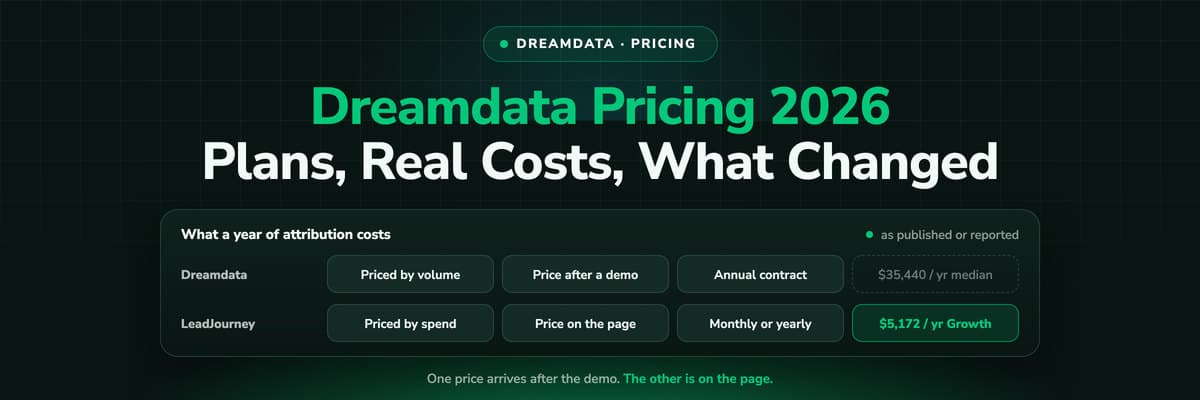
LeadJourney is an all-in-one attribution platform built around the named lead, B2B and B2C: it follows every person from the first click through the form, the call and the CRM stages to the closed deal. Its plans are priced by monthly ad spend and published in full.
How Dreamdata and LeadJourney price, side by side
| Pricing | Dreamdata | LeadJourney |
|---|---|---|
| Priced by | Tracked users or accounts | Monthly ad spend |
| Published price | Free plan only | Every plan |
| Attribution models | Paid plan, on quote | Every plan, from $139 / mo |
| Typical yearly cost | Median $35,440 as reported, plus implementation | $1,332 to $8,340 on yearly billing, Enterprise from $10,356 |
| Billing | Annual contracts | Monthly, or yearly at 20% off |
| Trying it | Free plan, guided trial of the paid plan | 14-day free trial, no credit card |
| Conversions back to ad platforms | Activation add-on | Every plan |
| Anonymous company identification | Yes, up to 80% by Dreamdata's figure | No, it starts at the identified lead |
The LeadJourney ladder
LeadJourney advertiser plans in US dollars; also priced in euros, pounds, Canadian and Australian dollars
| Plan | Monthly ad spend | Monthly billing | Yearly billing, per year |
|---|---|---|---|
| Launch | Up to $5,000 | $139 / mo | $1,332 |
| Starter | Up to $15,000 | $269 / mo | $2,580 |
| Growth | Up to $50,000 | $539 / mo | $5,172 |
| Scale | Up to $100,000 | $869 / mo | $8,340 |
| Enterprise | Above $100,000 | From $1,079 / mo | From $10,356 |
These are not the same product at different prices. Dreamdata sees the anonymous account and LeadJourney does not; LeadJourney tracks server-side on your own domain, attributes the named lead with every model on every plan, and sends the stage changes and closed deals back to Meta, Google, LinkedIn and Microsoft Ads without an add-on. If the account is what you need to see, the Dreamdata contract buys it. If the lead is, the price on the page is the shorter route.
The full Dreamdata comparison sets both products against each other row by row.
How to Estimate Your Dreamdata Price Before the Demo
- Count your monthly tracked users. Unique website visitors who accepted cookies, CRM contacts with activity, and LinkedIn members who engaged with an ad, deduplicated, per month.
- Count your tracked accounts too. The number of companies behind those users is what buyer data names as the main driver.
- Place yourself in a band. Use the Vendr ranges above, and budget the implementation fee on top for the first year.
- List the add-ons you need. Ask whether Activation and the Data Warehouse are in the quote, since conversion syncs to the ad platforms live in Activation.
- Ask about the renewal. The escalator, the multi-year discount and whether the MTU count is reviewed during the term.
- Price the alternative on the same needs. A tool priced by ad spend needs only your monthly budget, which you already know.
Further Reading
- Dreamdata vs LeadJourney: the full comparison, feature by feature.
- Hyros pricing: the other way to price attribution, by the revenue it tracks.
- LeadJourney pricing: every plan, in five currencies.
- Offline conversion tracking: sending the closed deal back to the ad platforms.
- Multi-touch attribution: what the models do with the touches first and last touch leave out.
FAQ
Frequently Asked Questions
The questions B2B teams ask about Dreamdata pricing before the demo.
How much does Dreamdata cost?
Dreamdata has a free plan at $0 and a paid Attribution & Activation plan on custom pricing, with no paid price published. Buyer data on Vendr, updated February 2026, puts the median contract at $35,440 a year, with deals from $27,000 to $96,000, annual subscriptions as the standard and implementation fees of $5,000 to $10,000 or more on top.
Is Dreamdata free?
There is a free plan with no credit card: B2B web analytics, company identification, engagement scoring, an audience builder and an ad spend report, limited to two months of history, five seats, three stage models, two notifications and one sync. The attribution models, the Analytics Agent and the MCP server are on the paid plan, so the free plan is analytics rather than attribution.
What is an MTU in Dreamdata pricing?
A monthly tracked user is a unique person who triggers at least one event in any connected source within a calendar month: a website visitor who accepted cookies, a CRM contact with tracked activity, or a LinkedIn member who engaged with an ad. Impressions do not count, a person is counted once across sources, and anonymous visits merge into one MTU once the person identifies themselves.
Did Dreamdata use to publish its prices?
Yes. An archived copy of the pricing page from June 2024 shows Team from $599 a month and Business from $1,499 a month, both billed annually, with 30,000 and 60,000 monthly tracked users included, and Enterprise on custom pricing. In July 2025 the page showed Activation from $750 a month with 10,000 tracked users. Today it lists a free plan and custom pricing only.
Does Dreamdata offer monthly billing?
The pricing page does not say. Buyer data on Vendr describes annual subscriptions as the standard and monthly billing as generally unavailable for new customers, with multi-year terms bringing the annual price down by 15 to 30%. The 2024 prices were also billed annually.
What is a cheaper alternative to Dreamdata?
For a team whose revenue arrives as named leads, forms, calls and CRM deals, LeadJourney publishes its price and bills by ad spend: $139 a month up to $5,000 of spend, $539 up to $50,000, monthly or yearly, with every attribution model and the conversion sync to four ad platforms on every plan and a 14-day free trial. It does not identify anonymous companies, which is the one thing to weigh if an account-based programme depends on it.
Keep reading
More from the blog
 Tool Comparisons
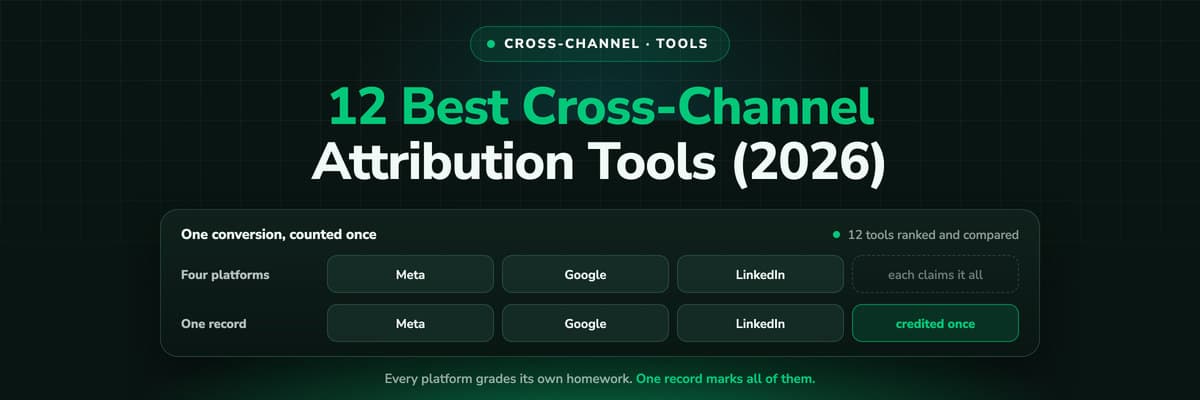
12 Best Cross-Channel Attribution Tools in 2026
Meta says 71, Google 58, LinkedIn 19, Microsoft 7. The CRM has 122 leads. Twelve cross-channel attribution tools compared on how they close that gap, record, model or move, with pricing, pros, cons and a verdict on who each one is built for.Read the article24 min read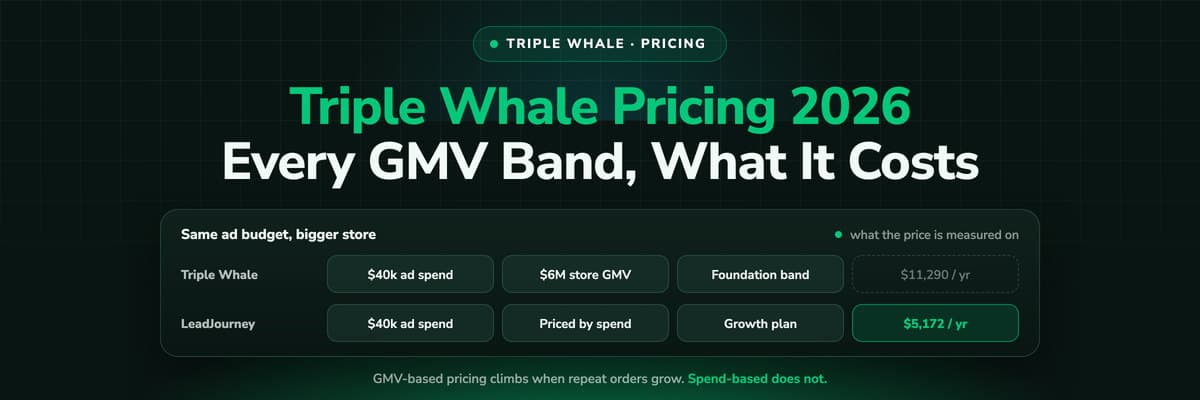 Tool Comparisons
Triple Whale Pricing 2026: Plans, GMV Bands and Real Costs
Triple Whale prices Foundation, Automate and Enterprise by your store's annual GMV, and its pricing page no longer prints a number. Every band it last published, what billing and Moby add, what changed since 2025, and what the model costs as the store grows.Read the article11 min read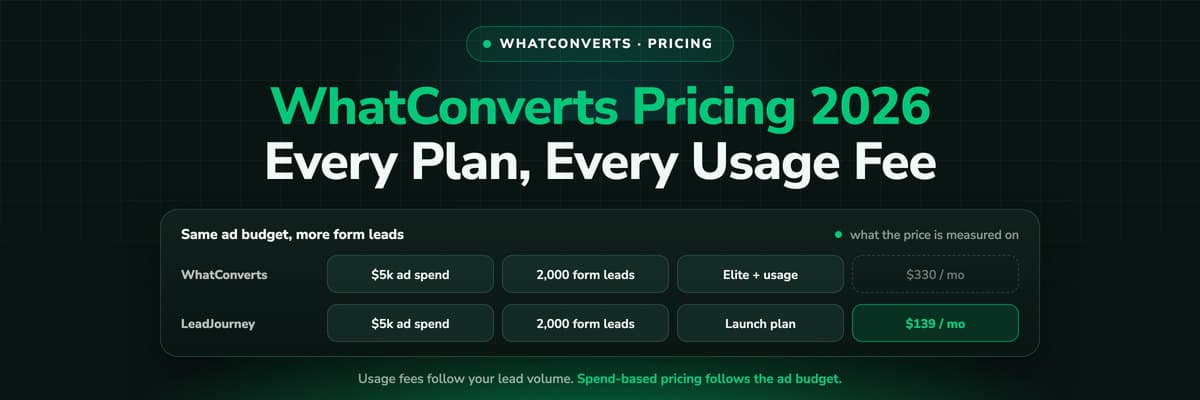 Tool Comparisons
WhatConverts Pricing 2026: Plans, Usage Fees and Real Costs
WhatConverts publishes every price: $30 to $160 a month for one account, $500 to $1,250 for agencies, each with a usage credit. What the credit covers, every rate past it, what the calculator adds at volume, and how the price changed since 2021.Read the article11 min read
Dreamdata pricing
Read the price before the demo
LeadJourney attributes every lead from first click to closed deal, priced by ad spend from $139 a month, with the sync back to four ad platforms on every plan. 14-day free trial, no credit card.