
















BlogTool Comparisons
Databox Pricing 2026: The New Plans and What They Cost
Databox rebuilt its price list in September 2026. Every plan and add-on on the page today, monthly and annual, how data sources, users and client packs move the price, what it used to cost, and what a team or an agency pays as it grows.


Contents
Summarise this article with AI
Opens the page with a ready prompt in:


Nothing is sent until you pick a service.
Databox rebuilt its price list in September 2026. The Analyst, Pro and Growth plans on the page at the start of the month are gone, and so is the extra data source at $5.60. In their place are two Team plans with fixed allowances of users and sources, and an Agency plan priced by client packs.
This guide lists every plan and add-on, monthly and annual, what the page used to charge, and what a growing team and a growing agency pay. Every Databox price below was read on databox.com on 13 September 2026.
Databox Pricing in Short
In short
Databox has a free plan and four paid plans, priced by data sources, users and clients: Analyst at $71 a month billed annually ($89 monthly), Team Core at $199 ($249) for 3 users and 10 sources, Team Scale at $319 ($399) for 10 users and 30 sources, and Agency from $79 ($99) plus $20 per client pack ($25 monthly). Custom is on quote. Annual billing saves 20%, and every paid plan has a 14-day trial with no credit card. White-labelling is an add-on at $80 a month ($100 monthly). And no plan tracks a visit: Databox reports the numbers your connected tools already report.
Databox plans as databox.com showed them on 13 September 2026, US dollars per month
| Plan | Annual billing | Monthly billing | Users | Data sources |
|---|---|---|---|---|
| Free | $0 | $0 | 1 | 3 |
| Analyst | $71 | $89 | 1 | 5 |
| Team Core | $199 | $249 | 3 | 10 |
| Team Scale | $319 | $399 | 10 | 30 |
| Agency | From $79, plus $20 per client pack | From $99, plus $25 per client pack | Unlimited | 20, plus 5 per pack |
| Custom | Quote | Quote | More | More |
How Databox Pricing Works
Databox prices on data sources, users and, on the Agency plan, clients. Which of them binds first depends on who you are.
What counts as a data source
A data source is one account, property or view, not one tool. The pricing page's own example: three GA4 properties are three data sources.
- Free and Analyst are single-user plans. A second person means Team.
- Team Core stops at 3 users and 10 sources. The fourth user or the eleventh source moves you to Team Scale, a $150 step on monthly billing and $120 on annual.
- Team Scale stops at 10 users and 30 sources. Past either, the next plan is Custom, which has no published price.
No more paying per extra source
Until this month an extra data source cost $5.60 a month. The new FAQ says adding more means moving up a tier, except on Agency, where sources arrive five at a time in client packs.
AI credits
Genie, the AI analyst, and the MCP server draw on a monthly credit pool: 50 credits on Free, 150 on Analyst, 500 on Team Core, 1,000 on Team Scale, and 300 on Agency plus 50 per pack. A top-up costs $200 a month billed annually or $250 monthly, and the page does not say how many credits it buys.
Every Databox Plan in 2026
What each Databox plan adds, per the plan cards and comparison table on databox.com
| Plan | What it adds |
|---|---|
| Free | 1 dashboard, 10 custom metrics, 50 AI credits, daily sync, Genie, goals, anomaly detection |
| Analyst | Unlimited dashboards and metrics, 150 AI credits, hourly sync, custom data integrations, API, MCP server, chat and email support |
| Team Core | 3 users, 10 sources, 500 AI credits, sharing and notifications, CSV export, Genie in Slack, routines |
| Team Scale | 10 users, 30 sources, 1,000 AI credits, sub-accounts |
| Agency | Unlimited users, 4 clients, 20 sources, 300 AI credits, bulk actions, custom templates, cross-client reporting |
| Custom | More users, sources and credits, a security review, setup by Databox and an embedded engineer |
The Agency plan and client packs
The Agency base covers 4 clients, 20 data sources and 300 AI credits with unlimited users. Each client pack adds 1 client, 5 sources and 50 credits for $20 a month billed annually or $25 monthly. We set the calculator stop by stop: 10 clients cost $199 a month on annual billing or $249 monthly, 20 clients $399 or $499, and 54 clients, the last numbered stop, $1,079 or $1,349.
Why the numbers online disagree
Articles still quote Databox at $47, $59, $159 or $399 a month, or at $5.60 per extra data source. Each was real at some point in the last two years, as the history below shows. None is today's price list, which replaced the old one after 3 September 2026.
What Is Included and What Costs Extra
Every plan, the free one included, gets the 130+ cloud integrations, Genie, performance summaries, the semantic layer, pre-built metrics, goals and anomaly detection. The rest is a plan step or an add-on.
Databox add-ons, US dollars per month, 13 September 2026
| Add-on | Annual billing | Monthly billing |
|---|---|---|
| Flexible AI credit top-up | $200 | $250 |
| Branding and white-labeling | $80 | $100 |
| Advanced security management (SSO, 2FA enforcement, login records) | $40 | $50 |
| Fiscal calendar | $160 | $200 |
| OKRs | $14 | $18 |
| 15-minute sync per source | Not printed | Not printed |
White-labelling, which an agency needs before a client sees a report without Databox's name on it, is an add-on on every plan, Agency included.
What no plan does
Databox does not collect data. It shows the numbers your connected tools report, so the conversions on a dashboard are the ones Meta, Google Ads and GA4 each claim on their own rules, side by side. Nothing on the pricing page tracks a visit, joins a CRM deal to the click that started it or sends a conversion back to an ad platform, at any price.
How Databox Pricing Changed
Archived copies of databox.com/pricing show the ladder changing shape four times in two years. The figures are the annual rate each page showed by default, with monthly billing in parentheses.
databox.com/pricing, archived snapshots from May 2024 to 3 September 2026, and the live page on 13 September 2026
| Snapshot | Plans and prices | Extra data source | Users |
|---|---|---|---|
| May 2024 | Starter $47 ($59), Professional $135 ($169), Growth $319 ($399), Premium $799 ($999) | $4.80 ($6) each above 3 | 5, 15, unlimited, unlimited |
| December 2024 to June 2025 | Starter $47 ($59), Professional $159 ($199), Growth $319 ($399), Premium $799 ($999) | $5.60 ($7) each above 3 | 5 on Starter, unlimited above |
| November 2025 to January 2026 | Professional $159 ($199), Growth $399 ($499), Premium $799 ($999) | $5.60 ($7) each above 3 | Unlimited on every plan |
| 3 September 2026 | Free $0, Analyst $64 ($79), Pro $159 ($199), Growth $399 ($499), Custom on quote | $5.60 ($7) on Pro and Growth | 1 on Free and Analyst, unlimited on Pro and Growth |
| 13 September 2026 | Free $0, Analyst $71 ($89), Team Core $199 ($249), Team Scale $319 ($399), Agency from $79 ($99), Custom on quote | None: a higher plan, or client packs on Agency | 1, 1, 3, 10, unlimited |
Two things changed. A shared account got dearer: from late 2024 until this month $159 a month billed annually bought unlimited users, and today $199 buys three. And three sources plus $5.60 for each one after became fixed allowances. Six sources cost about $176 a month on Pro at the start of September; they now need Team Core at $199, because Analyst stops at five.
What Databox Really Costs as You Grow
Databox and LeadJourney are different products, so these tables compare what each costs for the job it does. Databox's price follows sources, users and clients. LeadJourney's follows ad spend, or managed spend plus leads for an agency.
An in-house marketing team
Assumptions: users and sources as stated in each row, and LeadJourney's plan read off the ad spend, with its seat allowance (2, 5, 7 and 10 users) covering the team.
Databox vs LeadJourney for an in-house team, US dollars per month
| Team | Monthly ad spend | Databox, monthly (yearly) | LeadJourney, monthly (yearly) |
|---|---|---|---|
| 1 user, 5 sources | $5,000 | Analyst, $89 ($71) | Launch, $139 ($111) |
| 3 users, 10 sources | $15,000 | Team Core, $249 ($199) | Starter, $269 ($215) |
| 5 users, 10 sources | $15,000 | Team Scale, $399 ($319) | Starter, $269 ($215) |
| 7 users, 20 sources | $50,000 | Team Scale, $399 ($319) | Growth, $539 ($431) |
| 10 users, 30 sources | $100,000 | Team Scale, $399 ($319) | Scale, $869 ($695) |
| 11 users or 31 sources | $100,000 | Custom, on quote | Scale, plus $19 a month per extra seat |
Databox is cheaper in four of the six rows, and at the top of its Team ladder it costs less than half as much. The exception is headcount: a fourth user on Team Core adds $150 a month, so a five-person team at $15,000 of spend pays less on LeadJourney. Past ten users or thirty sources Databox has no public price.
A growing agency
Assumptions: 5 sources per client (GA4, Search Console, Google Ads, Meta Ads and the CRM), so each client beyond four is one Databox pack; LeadJourney's plan read off managed spend and monthly leads and sales, with its client workspaces (5, 10, 20 and 40) covering the roster.
Databox Agency vs LeadJourney agency plans, US dollars per month
| Clients | Managed spend, leads and sales a month | Databox Agency, monthly (yearly) | Databox with white-label | LeadJourney, monthly (yearly) |
|---|---|---|---|---|
| 5 | $40,000 and 800 | $124 ($99) | $224 ($179) | Starter, $429 ($343) |
| 10 | $200,000 and 5,000 | $249 ($199) | $349 ($279) | Growth, $1,079 ($863) |
| 20 | $600,000 and 15,000 | $499 ($399) | $599 ($479) | Scale, $2,159 ($1,727) |
| 40 | Over $750,000 and 25,000 | $999 ($799) | $1,099 ($879) | Enterprise, from $3,239 ($2,591) |
Here Databox costs 23% to 31% of the LeadJourney price at every size. On monthly billing that is about $25 a client, against $81 to $108 a client on LeadJourney.
What the difference buys
The gap is the price of producing a number rather than displaying it. A Databox client report shows what each platform claims, and one lead can be claimed by more than one of them. LeadJourney tracks the visit server-side on the client's own domain, follows the lead through the CRM stages to the closed deal, attributes the revenue to the campaign, and sends stages and deals back to Meta, Google, LinkedIn and Microsoft Ads as offline conversions. When a client asks which campaign made the deals, that answer is not in the Databox column.
When Databox Is Worth the Price
Databox is a good KPI layer, and at these prices an affordable one. It earns its plan when:
- You want every department on one screen. 130+ integrations, spreadsheets and SQL databases put finance, sales, product and marketing side by side.
- The numbers already exist. When your tools report what you need, a dashboard that collects them is the only thing missing.
- You run many client dashboards. At about $25 a client a month with unlimited users, the Agency plan is cheap per client.
- You want an AI layer on top. Genie is on every plan, the MCP server from Analyst up.
- Procurement asks for SOC 2. Databox states on its pricing page that it is SOC 2 certified.
- You start small. The free plan is real: 3 sources, 1 dashboard and no card.
When Databox Pricing Works Against You
- Your team grows past three. The fourth user moves you from Team Core at $249 to Team Scale at $399 on monthly billing.
- Your accounts multiply. Every GA4 property, ad account and CRM is a source, and outside Agency there is no per-source add-on any more, only the next plan.
- You outgrow Team Scale. Eleven users or 31 sources is a Custom quote with no published price.
- Your clients expect your brand. White-labelling adds $80 to $100 a month to any plan.
- You lean on the AI features. Credits are capped per plan, and a top-up is $200 to $250 a month.
- The KPI you need is revenue per campaign. A dashboard can only show what a connected source reports, and no ad platform knows which of its clicks became a closed deal.
Databox Pricing vs LeadJourney Pricing
LeadJourney is an all-in-one attribution platform, built lead generation first for B2B and B2C, with e-commerce through Shopify beside it and agencies as a named audience. It tracks server-side on your own domain, attributes every lead to its campaign, and reports with a custom report builder, dashboards and Atlas, its AI analyst.
How Databox and LeadJourney price, side by side
| Pricing | Databox | LeadJourney |
|---|---|---|
| Priced by | Data sources, users and clients | Ad spend; for agencies, managed spend and leads |
| Entry price | Free, then $71 / mo billed annually ($89 monthly) | $139 / mo up to $5,000 ad spend ($111 yearly) |
| Agency entry | From $79 / mo billed annually ($99 monthly), 4 clients | $429 / mo ($343 yearly), 5 client workspaces |
| Trying it | Free plan, 14-day trial without a card | 14-day free trial, no credit card |
| Collects its own data | No, it reports connected sources | Yes, server-side first-party tracking |
| Attribution to revenue | Not on the pricing page | Every model on every plan |
| Conversions back to ad platforms | Not on the pricing page | Meta, Google, LinkedIn and Microsoft Ads |
| White-label | Add-on, $80 / mo annual ($100 monthly) | Not listed on the agency plans |
The LeadJourney ladders
LeadJourney advertiser plans in US dollars; also priced in euros, pounds, Canadian and Australian dollars
| Plan | Monthly ad spend | Monthly billing | Yearly billing |
|---|---|---|---|
| Launch | Up to $5,000 | $139 / mo | $111 / mo |
| Starter | Up to $15,000 | $269 / mo | $215 / mo |
| Growth | Up to $50,000 | $539 / mo | $431 / mo |
| Scale | Up to $100,000 | $869 / mo | $695 / mo |
| Enterprise | Above $100,000 | From $1,079 / mo | From $863 / mo |
LeadJourney agency plans in US dollars, unlimited client seats, extra client workspaces $19 a month
| Plan | Managed spend and leads & sales a month | Client workspaces | Monthly billing | Yearly billing |
|---|---|---|---|---|
| Starter | Up to $50,000 and 1,000 | 5 | $429 / mo | $343 / mo |
| Growth | Up to $250,000 and 7,500 | 10 | $1,079 / mo | $863 / mo |
| Scale | Up to $750,000 and 20,000 | 20 | $2,159 / mo | $1,727 / mo |
| Enterprise | Above $750,000 or 20,000 | 40 | From $3,239 / mo | From $2,591 / mo |
Where Databox is ahead, it is ahead: a free plan, a lower price at almost every size, 130+ integrations across every department, and a SOC 2 certification LeadJourney does not have yet. For a scorecard of what the platforms report, it is the cheaper answer. LeadJourney answers a different question, which campaign produced the revenue, and prices it by the budget at stake. The two also run side by side, since Databox's API accepts metrics from any source.
The full Databox comparison sets both products against each other row by row, including the rows where Databox wins.
How to Estimate Your Databox Price Before You Buy
- Count data sources, not tools. Every GA4 property, Search Console site, ad account and CRM portal on a dashboard is one source.
- Count the people who need a login. One means Free or Analyst, up to three Team Core, up to ten Team Scale, more than that Agency or Custom.
- If you are an agency, count clients. The base covers four; add a pack for each client beyond that, and check that five sources covers every client.
- Add the add-ons you will really use. White-labelling for client reports, advanced security for SSO, a credit top-up if Genie becomes a habit.
- Price annual and monthly billing. The difference is 20%, and a cancelled annual plan runs to the end of the period already paid for.
- Decide what the dashboard has to show. If it is revenue per campaign, price the tool that produces that number as well, or instead.
Further Reading
- Databox vs LeadJourney: the full comparison, feature by feature.
- Hyros pricing: an attribution tool priced by the revenue it tracks.
- LeadJourney pricing: every plan for advertisers, agencies and affiliates, in five currencies.
- Agency reporting software: client reports built on tracked leads and revenue.
- Custom report builder: dashboards on the data LeadJourney tracks itself.
In the glossary
FAQ
Frequently Asked Questions
The questions teams and agencies ask about Databox pricing before they pick a plan.
How much does Databox cost per month?
Databox has a free plan, then Analyst at $71 a month billed annually or $89 monthly, Team Core at $199 or $249, Team Scale at $319 or $399, and Agency from $79 or $99 plus $20 or $25 per client pack, as databox.com showed on 13 September 2026. Custom is on quote. Prices are in US dollars.
Does Databox charge per user?
Not per seat, but users are capped by plan. Free and Analyst are for one user, Team Core includes three and Team Scale ten, while Agency and Custom have unlimited users. Growing from three people to four moves a team from Team Core to Team Scale, $150 a month more on monthly billing.
What counts as a data source in Databox pricing?
One account, property or view, not one tool: Databox's own example is that three GA4 properties count as three data sources. Plans include 3, 5, 10 or 30 sources. Since September 2026 adding more means a higher plan, except on Agency, where each client pack adds five.
Is there a free version of Databox?
Yes. The free plan needs no card and gives 1 user, 3 data sources, 1 dashboard, 10 custom metrics, 50 AI credits a month and a daily sync, with Genie, goals and anomaly detection. Every paid plan can also be trialled for 14 days without a credit card.
How much does Databox charge agencies?
The Agency plan starts at $79 a month billed annually or $99 monthly, with unlimited users, 4 clients and 20 data sources. Each client pack adds a client and 5 sources for $20 or $25 a month, so 10 clients cost $199 or $249 and 20 clients $399 or $499. White-labelling is $80 or $100 a month on top.
What is an alternative to Databox that tracks revenue?
Databox reports what your connected tools report, so it cannot show revenue per campaign that no tool has tracked. LeadJourney tracks every lead server-side to the closed deal and includes dashboards, from $139 a month for advertisers and $429 for agencies, with a 14-day free trial. For dashboards alone, Databox costs less at almost every size.
Keep reading
More from the blog
 Tool Comparisons
12 Best Cross-Channel Attribution Tools in 2026
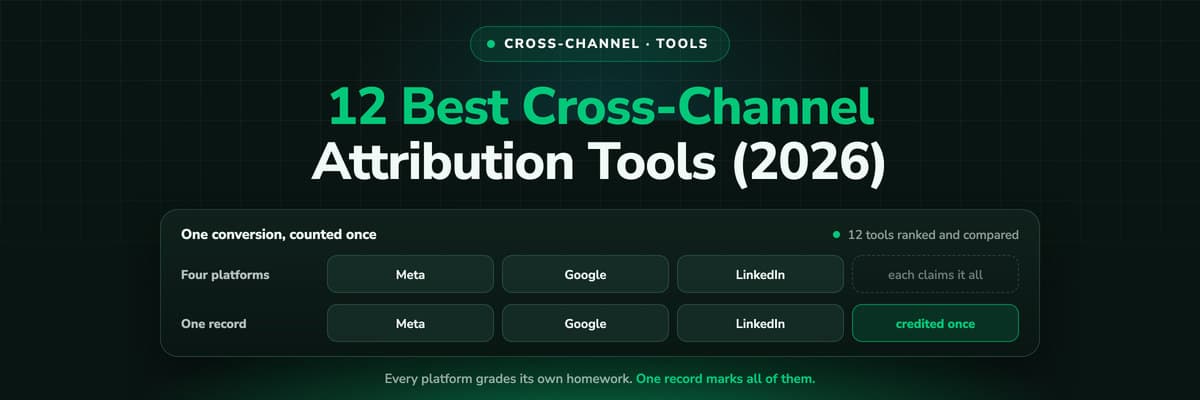
Meta says 71, Google 58, LinkedIn 19, Microsoft 7. The CRM has 122 leads. Twelve cross-channel attribution tools compared on how they close that gap, record, model or move, with pricing, pros, cons and a verdict on who each one is built for.Read the article24 min read Tool Comparisons
Triple Whale Pricing 2026: Plans, GMV Bands and Real Costs
Triple Whale prices Foundation, Automate and Enterprise by your store's annual GMV, and its pricing page no longer prints a number. Every band it last published, what billing and Moby add, what changed since 2025, and what the model costs as the store grows.Read the article11 min read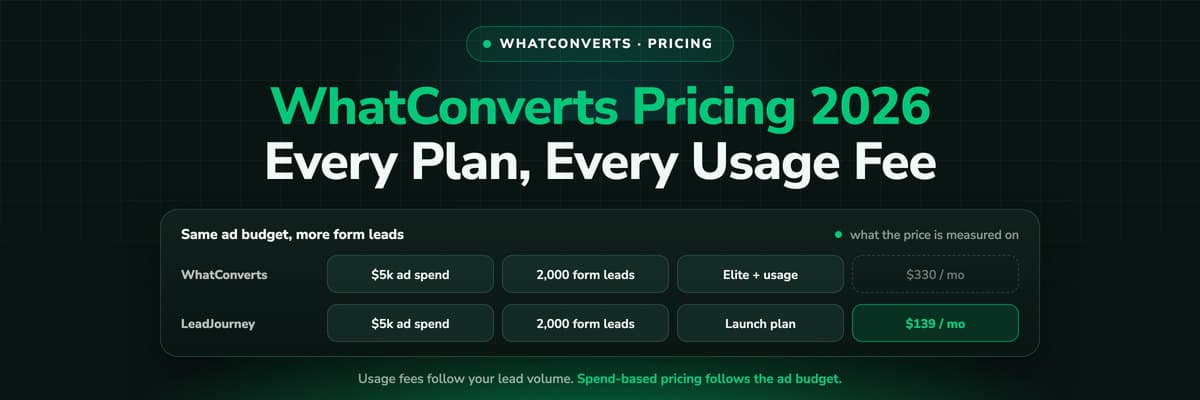 Tool Comparisons
WhatConverts Pricing 2026: Plans, Usage Fees and Real Costs
WhatConverts publishes every price: $30 to $160 a month for one account, $500 to $1,250 for agencies, each with a usage credit. What the credit covers, every rate past it, what the calculator adds at volume, and how the price changed since 2021.Read the article11 min read
Databox pricing
Put revenue on the dashboard, not only reported clicks
LeadJourney tracks every lead from first click to closed deal and reports it on dashboards you build, priced by ad spend from $139 a month. Start a 14-day free trial with no credit card, or book a demo on your own data.