
















BlogTool Comparisons
CallRail Pricing 2026: What the Four Plans Really Cost
CallRail's plans start at $50 a month and include 5 numbers and 250 minutes. Every tier, every published usage rate, and the arithmetic on three real setups, because the plan fee is rarely the invoice.

Contents
Summarise this article with AI
Opens the page with a ready prompt in:


Nothing is sent until you pick a service.
CallRail publishes its prices, which already puts it ahead of half the call tracking category. What the pricing page does not do is tell you what you will actually pay, because the plan fee is one of three lines on the invoice and usually the smallest one that moves.
This is every tier as it stood on callrail.com on 16 September 2026, every published usage rate, and the arithmetic worked through on three setups: a trades business, a multi-location clinic and an agency with ten clients.
CallRail Pricing in Short
In short
CallRail has four plans: $50, $95, $150 and $195 a month, all including 5 tracking numbers, 250 minutes and 25 texts. Form tracking arrives on the Complete plans and AI call summaries and sentiment on the Lead Conversion plans. Usage is the part that moves: $3 per extra local number, 5 to 6 cents per local minute, $5 per toll-free number and 8 cents per toll-free minute, 4 cents per transcription and 3 cents per text. A yearly plan saves up to 10%, the trial is 14 days, and there is no published agency or multi-account price.
CallRail plans, as callrail.com/pricing showed them on 16 September 2026
| Plan | Price per month | What it adds | Included |
|---|---|---|---|
| Lead Tracking | $50 | Call and text tracking, dynamic number insertion, recording, transcription | 5 numbers, 250 minutes, 25 texts |
| Lead Tracking Complete | $95 | Form tracking and attribution | Plus 1,000 form submissions |
| Lead Conversion | $150 | Premium Conversation Intelligence: call summaries and sentiment | Plus 10,000 transcription minutes |
| Lead Conversion Complete | $195 | Both of the above in one plan | 1,000 form submissions and 10,000 transcription minutes |
If you have seen $45, $90 and $135 quoted
Several third-party pricing guides still carry an older list with those figures and the plan names Call Tracking, Conversation Intelligence and Call Tracking Complete. The list above is what callrail.com printed on 16 September 2026. Check the pricing page itself before you budget from any article, this one included.
How CallRail Pricing Works
Three things are billed, and only the first is on the pricing page in large type.
- The plan fee$50 to $195 a month, decided by whether you want form tracking, AI conversation intelligence, both or neither. It buys the software and a small allowance.
- The numbersFive are included. Extra local numbers are $3 a month each, toll-free $5. This line grows with your website traffic, because a number pool is sized on concurrent visitors.
- The minutes250 are included. Local minutes are 5 to 6 cents, toll-free 8 cents, transcription 4 cents and texts 3 cents. This line grows with how well your marketing is working.
That is the whole model, and it is a fair one. The trap is only that the two lines that grow are the two nobody forecasts, and they grow with success: more traffic means a bigger pool, more calls means more minutes.
Every Published Usage Rate
CallRail usage rates, read on 16 September 2026
| What | Rate | Included in every plan |
|---|---|---|
| Local number | $3 per month | 5 numbers |
| Toll-free number | $5 per month | Counted in the same 5 |
| Local minute | $0.05 to $0.06 | 250 minutes |
| Toll-free minute | $0.08 | Counted in the same 250 |
| Text message | $0.03 | 25 texts |
| Call transcription | $0.04 | 10,000 minutes on Lead Conversion plans |
| Form submission | $0.02 | 1,000 on Complete plans |
Toll-free is the expensive choice twice over: 67% more per number and 33% more per minute. For a local service business there is rarely a reason to pay it, and for a national brand there usually is.
What CallRail Costs in Practice
Three setups, all local numbers, minutes taken at the top of the published band (6 cents) so the figures are the cautious ones rather than the flattering ones.
A trades business with one location
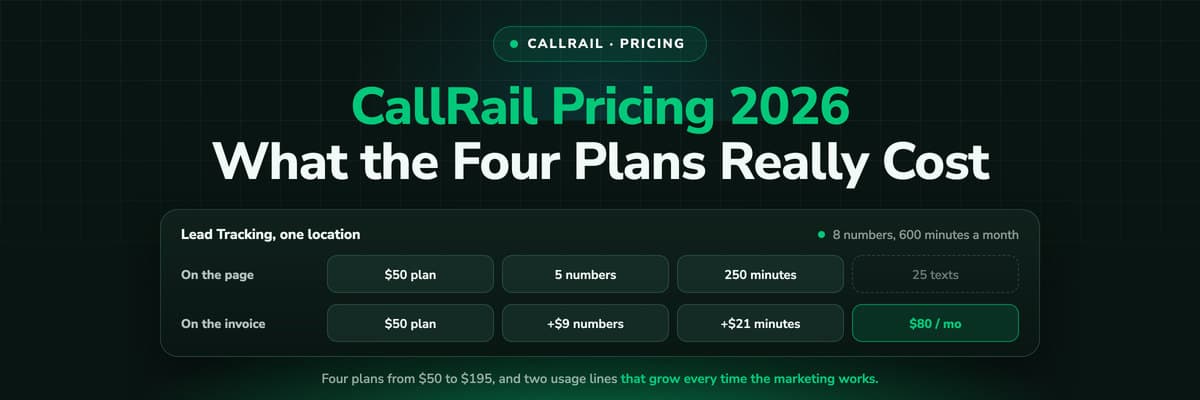
Eight tracking numbers (a small website pool plus fixed numbers for the Business Profile and a van) and 600 minutes of calls. On Lead Tracking: $50 plan, $9 of numbers (3 extra at $3), $21 of minutes (350 extra at 6 cents), $80 a month. Comfortable, and the cheapest honest way to find out which ads ring the phone.
A multi-location clinic that wants the AI summaries
Twenty numbers and 2,000 minutes, on Lead Conversion because somebody needs to know which calls were new patients rather than repeat prescriptions. $150 plan, $45 of numbers (15 extra), $105 of minutes (1,750 extra), $300 a month. The transcription is covered by the plan's 10,000 minute allowance, which is the one generous number on the page.
An agency with ten clients
Ten client accounts on Lead Tracking Complete, each with ten numbers and 800 minutes. Per client: $95 plan, $15 of numbers, $33 of minutes, $143. Across ten clients that is $1,430 a month at list price, before form submissions past the thousand included.
There is no published agency price
CallRail runs an agency partner programme with onboarding, an account manager and a partner community. Its agencies page prints no rates and no multi-account discount, so anything you read about volume pricing is a conversation with sales rather than a published number. Budget at list and negotiate from there.
Annual Billing, the Trial and Voice Assist
- Annual billing saves up to 10%, in CallRail's own wording. On a $150 plan that is about $180 a year, which is roughly three extra numbers and a few hundred minutes.
- The free trial is 14 days on every plan, which is enough to see whether the swap works on your site and not enough to see a month of call volume.
- Voice Assist, the AI answering add-on, starts at $95 a month on top of a plan. It answers calls rather than tracking them, so treat it as a different purchase.
- Usage is not capped by the plan. Going over the allowance does not stop anything, it appears on the invoice, which is the right behaviour and the reason to model it in advance.
Where the Bill Surprises People
- The pool is sized on traffic, not on calls. Dynamic number insertion holds a number for each visitor in session. Double your traffic and the pool doubles, even if the phone rings exactly as often.
- 250 minutes is nine days. A business taking twenty calls a week at four minutes each is through the allowance before the second invoice.
- Form tracking is a plan upgrade, not a rate. If you only need forms counted, you may already be paying for that elsewhere.
- AI summaries live on the $150 plans. The features that make the demo compelling are three times the entry price.
- Toll-free costs more on both lines. Numbers at $5 and minutes at 8 cents, so a toll-free-first setup is a different budget.
CallRail Against LeadJourney
These are different products and the price comparison only makes sense once that is clear. CallRail is a call tracker: it answers which marketing made the phone ring, and it answers it well. LeadJourney is an attribution platform that tracks calls alongside clicks, forms, organic visits and CRM deals, so the call is one event on a journey rather than a report of its own.
That shows up in the pricing model. LeadJourney is priced on tracked marketing spend, from 129 euros a month up to 5,000 euros of spend and 249 up to 15,000, and call tracking is an add-on at 9 euros per tracking number per month with per-minute usage on top. Twelve numbers is 108 euros of add-on on an account that is already reporting every channel. Against a $50 call tracker that is more money; against a call tracker plus an attribution tool it is one bill and one journey.
The other difference is what happens after the call. CallRail reports calls as conversions in Google Ads natively and supports Facebook offline events. LeadJourney writes the call onto the CRM contact and sends a qualified call back to Google Ads and Meta through their conversion APIs, so the bidding learns from calls that became jobs rather than from every ring. See call tracking software for the mechanism and pricing for the ladder.
Read Next
- The best CallRail alternatives: seven tools, why teams move and what each one is for.
- The 15 best call tracking software tools: the whole category with published prices.
- The CallRail integration: keeping CallRail and joining its calls to the rest of the journey.
- Call tracking: what the category does, in plain terms.
In the glossary
FAQ
Frequently Asked Questions
The questions people ask about CallRail pricing before they sign.
How much does CallRail cost per month?
Four plans, read on callrail.com on 16 September 2026: Lead Tracking $50, Lead Tracking Complete $95, Lead Conversion $150 and Lead Conversion Complete $195 a month. Each includes 5 tracking numbers, 250 minutes and 25 texts. Usage on top is billed separately, and a yearly plan saves up to 10%.
What does an extra CallRail number cost?
$3 a month for a local number and $5 for a toll-free one, beyond the five included in every plan. Minutes are separate again: 5 to 6 cents for local, 8 cents for toll-free, with 250 minutes included.
Does CallRail have a free trial?
Yes, 14 days on every plan. It is long enough to confirm that the number swap works on your website and short enough that you will not see a representative month of call volume, so model the usage from your own call logs rather than from the trial.
Does CallRail publish agency pricing?
No. CallRail runs an agency partner programme with onboarding, a dedicated account manager and a partner community, and publishes no multi-account rates or volume discounts. Ten clients on Lead Tracking Complete with ten numbers and 800 minutes each works out at about $1,430 a month at list price, which is the figure to negotiate from.
Is CallRail expensive?
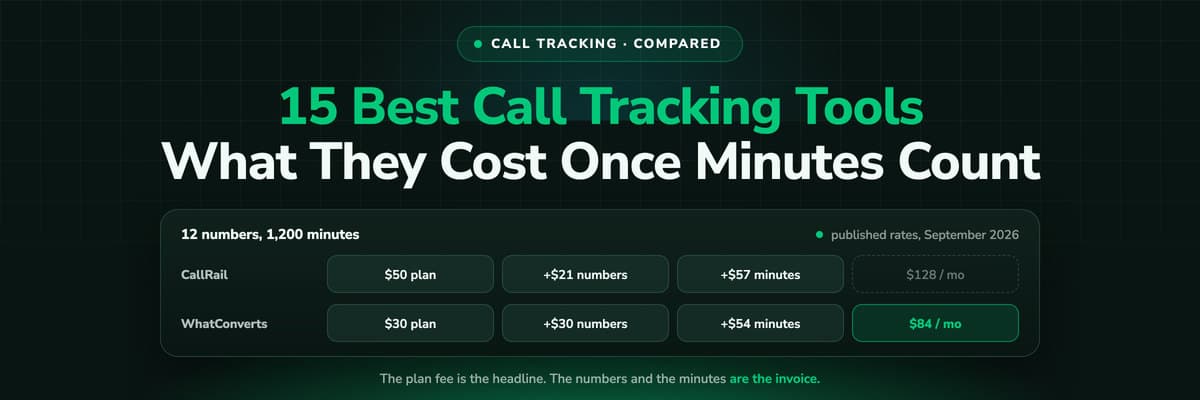
It is mid-market. On published rates in September 2026, twelve numbers and 1,200 local minutes cost $128 a month on CallRail's entry plan against $84 on WhatConverts and $105 on CallScaler's $45 plan. What you pay more for is the most complete standalone call tracking product in the category and the least work to set up.
What is a cheaper alternative to CallRail?
WhatConverts at $30 a month with cheaper numbers and minutes, Nimbata with a $0 entry plan billed per answered call, or CallScaler at $45 with local numbers at 50 cents. If the reason you are looking is that CallRail stops at the lead rather than that it costs too much, the answer is a different shape of tool, not a cheaper one.
Keep reading
More from the blog
 Tool Comparisons
15 Best Call Tracking Software Tools in 2026
Every call tracking tool ties a call to a source. Far fewer follow that call to the booked job, and almost none send the qualified one back to the ad platform that produced it. Fifteen tools ranked on that, with the numbers and the minutes counted into every price.Read the article17 min read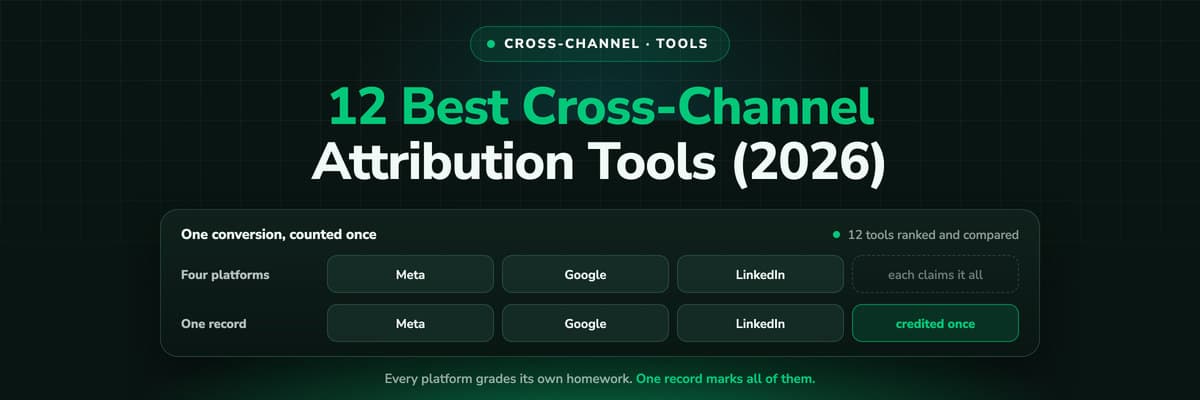 Tool Comparisons
12 Best Cross-Channel Attribution Tools in 2026
Meta says 71, Google 58, LinkedIn 19, Microsoft 7. The CRM has 122 leads. Twelve cross-channel attribution tools compared on how they close that gap, record, model or move, with pricing, pros, cons and a verdict on who each one is built for.Read the article24 min read Tool Comparisons
Triple Whale Pricing 2026: Plans, GMV Bands and Real Costs
Triple Whale prices Foundation, Automate and Enterprise by your store's annual GMV, and its pricing page no longer prints a number. Every band it last published, what billing and Moby add, what changed since 2025, and what the model costs as the store grows.Read the article11 min read
CallRail pricing
Pay for one platform, not for a call tool and an attribution tool
LeadJourney tracks calls, forms and clicks on one journey from 129 euros a month, with tracking numbers at 9 euros each. 14 days free, no credit card.