













BlogTool Comparisons
11 Best iGaming Tracking Software Tools in 2026
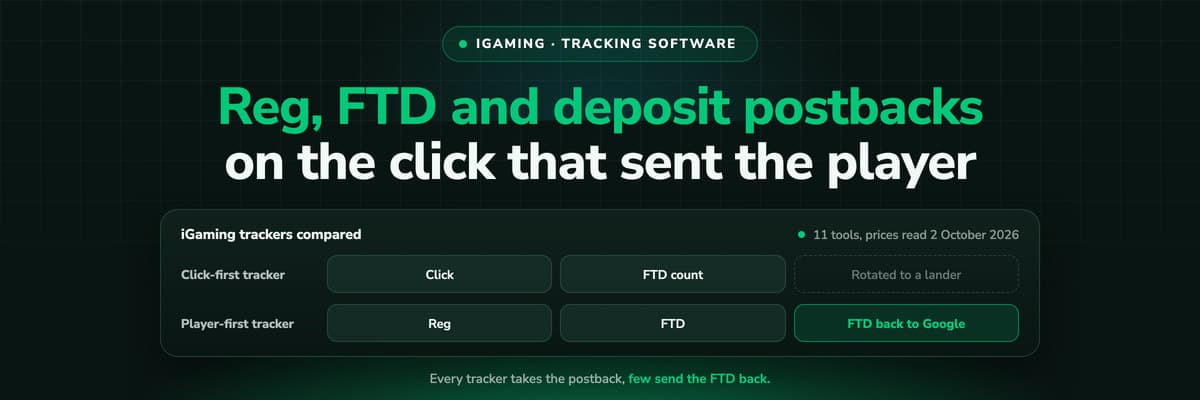
Every iGaming tracker takes a postback. Fewer split reg, FTD and deposit into stages of one player, and fewer still send the FTD back to Google and Meta. Eleven tools ranked on that, with every price read on the vendor's own page.

Contents
Summarise this article with AI
Opens the page with a ready prompt in:


Nothing is sent until you pick a service.
An iGaming affiliate's month has two ends that never meet. On one end, clicks: bonus keywords, review pages, a streamer deal, a Telegram channel. On the other, the operator's program dashboard with regs and FTDs, and a statement on the 10th. The program knows the player deposited. It does not know which keyword, page or stream sent them.
An iGaming tracker is the thing in the middle. It records the click with an ID of its own, hands that ID to the operator in the tracking link, and waits for the program to fire a postback with the same ID when the player registers and deposits. Every tool here does that. What separates them is what happens around it: one player or three counts, the FTD back to Google and Meta or not, and what the invoice does at ten million events.
Every price below was read on the vendor's own pricing page on 2 October 2026. Where a tool counts events, clicks or visits, the table says which, because those three words do not mean the same bill.
Quick Summary: The Best iGaming Tracking Software in 2026
In short
LeadJourney is the best iGaming tracking software for affiliates who get paid on FTDs and buy or earn the traffic across several channels, because reg, FTD and deposit land as stages on one player, per operator, brand and geo, and the FTD goes back to Google Ads and Meta as the conversion. It is priced on paid spend and visitors, not on events. Voluum is the classic iGaming tracker for media buyers at volume, with an iGaming Hub and an Affilka integration on its bigger plans. ClickFlare and PeerClick name iGaming on their own sites and price lower. Binom and Keitaro are the self-hosted picks for teams that want a flat fee and their own server. RedTrack, BeMob, FunnelFlux Pro, ThriveTracker and AdsBridge are general affiliate trackers that take an operator's postback like any other network's.
The table below is the whole list at a glance. The prices are entry prices on 2 October 2026, and the unit each tool bills on is part of the price.
The 11 best iGaming tracking software tools at a glance, October 2026
| Tool | What it is | Best for | Published price |
|---|---|---|---|
| Rank 1LeadJourney | Server-side tracker with reg, FTD and deposit postbacks as stages of one player, FTDs sent back to Google and Meta | Affiliates paid on FTDs across SEO, paid search, social and streamers | From €129/mo by spend and visitors |
| Rank 2Voluumvs LeadJourney | The classic cloud ad tracker, with an iGaming Hub and Affilka integration from Agency | Media buyers and operators buying traffic at volume | From $119/mo billed annually, 1M events |
| Rank 3ClickFlarevs LeadJourney | Fast cloud tracker that names FTDs, deposits and player value | Media buyers who want Voluum's shape for less | From $69/mo yearly, $89 monthly, 1M events |
| Rank 4PeerClickvs LeadJourney | Cloud tracker with registration and deposit columns, traffic distribution AI and a self-hosted edition | iGaming teams that want anti-fraud and a turnkey private option | From $99/mo, 1M events |
| Rank 5RedTrackvs LeadJourney | Affiliate tracker with postback templates, Conversions API and an AI Copilot | Affiliates running iGaming next to other verticals | From $69/mo annually, 2M events |
| Rank 6Binom | Self-hosted tracker at one fixed price for any click volume | High-volume teams that want their own server | From $104/mo yearly, no click limit |
| Rank 7Keitaro | Self-hosted tracker on your own VPS, priced by users and domains | Media buyers who run many domains and their own infrastructure | From €40/mo plus the server |
| Rank 8BeMob | Cloud tracker with a free plan and bot conditions | New affiliates testing their first operator deals | Free to 100K events, then $49/mo |
| Rank 9FunnelFlux Pro | Visual funnel builder with S2S postbacks and redirectless tracking | Affiliates running multi-step prelander funnels | $99/mo for 2M events |
| Rank 10ThriveTracker | Long-running cloud tracker billed on clicks, bot filter as an add-on | Media buyers already on it | From $79.99/mo, 500K clicks |
| Rank 11AdsBridge | Tracker plus a landing page builder, billed on visits | Small affiliates who want landers and tracking in one tool | From $29/mo, 100K visits |


How This List Was Judged
Every tool here receives a postback, so a feature grid makes them look identical. These five questions separate them.
- Are reg, FTD and deposit stages of one player?A program fires a reg postback, an FTD three days later and redeposits after that. A tracker that counts three conversion types on one click is fine. One that counts three conversions is reporting a player three times.
- Does the FTD go back to the ad platform?Google optimises on what it is told. A bonus keyword campaign that only ever sees the click buys bonus hunters. The tracker that sends the FTD back as the conversion changes what the bidding buys.
- What does it do about bad traffic?Bots, wrong geos and click farms cost you twice in iGaming: once in spend, and again when the AM points at your traffic quality. A click log of your own and a way to block what you can name is the minimum.
- Does it report per operator, brand and geo?Six operators means six dashboards and six statement formats. The tracker is the one place where DE and BR, or brand A and brand B, sit in one report with the cost next to the payout.
- What does it cost at your volume, and where does it run?Events, clicks, visits or spend: each tool bills on a different unit, and self-hosted tools add a server you pay for. The headline price is the smallest number on the page.
If the postback itself is new to you, what a postback URL is and how iGaming affiliate postbacks are set up cover the mechanics this list takes for granted.
1. LeadJourney: Best for Affiliates Paid on FTDs Across Every Channel
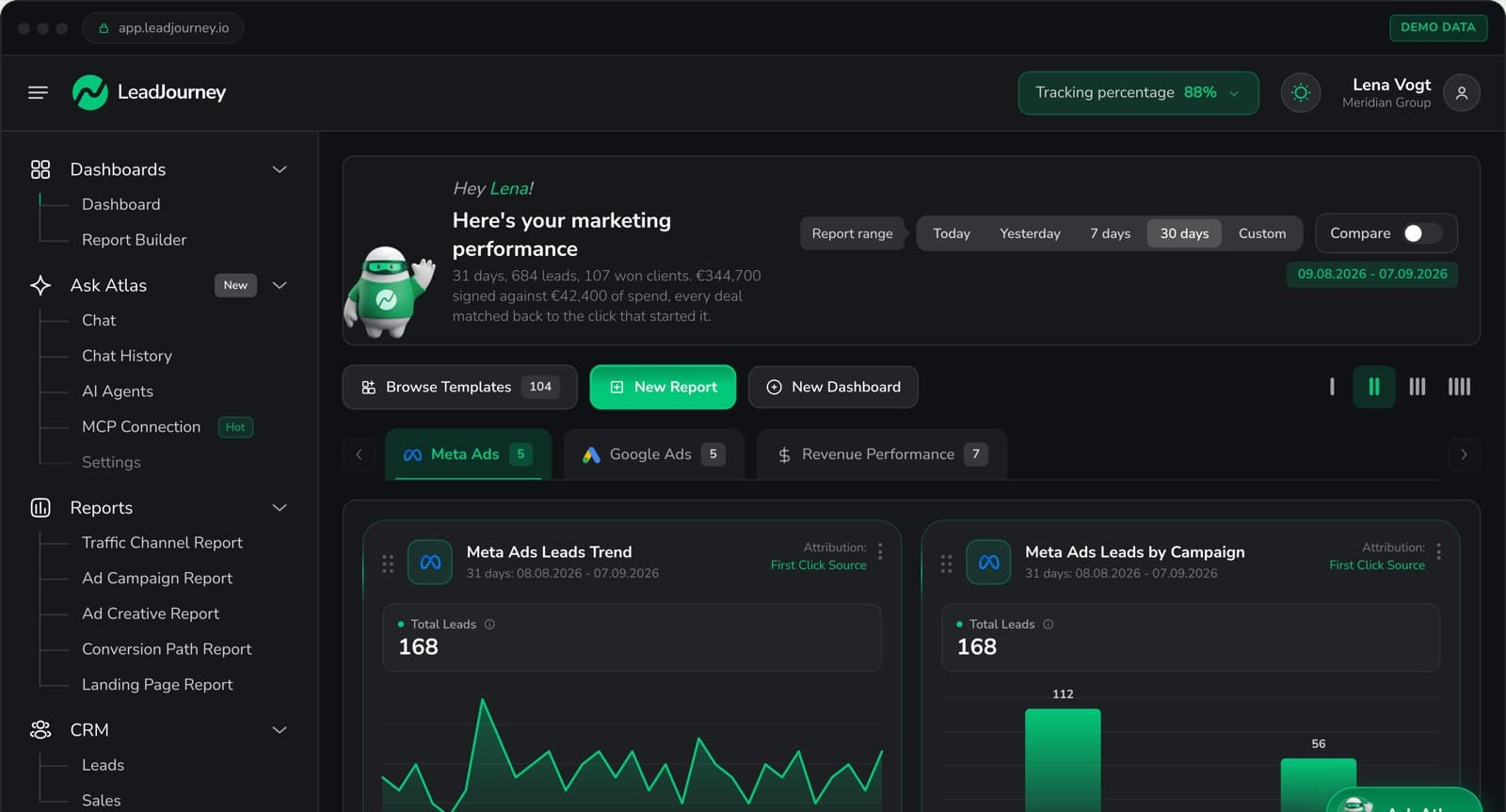
LeadJourney tracks the affiliate's click server-side on the affiliate's own domain, with a click ID of its own, and keeps that ID for months. The operator's program fires its reg, FTD and deposit postbacks to LeadJourney's postback URL with the click ID, event and amount macros filled in, and each one lands on the page, keyword, stream or ad that sent the player. A player is one journey with stages, not three rows in three reports, so the reg to FTD rate per source is a column rather than a spreadsheet.
The part a classic ad tracker leaves to you is the step after it. The FTD goes back to Google Ads, Meta, Microsoft and LinkedIn server-side, matched on the platform's own click ID from the first visit, with the CPA or the deposit as the value. Regs are kept out of that signal on purpose, so the bidding stops buying cheap registrations that never deposit. Any program that can fire a postback URL connects, Income Access, MyAffiliates, Cellxpert or an in-house build alike.
What it does
- Reg, FTD and deposit postbacks with click ID, player ID, event, amount and status macros, and a qualified FTD as its own event where the deal has a minimum deposit.
- One offer per brand and geo, carrying the CPA, rev share or hybrid terms, so six operators sit in one report.
- FTDs back to Google, Meta, Microsoft and LinkedIn as server-side conversions with the payout as the value.
- A click log of your own: every click with its IP, geo and source, every postback with its payload and the player it matched, bot traffic filtered and a blacklist by referrer, IP, user agent and domain.
Pros
- Reg, FTD and redeposit are stages of one player, so the reg to FTD rate per keyword, page and geo is a report, not a VLOOKUP
- The FTD goes back to Google Ads and Meta as the conversion, server-side, which is what turns a bonus keyword campaign into a depositor campaign
- Priced on paid spend and unique visitors, not events, so an SEO affiliate with no ad spend pays on visitors alone and a traffic spike does not change the bill
Cons
- No traffic distribution, lander rotation or automated rules against traffic sources, which media buyers on pop and push rely on
- No named native integration with any partner program platform: the program fires a generic postback, which every program supports but somebody still pastes in
- It attributes what the postback carries and does not compute an operator's NGR: a rev share that only appears on the monthly statement stays there
Verdict
The right pick when you are paid on FTDs and the traffic comes from search, review pages, social and streamers rather than from pop and push. A pure arbitrage team rotating landers all day should look at Voluum or ClickFlare first. See the iGaming tracking page for the whole setup.
2. Voluum: The Classic iGaming Tracker for Media Buyers at Volume
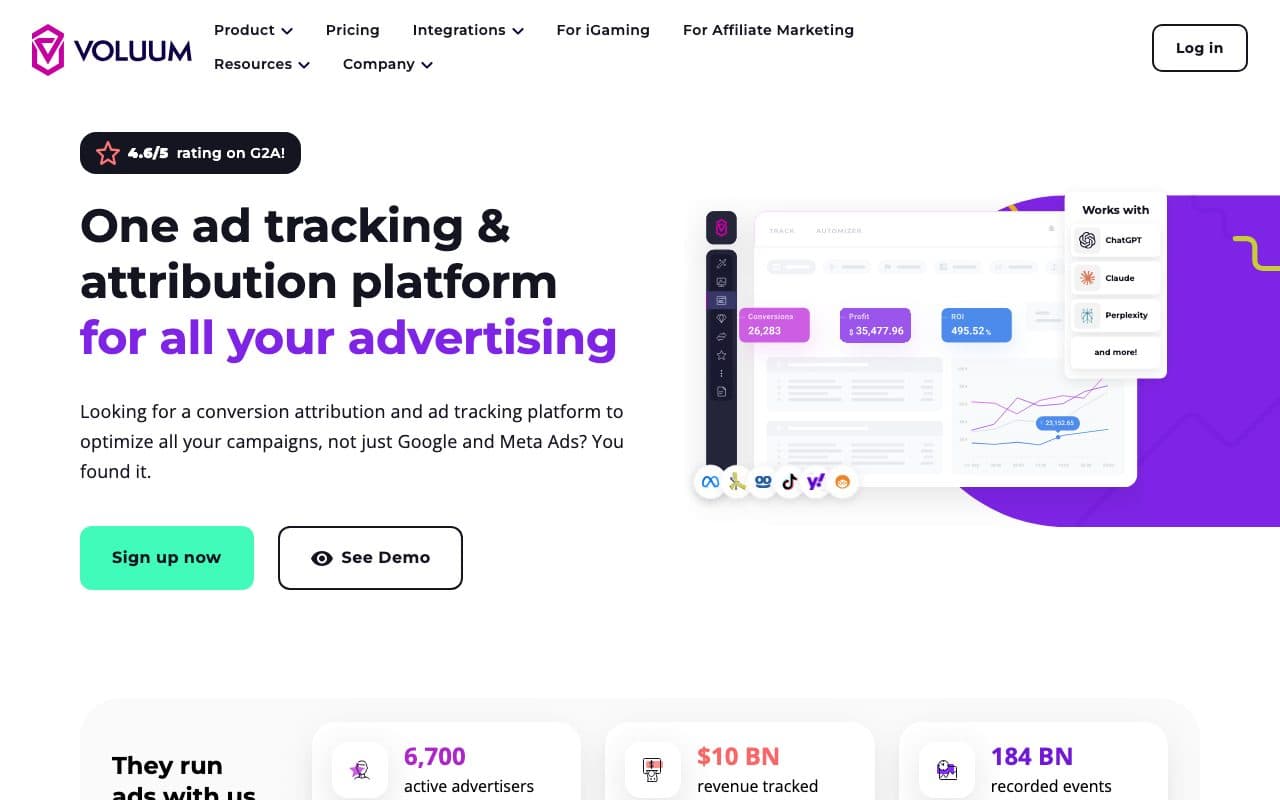
Voluum is the tracker most iGaming media buyers learned on, and its own iGaming page leans into it: real-time S2S postbacks, sign-ups and FTDs as conversion types, integrations with operators, traffic sources and affiliate platforms, and an Affilka integration that pulls player reports and commission data. Traffic Distribution AI shifts weight between landers and offers, Automizer runs rules against your traffic sources, and the Anti-Fraud Kit flags non-human patterns and lets you block IPs and user agents.
Pricing read on 2 October 2026, all billed annually: Profit $119 a month for 1 million events with 20 active campaigns and six months of data, Scale $299 for 5 million, Start-up $539 for 10 million, Agency $799 for 25 million, up to Executive at $7,999 for 500 million. Overage runs $0.06 per thousand events on Profit and falls with the plan. The iGaming Hub, which is where the Affilka integration and the operator introductions sit, is listed from Agency up. The 14-day preview needs no payment details.
Pros
- The deepest optimisation layer on the list: traffic distribution AI, Automizer rules and an anti-fraud kit in one product
- Built for pop, push, native and social buying at serious volume, with a long list of traffic source integrations
- An Affilka integration and an iGaming Hub, which no other tool here names
Cons
- The iGaming Hub starts at the $799 Agency plan, so a solo affiliate on Profit gets the tracker, not the vertical
- Annual billing on the headline prices, and 20 active campaigns on the entry plan is tight for an affiliate with many brands and geos
- Its reports are built around the click and the campaign, not around one player's stages across weeks and channels
Verdict
The safe choice for a media buying team that lives on paid traffic and optimises landers daily. Read LeadJourney against Voluum if your traffic is mostly search and SEO and you want the FTD back in Google.
3. ClickFlare: Best Voluum-Shaped Tracker for Less
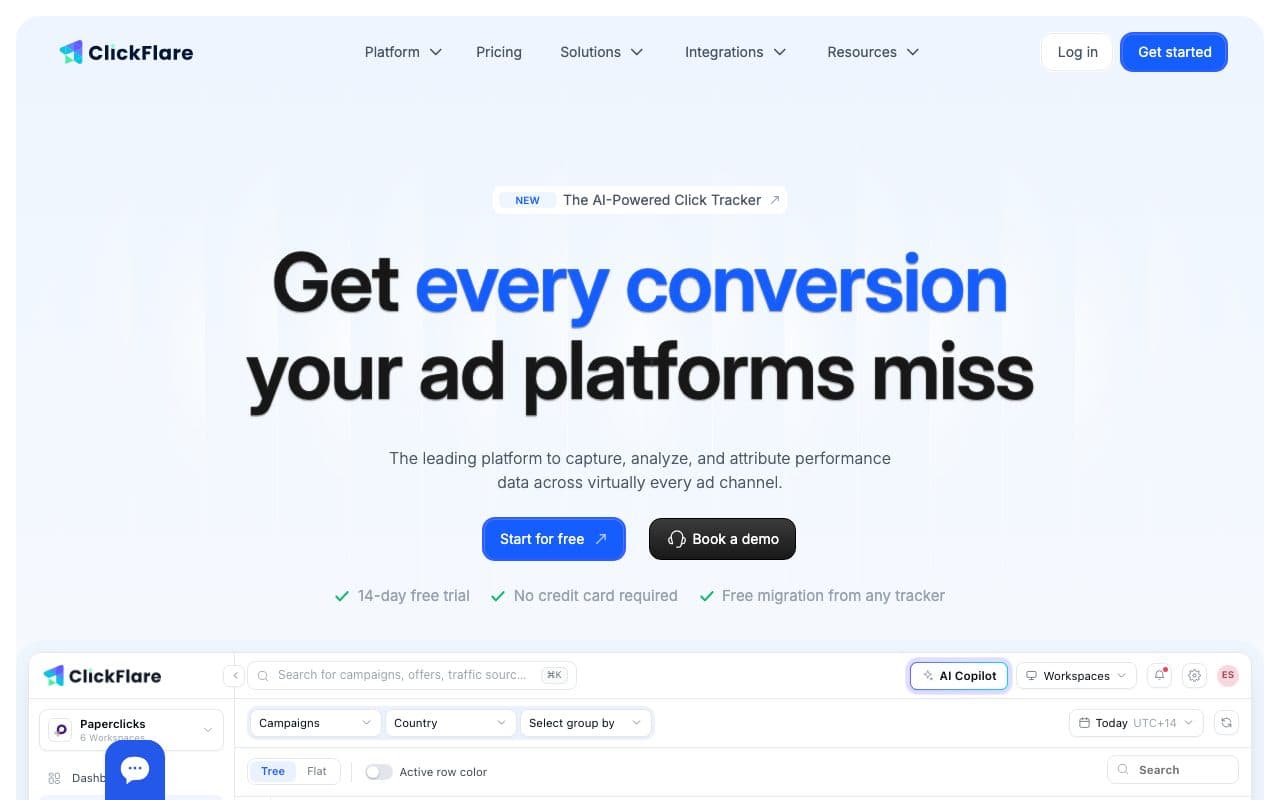
ClickFlare is a newer cloud tracker that names iGaming as one of its verticals in so many words: "Track FTDs, deposits, and player value". Server-side tracking on its own redirect network, postbacks from networks and operators, Conversions API connections to Facebook, Google, TikTok, Snapchat and Reddit, an AI copilot and AI traffic routing.
Pricing read on 2 October 2026: Starter $69 a month billed yearly or $89 monthly for 1 million events and 500 active campaigns, Pro $169 or $219 for 5 million, Master $329 or $429 for 20 million. Organisation plans with white label and more users run from Agency at $559 a month billed yearly to Corporate at $1,759. Every plan starts with a 14-day trial and no card.
Pros
- iGaming named on its own site, with FTDs and deposits as the events it talks about
- 500 active campaigns on the entry plan, where Voluum's Profit has 20
- Conversions API to five ad platforms, so the FTD can go back to the buying side
Cons
- Event-based billing, so a high click volume on cheap traffic moves you up a plan quickly
- The reporting is campaign and click first, the same shape as Voluum's
- Monthly billing costs about 30% more than yearly: $89 against $69 on Starter
Verdict
Voluum's shape at a lower entry price, with iGaming on the label. See LeadJourney against ClickFlare for where the two split.
4. PeerClick: Best for iGaming Teams That Want Anti-Fraud and a Private Option
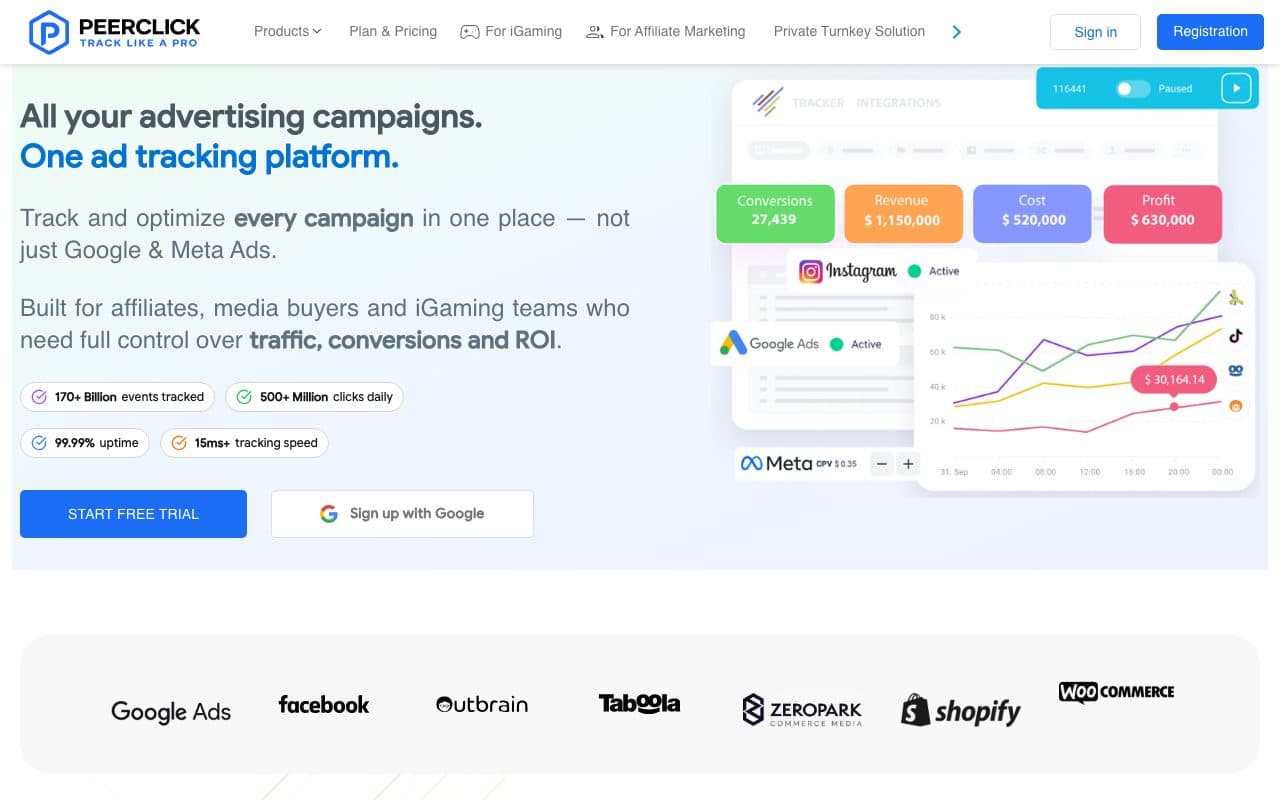
PeerClick puts iGaming in its headline: "Built for affiliates, media buyers and iGaming teams", with a page of its own for the vertical. Registrations, FTDs and player activity are tracked by S2S postback, pixel or API from operators and affiliate platforms, and the iGaming setup adds columns for registration, deposit and rev share. Traffic Distribution AI reweights campaign elements every minute, and the Anti-Fraud Kit sits on Advanced. A private edition runs on your own servers.
Pricing read on 2 October 2026: Starter $99 a month for 1 million events and 20 active campaigns, Basic+ $199 for 3 million and 100 campaigns, Advanced $399 for 10 million and 400 campaigns with the Anti-Fraud Kit, Exclusive $849 for 30 million, Enterprise on quote. Yearly billing takes 20% off every plan, and a free trial is offered.
Pros
- Registration and deposit columns out of the box, rather than custom conversion types you name yourself
- Traffic distribution AI and an anti-fraud kit, the Voluum feature set at a lower ladder
- A self-hosted private edition for teams that will not put player data on someone else's cloud
Cons
- Anti-fraud starts at $399 a month, four times the entry price
- 20 active campaigns on Starter, which a multi-brand affiliate outgrows in a week
- Event-based billing with active campaigns capped per plan, so brands and geos count against you twice
Verdict
A strong fit for an iGaming media buying team that needs fraud tooling and might want its own instance later. See LeadJourney against PeerClick.
5. RedTrack: Best for Affiliates Running iGaming Next to Other Verticals
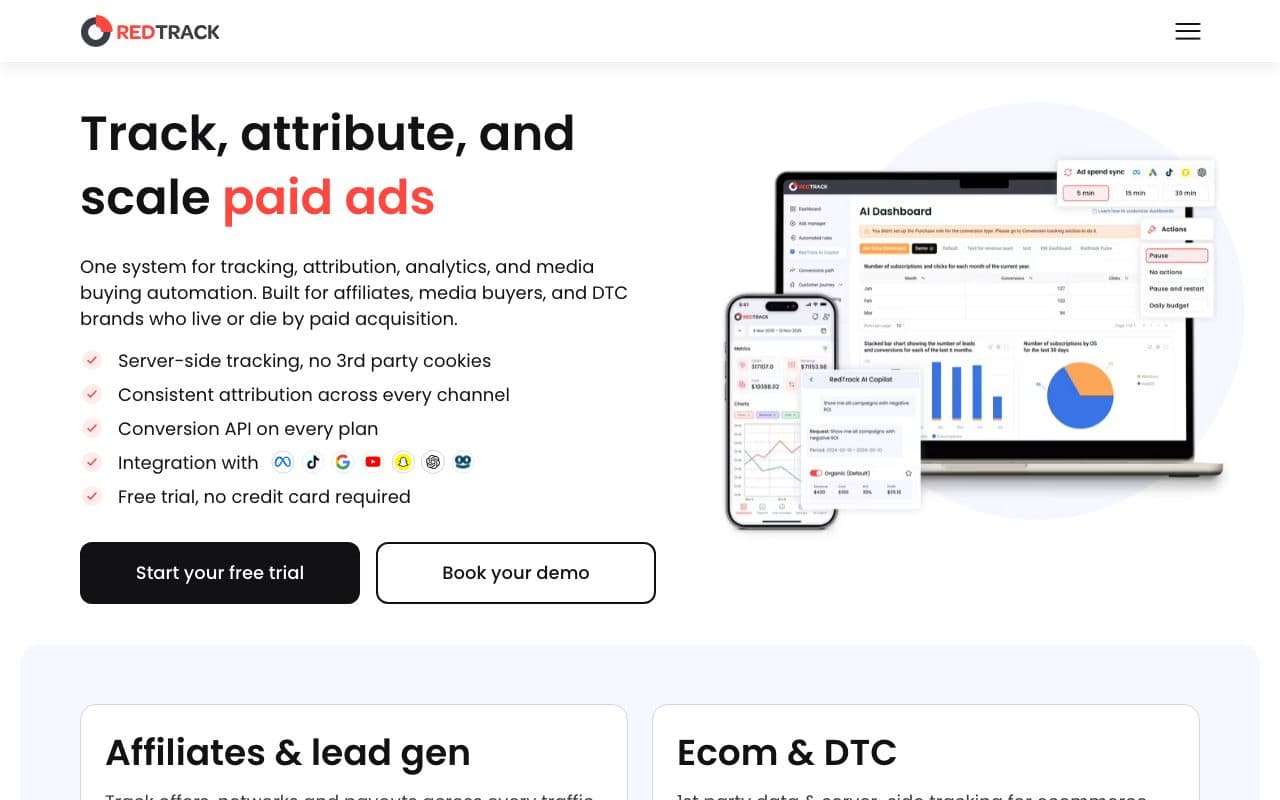
RedTrack is an affiliate tracker with a second product family for e-commerce brands. Its own site names affiliates, lead gen, e-commerce and agencies, not iGaming, but the mechanics are the ones an operator's program needs: S2S postbacks with the click ID in a sub parameter, conditional postbacks, templates for a long list of traffic sources, Conversions API to Meta, TikTok and Google on every plan, and an AI Copilot plus MCP access for questions about the data.
Affiliate and lead gen pricing read on 2 October 2026: Builder $79 a month or $69 billed annually for 2 million events, Solo $169 or $141 for 5 million, Team $399 or $333 for 20 million, Enterprise $999 or $833 for 75 million. RedTrack defines an event as a click or a conversion, and extra events cost $0.04 per thousand, less on the bigger plans. The trial is 14 days.
Pros
- 2 million events on the entry plan, the most generous of the cloud trackers here
- Conversions API on every plan, so the FTD can go back to Meta and Google
- Conditional postbacks, useful when a program fires every event to one URL
Cons
- No iGaming page, no operator integrations named: the program is just another affiliate network to it
- Add-ons for cost sync and some automation sit on top of the plan price
- The model is campaign and conversion, not a player with stages across weeks
Verdict
A solid generalist if iGaming is one vertical among several in your book. See LeadJourney against RedTrack and the RedTrack alternatives.
6. Binom: Best Self-Hosted Tracker at a Flat Price
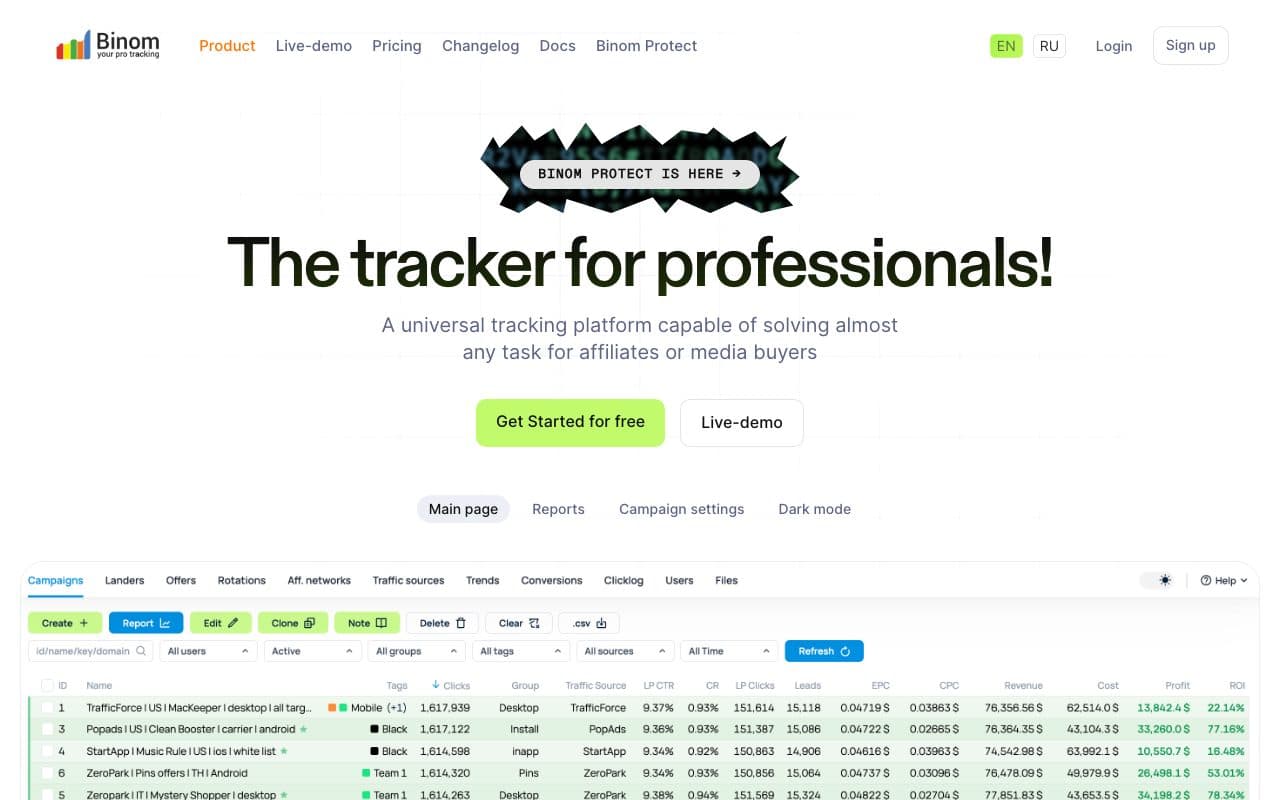
Binom is the self-hosted answer to per-event billing. You run the tracker on your own server, or on Binom's cloud edition, and you pay one price whatever the click volume. Paths, rules and rotations, bot detection, configurable incoming postbacks with up to 30 events and tokens, reports grouped up to five levels deep, and unlimited users, domains and data retention. Binom Protect, a separate product, filters bots, VPNs, proxies and checkers in front of any tracker.
Pricing read on 2 October 2026: Binom v2 self-hosted is $149 a month, or $104 a month on yearly billing, for traffic up to 260 million clicks a day, with a 30-day trial. Binom Cloud, installed and managed for you, is $299 a month for up to 2 million clicks a day with a 7-day trial. The server for the self-hosted edition is yours to rent and maintain.
Pros
- A flat price at any volume, which no event-billed cloud tracker can match for a team pushing tens of millions of clicks
- The data sits on your server, with unlimited retention
- Flexible postback handling, enough for reg, FTD and deposit as separate events
Cons
- Self-hosted means you run the server, the updates and the uptime
- Its own site does not mention iGaming, and the traffic source integrations named are Facebook and Google Ads
- Bot protection worth the name is a second product, Binom Protect
Verdict
The pick for a high-volume team with someone who can run a server and wants the bill to stop moving.
7. Keitaro: Best for Media Buyers Running Many Domains on Their Own Server
Keitaro is the other self-hosted tracker iGaming media buyers name, and its documentation is plain about it: you need a VPS, installed with one script, sized by clicks per day. Its homepage now calls it an attribution tracker; underneath are flows with A/B splits and routing rules, conversion sync back to traffic sources, a Click API and Admin API, a landing page editor and its own geo database.
Pricing read on 2 October 2026 is per seat and domain, not per click: Starter €40 a month with one user and one domain, Advanced €72 with 100 domains, Expert €104 with up to five users and 500 domains, then business plans Team at €200 for 50 users and 5,000 domains and Enterprise at €400 with no limits. Add the server.
Pros
- The cheapest entry on the list for a tracker you fully control
- Priced by users and domains, so click volume only costs you server capacity
- Hundreds of domains with SSL on the mid plans, which matters to buyers who rotate them
Cons
- You own the server: the install, the CentOS updates, the capacity and the outages
- No iGaming or operator integrations named on its site
- The homepage is moving towards brands and stores, so check the roadmap matches what you buy it for
Verdict
Right for a technical media buyer who wants a cheap, private tracker and is happy to run Linux.
8. BeMob: Best Free Plan for a First Operator Deal
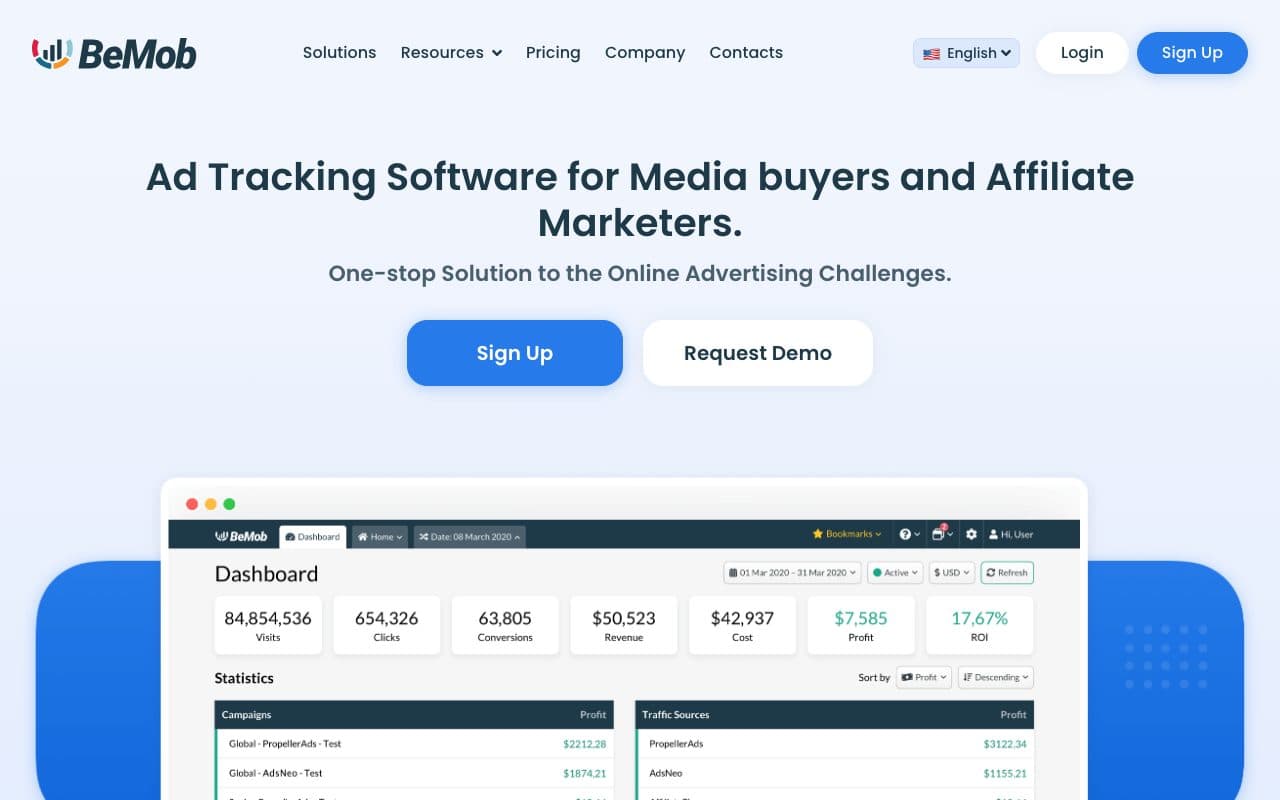
BeMob is a cloud tracker for media buyers and affiliate marketers with the only real free plan on this list. Traffic distribution conditions with bot, proxy and crawler checks, postbacks from affiliate networks, and no-redirect tracking for Facebook, Google and Bing. It does not name iGaming, but an operator's program is an affiliate network to it, and the postback works the same way.
Pricing read on 2 October 2026: Free at 100,000 events a month with one month of data, Professional $49 for 1 million events, Business $249 for 10 million with three months of data, Enterprise $499 for 30 million with six. Overage is $0.05 per thousand events on Professional and falls to $0.02 on Enterprise. The free plan has no overage, so it stops rather than bills.
Pros
- A free plan you can actually run a first operator deal on
- Bot and proxy conditions in the traffic distribution, not a paid add-on
Cons
- One month of data on the two smaller plans, which is shorter than many players take to make a second deposit
- Three affiliate networks and three traffic sources on the free plan
- No iGaming features named on its site
Verdict
A good place to learn postbacks for nothing. Move off it before retention starts cutting your redeposits.
9. FunnelFlux Pro: Best for Multi-Step Prelander Funnels
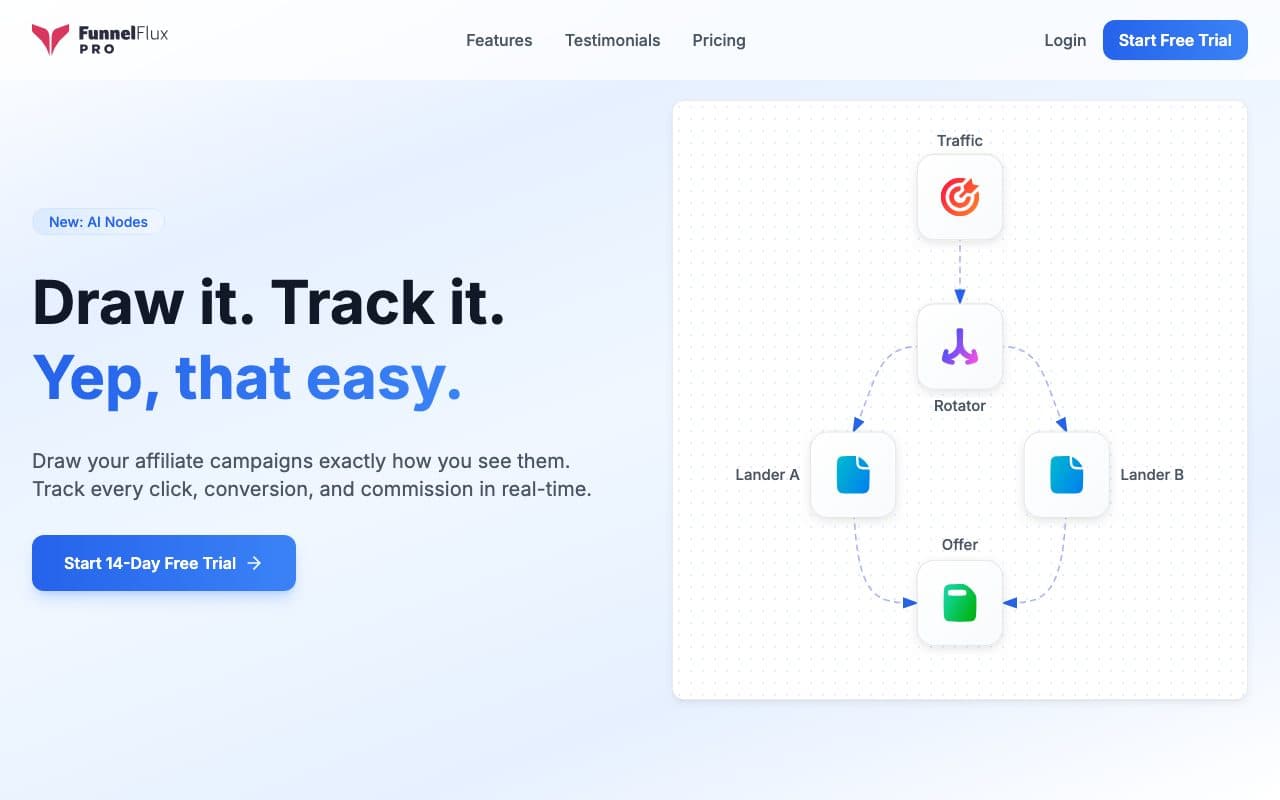
FunnelFlux Pro draws a campaign as a graph: traffic, rotators, conditions, landers and offers as nodes, with redirectless JavaScript tracking on the pages and S2S postbacks where a pixel cannot load, which is every operator's cashier. Conversions pass directly to TikTok, Meta, Microsoft and Google Ads, and reports group across 20 levels.
Pricing read on 2 October 2026 is one plan: $99 a month including 2 million events, then $10 per further million. Two custom domains are free and each one after costs $2 a month. The 14-day trial needs a payment method, and there is no annual contract.
Pros
- The visual builder makes multi-step funnels readable to the whole team
- Cheap overage at $10 a million, the lowest per-event rate here
- Direct conversion passing to the four big ad platforms
Cons
- No iGaming features or operator integrations named
- The trial needs a card, unlike most of the list
- Built around funnels you draw, not around a player's stages over weeks
Verdict
The tool for an affiliate whose edge is the prelander funnel, not the media buying volume.
10. ThriveTracker: Best for Media Buyers Already on It
ThriveTracker is one of the long-running cloud trackers, now sold as an AI tracker for performance marketers: AI optimisation for split tests, a bot filter that redirects by geo, browser and OS, an LP pixel for tracking without redirects, multi-page funnel tests and custom domains. It bills on clicks rather than events, and its site does not mention iGaming.
Pricing read on 2 October 2026: Cloud Lite $79.99 a month for 500,000 clicks, Classic $134.99 for 1 million, Pro $364.99 for 5 million, Entrepreneur $564.99 for 10 million, Enterprise $1,189.99 for 30 million, with two months free on annual billing. On Lite and Classic the bot filter is a $59 a month add-on and the reporting API $49; both are included from Pro.
Pros
- A mature product with years of traffic source edge cases behind it
- Bot filter and geo redirects available
Cons
- The most expensive entry for the volume: $79.99 for 500,000 clicks
- Bot filtering and the API cost extra on the two smaller plans
- No iGaming features named on its site
Verdict
Fine if your campaigns already live in it. Hard to argue for as a new purchase against ClickFlare or RedTrack.
11. AdsBridge: Best for Small Affiliates Who Want Landers and Tracking in One
AdsBridge pairs a tracker with a built-in landing page builder: conversion tracking with postbacks from more than 100 integrated networks, A/B split tests, URL rotation, a bot filter called Fraud-Guard and a smartlink. It bills on visits, and clicks and conversions on top of them are free.
Pricing read on 2 October 2026: Starter $29 a month for 100,000 visits, Professional $89 for 3 million, Advanced $199 for 7 million, Business $379 for 14 million, Agency $499 for 19 million, Enterprise $799 for 31 million. Overage starts at $0.07 per thousand visits on Starter. The 14-day trial covers 50,000 visits.
Pros
- Landing pages and tracking in one tool, for an affiliate without a developer
- The lowest paid entry on the list at $29
- Billed on visits, with clicks and conversions free
Cons
- No iGaming features or operators named
- 100,000 visits on Starter is a small allowance for paid traffic
Verdict
A starter kit for a small affiliate who needs landers as much as a tracker.
What iGaming Tracking Really Costs
Four units hide behind the prices above: events, clicks, visits and, in LeadJourney's case, paid spend plus visitors. An event is usually every visit, click and conversion the tracker records, so one player who lands, clicks through to the operator, registers and deposits is four or five events before the first redeposit.
Here is one basket priced on the published rates read on 2 October 2026: 3 million events a month, an affiliate buying paid traffic at a steady clip, on the cheapest plan or plan plus overage that holds it.
3 million events a month, on published rates, October 2026
| Tool | Plan | Overage | Monthly total |
|---|---|---|---|
| Binom v2 | $104 yearly, any volume | None | $104 plus your server |
| RedTrack Builder | $69 annually, 2M events | 1M at $0.04 per 1,000 = $40 | $109 |
| FunnelFlux Pro | $99, 2M events | 1M at $10 per million = $10 | $109 |
| BeMob Professional | $49, 1M events | 2M at $0.05 per 1,000 = $100 | $149 |
| PeerClick Basic+ | $199, 3M events, 20% off yearly | None | $159 yearly, $199 monthly |
| ClickFlare Pro | $169 yearly, 5M events | None | $169 yearly, $219 monthly |
| Voluum Profit | $119 annually, 1M events | 2M at $0.06 per 1,000 = $120 | $239 |
Read the unit, not the headline
Voluum's $119 is a cheaper headline than ClickFlare's $169, and the more expensive result at this volume, because 1 million events runs out on day ten. Keitaro sits outside the table because it bills per seat and domain (from €40) plus a server sized to your clicks; ThriveTracker and AdsBridge because they count clicks and visits, not events.
LeadJourney sits outside it on purpose too, because it does not count events at all. Affiliate plans are priced on paid spend and unique visitors: Solo at €129 a month up to €10,000 of paid spend and 250,000 visitors, Pro at €249 up to €50,000 and 1 million visitors, Scale at €499 up to €200,000 and 5 million, Network above that. A burst of clicks on a pop campaign is not billed event by event. See pricing for the full ladder.
Before You Send FTDs Back: The Ad Platforms' Gambling Rules
Sending the FTD back to Google or Meta only helps if you are allowed to run the ads in the first place, and no tracker changes that. Both platforms restrict gambling advertising by country and by licence, and both treat affiliates as a case of their own.
- Google Ads requires certification from Google to run gambling ads, and the ads may only target approved countries, each with its own rules on which forms of gambling are allowed. Affiliate and comparison sites are allowed only if they do not offer gambling themselves and do not promote unlicensed operators. The policy is at support.google.com/adspolicy/answer/6018017.
- Meta allows online gambling ads only once the ad account is authorized in Meta Business Suite, with evidence that the gambling is licensed or otherwise lawful in the territory targeted, and never targeted at people under 18.
Read both for your geos before a campaign. Once an account is approved, the FTD as a server-side conversion is what teaches the bidding depositors; server-side tracking for iGaming shows how that signal is built.
How to Choose, by How You Earn
SEO and review pages, paid on FTDs
LeadJourney: organic pages are sources of their own, it bills on visitors when there is no ad spend, and each FTD lands on the page that sent the player.
Paid search and social on bonus keywords
LeadJourney or ClickFlare. The question is which one sends the FTD back to Google and Meta as the conversion, matched to the first click.
Pop, push and native at volume
Voluum, ClickFlare or PeerClick. Traffic distribution, rules against sources and anti-fraud are what you are buying.
A team with its own servers
Binom for a flat price at any volume, Keitaro for many domains at a low seat price. Budget for the person who runs them.
Streamers and Telegram deals
A tool that takes an entered fee as a cost and treats the stream as a source. LeadJourney does; a click-first tracker needs a dummy campaign per deal.
First deal, no budget
BeMob's free plan or AdsBridge at $29, and move up before short retention starts cutting your redeposits.
Whichever you pick: one postback per event, the click ID in the program's sub ID field, and a test reg before the first real euro. First time deposit and click ID are the plain definitions.
In the glossary
FAQ
Frequently Asked Questions
What iGaming affiliates ask before choosing a tracker.
What is the best iGaming tracking software in 2026?
For an affiliate paid on FTDs whose traffic comes from search, review pages, social and streamers, LeadJourney, because reg, FTD and deposit land as stages of one player and the FTD goes back to Google Ads and Meta as the conversion. For a media buying team on pop, push and native at volume, Voluum, with ClickFlare and PeerClick as cheaper alternatives that name iGaming too. For a flat price on your own server, Binom.
How does an iGaming tracker see the FTD if I cannot put a pixel on the operator's site?
Through the postback. The tracker records the click on your side and passes its click ID to the operator in the tracking link. When the player registers or deposits, the operator's partner program fires a server-to-server request to the tracker's postback URL with that click ID in it. Nothing runs on the operator's pages. How iGaming affiliate postbacks work has the setup.
How much does iGaming tracking software cost?
Published entry prices on 2 October 2026 run from free (BeMob, 100,000 events) and $29 (AdsBridge) to $69 (RedTrack and ClickFlare, billed yearly), $99 (PeerClick and FunnelFlux Pro), $119 (Voluum, billed annually) and €129 (LeadJourney, by spend and visitors). Self-hosted Binom is $104 a month yearly at any volume and Keitaro from €40 plus the server. Check the unit: events, clicks, visits and spend are different bills.
Can a tracker calculate my NGR or rev share?
Only from what the program posts back. If the program fires deposit or commission amounts per player, a tracker can attribute them to the click. If rev share only appears on the monthly statement, no tracker on this list computes it for you, because NGR is the operator's figure. Ask your AM which events and amounts the program can post.
Can I send FTDs back to Google Ads and Meta?
Technically yes, with a tracker that sends conversions server-side, and it is the most useful thing a tracker can do for a paid search affiliate. Whether you may advertise gambling at all is a separate question: Google requires certification and limits gambling ads to approved countries, and Meta requires the ad account to be authorized, with evidence of a licence. Read both policies for your geos first.
Keep reading
More from the blog
 Tool Comparisons
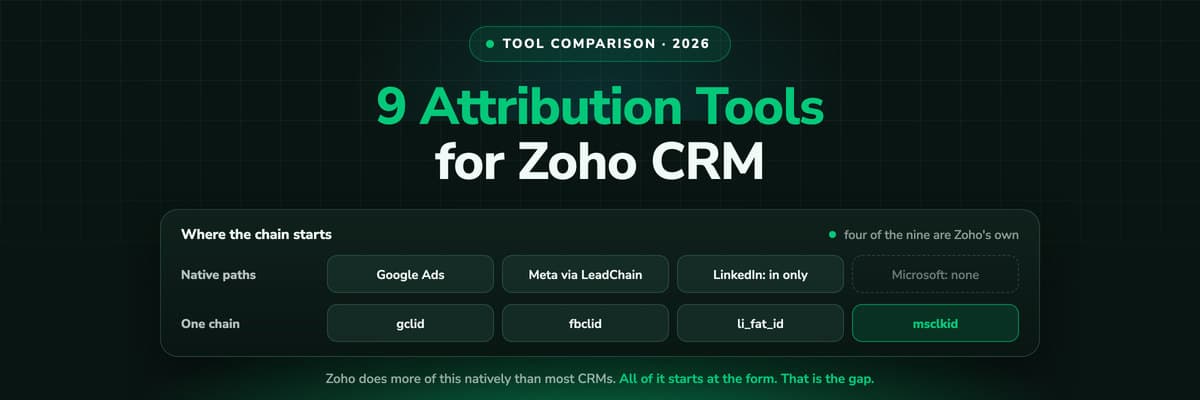
9 Best Marketing Attribution Tools for Zoho CRM in 2026
Four of the best attribution tools for Zoho CRM are Zoho products you may already pay for. Nine options compared on where the tracking starts, which ad platforms they cover, and whether the closed deal ever reaches the algorithm buying your traffic.Read the article13 min read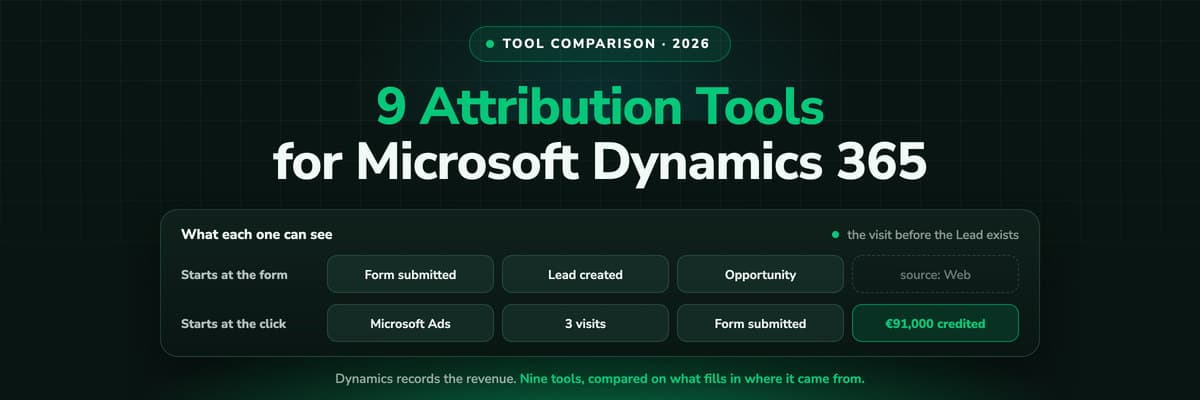 Tool Comparisons
9 Best Marketing Attribution Tools for Microsoft Dynamics 365 in 2026
Dynamics records the revenue and nothing fills in where it came from: Lead Source is a ten-option picklist and campaign spend is typed by hand. Nine tools compared on what each can actually see in a Dynamics environment, with pricing, pros, cons and a verdict.Read the article14 min read Tool Comparisons
12 Best GTM Tools and Software in 2026
A GTM stack is five or six tools that each report on their own step, which is why nobody can say which play produced the revenue. Twelve tools compared by the layer they own, with prices read this month and a verdict on who each one is for.Read the article16 min read
iGaming tracking software
Bring one program. Leave with FTDs per page.
LeadJourney lands every reg, FTD and deposit postback on the keyword, page or stream that earned it, and sends the FTD back to Google and Meta. Start a 14-day free trial with no credit card, or book a demo and set up the first program on the call.