













BlogHow To Guides
iGaming Affiliate Software: Postbacks by Platform
Partner program software is the operator's system, and most comparisons are written for the operator buying it. This one reads the same platforms from your side of the tracking link: which ones fire postbacks to affiliates, on which events, with which token carrying your click ID, and how to set it up so every FTD lands on the keyword that earned it.


Contents
Summarise this article with AI
Opens the page with a ready prompt in:


Nothing is sent until you pick a service.
Search for iGaming affiliate software and almost everything you find is written for the operator: which platform to license, how it computes NGR, what it costs per brand. That is a fair question for the person buying it. You are not that person. You are the affiliate on the other end of the tracking link, and the only question you have about Income Access, MyAffiliates, Affilka or Cellxpert is what it will tell you, and how fast.
This guide takes the platforms operators run, one by one, and answers that: whether the platform fires postbacks to affiliates, on which events, which parameter on the link carries your click ID and which token sends it back. Where a platform publishes nothing, it says so and tells you to ask your AM rather than guessing. Then the setup, the testing, and why an FTD on a keyword beats the same FTD on a statement.
Quick Summary: Postbacks From Partner Program Software
In short
Partner program software (Income Access, MyAffiliates, Affilka by SOFTSWISS, Cellxpert, NetRefer, Scaleo, IREV, PartnerMatrix, ReferOn) is the operator's system for tracking links, reg and FTD reporting, commission and statements. Most of them can fire a postback to the affiliate: a server-to-server call to your URL when a player registers or deposits, with your own click ID in it. You put the click ID on the tracking link in the parameter the platform reads (payload on MyAffiliates, afp on Cellxpert, aff_click_id on Scaleo, a custom parameter on Affilka), and you put the matching token in your postback URL. Whether the postback is on, which events it fires for and how often it fires is the operator's setting, not the platform's, so the same software can behave differently from one program to the next.
The sections below explain what the software is and whose it is, the three ways an affiliate gets data out of it, each platform from the affiliate's side, a comparison table, the setup step by step, and what an FTD with a click ID is worth that a statement is not.
What iGaming Affiliate Software Is, and Whose It Is
An operator who pays affiliates runs a partner program, and the program runs on software. That software issues your tracking links, records the click and drops the player on the brand, ties the registration and the first deposit to your account, computes your commission under the deal you signed (CPA, rev share or hybrid, often with a qualifying deposit or a minimum NGR), and produces the statement you get paid on. The operator licenses it, configures it and decides what you see in it.
- Tracking links and mediaYour links, banners and landing pages, each with an ID the program reports on. Most platforms accept extra parameters on the link, which is where your click ID goes.
- Player reportingRegs, FTDs, deposits and, on rev share, the net gaming revenue per player, as the operator's back office reports it to the platform.
- Commission and statementsCPA, rev share, hybrid, tiers and sub-affiliates, negative carryover, the monthly statement and the payment.
- Outbound data for affiliatesA reporting API or XML feed you can pull, and on most platforms a postback the program fires to you. Both are switched on per program.
So when Scaleo's comparison scores ten platforms on NGR logic, fraud scoring and pricing, it is answering the operator. From your side the platform matters only through what the program in front of you has switched on. To be plain about our side: LeadJourney is not a partner program platform and computes no commission; it is the tracker on the affiliate's side that receives the postback and puts it on the click.
The Three Ways an Affiliate Gets Data Out
The dashboard and the statement
Totals per tracking link, media item or campaign, and the statement after month end. Always there, and it only knows the link, not the keyword, page or stream behind it.
The reporting API or feed
You pull stats on a schedule with a key from your account. Useful for totals per brand, but a pull runs hours behind, and it reports by your sub id only if you passed one.
The postback
The program calls your URL when an event happens, with your click ID in it. One call per reg or FTD, so each lands on the click that earned it.
The pull is documented better than the push, mostly by the stats tools that rely on it. Voonix's brand integration notes say where the key lives on each platform: Income Access under API Reports, MyAffiliates as an OAuth2 client under Account > Authorisation, NetRefer as a key under XML Feeds, and Cellxpert as an API key that only works once your AM has whitelisted the caller's IP. Keep the pull as the reconciliation against the statement. Use the postback to attribute.
Platform by Platform: What Each One Fires to an Affiliate
In the order Scaleo's comparison names them, plus ReferOn. Each entry says what the platform's own pages say, then what the trackers and operators that integrate it document, and names whose page it is. A parameter a tracker documents is the one that works in that tracker's setup; confirm it with your AM before you rely on it.
Income Access (Paysafe)
Income Access calls its postback the S2S event relay and describes it as near real-time tracking "to partners who establish an endpoint to receive tagged events", for install, registration and sales events, open to affiliates as well as merchants. It publishes no token list. Links carry a btag (Paysafe's own program gives the structure as btag=a_[siteid]b_[bannerid]c_ plus affid, siteid and adid). AnyTrack's guide to the programs built on it puts your sub id in the c parameter on most programs and in tdpeh on BetMGM Partners, and connects most programs through a security key from the dashboard, a few by postback URLs sent to the AM. Practically: ask your AM whether the program has the event relay on for affiliates and which token returns your sub id.
MyAffiliates
Postbacks are per affiliate. An operator's help page on a MyAffiliates program lists the events (registrations, first deposit count, qualified FTD, reload depositor), a Postbacks menu on each affiliate profile where the AM grants each event, and your URL submitted from your affiliate account or set by the manager. The placeholders include {payload}, {s2s.req_id} and {s2s.pub_id} (the values you put on the link), {customer.id}, {media.id}, {landing_page.id} and {campaign.id}. Two catches. The calls go out "as frequent as we receive and process data", so an FTD processed once a day arrives once a day. And Voluum's guide says the three click ID parameters are not interchangeable, the payout can only be a static value, and MyAffiliates does not support HTTPS postbacks.
Affilka by SOFTSWISS
The most complete public list. Affilka's own feature page names postbacks on registration, first deposit, any deposit, qualification, prequalification, disqualification and net gaming revenue, with variables such as visit id, deposit amount, wager amount, net revenue amount and transaction id. Affiliates set postbacks up in their own account and can send their own parameters ("click id, web id"), and the operator decides which postback types are available. Routy's guide walks the screens: Campaigns > My postbacks, New postback, an action per postback, variables written as ${visit_id}, and a Postback Log under Campaigns > Postbacks. Voluum puts the click ID on the link as click_id.
Cellxpert
Cellxpert's product page lists "S2S postbacks per affiliate and event" that the program can "test, refire and tailor", and real-time click, registration and deposit events. The tokens are not on its site. AnyTrack's guide puts your click ID in afp on the link and reads it back as [afp], with [DepositId], [CommissionAmount] and [ProductName], a Lead on a free registration and a Purchase on a commission, and the postback URL goes to your AM to install.
NetRefer
NetRefer documents two operator features. Dynamic Variables are parameters an admin creates and adds to tracking links, stored and reported "in the admin and affiliate interface", which is how your sub id gets in. Action Tracking Pixel Firing is an add-on that tracks registrations and deposits and enables "a pixel to be fired to a specified callback/postback URL". Whether a program bought the add-on and which variable names it created are the operator's, so ask your AM for both.
Scaleo
The best documented token set, because Scaleo is also a general affiliate network platform. The link takes aff_click_id ("Unique ID for every click sent from the Affiliate"), sub_id1 to sub_id5 and aff_param1 to aff_param5, and Scaleo's own affiliate postback example is cid={aff_click_id}&payout={payout}. The event is a goal (goal_id, goal_alias), the status is approved, pending, rejected or trash, and adv_user_id, the advertiser's user ID, is available to affiliates. On sub-affiliates, Scaleo says it stores the sub id beside the click ID and the postback carries both.
IREV, PartnerMatrix and ReferOn
IREV's Partner Platform page promises "seamless postback and API integrations" and "full customization of link parameters" and publishes no token names; its postback guide is generic. PartnerMatrix (EveryMatrix) lists Server-2-Server postbacks and "feeds and APIs for affiliates", again without tokens. For both: ask your AM. ReferOn is the opposite: its help center lists Registration, First Deposit and Qualified CPA postbacks, created under Management > Create Postback at affiliate, brand, campaign or media level, parameters picked with Parse (EventTime, EventType, CustomerID, Dynamic Variables), amounts on request through the AM, and a Logs tab. Scaleo's list also names Optimove and BetConstruct; neither publishes anything for affiliates about postbacks.
The Platforms Side by Side
What each platform's public pages say an affiliate can receive, read 2 October 2026. Every row is switched on per program.
| Platform | Postbacks to affiliates | Events documented | Click ID on the link | Where documented |
|---|---|---|---|---|
| Income Access | Yes, the S2S event relay | Install, registration, sales | c on most programs, tdpeh on BetMGM (per AnyTrack) | incomeaccess.com, AnyTrack |
| MyAffiliates | Yes, per affiliate and event | Reg, FTD count, qualified FTD, reload depositor | payload, s2s.req_id or s2s.pub_id | An operator's help page, Voluum |
| Affilka | Yes, set up by the affiliate | Reg, first deposit, any deposit, qualification, disqualification, NGR | Your own parameter, click_id in Voluum's setup | affilka.com, Routy, Voluum |
| Cellxpert | Yes, per affiliate and event | Click, registration, deposit | afp, returned as [afp] (per AnyTrack) | cellxpert.com, AnyTrack |
| NetRefer | With the Action Tracking add-on | Registrations, deposits | A dynamic variable the operator creates | netrefer.com |
| Scaleo | Yes, affiliate postbacks | Goals set by the operator | aff_click_id, sub_id1 to sub_id5 | help.scaleo.io |
| IREV | Yes, per its product page | Not published | Ask your AM | irev.com |
| PartnerMatrix | Yes, S2S per its product page | Not published | Ask your AM | partnermatrix.com |
| ReferOn | Yes, created by the affiliate | Registration, first deposit, qualified CPA | Dynamic variables | help.referon.com |
The platform is not the program
Two programs on the same software can differ on every column: one AM turns postbacks on for every affiliate, another only for networks, a third only for the FTD. Read the table as what is possible, then ask the program what is switched on.
Setting Up a Postback, Step by Step
1. Put your click ID on the tracking link
Your tracker records the click on your side and gives it an ID. That ID has to ride on the operator's tracking link in the parameter the platform stores: payload on MyAffiliates, afp on Cellxpert, aff_click_id on Scaleo, the parameter you defined on Affilka, the dynamic variable your AM created on NetRefer. One parameter per program, and the same one every time, because the token in the postback reads only that parameter. A static sub id such as a page name tells you the page; a click ID per click tells you the page, the keyword, the ad, the geo and the time.
2. Build the postback URL with the platform's tokens
Your tracker gives you a postback URL; the platform's tokens go into it where the values belong. The click ID token is the one that matters. Add the event, the amount where the program sends one, and the player or transaction ID so a duplicate or a reversal can be matched to the player later. A MyAffiliates FTD postback to a tracker could look like this, with your tracker's own domain and parameter names in place of the placeholders:
http://track.example.com/postback?click_id={payload}&event=ftd&player={customer.id}&media={media.id}If the program only sends one postback URL for every event, it has to carry the event name in a token; if it lets you set one URL per event, put the event in the URL as above. LeadJourney takes one postback URL per program, with click ID, player ID, event, amount and status macros, and works with any program that can fire a postback URL. There is no named native integration with any of these platforms, and none is needed.
3. Decide which events you want
- Reg: the registration. Cheap and early, and a poor optimisation signal on its own, because a reg that never deposits looks the same as one that does.
- FTD: the first deposit, the event most CPA deals pay on. The one to attribute and to send back to an ad platform.
- Qualified FTD or qualified CPA: the FTD that met the deal's minimum deposit or wagering. Ask for it as a separate event where the platform has one (MyAffiliates, Affilka, ReferOn do).
- Deposits and NGR: every deposit after the first, and on rev share the net revenue the program posts. LeadJourney attributes the NGR the postback carries; it does not compute an operator's NGR.
4. Test it before you send traffic
Click your own tracking link so a click ID is recorded, then have the event fired: some platforms let the program send a test or refire a postback (Cellxpert says so), others only fire on a real event. Then read both logs. The platform side is Affilka's Postback Log or ReferOn's Logs tab, or your AM where there is no log for affiliates. Your side is the tracker's postback log, which should show the call, the payload and the click it matched. Check three things: the call arrived, the click ID in it is the one you sent, and the event name is the one you expected. Remember that a MyAffiliates program which processes FTDs once a day posts them once a day, so a quiet afternoon is not a broken postback.
Why an FTD by Keyword Beats the Statement
Say the statement tells you a program paid for 94 FTDs. It cannot tell you that 41 came from one exact match keyword at €44 each and 9 from a broad match at €149 each, because it only knows the tracking link. The postback with your click ID can, because the click ID points at the click your tracker recorded, with its page, keyword, ad, stream and geo. That is the difference between cutting the broad keyword in week one and finding out in month three.
- Reg to FTD per sourceEach source's regs and FTDs side by side, so the traffic that brings bonus hunters stops looking like a winner on cheap regs.
- Days, not a monthThe FTD lands when the program fires it, not when the statement arrives. How soon depends on the program, as the MyAffiliates note above shows.
- A log for the AM callWhen the statement says 88 and you counted 94, a log of every postback with its player and click is something to hold against theirs.
- The FTD as the ad platform's conversionWith the platform's click ID kept from the first visit, the FTD can go back to Google or Meta server-side, so the bidding learns what you are paid for.
That last point has a precondition that is not technical. Google runs gambling ads only for advertisers it has certified, per country, on a country list with a licence required in each; Meta only once the ad account is authorized in Meta Business Suite with evidence of a licence, never targeting under 18s or unsupported markets. Check where your account stands before you plan around it. The server-side half, from the click ID kept at signup to the FTD sent through the Conversions API, is in our guide to server-side tracking for iGaming.
Further Reading
- iGaming tracking software for affiliates: the click on your domain, reg and FTD postbacks per operator, brand and geo, FTDs back to Google and Meta.
- The best iGaming tracking software: the ad trackers affiliates compare, on postbacks, reporting and hosting.
- Server-side tracking for iGaming: keeping the click ID through signup and sending the FTD to the ad platforms.
- In the glossary: postback URL, first-time deposit, click ID and cost per acquisition.
- For affiliates outside iGaming: tracking for affiliate marketers, and how LeadJourney compares with Voluum and RedTrack.
In the glossary
FAQ
Frequently Asked Questions
What affiliates ask when they first try to get postbacks out of an operator's program.
What is iGaming affiliate software?
It is the software an operator runs its partner program on: Income Access, MyAffiliates, Affilka by SOFTSWISS, Cellxpert, NetRefer, Scaleo, IREV, PartnerMatrix, ReferOn and others. It issues the affiliate's tracking links, records regs, FTDs and deposits against them, computes CPA, rev share or hybrid commission, and produces the statement. The operator licenses and configures it; the affiliate sees what the program switches on, which usually includes a dashboard, often a reporting API and on most platforms a postback.
Does Income Access support postbacks?
Yes. Income Access calls it the S2S event relay, near real-time tracking for partners who set up an endpoint, covering install, registration and sales events. It does not publish its token names, and it is switched on per program, so ask your AM whether your program offers it to affiliates and which token returns your sub id. AnyTrack's guide puts the sub id in the c parameter on most Income Access programs and in tdpeh on BetMGM Partners.
Which parameter carries my click ID on MyAffiliates?
One of three: payload, s2s.req_id or s2s.pub_id, returned in the postback as {payload}, {s2s.req_id} or {s2s.pub_id}. Pick one and use it everywhere, because Voluum's guide notes they are not interchangeable. Postbacks are granted per event on your affiliate profile and go out as often as the program processes the data, which for FTDs can be once a day.
How do I set up an Affilka postback?
In the affiliate account, under Campaigns > My postbacks, create a new postback, pick its scope and the action it fires on (registration, first deposit, any deposit, qualification and others), and paste your tracker's URL with Affilka's variables written as ${...}. Pass your click ID on the tracking link as a custom parameter first, so there is a value to send back. The Postback Log shows what the brand sent.
What is the Cellxpert postback click ID parameter?
Cellxpert does not publish it on its own site. AnyTrack's integration guide puts the click ID in afp on the tracking link and reads it back with the [afp] token, alongside [DepositId], [CommissionAmount] and [ProductName], and has the affiliate send the postback URL to the AM to install. Cellxpert's product page confirms postbacks per affiliate and event that the program can test and refire.
Is LeadJourney a partner program platform?
No. LeadJourney is tracking on the affiliate's side: it records your click server-side on your own domain, receives the reg, FTD and deposit postbacks any program can fire with your click ID, and puts each on the page, keyword, stream or ad that earned it, per operator, brand and geo. It computes no commission and no NGR, and has no named native integration with any partner program platform, because a postback URL is all it needs.
Keep reading
More from the blog
 How To Guides
Server-Side Tracking for iGaming: Clicks to FTDs
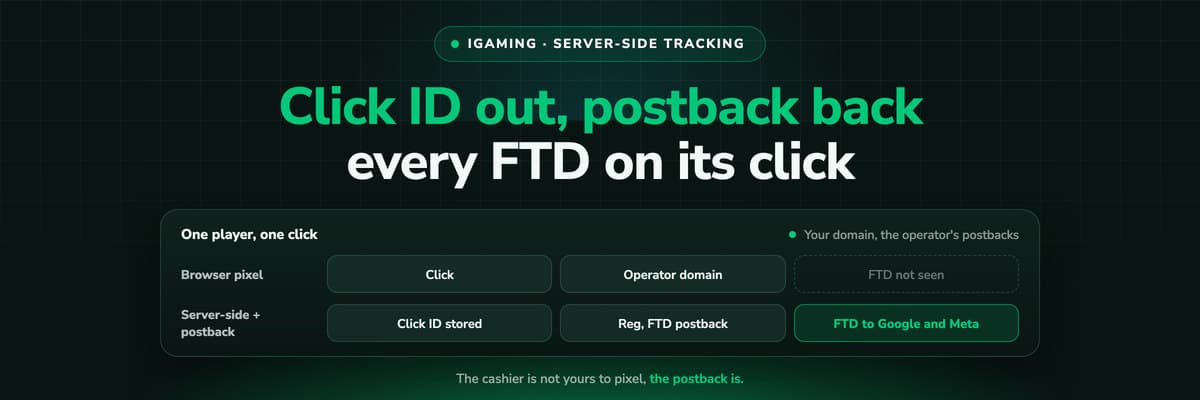
The player clicks on your page, registers on the operator's domain and deposits three days later in a cashier you will never put a pixel on. How server-side tracking follows that player anyway: the click ID stored at the click, returned on the program's postback, and the FTD sent back to Google and Meta with its value.Read the article13 min read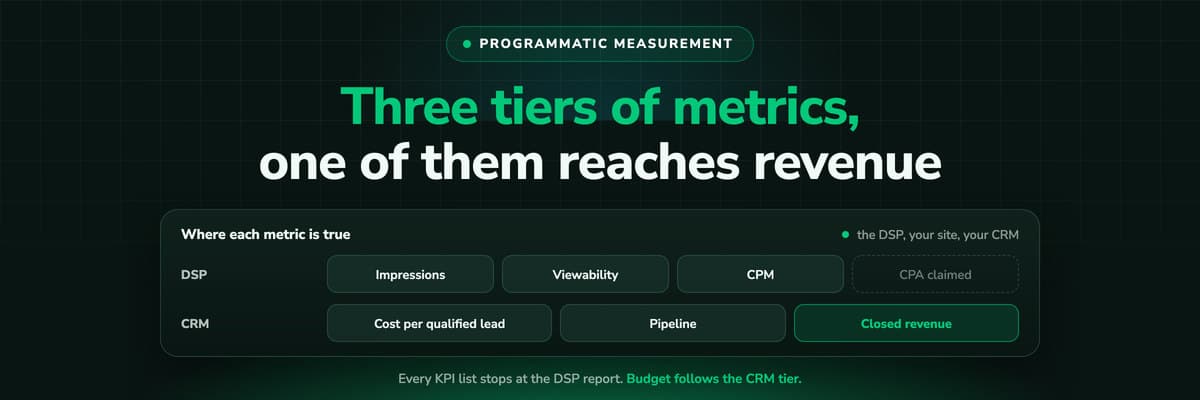 How To Guides
Programmatic Measurement: KPIs From the DSP to the CRM
Every programmatic KPI list stops at the numbers the DSP reports. This guide sorts programmatic metrics by where they are true: delivery in the DSP, visits on your site, qualified leads, pipeline and revenue in the CRM. With formulas, one month worked through all three tiers, KPIs per goal, B2B and a report template.Read the article23 min read How To Guides
Reddit Conversion Tracking: Pixel, CAPI and CRM Events
Reddit reports what the Pixel and the Conversions API tell it, inside the windows set on your account. What to count for lead generation and for a store, how the two sources deduplicate on one conversion ID, what a CRM stage can and cannot do in Reddit, how to verify it in Events Manager, and which number deserves the budget.Read the article20 min read
iGaming postbacks
Ready to see which keyword sent each FTD?
LeadJourney records the click on your own domain, takes reg, FTD and deposit postbacks from any program that can fire one, and lands each on the page, keyword or stream that earned it. Live in 21 minutes, 14-day free trial without a credit card.