















BlogTool Comparisons
Triple Whale Pricing 2026: Plans, GMV Bands and Real Costs
Triple Whale prices Foundation, Automate and Enterprise by your store's annual GMV, and its pricing page no longer prints a number. Every band it last published, what billing and Moby add, what changed since 2025, and what the model costs as the store grows.

Contents
Summarise this article with AI
Opens the page with a ready prompt in:


Nothing is sent until you pick a service.
Triple Whale's pricing page lists four plans and one price: $0. Foundation and Automate carry a "Book a walkthrough" button, Enterprise says "Contact sales", and the FAQ explains that every price depends on your store's annual GMV. The slider that used to turn that into a number is gone.
This guide puts the number back: the entry prices on Triple Whale's own Shopify listing, the GMV ladder its pricing page showed in August 2026, and what the model costs as a store grows. Every Triple Whale fact below was read on 13 September 2026.
Triple Whale Pricing in Short
In short
Triple Whale has four plans: Free, Foundation, Automate and Enterprise, and prices the paid ones by the package and the store's annual GMV, its order revenue over the last 365 days. The pricing page no longer prints a number. Triple Whale's own Shopify App Store listing starts Foundation at $219 and Automate at $749 a month, and the page's August 2026 slider climbed to $2,529 and $4,199 a month at $15 to $20 million of GMV, with custom pricing above that. Paid plans are 12-month subscriptions, billed monthly or annually with two months free. Because the price follows store revenue rather than ad spend, it rises whenever the store sells more.
Triple Whale plans on 13 September 2026, entry prices from its Shopify App Store listing
| Plan | Price | What decides it |
|---|---|---|
| Free | $0 | Fixed limits: 10 users, 12 months of data, first and last click |
| Foundation | From $219 / mo, or $2,190 / yr | Annual GMV band, 12-month subscription |
| Automate | From $749 / mo, or $7,490 / yr | Annual GMV band, 12-month subscription |
| Enterprise | Custom pricing | Generally $10 million of GMV and up, quoted by sales |
How Triple Whale Pricing Works
Two things set a Triple Whale price: the package and the size of the store. The help centre defines the size as Order Revenue over the last 365 days, not the Total Sales metric, which takes returns out. Three things follow from that.
- It counts all order revenue. Repeat purchases, email flows, organic search and paid ads land in the same number, so better retention moves the price as surely as a bigger ad budget.
- It looks back a full year. A record fourth quarter stays in the band for twelve months.
- Growth moves you up on its own. The FAQ promises notice well in advance, and only the annual prepay is described as locking the band for the year.
Why the page shows no price
In August 2026 the pricing page carried a GMV slider with a price for every band. Today Foundation and Automate say "Book a walkthrough", Enterprise says "Contact sales", and the FAQ still points to a slider that is gone. The entry prices survive on Triple Whale's Shopify App Store listing.
Triple Whale Pricing by GMV: Every Band
The last full ladder Triple Whale published is the slider on its pricing page on 24 August 2026, read from an archived copy. Its first band matches the Shopify listing today, so treat the rest as the price last published and confirm yours on the walkthrough.
Triple Whale pricing by annual GMV, as the pricing page's slider showed it in August 2026, US dollars
| Annual GMV | Foundation, monthly | Foundation, annual | Automate, monthly | Automate, annual |
|---|---|---|---|---|
| Under $250K | $219 / mo | $2,190 / yr | $749 / mo | $7,490 / yr |
| $250K to $500K | $329 / mo | $3,290 / yr | $899 / mo | $8,990 / yr |
| $500K to $1M | $429 / mo | $4,290 / yr | $1,099 / mo | $10,990 / yr |
| $1M to $2.5M | $549 / mo | $5,490 / yr | $1,349 / mo | $13,490 / yr |
| $2.5M to $5M | $799 / mo | $7,990 / yr | $1,799 / mo | $17,990 / yr |
| $5M to $7.5M | $1,129 / mo | $11,290 / yr | $2,399 / mo | $23,990 / yr |
| $7.5M to $10M | $1,529 / mo | $15,290 / yr | $2,899 / mo | $28,990 / yr |
| $10M to $15M | $1,849 / mo | $18,490 / yr | $3,499 / mo | $34,990 / yr |
| $15M to $20M | $2,529 / mo | $25,290 / yr | $4,199 / mo | $41,990 / yr |
| $20M and above | Talk to sales | Talk to sales | Talk to sales | Talk to sales |
Monthly or annual billing?
The paid plans are 12-month subscriptions either way. Billed monthly, you pay the monthly price twelve times; prepaid, you pay it ten times, about 17% less, and the band is locked for the year. On the $2.5 million to $5 million band, Foundation costs $9,588 a year billed monthly against $7,990 prepaid.
Why the numbers online disagree
Articles written before the summer of 2026 quote plans called Starter, Advanced and Professional, some from $149 a month. Those plans are gone, and the cheapest paid step now starts at $219.
What Each Triple Whale Plan Includes, and What Costs Extra
Each plan includes everything in the one before it.
- Free: the Triple Pixel, first and last click attribution, channel reporting, a light post-purchase survey, AI search visibility for ChatGPT, 10 users and 12 months of data.
- Foundation: multi-touch attribution with every model, product, cohort and creative analysis, dashboards, segments and a SQL editor, Sonar Send and Sonar Optimize, Moby for analysis, the Triple Whale MCP, and unlimited users and history.
- Automate: Moby Automations, Actions that pause or scale ads within your approvals, Creative Studio, landing pages, benchmarks, the Conversion and Retention capabilities and a significantly larger Moby allowance.
- Enterprise: Compass (marketing mix modelling, incrementality and geo-lift tests), multi-brand reporting, retail and wholesale data, custom integrations and dedicated success coverage.
What costs extra
- Moby past the allowance. Every paid plan includes a monthly Moby usage allowance sized to the plan and the store's GMV. It does not roll over, work pauses at 100%, and top-ups cost a standard rate on Foundation and a preferred rate on Automate and Enterprise. Neither rate is published.
- Add-ons. Data Warehouse Sync is separate on every plan, Enterprise included. Conversion, Retention and Compass can be added to lower plans for eligible stores, each through sales.
Leaving costs time as well: the help centre asks for 30 days' notice to cancel, with billing running through it, and says a 12-month contract cannot be paused.
How Triple Whale Pricing Changed
Archived copies of the pricing page show two ladders on the same GMV bands: the first from July 2025 through May 2026, the second live by 24 August 2026.
Monthly prices on triplewhale.com/pricing in September 2025 and August 2026 (archived), US dollars
| Annual GMV | Sept 2025: Starter, Advanced, Professional | Aug 2026: Foundation, Automate |
|---|---|---|
| Under $250K | $149, $219, $449 | $219, $749 |
| $1M to $2.5M | $429, $549, $799 | $549, $1,349 |
| $5M to $7.5M | $899, $1,129, $1,399 | $1,129, $2,399 |
| $15M to $20M | $1,999, $2,529, $2,899 | $2,529, $4,199 |
| Priced on the page up to | $50 million of GMV | $20 million of GMV |
| Terms in the FAQ | Month-to-month offered, 60-day guarantee | 12-month subscriptions |
Foundation took over the Advanced ladder band for band, and Automate sits above Professional in every band. What went is the cheapest step: multi-touch attribution from $149 a month on Starter in 2025, from $219 now. Month-to-month pricing and the guarantee left the page, and since September so has the price.
What Triple Whale Really Costs as the Store Grows
A GMV price and a spend price only meet through an assumption. The table assumes a blended 5x return, so ad spend is a fifth of revenue, and sets Triple Whale's August 2026 prices next to LeadJourney, which prices by ad spend and tracks the store through its native Shopify integration.
Triple Whale vs LeadJourney at a 5x return, US dollars per year: the lower figure is annual or yearly billing, the higher is monthly billing
| Annual GMV | Ad spend per month | Foundation per year | Automate per year | LeadJourney per year |
|---|---|---|---|---|
| $200,000 | $3,333 | $2,190 to $2,628 | $7,490 to $8,988 | $1,332 to $1,668 (Launch) |
| $750,000 | $12,500 | $4,290 to $5,148 | $10,990 to $13,188 | $2,580 to $3,228 (Starter) |
| $2 million | $33,333 | $5,490 to $6,588 | $13,490 to $16,188 | $5,172 to $6,468 (Growth) |
| $4 million | $66,667 | $7,990 to $9,588 | $17,990 to $21,588 | $8,340 to $10,428 (Scale) |
| $6 million | $100,000 | $11,290 to $13,548 | $23,990 to $28,788 | $8,340 to $10,428 (Scale) |
| $9 million | $150,000 | $15,290 to $18,348 | $28,990 to $34,788 | From $10,356 (Enterprise) |
| $18 million | $300,000 | $25,290 to $30,348 | $41,990 to $50,388 | From $10,356 (Enterprise) |
At this return LeadJourney costs less for six of the seven stores, and the table shows the exception plainly: at $4 million of GMV, Foundation is $350 a year cheaper on annual billing. At $2 million the gap is $318. Automate costs more at every size, and it buys what LeadJourney does not sell: an AI that acts in the ad accounts.
The return you assume decides the answer
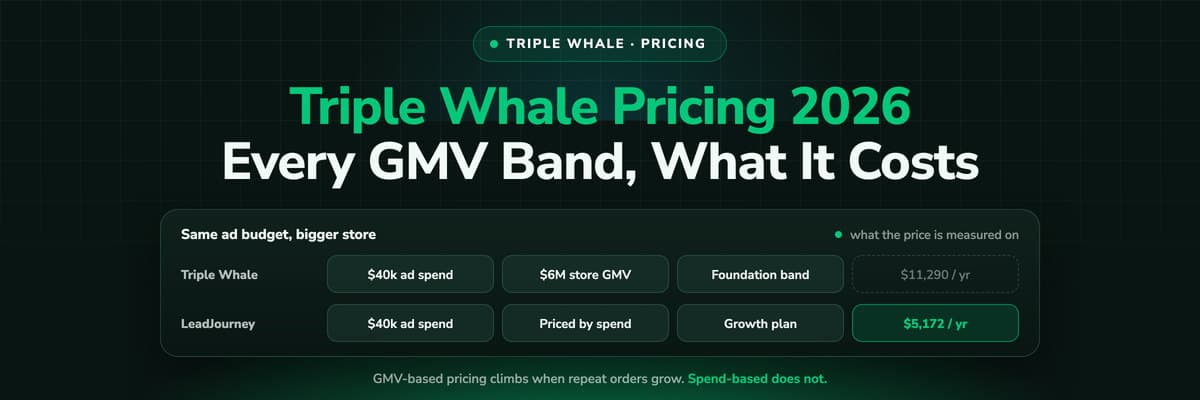
At a 3x return the order flips, and Foundation is the cheaper subscription in every band up to $5 million of GMV. A store that grows through repeat orders and email goes the other way: at $6 million of GMV on $40,000 a month of ad spend, Foundation costs $11,290 a year prepaid and LeadJourney on Growth $5,172 on yearly billing. A retention win can move the first number up a band. The second only moves with the ad budget.
When Triple Whale Is Worth the Price
Triple Whale built the reference product for Shopify analytics. It earns its band when:
- You manage a catalogue, not a funnel. Product, cohort and creative analysis and a SQL editor over the store's own data are in Foundation.
- Retention is half the business. RFM segments sync to ad and lifecycle platforms on Automate, and Sonar Send enriches email and SMS flows on every paid plan.
- You want an AI that acts. On Automate, Moby pauses and scales ads, edits creative and builds landing pages within your approvals.
- You need MMM and incrementality. Compass on Enterprise runs both beside multi-touch attribution.
- Procurement asks for SOC 2. Triple Whale holds a SOC 2 Type 2 report.
When Triple Whale Pricing Works Against You
- Your revenue outgrows your ad budget. Repeat orders, email and organic sales all raise GMV, and GMV sets the band.
- You want a price before a call. The pricing page prints none.
- You want to try the paid plan first. The page describes no trial of Foundation or Automate; the Free plan is the way in.
- You want an easy exit. Paid plans are 12-month subscriptions that cannot be paused, with 30 days' notice to cancel.
- You sell beyond the checkout. Forms, calls and CRM deals are not what Triple Whale's model is built around.
Triple Whale Pricing vs LeadJourney Pricing
LeadJourney is an all-in-one attribution platform, built lead generation first for B2B and B2C, with e-commerce beside it: Shopify and Stripe connect natively, so every order carries the campaign that produced it, with ROAS per campaign and the origin of every customer. Its plans are priced by monthly ad spend and published in full.
How Triple Whale and LeadJourney price, side by side
| Pricing | Triple Whale | LeadJourney |
|---|---|---|
| Priced by | Annual GMV and the package | Monthly ad spend |
| Entry price | Foundation $219 / mo under $250K of GMV, on the Shopify listing | $139 / mo up to $5,000 of ad spend, on the pricing page |
| Multi-touch attribution | Foundation and up | Every plan, every model |
| Billing | 12-month subscription, monthly or annual with two months free | Monthly, or yearly at 20% off |
| Trying it | Free plan; paid plans through a walkthrough | 14-day free trial, no credit card |
| Signals back to the ad platforms | Sonar on every paid plan | Conversions API sync to Meta, Google, LinkedIn and Microsoft on every plan |
| AI | Moby on every paid plan, allowance plus top-ups | Atlas AI chat from Starter, Atlas agents and MCP from Growth |
The LeadJourney ladder
LeadJourney advertiser plans in US dollars; also priced in euros, pounds, Canadian and Australian dollars
| Plan | Monthly ad spend | Monthly billing | Yearly billing |
|---|---|---|---|
| Launch | Up to $5,000 | $139 / mo | $111 / mo |
| Starter | Up to $15,000 | $269 / mo | $215 / mo |
| Growth | Up to $50,000 | $539 / mo | $431 / mo |
| Scale | Up to $100,000 | $869 / mo | $695 / mo |
| Enterprise | Above $100,000 | From $1,079 / mo | From $863 / mo |
Where Triple Whale is ahead, it is ahead: catalogue analytics, MMM and incrementality, an AI that acts in the ad accounts, a Free plan and a SOC 2 Type 2 report LeadJourney does not have yet. LeadJourney is built for breadth: server-side first-party tracking on your own domain, every model on every plan, and forms, calls and CRM deals in the same journey as the Shopify order, hosted in Frankfurt.
The full Triple Whale comparison sets both products against each other row by row, including the rows where Triple Whale wins.
How to Estimate Your Triple Whale Price Before the Walkthrough
- Pull your order revenue for the last 365 days. Gross order revenue, before returns come off.
- Ask how several stores are counted before you settle on a band.
- Read your band off the table above. Then pick the package: Foundation to measure, Automate for Moby to act.
- Price the billing cycle. The monthly figure times 12 billed monthly, or times 10 prepaid.
- Price the next band too. A growing store moves up automatically.
- Ask about Moby. The allowance on your band, and the top-up rate on your plan.
- Price the alternative on the same store. A tool priced by ad spend needs only your monthly ad budget, which you already know.
Further Reading
- Triple Whale vs LeadJourney: the full comparison, feature by feature.
- Hyros pricing: another way to price attribution by revenue, and what it costs as results grow.
- LeadJourney pricing: every plan, in five currencies.
- Shopify integration: how LeadJourney puts the campaign on every store order.
- Attribution for e-commerce brands: ROAS on real revenue, and the customer origin behind every order.
FAQ
Frequently Asked Questions
The questions stores ask about Triple Whale pricing before the walkthrough.
How much does Triple Whale cost?
Triple Whale prices its paid plans by annual GMV. Its Shopify App Store listing starts Foundation at $219 a month or $2,190 a year, and Automate at $749 a month or $7,490 a year. The slider on its pricing page in August 2026 ran up to $2,529 and $4,199 a month at $15 to $20 million of GMV, with custom pricing above that and on Enterprise.
Is Triple Whale free?
There is a Free plan: the Triple Pixel, first and last click attribution, channel reporting, a light post-purchase survey, AI search visibility for ChatGPT, 10 users and 12 months of data. Multi-touch attribution, custom dashboards, the SQL editor, Sonar and the Moby usage allowance start on Foundation, from $219 a month.
How does Triple Whale calculate GMV for pricing?
Triple Whale's help centre bases pricing on the store's Order Revenue over the last 365 days, not on the Total Sales metric, which takes returns out. All order revenue counts, whatever produced it, so repeat purchases and email flows raise the band as much as paid ads do. A store that crosses into a higher band moves up with advance notice.
Is Triple Whale billed monthly or annually?
Foundation, Automate and Enterprise are 12-month subscriptions either way. You choose the billing: monthly, or prepaid annually with two months free, about 17% less. Only the annual prepay is described as locking your GMV band for the year. The help centre adds that a 12-month contract cannot be paused and that cancelling takes 30 days' notice.
Does Triple Whale charge extra for Moby?
Every paid plan includes a monthly Moby usage allowance, sized to the plan and your GMV, and Automate includes a significantly larger one. Unused usage does not roll over. At 100% Moby work pauses until you top up, at a standard rate on Foundation and a preferred rate on Automate and Enterprise. Triple Whale does not publish either rate.
What is a cheaper alternative to Triple Whale?
It depends on how the store grows. LeadJourney prices by ad spend instead of GMV: $139 a month up to $5,000 of spend, $269 up to $15,000 and $539 up to $50,000, with Shopify connected natively and a 14-day free trial. At a 5x return it costs less than Foundation for most store sizes; at a 3x return Foundation is cheaper up to $5 million of GMV.
Keep reading
More from the blog
 Tool Comparisons
12 Best Cross-Channel Attribution Tools in 2026
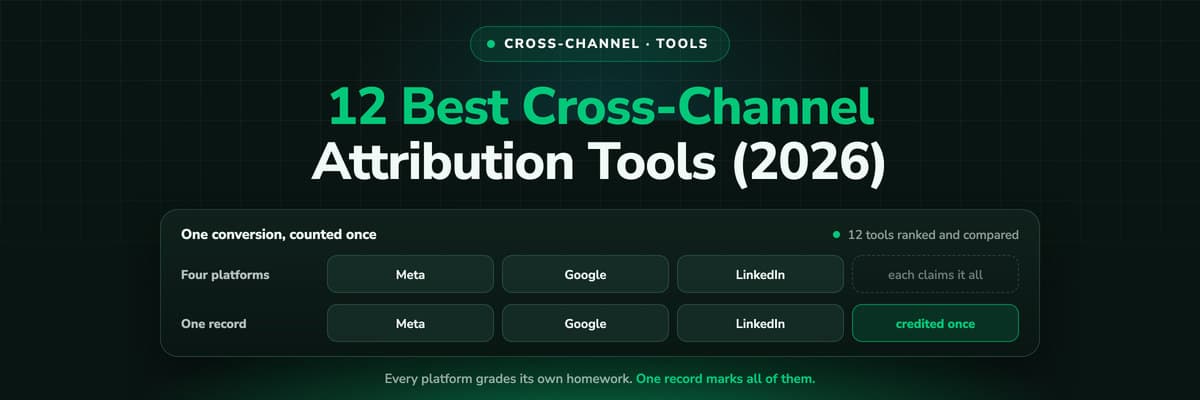
Meta says 71, Google 58, LinkedIn 19, Microsoft 7. The CRM has 122 leads. Twelve cross-channel attribution tools compared on how they close that gap, record, model or move, with pricing, pros, cons and a verdict on who each one is built for.Read the article24 min read Tool Comparisons
WhatConverts Pricing 2026: Plans, Usage Fees and Real Costs
WhatConverts publishes every price: $30 to $160 a month for one account, $500 to $1,250 for agencies, each with a usage credit. What the credit covers, every rate past it, what the calculator adds at volume, and how the price changed since 2021.Read the article11 min read Tool Comparisons
Databox Pricing 2026: The New Plans and What They Cost
Databox rebuilt its price list in September 2026. Every plan and add-on on the page today, monthly and annual, how data sources, users and client packs move the price, what it used to cost, and what a team or an agency pays as it grows.Read the article10 min read
Triple Whale pricing
Pay for your ad budget, not for your store's growth
LeadJourney traces every order and every lead to the click that produced it, priced by ad spend from $139 a month. Start a 14-day free trial with no credit card, or book a demo on your own data.