














BlogTool Comparisons
RedTrack vs Voluum (2026): Which Tracker to Pick
RedTrack and Voluum are the two trackers most media buyers weigh against each other. Tracking, signals back to the ad platforms, automation, anti-fraud, AI and both price lists, read on 25 October 2026, and which buyer each one fits.

Contents
Summarise this article with AI
Opens the page with a ready prompt in:


Nothing is sent until you pick a service.
RedTrack and Voluum are the two cloud trackers most affiliates and media buyers end up choosing between, and each vendor publishes a page explaining why the other is worse. Both track clicks and postbacks server to server, both price by events, and both now ship an MCP server. Underneath, they have grown in different directions: RedTrack toward signals and automation in the ad accounts, Voluum toward traffic distribution, anti-fraud and iGaming.
This comparison sets them side by side on the axes that matter to someone buying traffic: tracking modes, what goes back to the ad platforms, rules and automation, fraud, AI, and both price lists with a worked example. Every fact was read on the vendors' own sites on 25 October 2026. A short section at the end covers the buyer whose revenue closes somewhere neither tool looks.
RedTrack vs Voluum in Short
In short
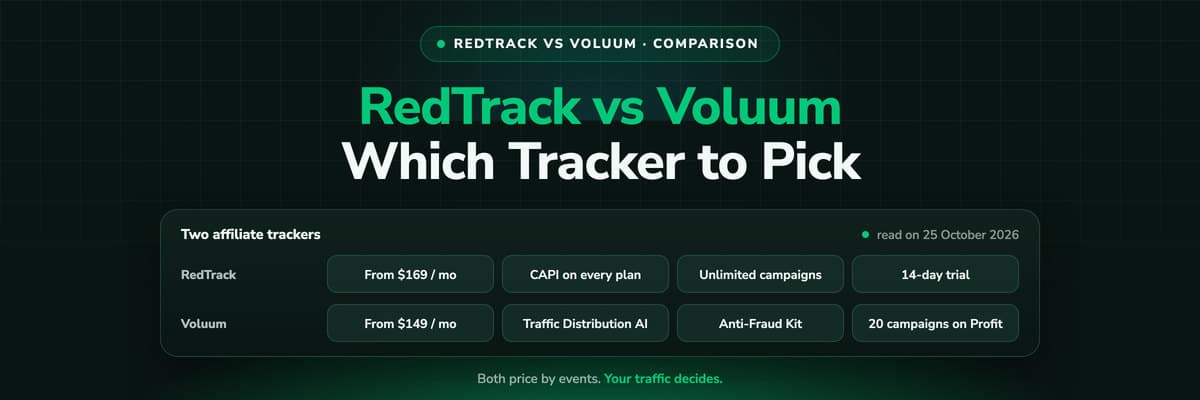
RedTrack fits media buyers who live in Meta, Google and TikTok and want the tracker to send conversions back, sync spend and act on the ads: Conversion API and Stop Rules on every plan, unlimited campaigns, a 14-day trial, from $169 a month. Voluum fits arbitrage and iGaming buyers at volume who rotate landers and offers, buy native, push and pop traffic, and need traffic distribution and an anti-fraud kit: from $149 a month, with campaign caps on the small plans and an events ladder that runs to 500 million.
RedTrack vs Voluum at a glance, as both sites showed them on 25 October 2026
| RedTrack | Voluum | |
|---|---|---|
| Built for | Affiliates, lead gen and media buying teams; e-commerce on its own plans | Affiliates, media buyers, agencies and iGaming at volume |
| Priced by | Events per month, plus seats and add-ons | Events per month, plus active campaigns and seats |
| Entry price, monthly | $169 (Solo, 5M events) | $149 (Profit, 1M events) |
| Annual billing | 30% off during Black Friday; ten months for twelve before it | 10% to 20% off, billed upfront |
| Campaigns | Unlimited on every plan | 20 on Profit, 60 on Scale, 100 on Start-up |
| Tracking | Redirect and direct, server to server | 302, meta refresh, double meta refresh and direct |
| Conversion API | Every plan, eight ad platforms | Add-on on some plans, included on the larger ones |
| Spend sync | Every 60 min on Solo, 30 on Team; faster as add-ons | Through auto-rules and API integrations, free up to $1,000 of spend on the small plans |
| Rules and automation | Stop Rules on every plan; Scale Rules and Ads Manager edits on Enterprise | Automizer, Traffic Distribution AI |
| Fraud | Bot filtering and traffic filters | Anti-Fraud Kit, honeypot, proxy reports |
| CRM and calls | HubSpot, GoHighLevel, Ringba, Retreaver as standard integrations | No CRM named on the pricing page |
| AI and MCP | AI Copilot, MCP and API on every plan | MCP from 20 requests a day; write access from Enterprise |
| Trial | 14 days, every add-on unlocked | None mentioned on the pricing page |
Tracking: Redirects, Direct Links and Postbacks
Both are server-side click trackers at heart: a click ID on the link, a postback from the network or the advertiser when the conversion happens, and the two matched on the tracker's side without relying on the browser.
Voluum offers the full set of redirect modes, HTTP 302, meta refresh and double meta refresh, plus direct tracking for traffic sources that refuse redirects. Multi-step funnels, click caps, landing page protection and rule-based paths by country, device or ISP are in the plan. It counts every visit, click, conversion and impression as an event.
RedTrack offers redirect and direct (no-redirect) tracking on every plan, smart links, traffic filters and day parting, and it puts no cap on campaigns, landers, offers, traffic sources or networks on any plan. Voluum caps active campaigns on its smaller plans: 20 on Profit, 60 on Scale, 100 on Start-up.
Verdict
Voluum wins on redirect options and funnel routing for classic lander-to-offer arbitrage; RedTrack wins for a buyer who runs many campaigns on a small plan.
Signals Back to the Ad Platforms
Since Meta, Google and TikTok started optimising on server-side conversions, a tracker that only records the sale leaves money on the table. This is where the two differ most.
- RedTrack includes the Conversion API on every plan, from the entry price, for eight ad platforms, and says it is an Official Meta Business Partner. Ad-level spend syncs every 60 minutes on Solo and every 30 on Team and Enterprise, at any ad spend.
- Voluum sends conversions to the major platforms by postback and API. On its pricing table, Conversion API postbacks are an add-on on some plans and included on the larger ones, and auto-rules with API integrations are free up to $1,000 of ad spend on Profit and Scale. The bigger plans include more spend under Automizer: up to $15,000, $30,000 and $65,000.
Verdict
RedTrack wins clearly for buyers on Meta, Google and TikTok, because the signal path is in every plan rather than priced by plan and spend.
Rules, Automation and Traffic Distribution
RedTrack automates the ad accounts. Stop Rules, which pause losing ads, are on every plan at any spend. Scale Rules, which raise budgets on winners, and the Ads Manager with bid and budget edits are included on Enterprise and sold as add-ons below it, priced by monthly ad spend from $99 a month. A Chrome extension and a mobile app show the numbers inside Meta and on the phone.
Voluum automates the traffic. Traffic Distribution AI shifts visitors between landers and offers by performance (landing page level on Scale, path level higher up), and Automizer runs rules and white or black lists against traffic sources. For a buyer testing ten landers against five offers on native or push, that routing is the product.
Verdict
RedTrack wins on automation inside Meta, Google and TikTok; Voluum wins on optimising the funnel between the click and the offer.
Fraud Protection and iGaming
Voluum's Anti-Fraud Kit, with bot filtering by IP and user agent, a honeypot, proxy reports and a lander scanning tool beside it, is one of its strongest arguments for buyers on open networks where bot traffic is a cost line. It also carries an iGaming Hub on its business plans, with an Affilka integration from Agency up according to an earlier reading.
RedTrack filters traffic and bots too and has an iGaming use case page, but it does not package fraud protection as a product of its own the way Voluum does.
Verdict
Voluum wins on fraud tooling and on iGaming; RedTrack is sufficient for traffic bought on the big self-serve platforms.
AI, MCP and API
Both trackers can now be read by Claude, ChatGPT or an agent of your own over MCP, with different limits.
- RedTrack includes an AI Copilot for dashboard questions, MCP and API access on every plan, and shareable AI dashboards (one on Solo, three on Team, ten on Enterprise). A premium MCP and API tier with 1,000 requests a minute costs $199 a month.
- Voluum caps MCP requests per day by plan: 20 on Profit, 60 on Scale, 100 on Start-up, up to 5,000 on Executive. Write access, where the assistant can change things rather than only read, is included from Enterprise and an add-on below. The API is standard on the small plans and extended from Enterprise.
Verdict
RedTrack wins for a buyer who wants an assistant to query the data all day; Voluum's daily caps are enough for a few questions and too tight for an agent.
Setup, Trial and Support
RedTrack offers a 14-day free trial with every add-on unlocked, and campaigns built in the trial carry over. Solo includes a 30-minute onboarding session, Team adds a one hour setup session, and a migration rep moves campaigns, domains and postbacks across. Switching from another tracker mid-contract earns up to four months off an annual plan.
Voluum's pricing page mentions no trial today; an earlier reading on 2 October found a 14-day preview without payment details, so ask. Profit includes a one hour onboarding call and 14 days of chat support, Start-up a week of individual onboarding, and from Agency up a technical account manager with a two hour or faster SLA. Campaigns can be migrated from another tracker; the FAQ notes that a CSV import brings landers and offers, not campaigns.
Verdict
RedTrack wins on trying before buying and on switching; Voluum wins on dedicated support at the higher tiers.
RedTrack vs Voluum Pricing
Both publish every plan and both meter events, but an event is not the same unit in both. Voluum counts each visit, click, conversion and impression; RedTrack's page does not define it, and an earlier reading described an event as a click or a conversion. The same traffic can therefore use a different share of each allowance.
RedTrack affiliate and lead gen plans, US dollars, 25 October 2026
| Plan | Events / users | Monthly | Annual, Black Friday | Annual, before the promotion |
|---|---|---|---|---|
| Solo | 5M / 1 | $169 / mo | $118 / mo ($1,420 / yr) | $141 / mo |
| Team | 20M / 5 | $399 / mo | $279 / mo ($3,352 / yr) | $333 / mo |
| Enterprise | 75M / 15 | $999 / mo | $699 / mo ($8,392 / yr) | $833 / mo |
| Custom | 100M+ / 25+ | Quote | Quote | Quote |
Extra seats cost $29 a month on Team and Enterprise only; Solo has one user. Faster spend sync, Scale Rules and the Ads Manager are priced by your rolling monthly ad spend, from $99 a month each at under $150,000.
Voluum plans, US dollars, 25 October 2026
| Plan | Events | Active campaigns | Monthly | Billed annually |
|---|---|---|---|---|
| Profit | 1M | 20 | $149 / mo | $119 / mo |
| Scale | 5M | 60 | $349 / mo | $299 / mo |
| Start-up | 10M | 100 | $599 / mo | $539 / mo |
| Agency | 25M | 200 | $999 / mo | $799 / mo |
| Enterprise | 60M | 400 | $1,999 / mo | $1,599 / mo |
| Corporate | 200M | More | $4,999 / mo | $3,999 / mo |
| Executive | 500M | More | $9,999 / mo | $7,999 / mo |
Three accounts, priced on both
The events per account are assumptions, stated in the first column. LeadJourney's affiliate plans, which meter paid spend and unique visitors rather than events, are in the last column.
Monthly billing, with annual or yearly billing in brackets, US dollars
| Account | RedTrack | Voluum | LeadJourney affiliate |
|---|---|---|---|
| Solo buyer: 1M events, $8,000 spend, 200K visitors, 1 user | $169 ($141), Solo | $149 ($119), Profit, 20 campaigns | $139 ($111), Solo |
| Small team: 5M events, $40,000 spend, 800K visitors, 3 users | $399 ($333), Team, for the seats | $349 ($299), Scale; $599 ($539) on Start-up for extra users | $269 ($215), Pro, 3 seats |
| Team at scale: 20M events, $150,000 spend, 4M visitors, 5 users | $399 ($333), Team | $999 ($799), Agency | $539 ($431), Scale, 10 seats |
Between the two trackers, Voluum is cheaper for one buyer on one login with few campaigns. RedTrack is cheaper as soon as the account needs seats or volume, and its Team plan beats both alternatives at 20 million events. Faster spend sync changes the sums: RedTrack syncs every 30 minutes on Team, LeadJourney every two hours unless you add a faster sync.
Which One Should You Choose?
RedTrack
Pros
- Conversion API for eight ad platforms on every plan
- Unlimited campaigns, offers, sources and networks
- Stop Rules at any spend, Scale Rules and Ads Manager edits on Enterprise
- MCP and API on every plan, without a daily cap
- 14-day trial and up to four months' switching credit
Cons
- Solo has one user and no extra seats
- Faster sync, Scale Rules and Ads Manager priced by ad spend below Enterprise
- Annual prices move with promotions
- No dedicated anti-fraud product
Voluum
Pros
- Every redirect mode plus direct tracking
- Traffic Distribution AI between landers and offers
- Anti-Fraud Kit and an iGaming Hub
- Events ladder to 500 million, with account management on the business plans
- The cheapest entry for one buyer on few campaigns
Cons
- Active campaigns capped on the smaller plans
- Conversion API an add-on on some plans
- MCP capped per day, write access from Enterprise
- No trial mentioned on the pricing page
Verdict
Choose RedTrack if you buy on Meta, Google and TikTok and want the tracker to feed and steer the ad accounts. Choose Voluum if you run lander and offer rotation on native, push or pop traffic, work in iGaming, or need fraud protection as a product.
When Neither Fits: LeadJourney
Both trackers end at the postback. That is enough when the network pays on a sale or a registration. It is not enough for an affiliate or media buyer whose revenue is decided later: a lead gen offer paid on qualified leads, pay per call, a lead you sell on after a sales team has spoken to it, or your own offer whose deals close in a CRM. Neither tool's pricing page builds the CRM stage into its model, and RedTrack lists HubSpot and GoHighLevel only as standard integrations.
LeadJourney is an all-in-one attribution platform built lead generation first, with an affiliate account type of its own:
- Server-to-server postbacks, direct linking and click ID tracking, with campaigns, offers, traffic sources and network integrations unlimited on every plan.
- The lead after the postback: CRM stages and closed deals from HubSpot, Salesforce, Pipedrive, Close, Attio, GoHighLevel, ActiveCampaign, Odoo, Zoho CRM and Microsoft Dynamics 365, sent back to Meta, Google, LinkedIn, Microsoft, Reddit, X, Taboola and Outbrain Ads as conversions.
- Priced by paid spend and unique visitors, never events: Solo $139 a month up to $10,000 and 250,000 visitors, Pro $269 up to $50,000 and 1 million, Scale $539 up to $200,000 and 5 million, Network from $979; yearly saves 20%. Either axis can be zero, so an SEO affiliate pays on visitors and a media buyer on spend.
- Organic and AI search as sources, multi-touch attribution with every model on every plan, server-side tracking on your own domain, 95%+ tracking accuracy, live in 21 minutes.
- Call tracking as a $50 add-on with five numbers and 250 minutes, for pay per call. Its AI summarises calls; it does not score them.
- Hosted in Frankfurt, with a one hour onboarding call with a tracking expert, 14 days of setup support and a 30-day money-back guarantee on every plan.
Where LeadJourney is not the right pick
For pure arbitrage it is the wrong tool. LeadJourney has no traffic distribution between landers, no anti-fraud kit, fewer traffic source templates than either tracker, and it does not write into the ad platforms: no stop rules, no budget changes, no bid automation. Spend syncs every two hours by default, with 30, 15 and 5 minute sync as add-ons. If your conversion is the network's postback and nothing after it, pick between RedTrack and Voluum on the sections above.
The full comparisons, including the rows where the competitor wins: LeadJourney vs RedTrack and LeadJourney vs Voluum.
Further Reading
- The best RedTrack alternatives: the trackers buyers move to, and who each one fits.
- LeadJourney vs RedTrack: the full comparison with both price lists.
- LeadJourney vs Voluum: every row, including where Voluum wins.
- LeadJourney vs ClickFlare: another tracker on the same shortlist.
- The best ad tracking software: the wider field, ranked.
- Tracking for paid traffic affiliates: how the affiliate account works.
- Server-side tracking: what first-party tracking on your own domain changes.
- LeadJourney pricing: the affiliate plans in five currencies.
In the glossary
FAQ
Frequently Asked Questions
The questions media buyers ask when RedTrack and Voluum are both on the table.
Is RedTrack better than Voluum?
For buyers on Meta, Google and TikTok, usually yes: RedTrack includes the Conversion API, spend sync and Stop Rules on every plan and does not cap campaigns. Voluum is better for lander and offer rotation on native, push and pop traffic, for iGaming, and for anyone who needs its Anti-Fraud Kit. Both are mature trackers; the traffic you buy decides between them.
How does RedTrack pricing compare with Voluum pricing?
On 25 October 2026 RedTrack charged $169, $399 and $999 a month for 5, 20 and 75 million events, with annual billing at a 30% Black Friday discount. Voluum charged $149 to $9,999 a month for 1 to 500 million events, or $119 to $7,999 billed annually upfront. Voluum is cheaper for one user with few campaigns; RedTrack is cheaper once you need seats or volume.
Does Voluum or RedTrack have a free trial?
RedTrack offers a 14-day free trial with every add-on unlocked, and the setup carries over when you subscribe. Voluum's pricing page did not mention a trial on 25 October 2026; an earlier reading found a 14-day preview without payment details, so ask its sales team before you sign up.
Can I switch from Voluum to RedTrack, or the other way round?
Yes. RedTrack assigns a migration rep who moves campaigns, domains and postbacks, and credits up to four months of prepaid time left on another tracker against an annual plan. Voluum advertises automatic campaign migration from your old tracker, and its FAQ adds that a CSV import brings landers and offers but not campaigns. Run both in parallel for a few days before switching postbacks over.
Which one is better for iGaming?
Voluum. It carries an iGaming Hub on its business plans, its Anti-Fraud Kit suits open traffic sources, and the iGaming community has used it for years. RedTrack handles operator postbacks like any other network and has an iGaming page, but packages less around the vertical. An affiliate paid on FTDs from search and content traffic may want a tool that tracks the player beyond the first deposit.
What is the best alternative to RedTrack and Voluum?
For pure arbitrage, other click trackers such as ClickFlare. For affiliates and media buyers whose payout depends on what happens after the lead, LeadJourney adds CRM stages and closed deals to postbacks and direct linking, prices by paid spend and visitors from $139 a month instead of events, hosts in Frankfurt, and comes with expert onboarding and a 30-day money-back guarantee.
Keep reading
More from the blog
 Tool Comparisons
Hyros vs Cometly (2026): Which Attribution Tool Fits?
Hyros is built around high-ticket sales, info products and calls; Cometly around B2B SaaS pipeline. Both quote prices on a call. A fair, dated comparison of tracking, CRM depth, AI, security and cost, and who should pick which.Read the article14 min read Tool Comparisons
Hyros vs AnyTrack (2026): Which Tracker at Your Size?
AnyTrack is a self-serve conversion router with a free plan and public prices from $100 a month. Hyros is a done-for-you attribution platform quoted on a call. A fair, dated comparison of tracking, attribution, affiliates, calls and cost.Read the article14 min read Tool Comparisons
Triple Whale vs Northbeam (2026): Which Fits Your Store
Triple Whale and Northbeam both measure e-commerce marketing, and they are built for different stores. Attribution, measurement, AI, setup and both price lists side by side, read on 25 October 2026, and which brand each one fits.Read the article13 min read
RedTrack vs Voluum
Track past the postback
LeadJourney tracks postbacks, direct links and every lead into the CRM, priced by paid spend and visitors from $139 a month. Book a demo: a tracking expert sets it up with you, with a 30-day money-back guarantee.
30-day money-back guaranteeSetup with a tracking expert