















BlogTool Comparisons
Cometly Pricing 2026: What It Costs and How It Changed
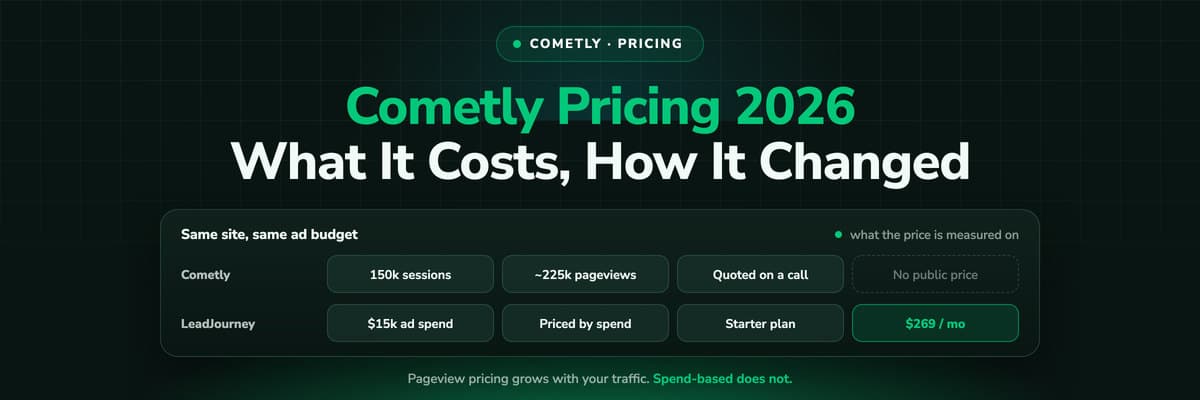
Cometly prices Core and Enterprise by monthly pageviews and quotes them on a call. What each plan includes, what billing and onboarding add, the $199 and $499 plans it used to publish, and what the model costs as your traffic grows.

Contents
Summarise this article with AI
Opens the page with a ready prompt in:


Nothing is sent until you pick a service.
Cometly's pricing page names two plans, Core and Enterprise, and prints a price for neither. It says both are usage-based and tailored to your monthly pageviews, and it offers a 30-minute call to size them and quote the price live.
This guide covers what each plan includes, how the pageview count sets the quote, what billing and onboarding look like, the price lists cometly.com still published in 2024 and 2025, and what the model means as your traffic grows. Every Cometly fact below was read on cometly.com or an archived copy of its pricing page on 13 September 2026.
Cometly Pricing in Short
In short
Cometly has two plans, Core and Enterprise, and no published price. Both are usage-based on monthly pageviews, which Cometly estimates at about 1.5 times your sessions, and the quote comes on a sales call. Billing is monthly, or annual at 20% off. There is no free trial: a 60-day onboarding program stands in for one. Enterprise adds the CRM and warehouse sync, the API and MCP. Third-party breakdowns report Core from about $750 a month at 50,000 sessions and a one-time onboarding fee of $1,500, figures Cometly does not confirm. As recently as June 2025 the page printed Lite at $199 and Standard at $499 a month, with a 14-day trial.
Cometly plans and terms as cometly.com showed them on 13 September 2026
| Plan or term | Price | What decides it |
|---|---|---|
| Core | Not published, quoted on a call | Monthly pageviews |
| Enterprise | Not published, talk to sales | Monthly pageviews, with more usage and AI credits |
| Annual billing | 20% off either plan | Paying yearly instead of monthly |
| Onboarding | Fee not published | A 60-day program on both plans |
How Cometly Pricing Works
Cometly calls its model usage-based pricing, and the usage is pageviews. The pricing page counts one each time a page on your website loads and is tracked by the Comet Pixel or through server-side events, the way Google Analytics counts them. A visit typically produces about 1.5 pageviews, so Cometly estimates your monthly pageviews at 1.5 times your sessions.
What that means for your quote
- The price follows your traffic, not your ad budget. Every tracked visit counts, including the organic, direct and returning visits no campaign paid for.
- Content raises the bill for your ads. A blog that doubles its readers doubles the pageviews the quote is set on, whether or not those readers ever click an ad.
- You move up automatically. Cross 90% of your tier and Cometly notifies you, then moves the account to the next tier at the start of the next billing period. It never stops tracking.
Why there is no price on the page
Core's button leads to a form asking for your team size, phone and website, Enterprise's to sales. The FAQ offers a 30-minute call to size your pageviews and quote pricing live, and the page's structured data lists both plans at "Custom". No tier price and no tier boundary is published.
Core and Enterprise: What Each Plan Includes
Core is the attribution product. In the page's own words it covers:
- Pixel and server-side tracking
- Multi-touch attribution
- Events and account journeys
- Customizable dashboards and analytics
- Agent, the AI assistant
- Conversion API
- AI Ads Manager
- Audiences
- 70+ integrations
Both plans include unlimited connections to Meta, Google, LinkedIn, TikTok, Microsoft, Reddit and Snapchat, with the server-side Conversion API to each. Few tools in the category put that many conversion syncs on the entry plan.
Enterprise is everything in Core plus a dedicated solutions engineer and success manager, CRM and warehouse sync, MCP, the Cometly API, Snowflake and BigQuery support (the FAQ adds Redshift), increased pageview usage and AI credits, custom feature and integration builds, and first access to new features.
What costs extra, or may
- Onboarding. Every customer starts with a 60-day program: Professional Onboarding on Core, with a dedicated specialist and live setup calls, and Enterprise Onboarding with a customer success manager, Salesforce work and warehouse tables. Cometly prints no fee. Third-party breakdowns report a one-time $1,500 for Professional Onboarding.
- AI usage. Enterprise lists increased AI credits, so Core carries an allowance of its own. The page does not say how large it is or what more credits cost.
- Your data, outside Cometly. Syncing attribution into Snowflake, BigQuery or Redshift, or into your own systems through the API or MCP, is on Enterprise, so a data team's needs can decide the plan on their own.
How Cometly Pricing Changed
Articles still quote Cometly at $199, $499, $500 or $1,000 a month. Each figure was on cometly.com at some point. Archived copies of the pricing page show how often the prices changed, and what they were measured on:
cometly.com/pricing in archived copies from 2023 to 2026, and on 13 September 2026
| Page as of | Plans and prices | Priced by | How you started |
|---|---|---|---|
| March 2023 | Business and Enterprise, no price shown | Tracked ad spend | Book a demo |
| April 2024 | Start Up from $500 / mo, Growth from $1,000, Enterprise from $5,000 | Tracked events: 100,000, 200,000, 1 million | Book a demo, no free trial |
| September 2024 | Starter from $500 / mo up to $50,000 ad spend, Growth from $1,000 up to $100,000, Enterprise from $3,000 | Ad spend | Book a demo |
| January and June 2025 | Lite $199 / mo up to $10,000 ad spend, Standard $499 up to $50,000, Enterprise custom | Ad spend, with a session cap and overage per ad dollar | 14-day free trial |
| October 2025 and February 2026 | One Core Platform plan, no price | Not stated, the form asked your ad spend | Form, then a demo |
| September 2026 | Core and Enterprise, no price | Monthly pageviews | Form or sales call, no free trial |
In 2025 the page was as open as a pricing page gets: Lite included 200,000 sessions and one user, Standard 500,000 sessions and five users, spend above the limit cost $18 or $15 per extra $1,000, extra users were $49 a month, and neither plan had a contract or a setup fee. Enterprise started at $400,000 of monthly ad spend.
Since then the unit has moved from events to ad spend to pageviews, so last year's quote is no guide to this one, and the trial anyone could start on Lite or Standard has become a paragraph explaining why there is no trial.
Why the numbers online disagree
A Cometly blog post from June 2026 says plans start at $99 a month, which no archived pricing page shows. A third-party breakdown reports Core at $750 a month up to 50,000 sessions and says annual billing brings no discount, which today's page contradicts. Treat any Cometly price without a date as a price from an older page.
What Cometly Really Costs as Your Traffic Grows
Pricing by pageviews means the bill follows your site's traffic, while most attribution budgets are planned around ad spend. The table sets six accounts side by side. With no price published, the Cometly column uses the Core prices third-party breakdowns report by monthly sessions; the LeadJourney column is the published plan for the same ad spend.
Cometly Core as reported vs LeadJourney as published, US dollars per month
| Account | Monthly sessions | Monthly ad spend | Cometly Core, as reported | LeadJourney, monthly (yearly) |
|---|---|---|---|---|
| Local lead generation | 30,000 | $5,000 | $750 | $139 ($111) |
| B2B SaaS with a blog | 150,000 | $15,000 | $1,349 | $269 ($215) |
| Scaling SaaS | 300,000 | $40,000 | $1,949 | $539 ($431) |
| Content-led brand | About 1,000,000 | $50,000 | $3,149 | $539 ($431) |
| Small site, big budget | 50,000 | $100,000 | $750 | $869 ($695) |
| Paid-only funnel | 50,000 | $150,000 | $750 | From $1,079 (from $863) |
For a site with real traffic, content or a product people log into, pricing by pageviews costs several times what pricing by spend does. For a small site behind a large budget it is the other way round, and the table says so: at 50,000 sessions and $100,000 of spend the reported Core price is $750 against $869 on LeadJourney Scale, and if the 20% annual discount applies to that figure, $600 against $695. Above $100,000 of spend the gap in Cometly's favour widens.
The first year, and the CRM
Two items move these numbers. The $1,500 onboarding fee reported for Core lands in the first year. And if your revenue closes in a CRM, check which plan you need: the page lists CRM and warehouse sync under Enterprise, which third-party breakdowns report from $1,495 a month, while LeadJourney connects HubSpot, Salesforce, Pipedrive, Close, Attio, GoHighLevel, ActiveCampaign and Odoo on every plan. Sessions also are not pageviews: at Cometly's own 1.5 ratio, 50,000 sessions are 75,000 pageviews.
When Cometly Is Worth the Price
Cometly is a real attribution platform, and for the right team the quote buys a lot. It earns its price when:
- You advertise on many networks. Meta, Google, LinkedIn, TikTok, Microsoft, Reddit and Snapchat all get the server-side Conversion API on both plans.
- You want to act on ads where the data is. The AI Ads Manager is on Core, so campaign decisions happen next to the attribution.
- Your site is small and your budget is not. Pageview pricing favours a lean landing page behind a large paid budget.
- You want setup done with you. The 60-day program pairs you with a specialist and live setup calls rather than documentation.
- Your data team wants the tables. Enterprise syncs attribution into Snowflake, BigQuery or Redshift.
When Cometly Pricing Works Against You
- You publish content. Organic and returning visits count as pageviews, so a growing blog raises the price of attributing your ads.
- You want a number before a call. No plan has a published price, for any volume.
- You want to try it first. There is no free trial, and the 14-day trial Cometly offered in 2025 is gone.
- You budget in advance. Crossing 90% of a tier moves you up at the next billing period, so a strong month for traffic lands on the invoice.
- Your revenue closes in a CRM. CRM and warehouse sync sit on Enterprise, the plan with the larger quote.
- Your data has to stay in the EU. Cometly's privacy policy says it primarily hosts data in the United States, with AWS among its sub-processors. That is one more transfer to document in a data protection review.
Cometly Pricing vs LeadJourney Pricing
LeadJourney is an all-in-one attribution platform, built lead generation first for B2B and B2C, with e-commerce through Shopify beside it. Its plans are priced by monthly ad spend, published in full and bought without a call.
How Cometly and LeadJourney price, side by side
| Pricing | Cometly | LeadJourney |
|---|---|---|
| Priced by | Monthly pageviews, about 1.5x sessions | Monthly ad spend |
| Published price | None, quoted on a call | Every plan |
| Entry price | Not published, Core reported from $750 / mo | $139 / mo up to $5,000 ad spend |
| Billing | Monthly, or annual at 20% off | Monthly, or yearly at 20% off |
| Free trial | No, a 60-day onboarding program instead | 14 days, no credit card |
| How you start | Form or sales call, then onboarding | Self-serve in 21 minutes, onboarding call from Starter |
| Outgrowing the plan | Moved up a tier at the next billing period | Next plan, or $5,000 more spend for $55 / mo |
| API, MCP and warehouse | Enterprise | API and MCP from Growth, BigQuery export from Scale |
| Conversion syncs | Seven ad networks on both plans | Meta, Google, LinkedIn and Microsoft on every plan |
The LeadJourney ladder
LeadJourney advertiser plans in US dollars; also priced in euros, pounds, Canadian and Australian dollars
| Plan | Monthly ad spend | Monthly billing | Yearly billing |
|---|---|---|---|
| Launch | Up to $5,000 | $139 / mo | $111 / mo |
| Starter | Up to $15,000 | $269 / mo | $215 / mo |
| Growth | Up to $50,000 | $539 / mo | $431 / mo |
| Scale | Up to $100,000 | $869 / mo | $695 / mo |
| Enterprise | Above $100,000 | From $1,079 / mo | From $863 / mo |
Where Cometly is ahead, it is ahead: conversion syncs to seven ad networks against LeadJourney's four, an ads manager next to the data, and warehouse syncs to Snowflake and Redshift as well as BigQuery on Enterprise. LeadJourney is built differently around the lead. Forms, calls through the call tracking add-on, booked meetings, CRM stages and closed deals are conversions on every plan, the eight native CRMs are on every plan, ChatGPT, Gemini, Claude, Copilot, Perplexity, Grok and DeepSeek are distinct sources, and the data is hosted in Frankfurt. Organic traffic adds nothing to the price, because the budget sets it.
The full Cometly comparison sets both products against each other row by row.
How to Estimate Your Cometly Price Before the Call
- Take your monthly sessions from your analytics for the last three months, every channel rather than paid alone.
- Multiply by 1.5. That is Cometly's own estimate of pageviews per session, and the number the tier is set on.
- Plan on your busiest month. Crossing 90% of a tier moves you up at the next billing period, so a launch or a post that takes off is the honest planning number.
- Decide which plan your stack needs. If revenue lands in a CRM or your data team wants a warehouse sync, ask for the Enterprise quote as well as Core.
- Ask about the extras. The onboarding fee, the AI credit allowance on Core and what more credits cost, and whether the 20% annual discount applies to the whole quote.
- Price the alternative on the same numbers. A tool priced by ad spend needs only your monthly budget, which you already know.
Further Reading
- Cometly vs LeadJourney: the full comparison, feature by feature.
- The best Cometly alternatives: seven tools teams compare it with, and who each one fits.
- Hyros pricing: another way to price attribution, by the revenue it tracks.
- LeadJourney pricing: every plan, in five currencies.
- Server-side tracking: what tracking on your own domain changes about the data.
In the glossary
FAQ
Frequently Asked Questions
The questions people ask about Cometly pricing before the sales call.
How much does Cometly cost?
Cometly does not publish a price. Its two plans, Core and Enterprise, are usage-based on monthly pageviews and quoted on a sales call, with 20% off for annual billing. Third-party breakdowns report Core from about $750 a month at 50,000 sessions, rising to about $3,149 near a million, Enterprise from $1,495, and a one-time onboarding fee of $1,500. Cometly has not confirmed those figures.
Does Cometly have a free trial?
No. Cometly's pricing page says it does not run a free trial because attribution needs the CRM and the ad platforms connected before it is useful, and offers Professional Onboarding with a dedicated specialist instead. It was not always so: in 2025 the page offered a 14-day free trial on the Lite and Standard plans, with no contract and no setup fee.
What counts as a pageview in Cometly pricing?
A pageview is counted each time a page on your website loads and is tracked by the Comet Pixel or by server-side events, the way Google Analytics counts them. Cometly estimates monthly pageviews at about 1.5 times your sessions. Every tracked visit counts, organic and direct included, and crossing 90% of a tier moves you to the next one at the start of the next billing period.
Is Cometly billed monthly or annually?
Both. The pricing FAQ says Core and Enterprise are available on monthly or annual billing, that no annual commitment is required, and that paying annually saves 20%. The page does not print the price either way, so ask on the call whether the figure you are quoted is the monthly or the annual rate.
Did Cometly use to publish its prices?
Yes. Archived copies of the pricing page show Start Up and later Starter from $500 a month and Growth from $1,000 in 2024, then Lite at $199 a month for up to $10,000 of ad spend and Standard at $499 for up to $50,000 through mid 2025, both with a 14-day trial. By October 2025 the page had stopped printing prices.
What is a cheaper alternative to Cometly?
It depends on your traffic and your budget. LeadJourney prices by ad spend instead of pageviews: $139 a month up to $5,000 of spend, $269 up to $15,000 and $539 up to $50,000, with CRM stages on every plan and a 14-day free trial with no credit card. For a small site behind a budget above $50,000, Cometly's reported Core price can cost less.
Keep reading
More from the blog
 Tool Comparisons
12 Best Cross-Channel Attribution Tools in 2026
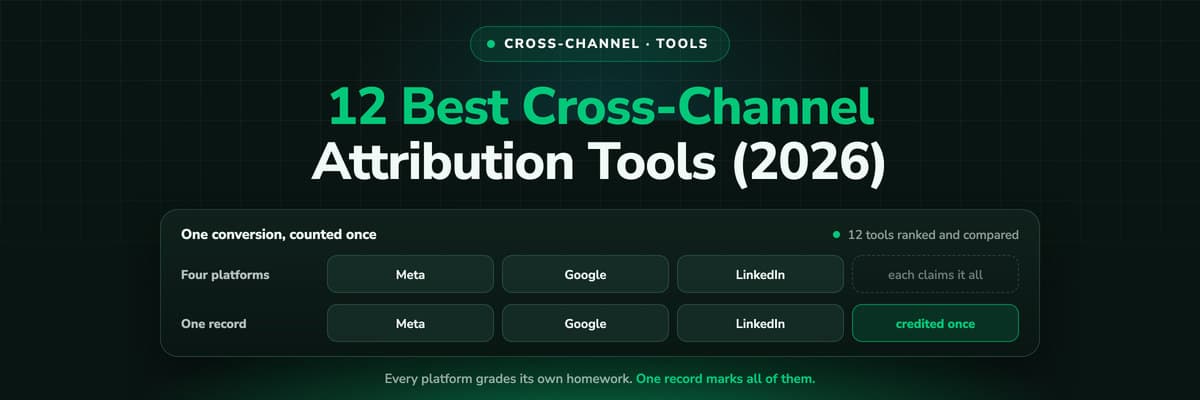
Meta says 71, Google 58, LinkedIn 19, Microsoft 7. The CRM has 122 leads. Twelve cross-channel attribution tools compared on how they close that gap, record, model or move, with pricing, pros, cons and a verdict on who each one is built for.Read the article24 min read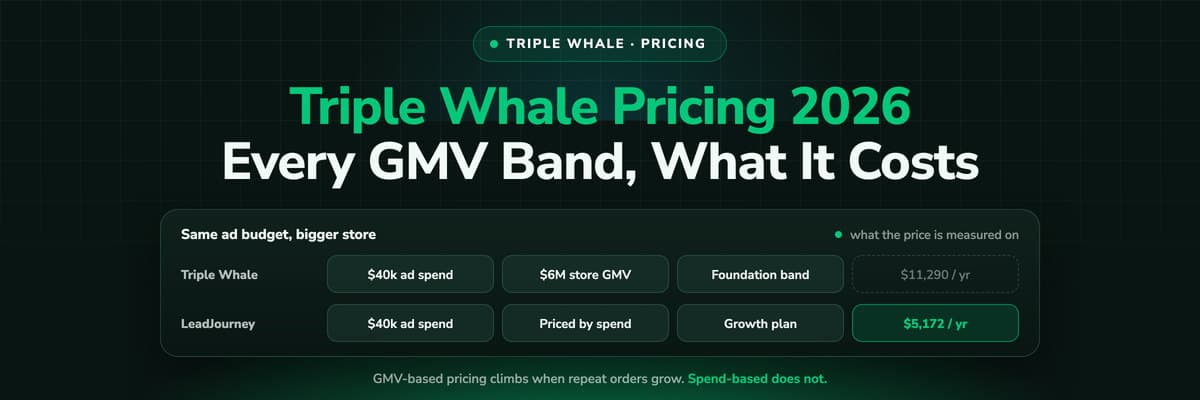 Tool Comparisons
Triple Whale Pricing 2026: Plans, GMV Bands and Real Costs
Triple Whale prices Foundation, Automate and Enterprise by your store's annual GMV, and its pricing page no longer prints a number. Every band it last published, what billing and Moby add, what changed since 2025, and what the model costs as the store grows.Read the article11 min read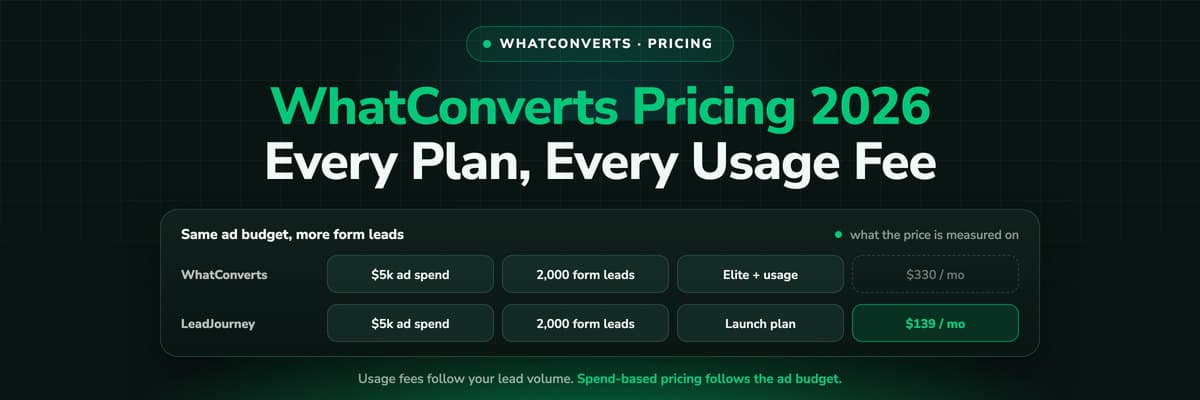 Tool Comparisons
WhatConverts Pricing 2026: Plans, Usage Fees and Real Costs
WhatConverts publishes every price: $30 to $160 a month for one account, $500 to $1,250 for agencies, each with a usage credit. What the credit covers, every rate past it, what the calculator adds at volume, and how the price changed since 2021.Read the article11 min read
Cometly pricing
Pay for your ad budget, not for your pageviews
LeadJourney attributes every lead from first click to closed deal, priced by ad spend from $139 a month, whatever your site's traffic. Start a 14-day free trial with no credit card, or book a demo on your own data.