













BlogAlternatives
7 Best AppsFlyer Alternatives in 2026
AppsFlyer is the biggest mobile measurement partner on the market, built around the app install. Seven alternatives, ranked: one for businesses whose conversions are forms, calls, deals and shop orders on the web, and six for the app itself, compared on tracking, pricing and who each is built for.

Contents
Summarise this article with AI
Opens the page with a ready prompt in:


Nothing is sent until you pick a service.
AppsFlyer is the mobile measurement partner (MMP) more apps use than any other: an SDK inside the app attributes installs, re-engagements and in-app events to the ad network that drove them, models SKAdNetwork on iOS, handles deep links with OneLink and fights install fraud with Protect360. For an app publisher buying installs across dozens of networks, that is the job, and AppsFlyer does it at a scale nobody else matches.
The search for an alternative usually starts in one of two places. Either you have an app and the per-conversion pricing, the add-ons or the sales-led Enterprise plan no longer fit, in which case you need another MMP. Or you were pointed at AppsFlyer, perhaps through its newer Web Attribution product, and your conversions are not installs at all: they are form fills, booked calls, deals in a CRM and orders in a Shopify store. For that business the install model has nothing to hold on to, and the right tool is a web and CRM attribution platform. This list covers both.
Quick Summary: Best AppsFlyer Alternatives in 2026
In short
LeadJourney is the best AppsFlyer alternative for businesses whose conversions happen on a website and in a CRM: lead generation, B2B and B2C, agencies and Shopify stores. It tracks server-side on your own domain at 95%+ accuracy, follows every form fill, call and order through the CRM stages to the closed deal, and sends that revenue back to Meta, Google, LinkedIn and Microsoft. Public pricing by spend from €129 a month, Frankfurt hosting, live in 21 minutes without an SDK release. If you need to attribute app installs, LeadJourney is not the tool: Adjust, Singular, Kochava, Branch and Airbridge are the MMPs on this list.
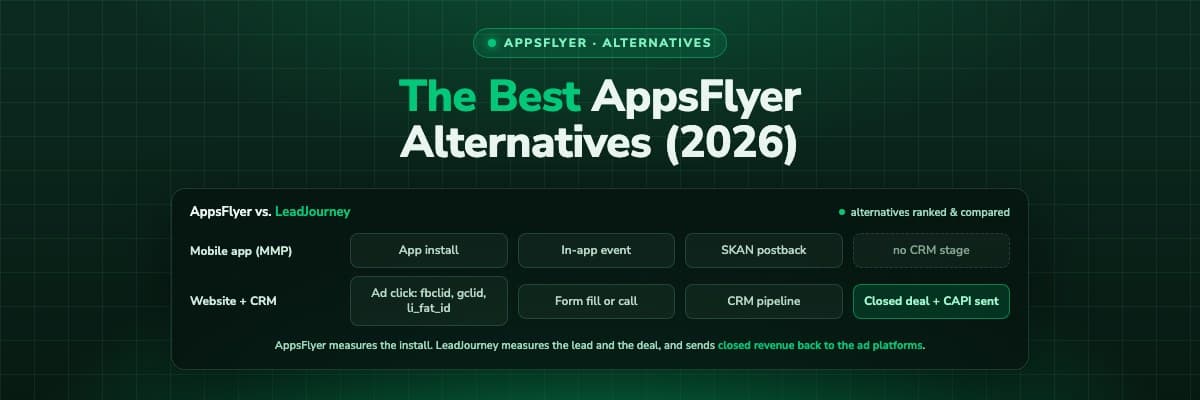
One rule before the ranking. An MMP measures the install and what happens inside the app; it needs an SDK in your app release and it counts conversions per install. A web attribution platform measures the website and the pipeline; it needs a script on your domain and a connection to your CRM or shop. No tool on this list does both well, and the honest shortlist starts with knowing which one you need.
The 7 best AppsFlyer alternatives at a glance
| Tool | Key features | Best for | Pricing |
|---|---|---|---|
| Rank 1LeadJourney | Server-side 95%+; CRM pipeline attribution; 4-platform CAPI; AI search tracking; Shopify orders; Frankfurt hosting | Websites, lead generation, agencies and Shopify stores; no app SDK | From €129/mo, 14-day free trial |
| Rank 2Adjust | Mobile attribution, SKAN, fraud prevention, CTV and PC measurement | App publishers wanting the most direct AppsFlyer replacement | Free Base plan, custom above |
| Rank 3Singular | Attribution plus cost aggregation, ROI analytics, fraud on every plan | Growth teams that want cost and attribution in one place | Free to 15K conversions, then $0.05 each |
| Rank 4Kochava | Mobile, CTV and web measurement, IdentityLink, free app analytics | Apps starting without budget, CTV advertisers | Free to 10K/mo, Foundation from $500/mo |
| Rank 5Branch | Deep linking first, attribution, SKAN, fraud detection | App growth that runs through links: web-to-app, email, QR | Free trial on Basics, quoted above |
| Rank 6Airbridge | Self-serve MMP by data points, AI agent with MCP, web-to-app | Startups on Meta, Google, Apple Ads and TikTok without a sales call | From $40/mo, 30-day trial |
| Rank 7Triple Whalevs LeadJourney | Triple Pixel, blended ROAS, MMM, Moby AI | Shopify brands without an app | Free plan, paid tiers by GMV |


1. LeadJourney: Best AppsFlyer Alternative for Websites, Lead Generation and Shopify Stores
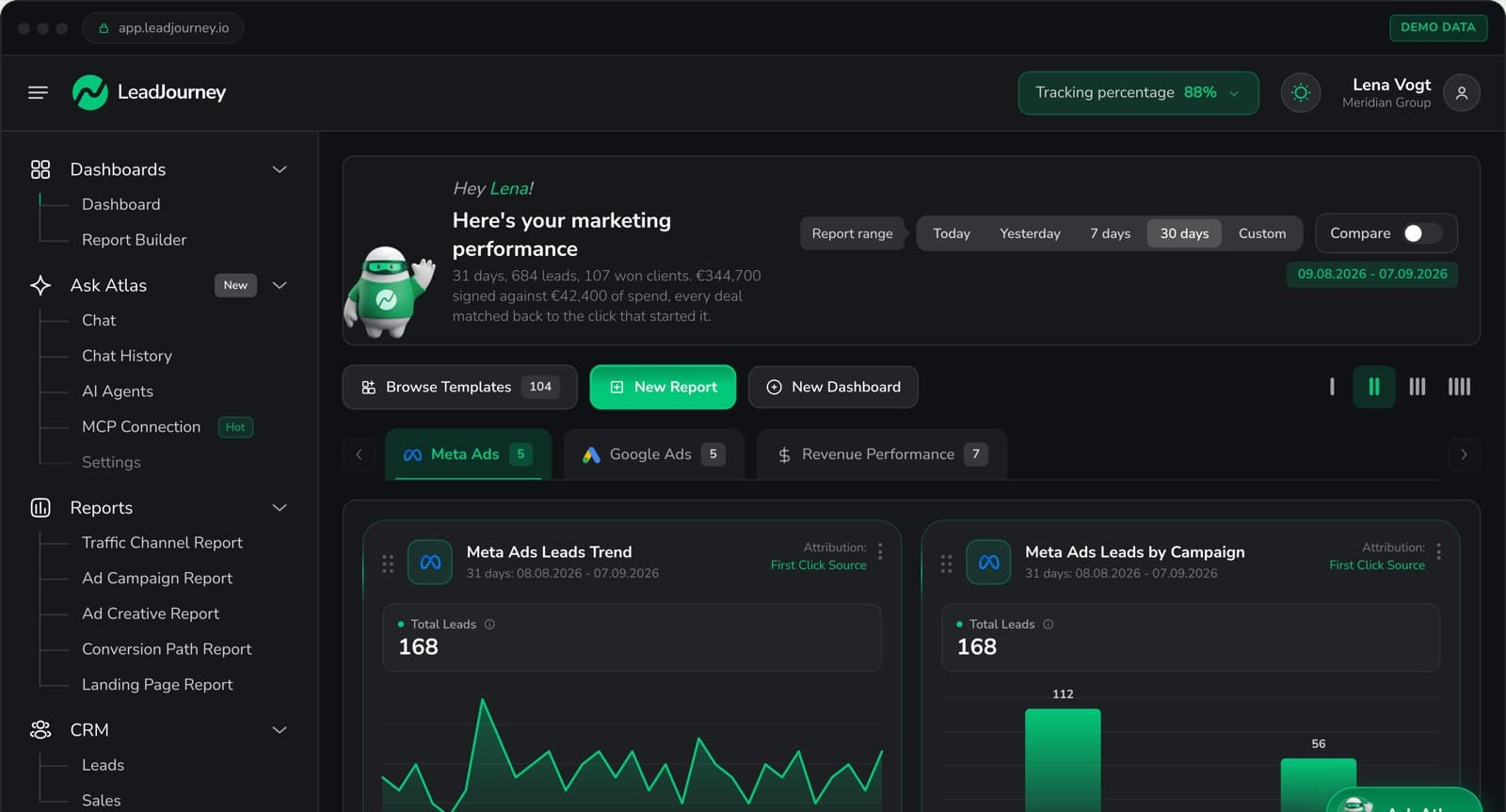
AppsFlyer answers the question an app publisher asks: which network drove this install, and what did the user do in the app afterwards? LeadJourney answers the question a lead generation business, an agency or a store asks: which click became a lead, which lead became a deal, and what did each campaign earn? It tracks on your own domain, server-side, so Safari, iOS and ad blockers do not thin the data, keeps the click IDs from Meta, Google, LinkedIn and Microsoft, and joins every form fill, call and order to the CRM record it created.
From there the pipeline is the report. Cost per qualified lead, cost per closed deal and revenue per campaign are standard views, every attribution model is switchable without re-tracking, and every stage change goes back to the ad platforms over their Conversions APIs, so the algorithms optimise on deals instead of form fills. Shopify and Stripe connect as revenue sources for the e-commerce side, organic and AI search (ChatGPT, Gemini, Claude, Perplexity and the rest) show up as sources of their own, and Atlas, the AI analyst, answers questions in plain language.
LeadJourney vs AppsFlyer: key differences
- Unit of measurement: AppsFlyer counts the install and the in-app event; LeadJourney counts the lead, the CRM stage, the closed deal and the shop order.
- Where the tracking lives: AppsFlyer needs an SDK in your app release, plus a web SDK for sites; LeadJourney is one script on your domain, live in 21 minutes.
- CRM: LeadJourney reads HubSpot, Salesforce, Pipedrive and the other native CRMs and writes attribution back; in AppsFlyer a lead is a web event and the pipeline stays in your warehouse.
- Sources: AppsFlyer integrates thousands of app media partners; LeadJourney covers Meta, Google, LinkedIn, Microsoft, the organic and AI search engines, and custom channels by webhook.
- Pricing: AppsFlyer charges $0.07 per attributed conversion on Growth and quotes Enterprise; LeadJourney publishes tiers by marketing spend from €129 a month, attribution included.
- Hosting: AppsFlyer offers an EU region next to the US; LeadJourney hosts every account in Frankfurt with a GDPR DPA on request.
- Mobile apps: AppsFlyer attributes installs, SKAN, deep links and fraud; LeadJourney does none of that and says so.
Pros
- Built for the conversions the install model ignores: forms, calls, CRM stages, closed deals and Shopify orders
- Server-side tracking on your own domain at 95%+ accuracy, no SDK release and no app store review
- Closed deals sent back to Meta, Google, LinkedIn and Microsoft as offline conversions, on every plan
- Public pricing by spend from €129 a month, monthly or yearly, 14-day trial without a card
- Frankfurt hosting and a GDPR-native setup for European teams
Cons
- No iOS or Android SDK: installs, SKAdNetwork, deep links and in-app events are out of scope
- E-commerce through the Shopify integration or a manually connected shop, without product-level catalogue analytics
- Fewer ad platform integrations than an MMP's thousands of media partners: the four big platforms plus custom channels
Verdict
LeadJourney is the best AppsFlyer alternative when your conversions are on the website and in the CRM: lead generation, B2B and B2C, agencies with client workspaces, and Shopify stores. If your paid media buys app installs, keep an MMP for the app and use LeadJourney for the website and the pipeline; the two run side by side.
The ability to track both online and offline conversions in one unified dashboard has given us insights we never had before. Our ROI has improved dramatically since we started integrating LeadJourney with our CRM. We're finally able to see the full customer journey, and it's been a game changer for our strategy.
 Andre WitzelFounder, Trading.de
Read verified reviews on Trustpilot, G2, Capterra and leadjourney.io/testimonials, or read the full LeadJourney vs AppsFlyer comparison.
2. Adjust: Best Direct AppsFlyer Alternative for Mobile Apps
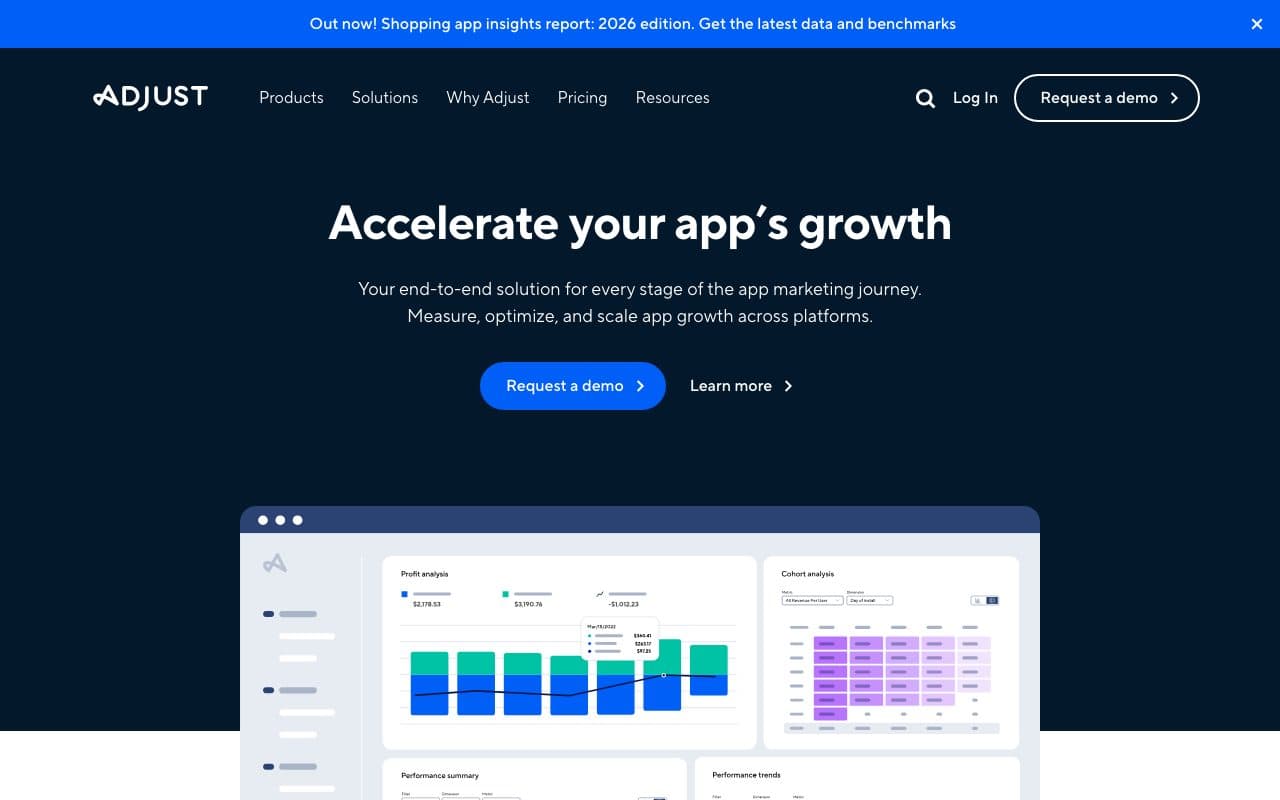
Adjust is the MMP most app teams shortlist against AppsFlyer, and since 2021 it has been part of AppLovin. The feature set mirrors the category: install and event attribution across the ad networks, SKAdNetwork conversion value tooling for iOS, a fraud prevention suite, cohort and retention analytics in Datascape, and measurement for CTV and PC or console titles. Adjust also documents data residency setup, which matters to regulated apps in Europe.
The difference to AppsFlyer is less about features and more about the commercial shape. Adjust's Base plan is free for up to twelve months with 1,500 attributions a month, enough for an indie developer to launch; above that every tier is custom priced through sales, so there is no public per-conversion rate to compare against AppsFlyer's $0.07.
Pros
- Full MMP feature set: attribution, SKAN, fraud prevention, CTV and PC
- Free Base plan for a year, up to 1,500 attributions a month
- Data residency setup documented for regulated apps
- AppLovin ownership brings scale and a large partner network
Cons
- Paid pricing is not published; every tier above Base is a sales conversation
- Owned by AppLovin, which also sells media; ask about measurement independence on the call
- No CRM or web pipeline attribution: a lead is an event, not a deal
Verdict
The most direct AppsFlyer replacement for an app publisher: same category, same job, a free year to start and a quote after that. Not a tool for websites, forms or CRM deals.
3. Singular: Best for Cost Aggregation and Transparent Per-Conversion Pricing

Singular started as a marketing analytics layer that pulled cost from every ad network into one place, then added attribution and became a full MMP. That history still shows: cost aggregation, ROI analytics and creative reporting sit next to install attribution, SKAdNetwork cohort prediction and fraud prevention, and every plan includes them rather than selling them as add-ons.
Pricing is the clearest in the category. The Free plan covers the first 15,000 paid conversions with no card, Growth is $0.05 per conversion, and Enterprise is quoted for cross-device attribution, 365-day cohorts, SSO and a dedicated success manager. Singular also lets larger accounts pay by ad spend instead of conversions, which is closer to how LeadJourney prices the web side.
Pros
- Cost aggregation and ROI analytics included, not an add-on
- Free to 15,000 paid conversions, then a published $0.05 per conversion
- Fraud prevention on every plan
- Pay by ad spend or by conversions on larger accounts
Cons
- Cross-device attribution only on Enterprise
- ETL exports to your warehouse are a paid add-on
- Mobile first: the web is a channel into the app, not a pipeline of its own
Verdict
The AppsFlyer alternative for a growth team that wants cost and attribution in one product and a price it can read before the call. Two cents cheaper per conversion than AppsFlyer's Growth plan.
4. Kochava: Best Free Tier for App and CTV Measurement
Kochava has been in the MMP category as long as AppsFlyer and covers more screens than most: mobile, CTV and, from the Foundation plan up, the web. Its Free App Analytics tier is unusually generous, with 10,000 attributed conversions a month, install and standard event tracking, attribution for the self-attributing networks, SKAN and Android Privacy Sandbox support, SmartLinks deep linking and AI-powered fraud prevention, all at no cost.
Above that, Foundation starts at $500 a month with 33,000 conversions and adds attribution for every integrated partner, cost aggregation, IdentityLink cross-device identity resolution and row-level reporting; Enterprise starts at $2,000 a month with 200,000 monthly active users, unlimited raw data queries, custom ETL and postbacks, and a fraud console.
Pros
- Free tier with 10,000 attributed conversions a month and fraud prevention included
- Mobile, CTV and web measurement in one account
- Published prices for Foundation and Enterprise
- IdentityLink cross-device identity on the paid plans
Cons
- Web measurement and partner-wide attribution only from Foundation at $500 a month
- A smaller review base than AppsFlyer or Adjust on G2
- Like every MMP, no CRM stage or deal-level attribution
Verdict
The AppsFlyer alternative for an app that wants to start measuring without budget, and for CTV advertisers. Published prices are a plus; the web tier is priced for apps that also sell on the web, not for lead generation.
5. Branch: Best for Deep Linking and Web-to-App Journeys
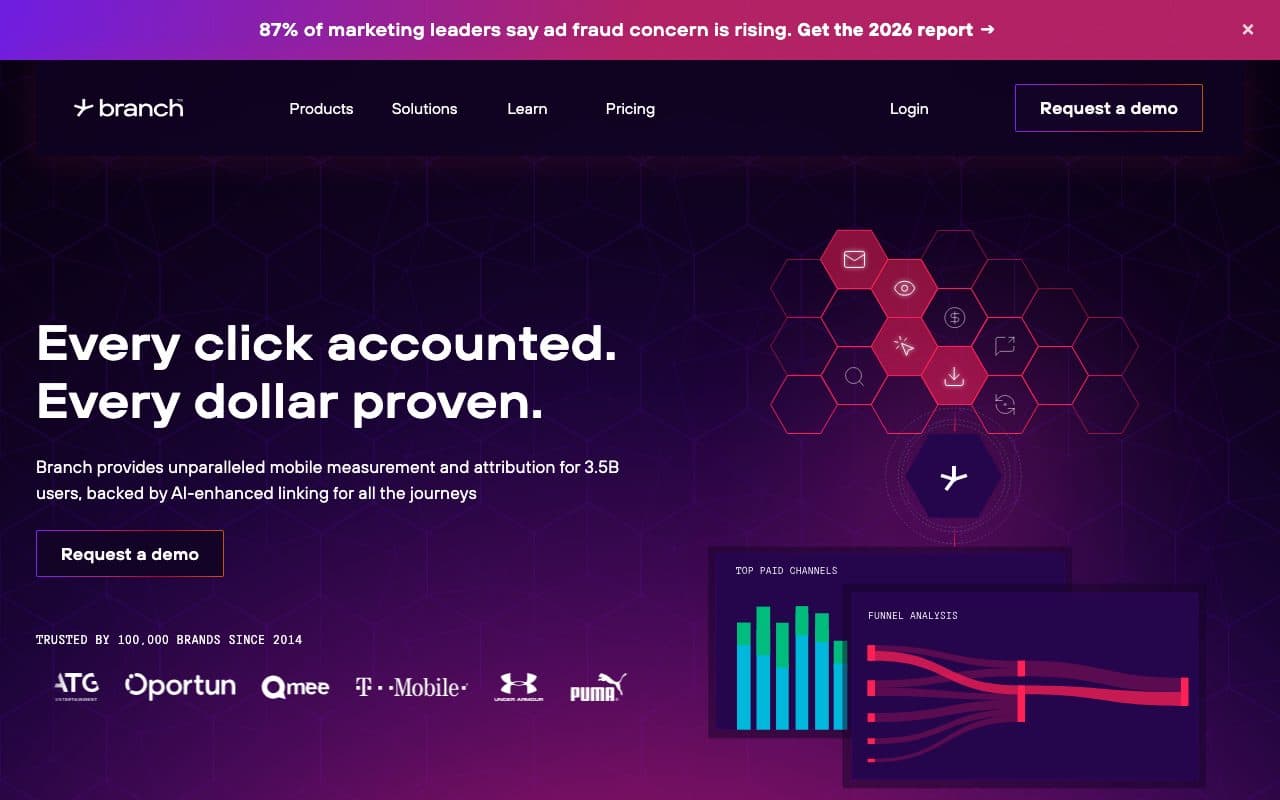
Branch built the deep linking layer many apps run on and grew it into an MMP: attribution, SKAdNetwork tooling, fraud detection and CTV measurement on the Enterprise tier. Where AppsFlyer treats OneLink as one product among many, links are Branch's centre of gravity, so journeys that start in an email, on a QR code, in a referral or on a web page and end in the app are its strongest case.
Pricing is the least transparent on this list. Basics opens with a free trial, Essentials adds unlimited partners, SKAN and fraud tools on a demo, and Enterprise adds predictive LTV and CTV attribution, also on a demo; no allowance or rate is published, so budgeting means a call.
Pros
- The strongest deep linking and web-to-app product in the category
- Attribution, SKAN and fraud detection on the paid tiers
- Journeys from email, QR, referrals and the web stitched into the app
Cons
- No published prices above the Basics trial
- Measurement is the newer half of the product; the MMPs above it started there
- No CRM or pipeline attribution for the web side
Verdict
The AppsFlyer alternative when your growth runs through links. For install attribution alone, Adjust and Singular publish more and cost less to evaluate.
6. Airbridge: Best Self-Serve MMP for Startups
Airbridge is the MMP that sells the way LeadJourney does: a public price, a trial and no sales call. The Core plan is $40 a month after a 30-day trial, with 500,000 data points included and $0.0001 per data point above that, no annual contract, and it covers attribution for Meta, Google, Apple Ads and TikTok, deep links and web-to-app banners, web-to-app attribution, and an AI agent called AI Pilot with an MCP server for Cursor and Claude Code.
Growth is custom priced by monthly active users or installs and adds the 330+ ad networks, custom events, multi-touch reports, raw data export to S3, BigQuery and Snowflake, and fraud detection. For a startup on the four big platforms, Core is the cheapest working MMP on this list by a wide margin.
Pros
- Public pricing from $40 a month, 30-day trial, no annual contract
- Attribution for Meta, Google, Apple Ads and TikTok on the entry plan
- AI agent with an MCP server, unusual at this price
- Web-to-app attribution and deep links included
Cons
- Only four networks on Core; the long tail needs the custom-priced Growth plan
- A smaller partner ecosystem than AppsFlyer or Adjust
- An MMP all the same: installs and app events, not leads and deals
Verdict
The AppsFlyer alternative for a startup that wants to measure app installs on the big four platforms without a procurement cycle. Public pricing and an MCP server put it closer to LeadJourney's way of selling than any other MMP here.
7. Triple Whale: Best for Shopify Brands Without an App

Triple Whale belongs on an AppsFlyer alternatives list for one reader: the Shopify brand that was shown AppsFlyer's Web Attribution and has no app. Its Triple Pixel is first-party tracking with an identity graph, the reports are blended ROAS, multi-touch attribution and product-level analytics, Compass adds media mix modelling and incrementality testing, and Moby is the AI analyst and operator. There is a free plan, and the paid tiers are priced by annual store GMV through a demo.
Against LeadJourney the split is the conversion again: Triple Whale is built around the order and the catalogue, LeadJourney around the lead and the CRM with Shopify orders as one revenue source. A pure DTC store with no sales team is Triple Whale territory; a store that also runs lead generation, or an agency with both kinds of client, is LeadJourney's.
Pros
- First-party Triple Pixel tracking with an identity graph
- Blended ROAS, MMM and incrementality built for e-commerce
- Moby AI analyst and automations
- A free plan to start
Cons
- Shopify first; a lead generation funnel has no place in the model
- Paid pricing by GMV is quoted through a demo, not published
- No CRM stage attribution: the pipeline of a lead gen business is outside the model
Verdict
The AppsFlyer alternative for a Shopify brand without an app. For a store that also generates leads, or an agency serving both, LeadJourney covers both conversions in one account.
How to Choose: MMP or Web and CRM Attribution?
The shortlist writes itself once you know where the conversion happens. Three cases cover almost every reader of this page.
Your paid media buys installs
You need an MMP, full stop. Adjust and Singular are the closest AppsFlyer replacements, Kochava and Airbridge the cheapest to start on, Branch the pick when links drive the growth.
Your conversions are on a website
Forms, calls, demos, deals in a CRM, orders in a shop: the install model has nothing to measure. LeadJourney tracks the site on your domain, reads the CRM and sends closed revenue back to the ad platforms.
You have both
Keep the MMP for the app and run LeadJourney for the website and the pipeline. The two do not overlap, and the ad platforms receive app events from one and CRM conversions from the other.
Whichever side you land on, ask the same three questions on the call: what is the unit the tool counts, where does the data live, and what does the price do when volume doubles. AppsFlyer's answers are the install, an EU or US region, and seven cents per additional conversion. LeadJourney's are the lead and the deal, Frankfurt, and the next spend tier. Explore the LeadJourney marketing attribution platform or compare the best lead attribution tools and the best offline conversion tracking software.
FAQ
Frequently Asked Questions
The questions teams comparing AppsFlyer alternatives ask most.
What is the best AppsFlyer alternative?
It depends on what you attribute. For app installs, Adjust and Singular are the most direct AppsFlyer alternatives, Kochava and Airbridge the cheapest to start on and Branch the pick for link-driven growth. For a business whose conversions happen on a website and in a CRM, lead generation, agencies and Shopify stores, LeadJourney is the best alternative: server-side tracking on your own domain, CRM revenue attribution and closed deals sent back to the ad platforms, none of which an MMP does.
What does AppsFlyer do?
AppsFlyer is a mobile measurement partner. An SDK inside your app attributes installs, re-engagements and in-app events to the media source that drove them, models SKAdNetwork conversions on iOS, provides deep linking through OneLink, fraud protection through Protect360, audience segmentation and raw data exports, and its Web Attribution product extends the model to websites with postbacks to Google, Meta, TikTok, Snap and X. It does not read a CRM pipeline or attribute deal stages.
How much does AppsFlyer cost?
AppsFlyer publishes three plans. Zero is free but meant for owned media only, Growth is pay as you go at $0.07 per attributed conversion after a welcome package of 12,000 free conversions in the first year, and Enterprise, where cross-channel attribution, advanced fraud protection and the AI features live, is custom priced. Raw data access, Protect360, Audiences and Data Locker are premium add-ons.
Can I use AppsFlyer for a website without an app?
Technically yes, through AppsFlyer Web Attribution, which covers paid, organic search and direct traffic, unifies cost and revenue and sends web events to the ad networks. The model is still the install's: a lead is a web event, there is no CRM stage, no deal value and no lead-level journey into the pipeline, and the product is sold and onboarded through sales. A lead generation business or a Shopify store is better served by a platform built for that conversion.
Does LeadJourney track mobile app installs?
No. LeadJourney has no iOS or Android SDK and does not attribute installs, SKAdNetwork conversions, deep links or in-app events. It tracks websites server-side on your own domain, reads the CRM and the shop, and sends conversions to Meta, Google, LinkedIn and Microsoft over their Conversions APIs. An app business keeps its MMP and uses LeadJourney for the website and the pipeline.
Can I run an MMP and LeadJourney together?
Yes, and many businesses with both an app and a website do. The MMP measures the app and sends install and in-app events to the ad networks; LeadJourney measures the site and the CRM and sends leads, qualified leads and closed deals as offline conversions. There is no overlap in what each one tracks, so the numbers do not compete.
Keep reading
More from the blog
 Alternatives
7 Best CallRail Alternatives in 2026
CallRail is the reference call tracker, and teams still leave it: the usage bill at pool scale, reporting that stops at the lead, and a second tool to reconcile with the ad platforms. Seven alternatives, with every published price read this month.Read the article11 min read Alternatives
7 Best Fibbler Alternatives in 2026
Fibbler tracks company-level LinkedIn engagement, and that is where it stops. These seven alternatives cover click-level revenue attribution across every channel.Read the article9 min read Alternatives
7 Best Ruler Analytics Alternatives in 2026
Ruler Analytics connects touchpoints to CRM revenue and is strong on phone calls, but its tracking is browser-side and its data stops at reporting. Seven alternatives that capture click IDs server-side and feed closed deals back to all four ad platforms.Read the article6 min read
Beyond the install
Ready to attribute the lead and the deal, not the install?
Server-side tracking on your domain, CRM revenue per campaign and closed deals sent back to every ad platform. Public pricing, Frankfurt hosting, 21-minute setup.