














BlogB2B Marketing Attribution
Meta Incremental Attribution: What It Counts for Lead Gen
Meta's incremental attribution model optimises and reports on the conversions its models predict an ad caused, not every conversion inside a window. This guide covers what Meta's own help pages say about it, how it differs from 7-day click 1-day view, why its numbers come out lower, what it cannot see in lead generation, and how to read it next to the deals in your CRM.

Contents
Summarise this article with AI
Opens the page with a ready prompt in:


Nothing is sent until you pick a service.
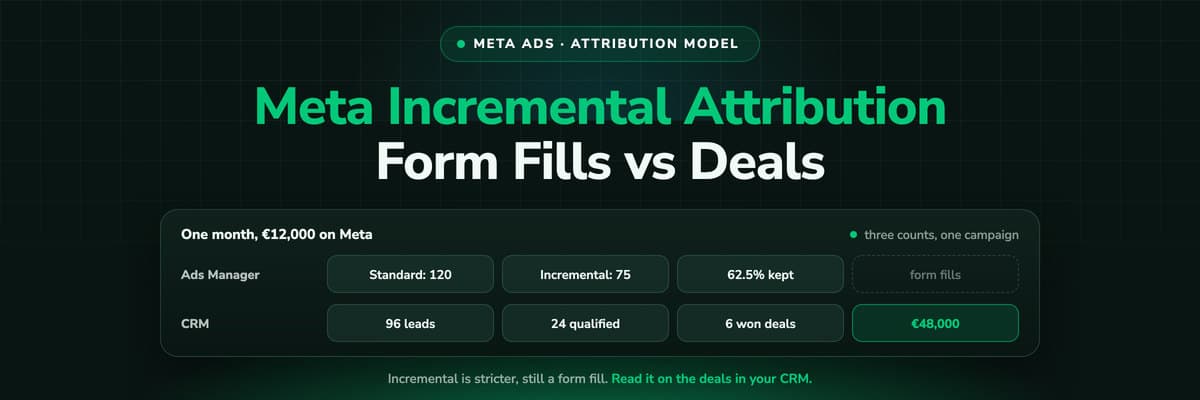
Open the Compare attribution models column on a Meta lead campaign and two numbers sit side by side. Under the standard setting the campaign shows 120 results for €12,000, €100 each. Under incremental attribution the same campaign shows 75, at €160 each. Nothing was switched off and nobody changed a pixel. The second number is Meta's estimate of how many of the 120 its ads actually caused.
That is a better question than the one a click window answers, and Meta deserves credit for putting it in Ads Manager for every advertiser. But in lead generation both numbers count the same thing: a form fill. The deal that pays for the campaign happens weeks later in the CRM, and neither column knows which of the 120 people became a customer.
This guide sticks to what Meta's own help pages and announcements say about the setting, and marks where they say nothing. It covers what incremental attribution is, when it arrived, how it differs from 7-day click and 1-day view, what it supports, why its numbers are lower, what it cannot see for lead gen, and how to read Ads Manager against the CRM afterwards. The general argument lives in incrementality vs attribution, the definitions in the glossary entry on incrementality.
Quick Summary: Meta Incremental Attribution in One Paragraph
In short
Incremental attribution is one of two attribution models Meta offers on an ad set, next to standard. Standard counts every conversion inside a window (7-day click, 1-day view and 1-day engagement by default); incremental counts only the conversions Meta's models predict the ad caused, and optimises delivery for those. Meta announced it in August 2024, its results column covers dates from 1 April 2025, and Meta said the global rollout was complete in June 2025. You pick it on a Sales, Leads or Engagement campaign with a Website or Website and app conversion location, without bid controls, and you cannot change it after publishing. Anyone can see the incremental numbers for an existing campaign through Compare attribution models. They come out lower because they leave out conversions Meta thinks would have happened anyway. For lead generation the limit is the outcome: Meta's help pages we read say nothing about instant forms or CRM events, so the setting judges form fills, not customers. Read it next to qualified leads and deals from the CRM, and test the big decisions with a lift study.
It is written for the people who run Meta for lead generation, in house or at an agency, and have to explain why Ads Manager, the CRM and now a second Ads Manager column all disagree. If you want the case for incrementality in general first, start with incrementality vs attribution.
What Meta's Incremental Attribution Setting Is
Meta calls it an attribution model, and the word matters. On the ad set you first choose a model, which decides how delivery is optimised and how conversions are credited, and only under the standard model do you then choose the windows. Meta's help centre lists the models like this.
Standard attribution
Optimises delivery for the time windows and behaviours you select, and credits every conversion inside them: link clicks within 1 or 7 days, views within 1 day, engagements within 1 day.
Incremental attribution
Optimises delivery for incremental conversions, using models that predict whether a conversion was caused by an ad, and reports only those. No windows to choose.
Custom attribution
Shares credit from your own analytics tool so delivery follows your attribution logic. Meta says it may not be available to you yet and suits sales campaigns optimising for purchases.
Meta describes the incremental model in one sentence: it "uses machine learning models that predict whether a conversion is caused by an ad". In its June 2025 announcement Meta added that an advertiser who has never run a Conversion Lift test can simply switch the setting on. How the model is trained beyond that sentence, the help pages we read do not say. What it gives you is a prediction of causation per conversion, not a measurement of it on your account; that is what a lift test is for, and why this post ends on one.
When Meta Launched Incremental Attribution
Several blogs date it to April 2025. Meta's own pages give four dates, and the safest reading is the one they support.
Incremental attribution in Meta's own announcements and help pages
| Date | What Meta said | Source |
|---|---|---|
| 14 August 2024 | Plans "a new opt-in attribution setting that optimizes for and reports on incremental conversions", later that half. In an experiment that year, advertisers saw "an average improvement of more than 20% in incremental conversions". | Meta for Business announcement |
| 1 April 2025 | The earliest date the incremental results column covers: "not available for date ranges before 1 April 2025". | Meta Business Help Centre |
| 4 June 2025 | "We recently completed the global rollout of Incremental Attribution". Testers saw "an average 46% increase in incremental conversions compared to their business-as-usual campaigns". | Meta for Business announcement |
| 3 March 2026 | Calls incrementality experiments such as Conversion Lift "the gold standard" and narrows standard click-through to link clicks for website and in-store conversions. | Meta for Business announcement |
The 20% and 46% are Meta's figures about Meta's own tests, measured on incremental conversions, and as reported by Meta. They say the setting finds more conversions of the kind it is built to find, which is a fair claim; they do not say anything about revenue in a CRM, and no third party has published the method behind them that we could find.
Standard vs Incremental Attribution on Meta Ads
The standard default is 7-day click, 1-day view and 1-day engagement. It is a rule: any conversion inside a window after an eligible interaction counts. Incremental attribution replaces the rule with a prediction.
Standard (7-day click, 1-day view) against incremental, as Meta's help pages describe them
| Standard attribution | Incremental attribution | |
|---|---|---|
| What counts | Every conversion inside the chosen windows | Only conversions Meta's models consider caused by the ad |
| Windows | Link click 1 or 7 days, view 1 day, engagement 1 day | None to choose |
| What delivery optimises for | Conversions inside the selected windows | Predicted incremental conversions |
| Bid controls | Available | "You cannot use bid controls" |
| Change after publishing | Settings can be compared in reporting | Model cannot be changed; make a new campaign |
| Reported results | All attributed conversions | A subset of them, so lower, with a higher cost per result |
The difference shows most where standard attribution is most generous. A 1-day view counts somebody who scrolled past the ad and filled in the form the next day after searching your name, and a retargeting ad set collects conversions from people who were already on their way back. Those are exactly the conversions an incrementality model should discount. The glossary entry on view-through conversion and the guide to click-through vs view-through conversions cover the windows themselves.
Measurement vs Optimisation: Two Different Switches
Most confusion about the setting comes from treating two separate things as one. Meta offers incremental numbers as a report on any campaign, and incremental attribution as a model that changes who sees the ads.
- As a report: Compare attribution modelsColumns, Compare attribution models, Incremental. It works on campaigns that run on standard attribution and changes nothing about delivery. Meta's note: dates from 1 April 2025 only.
- As a model: set on the ad setDelivery is optimised for conversions the model predicts it can cause, and the Results column reports those. Fixed at publishing, no bid controls.
So the cheap first step is the report. Add the column to the campaigns you already run and see how far the two counts sit apart per campaign. A prospecting campaign whose incremental count is close to its standard count is doing work the rule-based column already credits; a retargeting or brand campaign that falls by half is collecting credit for people who were coming anyway. Meta itself warns against comparing results across ad sets that use different models in the overview table, and recommends comparing within one setting.
How to Set Up Incremental Attribution in Ads Manager
The steps as Meta's help centre gives them on 7 October 2026. Meta is rolling out a new campaign setup, so the screens may differ slightly from the order below.
- In Ads Manager, click Create and choose Sales, Engagement or Leads as the objective.
- Choose the campaign setup and review the campaign settings.
- In the ad set, choose Website or Website and app as the conversion location.
- Under Conversion goals, choose Maximise number of conversions or Maximise value of conversions, then Show more options.
- Under Attribution model, open Options and select Incremental.
- Leave bid controls off: Meta says they cannot be used with incremental attribution.
- Create the ad and publish. The model is now fixed; to change it you build a new campaign.
Run it as a new campaign beside the old one
Because the model cannot be changed after publishing, the clean way to try it is a duplicate campaign on incremental attribution next to the standard one, with the same creative and audience, judged on the same CRM outcome rather than on either Results column.
Which Objectives, Conversion Locations and Events It Supports
This is where lead generation teams need precision, because a Leads objective is not the same as a lead form. The table separates what Meta's help pages state from what they leave open.
Incremental attribution support, as read on Meta's help pages on 7 October 2026
| Option | Supported? | What Meta's pages say |
|---|---|---|
| Sales objective | Yes | Listed in the setup steps |
| Leads objective | Yes, with a website location | Listed in the setup steps |
| Engagement objective | Yes | Listed in the setup steps |
| Website, or Website and app | Yes | The two conversion locations the steps name |
| Instant forms (lead ads) | Not documented | The help pages we read do not list instant forms as a location for this model |
| Conversion Leads performance goal | Not documented | The steps name only Maximise number or value of conversions |
| Offline or CRM events via the Conversions API | Not documented | The help pages we read do not say whether these can be the optimised event |
| Bid controls | No | "You cannot use bid controls" |
In practice that means the setting fits a lead campaign whose conversion is a form on your own website, tracked by the pixel and the Conversions API. A lead ad campaign with an instant form, and the Conversion Leads goal that optimises on CRM stages for instant form leads, are not mentioned on the pages we read. If you need either, check in your own Ads Manager whether the Incremental option is offered for that combination before you plan around it.
Why Incremental Attribution Numbers Come Out Lower
They are lower by design. Meta's own example: a campaign with 100 total conversions, 70 of which Meta considers incremental, shows 70 under incremental attribution and 100 under standard, and every derived metric such as cost per result is calculated on the smaller number.
75 ÷ 120 = 62.5%: the month from the introduction, where €12,000 bought 120 results at €100 or 75 at €160.
Three kinds of conversion fall out between the two columns. People who would have filled in the form anyway and happened to see an ad first, which is common on retargeting and on anyone already in a sales conversation. View-throughs and engage-throughs that the 1-day windows credit without any causal link. And conversions from people who were reached by several channels, where Meta's ad was not the one that moved them. A lower count is not a worse campaign; it is a stricter count of the same campaign.
The share is also the number to watch per campaign. If prospecting keeps 80% of its results and retargeting keeps 30%, the retargeting cost per result is the one most inflated by the standard column. That is a hypothesis worth testing, not yet a budget decision.
What It Cannot See in Lead Generation
A form fill is not a customer. Incremental attribution answers whether the ad caused the form fill, which is progress, but in lead generation the expensive mistakes happen after the form.
- Lead qualityAn incremental lead can be a student, a competitor or a company too small to buy. The model predicts causation, not fit, and it has no field for a sales rep's verdict.
- The sales cycleA B2B deal often closes weeks or months after the form. Meta's standard windows end after 7 days, and the help pages we read do not describe any window for the incremental model reaching a deal.
- The CRM outcomeQualified, opportunity and won live in the CRM. Unless they are sent back, Meta never sees them, and the pages we read do not say incremental attribution can optimise on them.
- Revenue per leadMaximise value of conversions needs a value per conversion. For a form fill that is a guess you type in; the deal value only exists in the CRM.
So an incremental lead campaign can get better at producing form fills that would not have happened otherwise, and still fill the pipeline with the wrong people. The guide to fixing Meta lead quality covers that problem on its own; the point here is that no attribution model on the form event can solve it.
How to Use It with CRM Events Sent Back Through the Conversions API
The fix for lead quality on Meta is to give the algorithm the outcome rather than the form. There are two documented routes, and neither is described as working with incremental attribution on the pages we read.
- Website leads: CRM stages as Conversions API eventsWhen a lead qualifies or a deal closes, send that stage to Meta as a server event with the match keys and the fbclid captured at the click, and the deal value. It becomes an event you can report on and, once volume allows, optimise for.
- Instant form leads: the Conversion Leads integrationMeta's Conversions API for CRM uploads CRM stages for lead ads only, keyed on the Meta Lead ID, at least daily, for a stage reached within 28 days, on 200 leads a month and a 1% to 40% conversion rate.
Whether a qualified lead or won deal event sent this way can be chosen as the optimisation event of an incremental attribution ad set, Meta's help pages we read do not say. Check whether your event is offered under the website location with the Incremental option still available; if it is not, run the CRM-optimised campaign on standard attribution and use the incremental column as a report. The guides to the Meta Conversions API for lead generation and to sending CRM data back to Meta and Google cover the plumbing.
What about custom attribution?
Meta's third model takes credit from an outside tool, but Meta says it may not be available yet and suits sales campaigns optimising for purchases with order-level credit, through the Conversions API or Adobe, Northbeam, Rockerbox or Triple Whale. A lead gen account is not who Meta describes it for.
How to Read Ads Manager Against the CRM Afterwards
Put the three counts in one table for the same month and the same spend. They answer three different questions, and none of them replaces the others.
Illustrative: one month, €12,000 on one Meta lead campaign
| Where | Count | Cost each | The question it answers |
|---|---|---|---|
| Ads Manager, standard (7-day click, 1-day view) | 120 results | €100 | How many form fills Meta can connect to an ad |
| Ads Manager, incremental | 75 results | €160 | How many of those Meta thinks the ads caused |
| CRM, leads with a Meta first click | 96 leads | €125 | How many people a Meta click actually brought |
| CRM, qualified | 24 leads | €500 | How many were worth a sales call |
| CRM, won deals (€48,000) | 6 deals | €2,000 | What the spend bought: revenue 4.0 times spend |
Read down the table, not across it. The 120 includes view-throughs and engage-throughs the CRM cannot see, because no visit came from them. The 96 is a click-based count, one lead one credit. The 6 deals are the only row finance will reconcile to. The tempting move is to multiply the deals by Meta's 62.5% and call 3.75 deals incremental, and it is not supported by anything: the model predicted causation on form fills, and people who would have converted anyway may be more or less likely to buy than the rest.
What the comparison is good for is ranking. Run the same table per campaign. A campaign that is cheap in Ads Manager, keeps little of its result under incremental attribution and closes few deals in the CRM is the first candidate to cut or to test. A campaign that looks expensive per form fill but keeps its incremental share and closes deals is the one the standard column undersells. Pixel and CRM mismatch shows how to set up the CRM side.
Meta Incrementality Testing: Conversion Lift and GeoLift
Incremental attribution is a model's estimate. When a decision is big, such as doubling a budget or cutting retargeting, measure it instead. Meta itself calls incrementality experiments like Conversion Lift the gold standard.
- Conversion LiftA randomised holdout: a percentage of accounts in the audience does not see the ads, and conversions are compared. Meta's API docs say access is currently limited and to ask your Meta representative; Ads Manager shows what your account can run.
- Lift on offline eventsMeta's lift study documentation lists pixel events including leads, app events, custom conversions and offline event sets as sources. Check whether your study type accepts the offline events your CRM sends before planning on deals.
- GeoLiftMeta's open source R package for geo experiments, built on synthetic control, with power calculations and market selection. MIT licensed, and it runs on the regional time series you give it.
For lead generation the outcome is the whole game. A lift test on form fills repeats the limit of the incremental column; a lift test read on qualified leads or deals answers the question the business asks. For a geo test that means exporting deals from the CRM with their source and the customer's region, per week, and feeding that series to the analysis. Incrementality testing for lead gen walks through the methods and a DIY geo holdout, and the incrementality calculator does the lift and significance arithmetic.
How LeadJourney Fits Next to Meta's Incremental Attribution
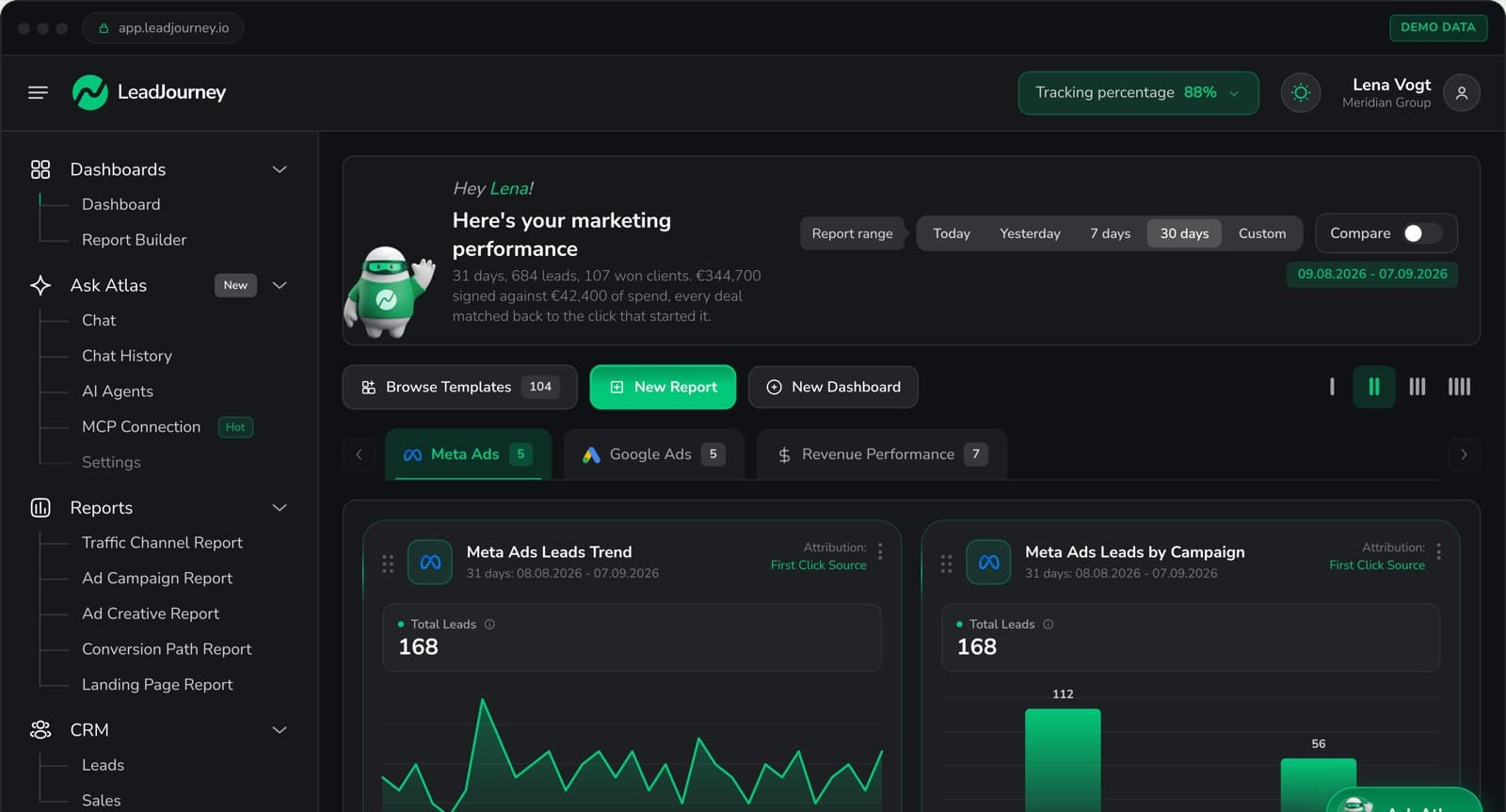
Plainly first: LeadJourney does not run incrementality tests, lift studies, holdouts, geo experiments or MMM, and it counts no view-through conversions. It answers the attribution question, which touchpoints led to this lead and this deal, and leaves the causal question to Meta's model and to tests. You need both, and both are only as good as the outcome they are read on.
That outcome is what LeadJourney supplies. One script on the site or in GTM records every visit server-side on your own domain, first-party, at 95%+ tracking accuracy, and captures the fbclid and the other click ids (gclid, gbraid, wbraid, li_fat_id, msclkid) at the click. The anonymous history is joined to the person at the form, the call or the booking, and the native CRM integrations (HubSpot, Salesforce, Pipedrive, Zoho and more) write the source, campaign and journey onto the record and read stage changes and won deals back. Meta spend is pulled in and joined to leads, deals and revenue per campaign and ad, under five switchable models.
And the loop runs back: won deals go to Meta through the Conversions API with the deal value, and to Google Ads, LinkedIn and Microsoft Ads the same way. That is what lets the bottom three rows of the table above exist per campaign, and what gives a lift study or Meta's own optimisation an outcome worth reading. Consent is respected, so a visitor who declines is not measured. It is live in about 21 minutes, and the reports can be clicked through in the live demo.
A Checklist for Meta Incremental Attribution in Lead Gen
- Add the incremental column first. Compare attribution models, Incremental, on the campaigns you already run, from 1 April 2025 onwards.
- Compute the incremental share per campaign and rank them; retargeting and brand usually fall furthest.
- Check your setup qualifies: Sales, Leads or Engagement, a Website or Website and app location, no bid controls.
- Test it as a new campaign, because the model cannot be changed after publishing.
- Do not assume instant forms or CRM events are supported. Check in your account; Meta's pages we read do not say.
- Send qualified leads and won deals back through the Conversions API, with the deal value.
- Judge every variant on CRM outcomes: qualified leads first, deals and revenue as they close.
- Never multiply deals by Meta's incremental share. Test the big decisions with Conversion Lift or a geo test read on the CRM.
Further Reading
The incrementality cluster: incrementality in the glossary, incrementality vs attribution, incrementality testing for lead gen, MMM vs MTA and the incrementality calculator. Meta's windows and data: click-through vs view-through conversions, view-through conversion, attribution window and why GA4, Meta and Google conversions don't match your CRM. Sending the outcome back: Meta Conversions API, Meta Conversions API for lead generation, offline conversion tracking and optimising on revenue.
FAQ
Frequently Asked Questions
What Meta advertisers ask about the incremental attribution setting.
What is incremental attribution on Meta?
Incremental attribution is one of Meta's attribution models for an ad set, next to standard. Instead of crediting every conversion inside a click, view or engagement window, it uses machine learning models that predict whether a conversion was caused by the ad, reports only those, and optimises delivery to drive more of them. Meta announced it in August 2024 and said the global rollout was complete in June 2025. You can also see incremental numbers for campaigns on standard attribution, through Compare attribution models in Ads Manager, for dates from 1 April 2025.
What is the difference between standard and incremental attribution on Meta Ads?
Standard attribution is a rule: it counts conversions inside the windows you choose, 7-day click, 1-day view and 1-day engagement by default, and optimises delivery for those windows. Incremental attribution is a prediction: it counts only the conversions Meta's models consider caused by the ad and optimises for those. Incremental has no windows to choose, cannot be used with bid controls, and cannot be changed after the campaign is published. Its result counts are lower and its cost per result higher, because it leaves out conversions Meta thinks would have happened anyway.
Does Meta incremental attribution work with lead ads and instant forms?
Meta's setup steps name Sales, Engagement and Leads as objectives, with Website or Website and app as the conversion location. The help pages we read on 7 October 2026 do not list instant forms as a location for incremental attribution, and do not mention the Conversion Leads performance goal. So a Leads campaign whose conversion is a form on your website is covered; a lead ad campaign with an instant form may not be. Check in your own Ads Manager whether the Incremental option is offered before planning around it.
Why are incremental attribution results lower than standard results?
Because they are a subset of them. Meta's own example: a campaign with 100 conversions, 70 of which Meta considers incremental, shows 70 under incremental attribution and 100 under standard, and cost per result is calculated on the 70. The difference is mostly conversions from people who would have converted anyway, view-throughs and engage-throughs credited by the 1-day windows, and people moved by another channel. A lower count is a stricter count of the same campaign, not a worse campaign, and the share kept per campaign is the useful number.
Can I use incremental attribution with CRM or offline conversions?
Meta's help pages we read do not say. You can send CRM stages such as a qualified lead or a won deal to Meta through the Conversions API, and for instant form leads Meta's Conversion Leads integration uploads CRM stages keyed on the Meta Lead ID. Whether such an event can be the optimised event of an incremental attribution ad set is not documented on the pages we read, so check it in your account. If it is not offered, optimise on the CRM event under standard attribution and use the incremental column as a report.
Is incremental attribution the same as a Meta Conversion Lift test?
No. Incremental attribution is a model's prediction, applied to every conversion, available to every advertiser as a setting or a column. A Conversion Lift test is an experiment: a random share of the audience is held out from the ads and conversions are compared between the groups, which measures causation on your account rather than predicting it. Meta calls lift experiments the gold standard and its API documentation says access is currently limited. For lead generation, read any lift test on qualified leads or deals from the CRM rather than on form fills.
Keep reading
More from the blog
 B2B Marketing Attribution
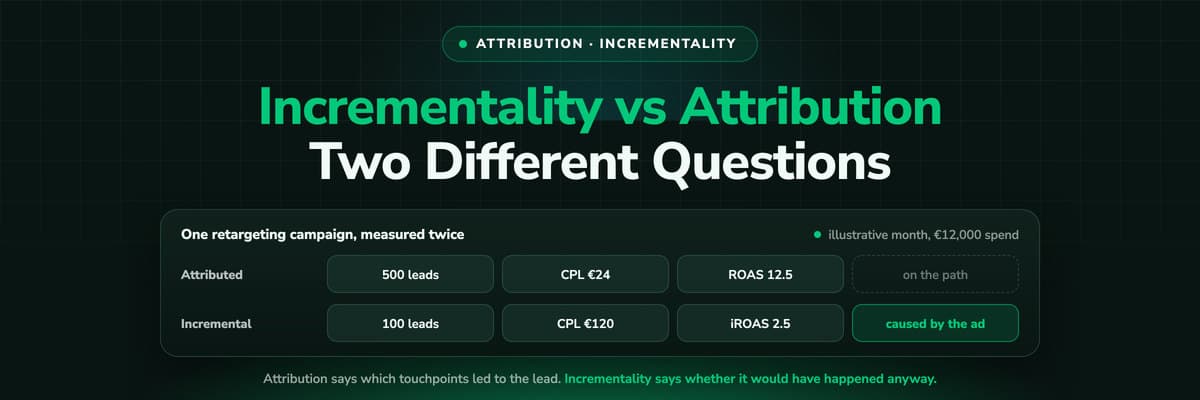
Incrementality vs Attribution: Which Question Each Answers
Attribution tells you which touchpoints led to a lead or a deal. Incrementality tells you whether it would have happened anyway. This guide works one retargeting campaign through both, shows where each belongs, and how to combine them when the outcome lives in your CRM.Read the article17 min read B2B Marketing Attribution
MMM vs MTA: Which One a Lead Gen Team Actually Needs
Marketing mix modeling and multi-touch attribution answer different questions from different data. This guide compares them side by side, covers Robyn and Meridian, shows why a typical lead gen budget struggles to feed an MMM, and where incrementality tests calibrate both.Read the article17 min read B2B Marketing Attribution
iGaming Attribution: Who Gets Credit for the FTD
The operator's program decides which affiliate gets the player. It does not decide which of your pages, streams or keywords earned the FTD. How the attribution models split one player's FTD, which model fits a CPA, rev share or hybrid deal, and whether to credit the count, the deposit or the NGR the program posts back.Read the article12 min read
From the Meta click to the closed deal
See which Meta campaigns close deals, not just form fills
LeadJourney captures every Meta click server-side on your own domain, joins it to the lead and the CRM deal, and sends the revenue back through the Conversions API. Live in 21 minutes, 14 days free.