














BlogB2B Marketing Attribution
Click-Through vs View-Through Conversions: What to Count
Every ad platform counts view-through conversions its own way, with its own window, and none of them deduplicates against the others, which is how 100 leads become 190 conversions. This guide covers how each platform counts them, the honest case for and against, which number to use for bidding, budget and reporting, and how to test a view-through claim.

Contents
Summarise this article with AI
Opens the page with a ready prompt in:


Nothing is sent until you pick a service.
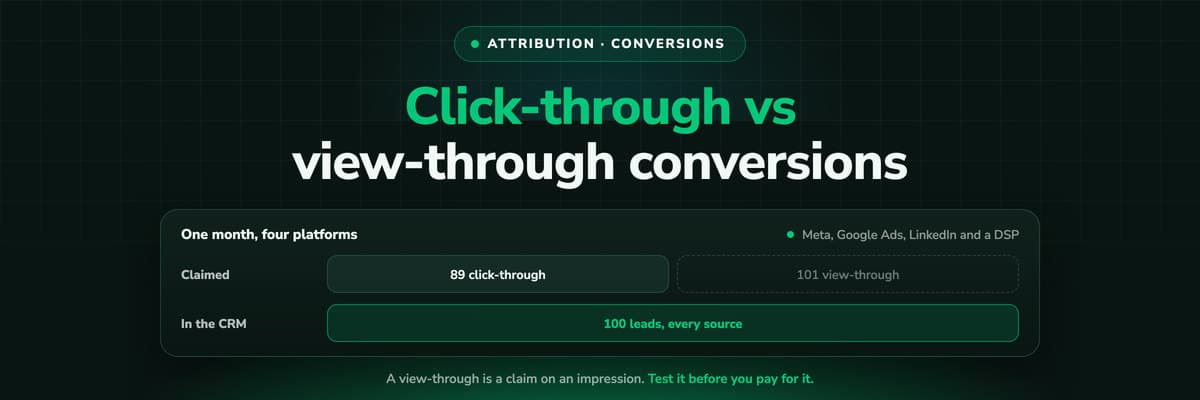
Here is a month of leads, invented for this guide but ordinary in its shape. The CRM holds 100 new leads. Meta reports 58 conversions, Google Ads 59 once its view-through column is added, LinkedIn 27 and the programmatic DSP 46. That is 190 conversions claimed for 100 leads, and 101 of the 190 are view-throughs: conversions a platform credits to an ad the person was shown and never clicked.
Nobody is lying. Each platform counts exposure inside its own walls, with windows it set by default, and credits itself in full. The CRM counts people, once, with the source of the visit that actually arrived. The useful question is not which count is true but which one belongs to which decision.
This guide puts the two definitions side by side, shows how each platform counts view-throughs and where they land in the report, makes the honest case for them and against them, and then gets practical: which number to use for bidding, budget and reporting, how to test a view-through claim, and the settings worth changing. The definition alone, with the full table of windows, is the glossary entry on view-through conversion.
Quick Summary: Click-Through vs View-Through in One Paragraph
In short
A click-through conversion is one where the person clicked the ad and converted inside the click window; a view-through conversion is one where the person was shown the ad, did not click, and converted inside the view-through window. Click-throughs leave a visit every other system can check; view-throughs exist only inside the platform that served the impression. Each platform counts its own view-throughs in full, on defaults from 1 day (Google Ads, Meta, Microsoft, Reddit) to 90 days (LinkedIn), and no platform deduplicates against another, so the sum of platform claims routinely exceeds the leads in your CRM. Let each platform bid on its own counting, ideally fed qualified CRM conversions; move budget between channels on click-based journeys joined to CRM revenue, corrected by holdout or geo tests; and report CRM revenue to leadership. View-throughs are real for video, CTV and display, where clicks are rare, and inflated wherever retargeting and long windows are involved, so test them rather than trust or ignore them.
It is written for the people who have to reconcile a platform dashboard with a pipeline report: performance marketers, marketing leaders and the agencies that run paid channels for them. If your question is only why four dashboards disagree, why GA4, Meta and Google conversions don't match your CRM is the shorter read. If you have to decide what to count, start here.
Click-Through vs View-Through Conversions: The Two Definitions
Both are conversions an ad platform credits to its own ad. What separates them is what the person did with the ad, and what that leaves behind for anyone else to check.
Click-through conversion
The person clicked the ad and converted inside the click window: 7 days by default on Meta, 28 on Reddit, 30 on Google Ads and Microsoft, 90 on LinkedIn. The click leaves a visit with a click ID and UTMs that GA4 and your CRM can see.
View-through conversion
The person was shown the ad, did not click, and converted inside the view-through window: 1 day by default on most platforms, 90 days on LinkedIn. Only the platform that served the impression knows it happened.
Engaged-view conversion
The video case in between. Google counts 10 seconds of a skippable YouTube ad, Meta's engage-through 5 seconds of video or a non-link interaction. Google puts these in its Conversions column.
The difference that matters in practice is not the window but the witness. A click-through has a visit behind it: a landing page, a click ID, UTM parameters, a session that GA4 recorded and a lead that your CRM can trace back to it. A view-through has only the platform's word, matched through its own pixel or conversion API against a person it believes it showed the ad to. The glossary entry on view-through conversion has the long definition, the full table of windows and the view-through rate, and attribution window covers how windows work in general.
How Each Platform Counts View-Through Conversions
Grouped by channel type, because that is how the decision reaches you: what a search, social, display or video line in the plan is really reporting. Defaults as read on each platform's own help pages on 28 September 2026.
Default view-through windows and where the view-throughs land, by channel type
| Channel type | Default view window | Where view-throughs land | What it means |
|---|---|---|---|
| Search | Google Ads search campaigns: none documented | Nowhere | Clicks only, the closest number to your CRM |
| Social | Meta 1 day, Reddit 1 day, LinkedIn 90 days | In Meta's Results and LinkedIn's Conversions | The headline figure mixes clicks and views |
| Display and programmatic | Google Display 1 day, Microsoft Audience ads 1 day, AdRoll retargeting 7 days, CM360 and DV360 Floodlight 30 days | Own columns on Google and Microsoft, in the total on Basis | Long windows on cheap impressions |
| Video and CTV | YouTube 1 day, plus engaged views for 3 days; Meta engage-through 1 day | Google's engaged views count in Conversions | Few clicks, so views are most of the number |
Google documents view-through conversions for the Display Network, video, Demand Gen and App campaigns; search ads are not among them. Microsoft counts them on its Audience ads and on search ads extended to its audience network. Google adds a limit most reports never mention: view-throughs from browsers that do not allow cross-site cookies cannot be reported, so the column is not only generous in some places but blind in others.
Meta moved three of its defaults this year. The 7-day and 28-day view windows stopped being returned by its reporting API on 12 January 2026, so the view window is now 1 day or nothing. In March 2026 click-through was narrowed to link clicks, and the old engaged-view class was renamed engage-through, taking in shares, saves and other non-link interactions, with the video threshold cut from 10 seconds to 5. The default today is 7-day click, 1-day view and 1-day engagement. A year-on-year comparison of Meta conversions across those dates compares two different definitions.
Inside one platform the rule is the same everywhere: a click beats an impression. Google and Microsoft exclude anyone who clicked any of your ads on their network from the view-through count, TikTok attributes each conversion to one touchpoint, and a DSP like Basis counts a conversion as click-through when a click came first. Across platforms there is no rule at all, because no platform knows what the others served.
The Case for Counting View-Through Conversions
Impressions do work. Most people who see an ad never click it, and some of them act on it later, by searching your name, typing your URL or clicking a different ad. A report that credits only clicks gives those impressions nothing, and the channels that live on impressions end up looking worthless whatever they did.
- Video and CTV have almost nothing else to countA video ad is watched rather than clicked, and a television screen has no cursor. On CTV a view-through or a test is nearly all there is to measure with.
- Brand search collects credit it did not createThe person who saw a LinkedIn ad on Monday and searched your brand on Thursday is a Google Ads click-through. On a click report, brand search looks like the best campaign in the account.
- Upper-funnel spend gets cut firstChannels that start journeys are judged against channels that finish them. Ignore every view and the budget drifts, quarter by quarter, towards retargeting and brand terms, until nothing is filling the funnel they harvest.
- The bidding needs a signalWhere clicks are rare, conversions after an impression are the only feedback an algorithm gets, which is why Google lets YouTube-only Demand Gen campaigns opt into bidding on view-throughs.
That is a real argument and it deserves a real answer, not a dismissal. Ignoring view-throughs entirely is its own bias: it systematically under-credits the upper funnel and hands the difference to whatever channel sits closest to the form. The question is not whether impressions matter but whether a platform's view-through column is a good measure of how much.
The Case Against: One Lead, Claimed by Every Platform
Now the other side, with the month from the introduction. The windows are the defaults, except the DSP, set to the 30 days a programmatic platform commonly starts from. The figures are illustrative, and every column adds up.
Illustrative: one month, 100 leads in the CRM, 190 conversions claimed by four platforms
| Platform | Windows | Click-through | View-through | Claimed |
|---|---|---|---|---|
| Meta | 7-day click, 1-day view | 34 | 24 | 58 |
| Google Ads | 30-day click, 1-day view | 41 | 18 | 59 |
| LinkedIn Ads | 90-day click, 90-day view | 11 | 16 | 27 |
| Programmatic DSP | 30-day click, 30-day view | 3 | 43 | 46 |
| All four platforms | 89 | 101 | 190 |
The CRM has 100 leads, from every source including organic search and direct. The platforms claim 190, and 101 of the claims are view-throughs. Three mechanisms produce the 90 extra conversions, and none of them requires anybody to be dishonest.
- The same conversion, claimed by every platform that served an impression. A lead who scrolled past a Meta ad, saw a LinkedIn post and was served a banner in the same week is a view-through in three dashboards, and a click-through in a fourth if she then clicked a search ad. Each platform is right about its own impression. The sum is wrong.
- Retargeting counts people already converting. A retargeting audience is people who already visited. The ones who come back on their own inside the window after an impression are view-throughs whether the ad changed anything or not, and the DSP's 43 view-throughs against 3 clicks is what that looks like at scale.
- Windows that outlast the decision. LinkedIn's default credits a lead to any impression served in the previous 90 days. On a B2B account that is often before the buyer had a project at all, so the 16 view-throughs include people who decided for reasons LinkedIn never saw.
Two details in the table are worth a second look. Google's 18 view-throughs sit in their own column, outside Conversions, so the Google Ads headline reads 41, while Meta's and LinkedIn's headlines include theirs. And the click-through column is not clean either: 89 click-throughs against 100 leads looks close, but a person who clicked a Meta ad and then a Google ad is a click-through on both, and 30 of the 100 leads never clicked a paid ad at all.
Why GA4 and Your CRM Show None of Them
Your CRM only knows the visits that arrived. A lead is recorded with the source of the session that produced it: UTM parameters, a click ID, a referrer, or a field somebody typed. An impression that was never clicked produces no visit, so it cannot be the source of anything in the CRM. The lead who saw the DSP's banner and then searched your brand arrives as search, correctly, because that is the visit that happened.
GA4 is almost the same, and the exact answer matters because it is asked so often. Its attribution settings are a reporting model, the channels that can receive credit and a key event lookback window; there is no view-through window among them. Google describes its last click model as crediting "the last channel that the customer clicked through (or engaged view through for YouTube)", and its data-driven model as measuring the contribution of each click interaction.
The exception is YouTube. With Google Ads linked, GA4 records engaged-view key events: somebody watched a YouTube ad for at least 10 seconds and triggered a key event on your site within 3 days. GA4 files those under google / cpc with the YouTube campaign's name, so a YouTube engaged view can take credit in GA4 much as a click would. A display banner, a Meta or LinkedIn ad, or a programmatic impression that was only seen never reaches GA4 at all.
Does GA4 count view-through conversions?
Not from display, social or programmatic impressions. It counts clicks, and YouTube engaged views through the Google Ads link. The View-through conversions column lives in Google Ads, not in GA4.
The consequence is predictable. A channel whose results are mostly view-through, a DSP running display and CTV above all, reports dozens of conversions in its own dashboard and close to nothing in GA4 and the CRM. Neither side is broken. Programmatic attribution covers how to get a DSP's clicks into the CRM at all.
Which Number to Use for Which Decision
The way out of the argument is to stop looking for one true number and give each decision the number built for it. Five decisions cover almost everything a marketing team does with conversion data.
One number per decision
| Decision | Use | Why |
|---|---|---|
| Bidding inside one platform | The platform's own conversions, fed qualified CRM conversions where it accepts them (Meta, Google, LinkedIn, Microsoft) | The algorithm learns from what it is sent, so send it deals rather than impressions |
| Comparing creatives or audiences inside one platform | Click-through and view-through side by side, in that platform's counting | A ranking inside one counting system holds even when its totals are inflated |
| Moving budget between channels | Click-based journeys joined to CRM revenue, corrected by tests | One lead, one credit: the columns add up to your real total |
| Judging display, video or CTV | A holdout, a geo split or a lift study | Only an experiment separates cause from exposure |
| Reporting to leadership | CRM revenue, with platform claims as context | The number finance reconciles to |
Bidding deserves a closer look, because the attribution setting is not only a reporting choice. Meta says in its own help centre that standard attribution optimises delivery for the time windows you select. A 1-day view setting therefore teaches delivery to find people who convert within a day of seeing an ad, and on an account heavy with retargeting those are often people who were converting anyway. Meta also offers an incremental attribution model, which it describes as optimising for conversions its models predict were caused by the ad. Google, by contrast, keeps view-throughs out of bidding for Display and video unless a campaign type opts into it.
The strongest fix for bidding is upstream of the window: send the platforms the conversions your business actually wants. When a lead qualifies or a deal closes in the CRM, that event goes back to Meta, Google, LinkedIn and Microsoft with the click ID and the deal value, and the algorithm learns from deals rather than from form fills and impressions. Sending CRM data back to Meta and Google and offline conversion tracking cover the mechanics.
How to Test a View-Through Claim
A view-through count is a hypothesis: these people converted because they saw the ad. The only way to test it is to compare them with similar people who did not see it. There are four ways to do that, from rigorous to rough.
- A holdout or PSA testSplit the target audience at random, show one half your ad and the other half nothing, or a public service ad, and compare conversion rates in your CRM rather than in the platform. The PSA version gives the control group a real impression too, so both halves carry the same counting bias and only the message differs.
- A geo splitSwitch the channel on in some regions and off in comparable ones for several weeks, then compare leads per region in the CRM. Cruder than a holdout, but it needs no platform cooperation and it works for CTV.
- A platform lift studyGoogle runs Conversion Lift studies based on users or on geography, though not for every account; Meta describes an incremental attribution model; Reddit lists conversion lift among its measurement products. They are randomised, which is the point, but measured on the platform's own conversions.
- The cheap proxy: branded search and directWatch branded search clicks and direct visits in the weeks a channel goes on and off. Display and CTV that work send people to Google with your name; a channel whose view-throughs climb while branded search stays flat is claiming conversions it did not start.
Academic work points the same way. Gordon and colleagues, in Marketing Science, compared the observational methods advertisers use with the results of large randomised experiments run on Facebook, and found that the observational estimates often failed to recover what the experiments measured. A view-through column is an observational method of the simplest kind.
Read the result in both directions. If the holdout converts at nearly the same rate as the exposed group, most of the view-throughs were people converting anyway. If it converts far less, the impressions worked and a click-only report was under-crediting them. Either answer is worth more than the view-through column, and it is worth repeating when the creative, the audience or the budget changes a lot.
Settings Worth Changing
None of these makes view-throughs true or false. They make the column smaller where it is least likely to mean anything, and keep it apart from the numbers you add up.
- Shorten the long view windows. LinkedIn's default is 90 days of view, which on a B2B account credits impressions served a quarter before the lead; 7 days, or 1, is nearer to what an impression can plausibly do, and LinkedIn offers both. A DSP's 30-day view window deserves the same look. Google Ads, Meta, Microsoft and Reddit already default to 1 day.
- Decide Meta's view-through setting on purpose. Meta offers None or 1-day, and because standard attribution optimises delivery for the windows you select, the setting changes who sees the ads, not only what is reported. Compare attribution settings in Ads Manager shows 1-day view, 1-day click, 7-day click and 28-day click side by side without touching delivery.
- Pick LinkedIn's last ad set model. Under "Last touch, each ad set" every ad set that reached the member inside the window is credited with the conversion; "Last touch, last ad set" credits only the most recent one.
- Exclude existing customers and recent converters from prospecting. Upload the CRM's customer list and open pipeline as exclusions and exclude recent converters from retargeting, so impressions are not spent on people who are already buying and view-throughs are not collected from them either.
- Keep view-throughs out of blended totals. Microsoft adds Audience view-throughs to All conv. by default and has an account-level option to stop it; Google already keeps them out of Conversions for Display and video. On a DSP, Basis lets you value view-through conversions at a percentage of a click-through's revenue, 100% by default.
- Deduplicate across platforms in your own reporting. No platform will do it for you. One lead gets one credit, in the CRM, and the platforms' claims sit beside it as context, never summed with each other.
Programmatic and CTV: Where View-Through Is Most of the Number
On a DSP the view-through column is not a side effect, it is usually most of the result. Simpli.fi, a programmatic platform, writes that the majority of digital campaign conversions are classified as view-through. Part of the reason is its own definition, under which a click-through only counts when the conversion happens in the same session as the click, but the direction is not in doubt: display is clicked rarely and CTV hardly at all.
The windows are long as well. StackAdapt's own blog says a DSP's view-through and click-through windows default to 30 days, and Campaign Manager 360's Floodlight uses one conversion window for clicks and impressions, 30 days by default. A 30-day view window on retargeting impressions, matched by the DSP's own identity data, is the setup most likely to credit conversions that would have happened anyway, and also the one where a real upper-funnel effect has no other way to show up.
So programmatic needs both halves. The clicks a DSP does produce can be tracked like any other click, with the DSP's macros filling UTM parameters so each lead reaches the CRM with the campaign and the site it came from; programmatic attribution shows how. The view-through part needs a test, and programmatic measurement covers which DSP metrics are worth reporting next to the CRM's.
What a Click-Based Attribution Tool Can and Cannot Say
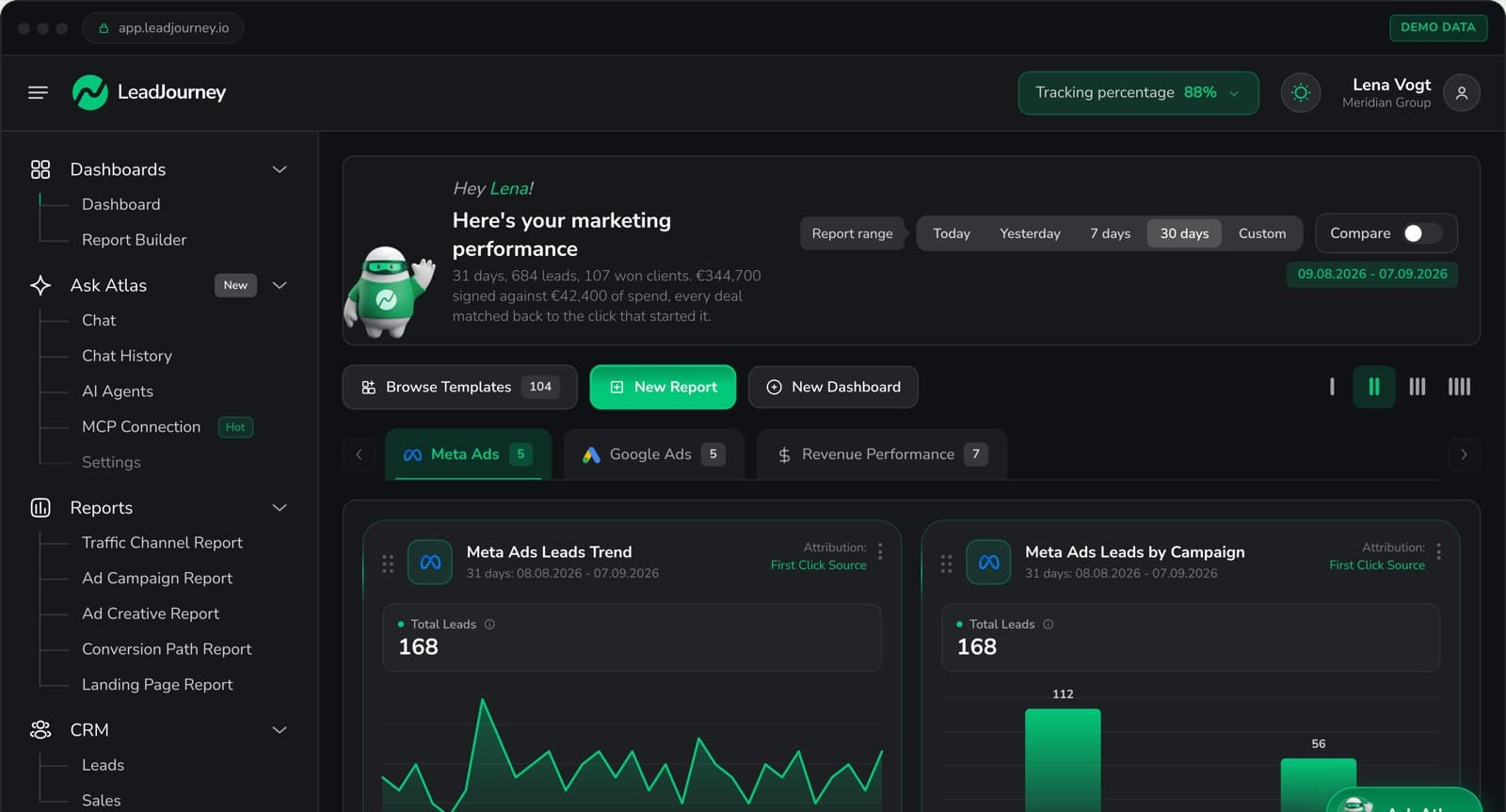
LeadJourney is an all-in-one attribution platform for lead generation, B2B SaaS, e-commerce and agencies, and it sits on the click side of this argument. Tracking runs server-side on your own domain at 95%+ accuracy. On the first visit it stores the UTM parameters, the referrer, the landing page and the ad click IDs it knows (gclid, gbraid, wbraid, fbclid, msclkid, li_fat_id, ttclid) first-party on the LeadJourney Click ID, kept for weeks or months, and it writes the source onto the lead in the CRM. The visitor is joined to the lead at the form, the call or the booking, and the record follows the CRM stages to the closed deal, with first click, last click, linear, position-based and time decay switchable without re-tracking.
The loop runs back to the platforms as well: CRM stages and closed deals go to Meta, Google, LinkedIn and Microsoft as conversions with the deal value, which is the bidding fix from the section above. DSPs are tracked as custom traffic channels: LeadJourney does not connect to The Trade Desk, StackAdapt or DV360 today, so their clicks arrive through UTMs and the spend is entered as a channel cost.
What it cannot say, stated plainly: LeadJourney does not see impressions and counts no view-through conversions. It does not run lift studies or incrementality tests. That is exactly why its numbers are lower than the platforms', and why the gap is the thing worth looking at. In the month above, 70 of the 100 leads have a paid click in their journey. Credited to the first one, 36 go to Google Ads, 22 to Meta, 9 to LinkedIn and 3 to the DSP; the other 30 came in through organic search, direct and referral without a paid click. Meta claims 58 against the 22 journeys its clicks opened; the DSP claims 46 against 3. That difference, per channel, is the view-through and cross-platform share of each claim, and pixel and CRM mismatch shows how to read it.
Setup takes about 21 minutes, from €129 a month, with a 14-day free trial and no credit card, and the reports can be clicked through on demo data in the live demo first.
A Checklist for Click-Through and View-Through Conversions
- Know which column holds the view-throughs on each platform: a column of their own on Google Ads, Results on Meta, Conversions on LinkedIn, All conv. on Microsoft.
- Write down every view window you run, and shorten the long ones: LinkedIn's 90 days first, then any DSP at 30.
- Never add platform conversions together. Each platform deduplicates only against itself.
- Count leads and revenue once, in the CRM, from click-based journeys joined to the deal.
- Send qualified CRM conversions back to Meta, Google, LinkedIn and Microsoft, so bidding learns from deals.
- Exclude customers and recent converters from prospecting and retargeting.
- Test any channel whose case rests on view-throughs with a holdout, a geo split or a lift study before scaling it.
- Watch branded search and direct in the weeks a channel goes on or off.
- Re-read the platform defaults twice a year. Meta changed three of them in 2026 alone.
Further Reading
The definitions: view-through conversion, attribution window, click ID and multi-touch attribution. Programmatic in depth: programmatic attribution and programmatic measurement. Why the dashboards disagree: why GA4, Meta and Google conversions don't match your CRM, cross-channel attribution and, for one platform's windows in detail, Reddit Ads attribution. On the product side: pixel and CRM mismatch, optimising on revenue and multi-touch attribution.
FAQ
Frequently Asked Questions
What marketers ask before deciding which conversions to count.
What is a view-through conversion?
A view-through conversion is a conversion an ad platform credits to an ad that somebody was shown and did not click, because they converted inside the platform's view-through window after the impression. Google Ads, Meta, Microsoft and Reddit default to a 1-day view window, LinkedIn to 90 days. The platform matches the impression to the conversion through its own pixel or conversion API, and it is the only system that knows the impression happened: no visit reached your site from it, so GA4 and your CRM record the lead under whatever visit did arrive, such as a brand search or a direct visit.
What is the difference between click-through and view-through conversions?
A click-through conversion follows a click on the ad inside the click window; a view-through conversion follows an impression that was not clicked, inside the view-through window. Inside one platform a click wins: Google and Microsoft remove anyone who clicked any of your ads from the view-through count. The practical difference is what each leaves behind. A click produces a visit with a click ID and UTM parameters that GA4 and the CRM can check; a view-through exists only in the platform's own report. That is why click-throughs can be joined to CRM revenue and deduplicated across platforms, and view-throughs cannot.
What is a good view-through window?
Shorter than most defaults outside the big social platforms. One day, the default on Google Ads, Meta, Microsoft and Reddit, keeps the view-through close to the impression. LinkedIn's 90-day default and the 30 days common on DSPs credit impressions served long before most buyers start deciding, so 1 to 7 days is a more defensible reporting window there. Remember that a window is also an optimisation input on some platforms: Meta optimises delivery for the windows you select, so changing it changes who sees the ads. Whatever you choose, test the channel rather than trusting any window to measure cause.
Does GA4 count view-through conversions?
Not in the ad platform sense. GA4's attribution settings have no view-through window, and Google describes its models as crediting clicks. The exception is YouTube: with Google Ads linked, GA4 records engaged-view key events, where somebody watched a YouTube ad for at least 10 seconds and triggered a key event within 3 days, under google / cpc. Display, Meta, LinkedIn and programmatic impressions that were only seen never reach GA4. The View-through conversions column you may have seen belongs to Google Ads, not GA4.
Should I include view-through conversions in ROAS?
Not in a ROAS you compare across channels or report to finance. Each platform counts its view-throughs in full and none deduplicates against the others, so a blended ROAS that includes them counts the same revenue several times. Inside one platform, a ROAS with view-throughs can still rank campaigns against each other, as long as everyone knows which column it came from. For budget decisions, calculate ROAS on revenue from click-based journeys joined to the CRM, and give channels that live on impressions, such as CTV, a test instead of a view-through ROAS.
How do I know if view-through conversions are real?
Test them against people who were not shown the ad. The rigorous version is a holdout or PSA test: a random half of the audience sees your ad, the other half sees nothing or a public service ad, and you compare conversion rates in the CRM. A geo split does the same with regions, and Google runs Conversion Lift studies for accounts that qualify. The cheap proxy is branded search and direct traffic in the weeks a channel goes on and off. If the unexposed group converts at nearly the same rate, most view-throughs were people converting anyway.
Keep reading
More from the blog
 B2B Marketing Attribution
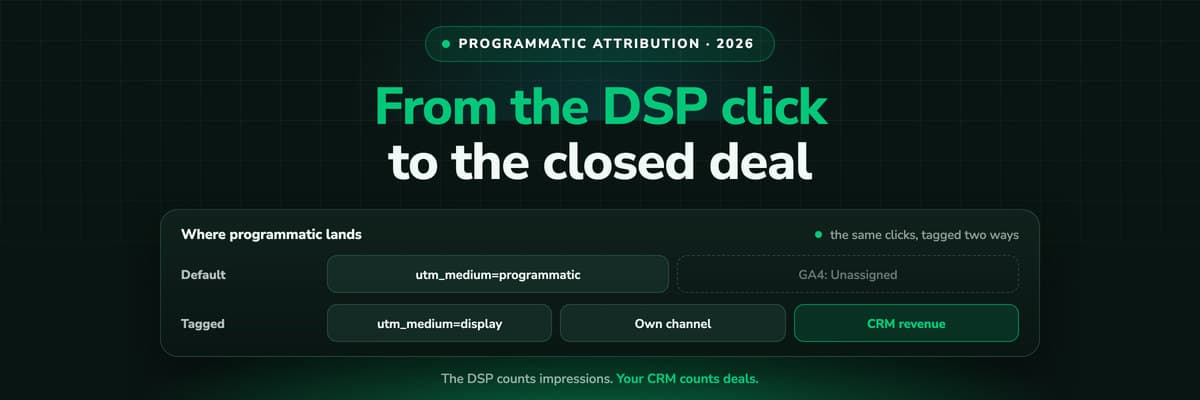
Programmatic Attribution: Track DSP Campaigns to Revenue
A DSP reports view-through conversions no other system can see, GA4 files its clicks as Unassigned or Paid Other, and the CRM records whatever the last form wrote. This guide covers why programmatic resists attribution, one UTM convention with templates for The Trade Desk, StackAdapt, DV360 and three more DSPs, and how to judge each DSP on CRM pipeline and revenue.Read the article23 min read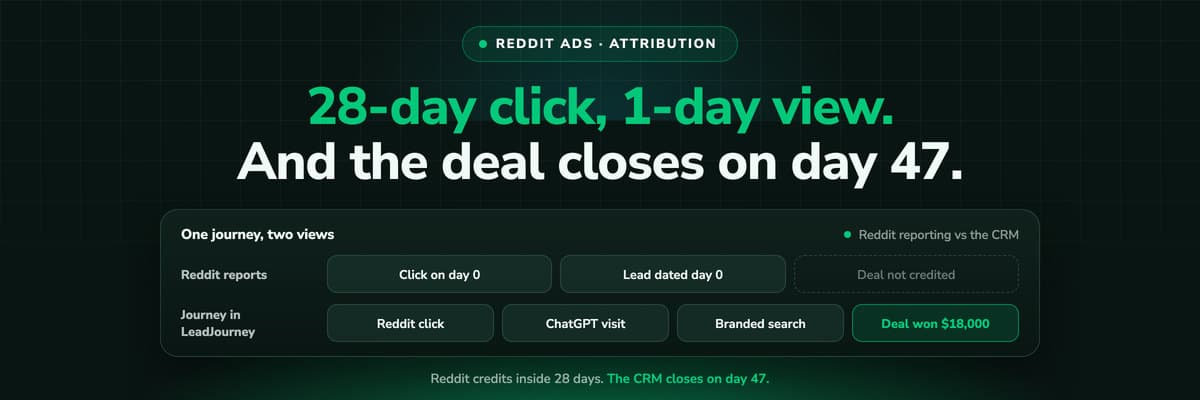 B2B Marketing Attribution
Reddit Ads Attribution: Windows, View-Through and the CRM
Reddit Ads Manager, GA4 and the CRM give you three different numbers for the same campaign, and none of them is broken. The reporting windows and the separate optimisation window, why Reddit dates a conversion to the click, what view-through and modeled conversions add, and how to read a channel whose clicks come back as branded search, AI search and Direct.Read the article20 min read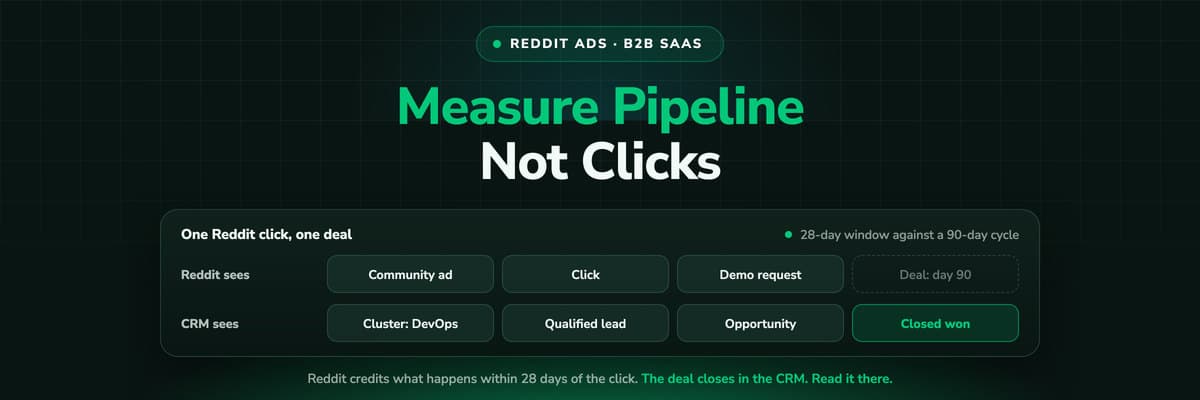 B2B Marketing Attribution
Reddit Ads for B2B SaaS: How to Measure Pipeline, Not Clicks
B2B buyers research on Reddit long before they talk to sales, which makes it a good channel and a hard one to measure. How to target a business buyer, why Reddit's reporting undercounts a SaaS deal, which numbers replace cost per lead, the account structure that makes pipeline per community readable, and what to send back to Reddit.Read the article16 min read
Clicks, leads and revenue, counted once
See what your clicks produced before you trust a view-through
LeadJourney captures every click server-side on your own domain, joins it to the lead and the CRM deal, and sends the revenue back to Meta, Google, LinkedIn and Microsoft. Live in 21 minutes, 14 days free.