














BlogB2B Marketing Attribution
iGaming Attribution: Who Gets Credit for the FTD
The operator's program decides which affiliate gets the player. It does not decide which of your pages, streams or keywords earned the FTD. How the attribution models split one player's FTD, which model fits a CPA, rev share or hybrid deal, and whether to credit the count, the deposit or the NGR the program posts back.

Contents
Summarise this article with AI
Opens the page with a ready prompt in:


Nothing is sent until you pick a service.
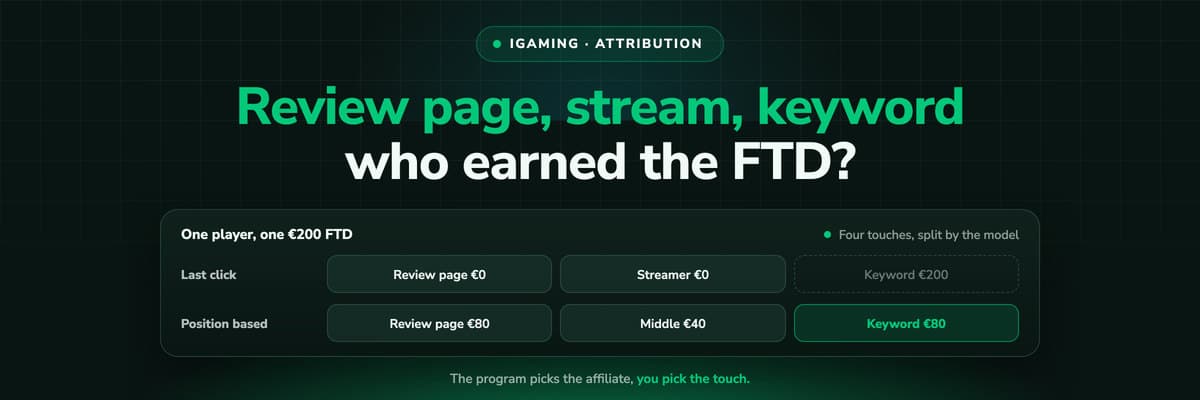
A player reads your casino review, watches a streamer you pay, sees a bonus code in your Telegram channel, then clicks your bonus keyword ad and deposits two days later. The program pays you one €200 CPA. Which of the four earned it? The program does not know and does not need to: it only had to decide that the player is yours. You need to know, because next month's budget goes to one of those four.
This guide is about that credit question and nothing else. The mechanics of getting the FTD back to you are in server-side tracking for iGaming, and what each partner program platform sends is in iGaming affiliate postbacks. Here: the attribution your program already applies, the models worked on one player, which model fits which deal, which value to credit, and the windows Google and Meta apply to the same FTD.
Quick Summary: iGaming Attribution
In short
iGaming attribution happens on two layers. The operator's program decides which affiliate gets the player, usually by last cookie wins on the tracking link, and on rev share pays you for that player for life. You decide which of your own touches gets the FTD: the review page, the stream, the channel or the keyword. For that you need every touch recorded on your side and a model: last click for reconciling with the program, position based or linear for budget across SEO and paid, and the same model for count and value. Credit FTDs on a CPA deal, and deposits or the NGR the program posts back on rev share.
The terms behind it are in the glossary: attribution model, first-time deposit and postback URL.
Ad Tracking vs Attribution: Two Different Jobs
The two words get used as one, and they answer different questions. Tracking is the record: this click happened, on this page, from this keyword, and this postback says the player behind it deposited. Attribution is the rule applied to the record: when one player has four recorded touches and one FTD, how much of the FTD each touch gets.
- Tracking recordsEvery click with its source, page, keyword and geo, and every reg, FTD and deposit postback matched to a click ID. Without it, there is nothing to attribute.
- Attribution dividesA model takes all the touches one player had before the FTD and splits the credit between them. Same record, different model, different winner.
- Tracking gaps become attribution errorsA touch that was never recorded cannot get credit, so its share goes to whatever was recorded. A streamer link that skips your domain hands its FTDs to the keyword the player clicked later.
So the order is fixed: record every touch first, on your own domain, then pick the model. A sophisticated model on a record with holes in it just distributes the holes more evenly.
The Attribution Your Program Already Applies, and the One You Need
Every partner program runs an attribution rule already, and it is written into the terms you accepted. Two operators' own terms, read on 2 October 2026, say it in almost the same words. Energy.Partners: "A customer will be linked to the last Affiliate who referred the customer to the Company based on the affiliate tracking cookie." Bons Partners calls it "Last Cookie Wins": your link has to be the last one the player used to register.
- Last click between affiliates. If the player clicked another affiliate's link after yours and registered from it, the player is theirs. Your earlier work is not split, it is gone.
- A period the terms state, or do not. How long the program remembers your click (the cookie or tracking period) is whatever your terms say. Neither of the two programs above states a number of days, so ask your AM rather than assuming a figure from a listicle.
- Rev share follows the player for life. Energy.Partners pays rev share "for the lifetime of its referred New Customers until termination of this agreement"; Bons Partners guarantees lifetime commission on rev share and the rev share part of hybrid deals. Once the player is yours, every month of their play is yours too.
- Negative months do not carry over at either of these two. Other programs do carry them, so read your own terms before you read a negative NGR month as a loss.
That rule answers the operator's question, which affiliate to pay. It says nothing about your question. Inside your own traffic, the same player may have touched a review page, a stream and a keyword, all of them yours, and the program sees one tracking link at registration. The click ID it returns on the postback is the one on the link the player registered through, which makes your raw postback data last click by construction.
Two layers of attribution on the same FTD
| Layer | Who applies it | The question | The usual rule |
|---|---|---|---|
| Between affiliates | The operator's program | Which affiliate gets the player and the commission? | Last cookie wins, inside the period the terms state |
| Inside your traffic | You, in your tracker | Which page, keyword, stream or ad set earned the FTD? | Whatever model you choose, on the touches you recorded |
| Inside one ad platform | Google or Meta | Which of its own ads gets the conversion you send back? | Its own model and window, its own ads only |
Six Attribution Models on One Player's Journey
One invented player, four touches, all yours, and one FTD on a €200 CPA deal. The days count back from the FTD.
- Day 0, 13 days before the FTD: Google organic search, lands on your casino bonus review page.
- Day 4, 9 days before: clicks the link under a Twitch stream you pay a flat fee for.
- Day 9, 4 days before: taps a bonus code post in your Telegram channel.
- Day 11, 2 days before: clicks your "casino bonus" exact match ad and registers. FTD on day 13.
How each model splits one €200 FTD
| Model | Review page (SEO) | Streamer | Telegram | Bonus keyword (ads) |
|---|---|---|---|---|
| Last click | €0 | €0 | €0 | €200 |
| First click | €200 | €0 | €0 | €0 |
| Linear | €50 | €50 | €50 | €50 |
| Time decay (7-day half-life) | €25.33 | €37.64 | €61.75 | €75.28 |
| Position based (40/20/40) | €80 | €20 | €20 | €80 |
| Data-driven | Learned from your data | Learned | Learned | Learned |
Last click
Last click gives the keyword everything. It is what the postback says by itself, and it makes the bonus keyword look like the whole business.
First click
First click gives the review page everything. Right about where players are found, blind to what made them deposit.
Linear
Linear gives each touch €50. Fair to every touch, and therefore no help ranking them.
Time decay
Time decay halves a touch's weight every seven days back from the FTD. The keyword gets 37.6%, the review page 12.7%.
Position based
Position based gives 40% to the touch that found the player and 40% to the one that closed, and splits 20% between the middle.
Data-driven
Learns weights from your own converting and non-converting journeys. It needs volume, and it shows no fixed split you can check by hand.
Read the table by column, not by row. The review page earns between €0 and €200 for the same player depending on the rule, and the keyword between €0 and €200 the other way round. Nothing about the player changed. That is the whole case for choosing a model on purpose rather than inheriting last click from the postback. The attribution model entry has the general version of this comparison.
LeadJourney offers first click, last click, linear, position based and time decay, switchable per report on the same recorded journey, without re-processing anything. Data-driven is not among them.
Which Model Fits CPA, Rev Share and Hybrid Deals
The deal decides what you are paid for, and so what the model has to get right. There is no model that is correct; there is one that answers the question your deal asks.
A starting point per deal type
| Deal | What pays | What to credit | Model to start with |
|---|---|---|---|
| CPA | A fixed amount per FTD or qualified FTD | FTD count, the CPA as value | Position based for budget, last click to reconcile with the program |
| Rev share | A share of the player's NGR, for life | Deposits or the NGR the program posts back | First click or position based, so the source that found valuable players keeps credit |
| Hybrid | A smaller CPA plus a smaller rev share | Both, on the same player | One model for both parts, so the CPA and the rev share land on the same touches |
CPA: count the FTDs, but do not starve the pages that find players
On a CPA deal every FTD is worth the same, so the question is how many FTDs each source produces and what each cost. Last click is the right view for the statement check, because it is the view the program shares: one FTD, one click ID. For budget it is the wrong one, because it gives the keyword the credit for players the review page and the stream found. Cut the review page on last click numbers and next quarter's bonus keyword clicks come from fewer people who already knew you.
Rev share: the player's value arrives after the FTD
On rev share the FTD is the start of the money, not the money. What you want to know is which sources bring players who keep playing, and that is a question about who found them. First click or position based keeps the acquiring touch in view; time decay is the weakest fit here, because it rewards whatever was nearest the FTD, which on most journeys is a bonus code or a keyword. Credit the later value back to the same split you used for the FTD, so a player's month six lands where their day one did.
Hybrid: one model, two values
A hybrid deal tempts you to run last click for the CPA part and first click for the rev share part. Do not: the two halves then credit different touches for the same player, and the sources stop adding up to the statement. Pick one model, apply it to the FTD count and to the value, and change it for both or for neither.
What to Credit: FTD Count, Deposit Amount or NGR
A model decides the share. You also have to decide what the share is of. Three candidates, each with its own catch.
- FTD countThe cleanest unit on a CPA deal: one FTD, split by the model. Pair it with reg to FTD per source, so a source with cheap regs and few deposits does not look like a winner.
- Deposit amountThe FTD amount and redeposits, when the program posts them. A good early signal of player value, but a deposit is not revenue: bonus play and withdrawals sit between the two.
- NGR posted backWhat a rev share deal actually pays on. It is the operator's calculation, gross revenue less bonuses, fees, taxes and the rest of their list, so it can only reach you on a postback or the statement.
NGR has one property the other two do not: it can be negative. Say the program posts €310 of NGR for our player in month one and -€120 in month two, because the player won (both figures invented). Under position based, the review page is credited €124 and then -€48. That is correct, and it is why a rev share report has to show months, not only totals. Whether a negative month carries over is your program's rule, not your model's.
What LeadJourney does with value
LeadJourney attributes what the postback carries: the CPA on the FTD, deposits, and rev share or hybrid amounts when the program posts them. It does not compute an operator's NGR. If a program reports rev share only on the monthly statement and never posts it back, that figure stays in the statement, and the report shows the FTDs and deposits that did arrive. Which platforms post what is covered in iGaming affiliate postbacks.
Google and Meta Attribute the Same FTD Their Own Way
When you send the FTD back to Google Ads or Meta, each platform runs its own attribution on it, over its own ads only, inside its own window. That attribution is for its bidding, not for your ledger, and the two will not match. Read from their own pages on 2 October 2026, and check again before you rely on a number; the sending itself is covered in server-side tracking for iGaming.
The platforms' own models and windows, read 2 October 2026
| Google Ads | Meta | |
|---|---|---|
| Models offered | Data-driven (the default for most conversion actions) and last click | Standard and incremental, plus a setting that takes attribution from your own analytics tool |
| Click window | 30 days by default; 1 to 30, 60 or 90 days for Search and Display | 1 or 7 days after a link click |
| View and engagement | Engaged-view 3 days by default; view-through 1 day by default | View-through 1 day; engage-through 1 day after a non-link interaction |
| Rules-based models | First click, linear, time decay and position based are no longer supported | Not offered as such |
Two consequences for an affiliate. First, a Meta ad that was the first touch of a 13-day journey falls outside a 7-day click window, so Meta records nothing for an FTD your own first click report gives entirely to that ad. Second, Google's data-driven model only divides credit among Google ads; your review page, stream and Telegram channel do not exist for it. Set Google's click window to your real click to FTD time rather than the default, and keep the model question in your own tracker, where every source is in the same record. The attribution window entry explains the window in general.
None of this makes a gambling ad eligible. Google certifies gambling advertisers per country and Meta requires authorization in Business Suite; the details are in the policy section of the server-side tracking guide.
The Operator's Side: Paid UA, Affiliates and LTV
An operator has the opposite view. It sees every reg and deposit in its own backend, and its attribution problem is across channels it pays in different ways: paid UA on Google and Meta bought per click, affiliates paid per FTD or per share of NGR, and organic and brand traffic it pays nothing for directly.
- Affiliate last click is a payment rule, not a marketing model. A player who saw a paid social ad, then registered through an affiliate's link, is the affiliate's for commission. For the marketing budget, the paid ad still did something, and a multi-touch model across paid and affiliate touches is how that shows.
- Value is lifetime value. The operator has the full deposit and NGR history per player, so it can credit LTV rather than the FTD, and compare an affiliate's lifetime cost against paid UA's on the same footing.
- Data-driven needs volume, and operators have it. An operator with thousands of FTDs a month can feed a data-driven model; an affiliate with a few hundred across six brands usually cannot, which is one reason rule-based models remain the affiliate's tool.
LeadJourney's iGaming product is built for the affiliate's side of this, not as an operator's casino platform or partner program software. The operator's half lives in its own backend; the guide's operator section covers how it sends FTDs to the ad platforms.
An iGaming Attribution Checklist
- Read your program's terms for the attribution rule, the tracking period and whether negative months carry over. If the period is not stated, ask your AM and write the answer down.
- Record every touch on your own domain: SEO pages, streamer and Telegram links, paid clicks. A touch that skips your domain cannot get credit.
- Pass your click ID on every tracking link and receive reg, FTD and deposit postbacks against it.
- Choose one model per deal type before you look at the numbers, and keep last click beside it to reconcile with the statement.
- Credit FTD count on CPA, deposits or posted NGR on rev share, and both with the same model on hybrid.
- Report rev share by month, so a negative month is visible on the source that brought the player.
- Set Google's click window to your real click to FTD time, and remember Meta's 7-day click limit when you compare its numbers with yours.
- Review the model once a quarter against one question: did the budget it suggested produce more FTDs or more NGR than the one before?
Further Reading
- Server-side tracking for iGaming: the click ID, the postback, FTDs to Google and Meta, and the gambling ad policies.
- iGaming affiliate postbacks: what Income Access, MyAffiliates, Affilka, Cellxpert and NetRefer send, platform by platform.
- The best iGaming tracking software: the trackers that do the click and the postback, compared.
- In the glossary: attribution model, multi-touch attribution, first-time deposit, postback URL and click ID.
- On the product side: iGaming tracking software and tracking for affiliate marketers.
FAQ
Frequently Asked Questions
What casino and sportsbook affiliates ask once the FTDs arrive and the budget question starts.
What is iGaming attribution?
It is deciding which marketing touch gets the credit for a player's registration, FTD and later value. In iGaming it happens on two layers: the operator's partner program decides which affiliate gets the player, usually by last cookie wins, and the affiliate decides which of their own pages, streams, channels or keywords earned the FTD, using an attribution model on the touches they recorded.
How do casino affiliate programs attribute players?
Most state a last click rule in their terms: the player belongs to the last affiliate whose tracking link they used before registering. Energy.Partners and Bons Partners both say so in their own terms, read on 2 October 2026, and both pay rev share for the lifetime of the player. How long the program remembers your click is whatever your terms state; if they state nothing, ask your AM.
Which attribution model is best for sportsbook and casino affiliates?
It depends on the deal. On CPA, count FTDs and use position based for budget decisions with last click beside it to reconcile with the program. On rev share, credit deposits or the NGR the program posts back, and lean on first click or position based so the source that found the player keeps the credit. On hybrid, use one model for both parts.
Can I use data-driven attribution as an affiliate?
Google Ads uses data-driven attribution by default for most conversion actions, but only among Google ads, so your SEO pages and streams are not in it. A data-driven model across all your sources needs enough FTDs to learn from, which most affiliates do not have per brand and geo. LeadJourney offers first click, last click, linear, position based and time decay; data-driven is not among them.
Does LeadJourney calculate NGR?
No. LeadJourney attributes what the program's postback carries: the FTD and its CPA, deposits, and rev share or hybrid amounts when the program posts them. NGR is the operator's calculation and reaches you on a postback or on the statement.
Keep reading
More from the blog
 B2B Marketing Attribution
Click-Through vs View-Through Conversions: What to Count
Every ad platform counts view-through conversions its own way, with its own window, and none of them deduplicates against the others, which is how 100 leads become 190 conversions. This guide covers how each platform counts them, the honest case for and against, which number to use for bidding, budget and reporting, and how to test a view-through claim.Read the article21 min read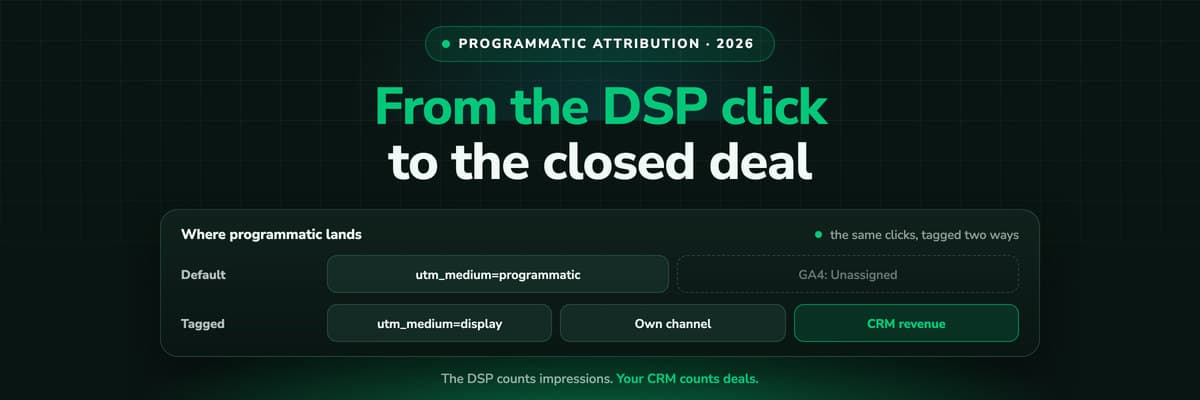 B2B Marketing Attribution
Programmatic Attribution: Track DSP Campaigns to Revenue
A DSP reports view-through conversions no other system can see, GA4 files its clicks as Unassigned or Paid Other, and the CRM records whatever the last form wrote. This guide covers why programmatic resists attribution, one UTM convention with templates for The Trade Desk, StackAdapt, DV360 and three more DSPs, and how to judge each DSP on CRM pipeline and revenue.Read the article23 min read B2B Marketing Attribution
Reddit Ads Attribution: Windows, View-Through and the CRM
Reddit Ads Manager, GA4 and the CRM give you three different numbers for the same campaign, and none of them is broken. The reporting windows and the separate optimisation window, why Reddit dates a conversion to the click, what view-through and modeled conversions add, and how to read a channel whose clicks come back as branded search, AI search and Direct.Read the article20 min read
iGaming affiliates
Ready to see which touch earned each FTD?
LeadJourney records every click on your own domain, matches the program's reg, FTD and deposit postbacks to it, and splits the credit by the model you choose. Live in 21 minutes, 14-day free trial without a credit card.