

















BlogHow To Guides
Does Call Tracking Hurt Your SEO? What Actually Puts NAP at Risk
The fear is old and the answer is boring: dynamic number insertion does not hurt rankings when the real number stays in your source, your schema and your listings. The mistakes that do cause damage are all about where you put the tracking number.


Contents
Summarise this article with AI
Opens the page with a ready prompt in:


Nothing is sent until you pick a service.
Somebody on your team, or somebody at your agency, has said this sentence: we cannot use call tracking numbers, they break NAP consistency and it will hurt our local rankings. It is the single most common reason a phone-led business measures nothing about its phone.
The fear was earned. It is also fifteen years out of date, and the version of it that still holds is narrower and more specific than the folklore. This is what dynamic number insertion actually does to the page, what a crawler sees, what Google's own guidelines say (and what they pointedly do not say), and the five mistakes that genuinely put a local ranking at risk.
Quick Summary: Call Tracking and SEO
In short
Properly implemented call tracking does not hurt your SEO. Dynamic number insertion swaps the number in the browser for a visitor's session while your real number stays in the page source, in your structured data and in every citation, so the name, address and phone number that identify your business never change. What does cause damage is putting a tracking number where your identity lives: hard-coded into the site template, into directory listings, into schema markup, or onto a Business Profile that you later cancel and leave pointing at a dead line.
The short version of the rules: one real number in the HTML and the schema, tracking numbers only in the swap, and never a pool number anywhere a human might write it down.
Where the Fear Comes From
Before dynamic number insertion existed, call tracking meant replacing the number. An agency would take a tracking number, put it in the website template, print it in the Yellow Pages advert, submit it to a hundred directories and set it as the number on what was then Google Places. Six months later the client had three different phone numbers across the web, none of which matched their invoices, and their listing behaved oddly.
That was a real problem and it had nothing to do with call tracking as a technique. It was caused by putting a temporary number into the places that tell search engines which business this is. The technique changed; the story stayed.
What NAP Consistency Actually Affects
Name, address, phone number. Search engines use them to decide that the business on your website, the business in a directory and the business in a listing are the same business. Consistency is an identity signal, not a quality score, and inconsistency is not a penalty: there is no manual action for having two phone numbers. What there is, is doubt, and doubt about an entity is a bad thing to introduce into local search.
- Your Business ProfileThe single most important record, and the one most likely to be compared with everything else.
- Citations and directoriesAggregators, industry directories, chambers, review sites. These are copied, scraped and rarely corrected, which is why a mistake here outlives the campaign.
- Your own websiteThe page source and the structured data, which is where a crawler goes looking for the canonical answer.
Notice what is not on that list: the number a specific visitor happens to see on your website for the twenty minutes they are reading it.
What a Crawler Sees on a Page With Number Insertion
A dynamic number insertion script runs in the browser after the page loads. The number in the HTML your server sends is your real one; the script rewrites what is displayed, and the tap-to-call link with it, for that session. Nothing about your markup changes on the server.
Be careful with the version of this claim the vendors like, that crawlers only ever see your real number. Googlebot renders JavaScript. If your script swaps the number on every single request regardless of source, a rendered crawl can pick up a pool number. That is an argument for implementing it properly, not for avoiding it.
The source stays yours
The number in the served HTML is your real line. It is what a crawler reads first and what anybody reading the source sees.
The schema is never swapped
The telephone property in your LocalBusiness or Organization markup carries the real number, always. No call tracker needs to touch it and none should.
The swap is for sessions with a source
A visitor who arrived from an ad, a search or a campaign gets a pool number. Everything else, crawler included, sees the number you own.
The Rules That Keep You Safe
- Your real number is in the HTML. Whatever is swapped, the served page contains the line you own. Check with view-source, not with the rendered page.
- Your real number is in the structured data. The telephone property in your schema is the canonical answer and no script touches it.
- Citations keep the real number. Directories, aggregators, review sites, the chamber of commerce. A tracking number in a citation is the mistake the folklore is actually about.
- Pool numbers are never printed. Not on a van, not in a brochure, not in an email signature. They rotate, and a printed pool number is a dead line waiting to happen.
- Offline sources get fixed numbers, not pool numbers. One stable tracking number per flyer, per vehicle, per radio spot, kept for as long as the asset exists.
- Nothing is cancelled without a plan. Turning off a call tracking account releases its numbers. Anything a customer might still dial has to be ported or forwarded first.
- Somebody checks the source once a quarter. Scripts get moved, templates get rebuilt, and the failure is silent.
The Business Profile Question
This is the part everybody actually wants an answer to, and it is the part where the honest answer is a judgement rather than a rule.
Google's guidelines for representing a business let you add up to two phone numbers beside the primary one, require that the number is under the business's direct control, and say not to provide numbers that redirect or refer users to numbers other than those of the actual business. Nowhere do they mention call tracking. So there is no sentence to quote in either direction, and anybody telling you Google has approved call tracking numbers on a profile is quoting an agency, not Google.
What the industry does, and what the call tracking vendors document, is to set a tracking number as the primary and move the real one into the additional numbers, on the reading that a forwarding number rings the actual business and the real number is still on the record. It works, it is widely used, and it is a position rather than a permission.
Why people want it at all
Because the profile stopped telling you. Google retired Business Profile call history on 31 July 2024. The Performance report still counts calls, but a call there is a tap on the call button: no caller, no duration, no idea whether anybody answered or what the job was worth. A tracking number is how a local business turns that tap into a measurable lead.
The cautious setup
Real number primary, tracking number as an additional number. Nothing about your identity moves. You measure less, and you sleep.
The common setup
Tracking number primary, real number additional. Calls from the profile are measurable and attributable. Widely used, documented by the vendors, not written down by Google.
Whichever you choose, the decision belongs with whoever owns local search for the business, not with the person installing the call tracker. And if you run multi-location or franchise listings, take the cautious setup: the blast radius of a listings problem across forty profiles is not worth the extra attribution.
The Five Mistakes That Actually Cause Damage
- Hard-coding a tracking number into the template. Now the served HTML and the schema disagree with every citation you have, permanently, and the swap has nothing to do with it.
- Submitting a tracking number to directories. Citations get copied between aggregators for years. This is the one that is genuinely expensive to undo.
- Swapping the number inside structured data. A script that rewrites the telephone property is telling a crawler your identity changed on every visit.
- Cancelling the account and orphaning numbers. The flyer still says 0800 555 0142 and the line is gone, or worse, reassigned to somebody else's pool.
- Letting each agency add its own. Three trackers over five years, three pool providers, three numbers still on three directories nobody audited.
Every item on that list is about where the number was put, not about whether calls are tracked. Which is why the answer to the original question is: no, call tracking does not hurt your SEO, and yes, a careless implementation can.
Measuring Calls From Organic Search Without Touching Your Listings
A last practical note, because the SEO worry usually hides a real question: how do you prove that organic search produces phone calls?
- Organic visitors get pool numbers like everyone else. A session from a Google search result is a source, so the call it produces is attributed to organic, down to the landing page. Nothing about your listings is involved.
- Your Business Profile is a separate channel from organic search, and it deserves its own fixed number or its own decision to stay unmeasured. Do not blend them: a call from the map pack and a call from a blog post are different marketing.
- Fixed numbers for offline sources give print, vehicles and events a calls column, which is usually the first time anybody has seen one.
Put together, that is an organic channel with a cost per call and a Business Profile with its own. See dynamic number insertion for how the swap works and call tracking software for what it looks like beside your other channels.
In the glossary
FAQ
Frequently Asked Questions
What local businesses and their agencies ask before switching call tracking on.
Does call tracking hurt local SEO?
Not when it is implemented properly. Dynamic number insertion swaps the displayed number in the browser for a visitor's session while your real number stays in the page source, in your structured data and in every citation, so the identity signals do not change. Damage comes from hard-coding a tracking number into your site, your listings or your schema.
Does dynamic number insertion break NAP consistency?
No, because NAP consistency is about the records that identify your business: your Business Profile, your citations, your own markup. A pool number shown to one visitor for the length of one visit is not one of those records. The rule that keeps it true is that the swap never reaches the HTML source, the schema or anything printed.
Can I put a call tracking number on my Google Business Profile?
Google's guidelines let you list up to two additional numbers beside the primary, require the number to be under your control and prohibit numbers that redirect users to somewhere other than the actual business. They do not mention call tracking at all. The common industry setup is a tracking number as primary with the real number as an additional number; the cautious one keeps the real number primary. It is a judgement, not a documented permission.
Will Google see the tracking number when it crawls my site?
It can, because Googlebot renders JavaScript. That is why implementation matters: the served HTML and the structured data must carry your real number, and the swap should apply to visitors with a source rather than to every request. Done that way, the canonical answer on your page is always the number you own.
Should call tracking numbers appear in my schema markup?
Never. The telephone property in your LocalBusiness or Organization markup is a statement about who you are and it carries the number you own. No call tracking tool needs to touch it, and a script that rewrites it is creating exactly the inconsistency this whole worry is about.
What happens to my tracking numbers if I cancel?
They go back to the provider and are eventually reassigned. Pool numbers do not matter, since nobody has written them down. Fixed numbers printed on vehicles, flyers or a Business Profile do: port them or forward them before you cancel anything, because a dead number on a van is worse than never having measured that channel.
Keep reading
More from the blog
 How To Guides
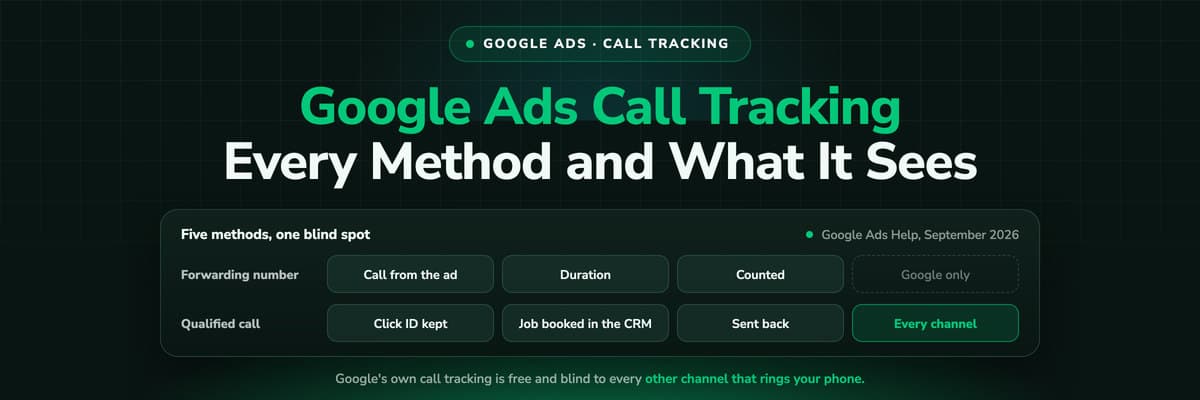
Google Ads Call Tracking: Every Method and What Each One Sees
Google Ads has call tracking built in, free, and most accounts run one method without knowing what it cannot see. All five, what each records, where they conflict with a call tracker, and how to send the qualified call back.Read the article12 min read How To Guides
What Is RevOps? Revenue Operations and GTM Ops Explained (2026)
Revenue operations runs marketing, sales and customer success as one revenue engine: the funnel definitions, the CRM, the handoffs, the reporting and the forecast. GTM ops is the wider name the same job has been taking on. What the function owns, how it differs from sales ops and marketing ops, the stack, the metrics, and the one thing all of it depends on: whether the CRM record says where the customer came from.Read the article17 min read How To Guides
B2B Buyer Journey: Stages, Statistics and Measurement (2026)
Every B2B team has two buyer journeys: the one mapped in a workshop and the one recorded in the tracking data and the CRM. The stages, Gartner's six buying jobs, the statistics worth knowing, one recorded €46,000 journey touch by touch, and how to build the map from the record and set the budget by it.Read the article15 min read
Call tracking
Measure every call without touching what identifies your business
LeadJourney swaps the number for the visit and leaves your real line in the page, the schema and every listing. 14 days free, no credit card.