






Skip to content

Free tool: cost per acquisition

CPA calculator for any conversion, with the gap to your target

Pick the action: purchase, lead, signup or booked call. Enter spend and count, then add revenue per action for profit and ROAS.

Calculate your cost per acquisition

Works for any conversion event. Add revenue per action and a target CPA for the profitability view.

Currency

Spend for the period you are measuring.

Acquisitions in the same period.

Add revenue and a target CPA

Order value, deal size or lifetime value per action.

The CPA the business needs you to hit.

Runs in your browser. Nothing you type is sent or stored.

The formula

The cost per acquisition formula

CPA=Total ad spendNumber of acquisitions

Spend €10,000 and get 100 purchases and the CPA is €10,000 ÷ 100 = €100 per purchase. The formula is the same for any action; only the definition of the action changes.

What CPA measures and when to use it

Cost per acquisition is the price of one completed action, and the action is whatever you are paying the platform to produce: a purchase for e-commerce, a lead for a B2B site, a trial for SaaS, an install for an app, a booked call for a sales team. That flexibility is why CPA is the metric ad platforms bid on. Google's Target CPA and Meta's Cost Cap take a CPA and work backwards to a bid.

It sits between cost per lead, which is always a lead, and customer acquisition cost, which is always a paying customer. Use CPA when the conversion you optimise for is neither, or when you run several conversion types and want one word for the metric.

CPA only means something next to revenue

A €100 CPA is a bargain if the action brings in €500 and a loss if it brings in €40. The formula is the easy part. The judgement comes from your unit economics: revenue per action, gross margin, and how much of that margin you are willing to spend on growth. That is what a target CPA is, the ceiling those three numbers allow, and it is what the calculator compares your actual CPA against.

The comparison tells you two things: how far over or under the ceiling you are per action, and what the same spend would have produced at target. The second number is the one to bring to a budget meeting. "We got 100 purchases; at target CPA the same budget buys 125" is a sentence people act on.

How to lower CPA

In order of leverage:

  • Tracking. Automated bidding learns from the conversions it can see. If the pixel misses 30 to 40 percent of them, the platform optimises towards the visible subset and your real CPA is a third lower than the dashboard says. Fixing the feed often drops reported CPA more than any campaign change.
  • Conversion rate. Doubling the landing page from 2 to 4 percent halves CPA on the same media plan, with no change to bids or audiences.
  • Creative and audience. Better hooks raise click-through, which lowers CPC, which lowers CPA proportionally. Real, but the smallest of the three.

FAQ

Cost per acquisition, answered

The questions behind the search for a CPA formula.

What is the CPA formula?

Cost per acquisition = total ad spend ÷ total acquisitions. Spend €10,000 and get 100 acquisitions and the CPA is €100. The formula does not change with the action; the definition of an acquisition does, and it has to stay the same from one month to the next.

Is CPA cost per acquisition or cost per action?

Both are used and they mean the same thing: the cost of one completed conversion event. Cost per action is the older, media buying term; cost per acquisition is the more common one in performance marketing today.

What is the difference between CPA, CPL and CAC?

CPL counts leads, CAC counts paying customers, CPA counts whatever action you define. The math is identical, spend divided by a count, and they connect: CPL ÷ lead-to-customer rate = CAC. CPA fills whichever step of the funnel you are optimising.

What is a good CPA?

One below the revenue, or lifetime value, per action, with enough room left for product cost and profit. Nothing else decides it. A €5 CPA is fine on a €10 product at 60 percent margin; a €500 CPA is fine on a €5,000 contract. Compare with your own target, not with an industry chart.

How is target CPA calculated?

Start from revenue per action, take gross margin, then decide how much of that margin can go to acquisition. Revenue €250, margin 40 percent, half the margin available for growth: target CPA is €50. Google's Target CPA and Meta's Cost Cap then bid to hit that number.

Should I optimise for CPA or ROAS?

If order values are roughly constant, CPA is the faster, denser signal. If they vary a lot (mixed cart sizes, monthly and annual plans), ROAS catches the variance CPA hides. Many teams bid on CPA and report on ROAS.

Why does my CPA in the ads manager not match my finance numbers?

The ads manager divides spend by the conversions it could track and attribute, which after iOS 14 and consent banners is 60 to 70 percent of the real ones. Finance divides by what actually happened. Close that gap and the two numbers meet.

Your real CPA

See the CPA your campaigns actually run at

LeadJourney records every conversion server side and sends the real ones back to the platforms, so Target CPA optimises for customers. Book a demo on your own account.

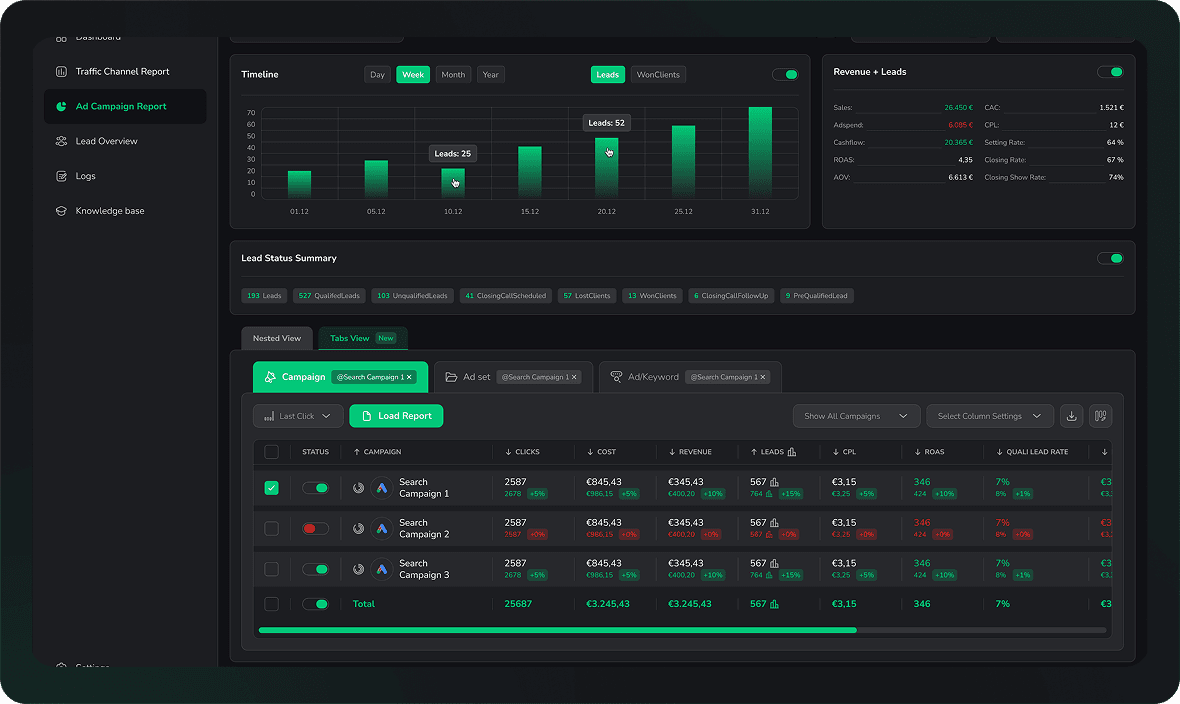
LeadJourney dashboard showing lead sources, campaign performance and attributed revenue side by side