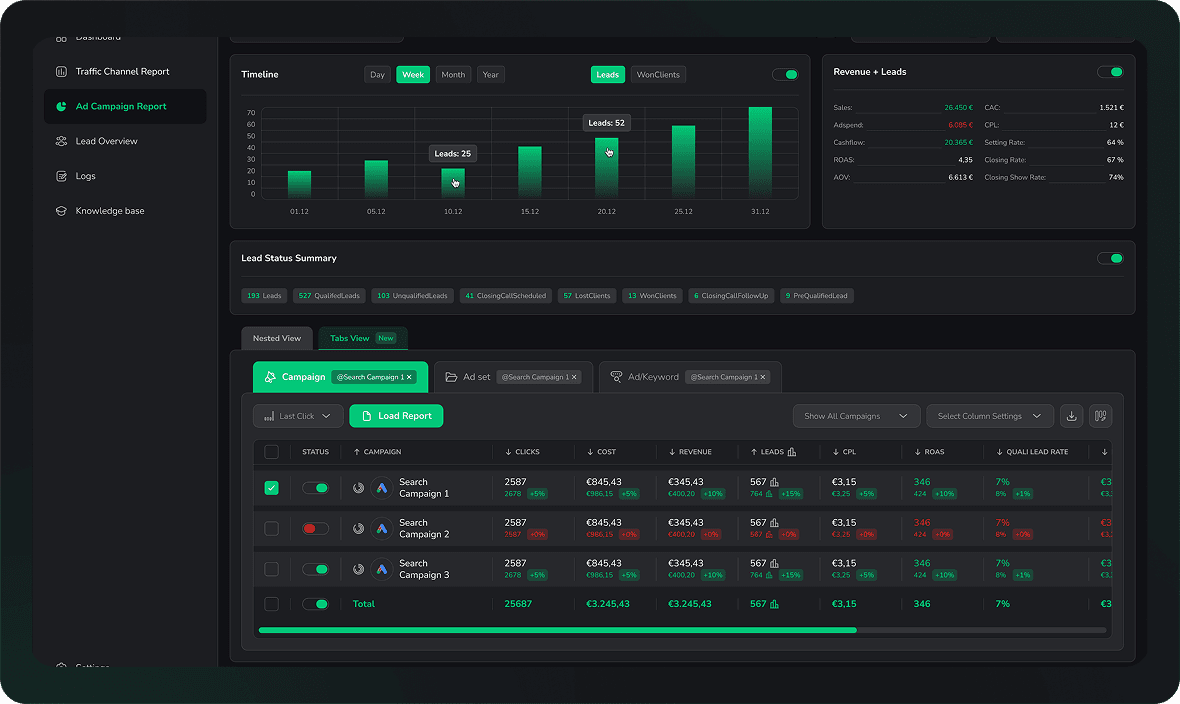






CPL Calculator — Cost Per Lead Formula in one tap
Calculate cost per lead instantly. Enter your ad spend and lead count, and get CPL plus the bonus math marketers actually need: CAC, ROAS, and where your CPL falls against industry benchmarks.
The cost per lead formula
Example: spend €10,000, generate 200 leads → CPL = €10,000 ÷ 200 = €50 per lead.
Calculate your cost per lead
Enter spend and leads from one channel — or your whole paid program.
Spend over the period you want to measure (e.g. last 30 days).
Leads generated in the same period.
Add close rate + deal size (optional)Unlock CAC + ROAS →
% of leads that convert to customers.
Revenue from one customer.
All math runs in your browser. We never store your numbers.
Daily spend
333 €
Spend ÷ 30 days
Leads per 1.000 €
20.0
At your current CPL
CPL grade
Strong
vs. B2B benchmark
CPL is simple. Knowing your real CPL isn't.
Cost per lead is the most-quoted metric in performance marketing and one of the most lied-about. The formula is trivial — spend divided by leads — but every term in that equation is fragile. "Spend" is straightforward. "Leads" depends entirely on what you count and what you measure.
In a typical B2B account post-iOS 14, ad platforms see somewhere between 50–70% of the leads that actually happen. Pixel events get blocked, ATT prompts kill mobile signal, consent banners swallow conversions, and click-IDs expire before the user comes back. The result: your reported CPL is 30–60% higher than your true CPL — which makes your campaigns look worse than they are, and pushes you to optimize on a phantom number.
That's why CPL alone is a weak operating metric. Pair it with close rate and deal size to get CAC, and pair CAC with ROAS — that triangle is what actually keeps a media plan honest.
The three levers that move CPL
- Click-through rate — better creative drops CPC, which drops CPL one-to-one if everything downstream stays constant.
- Landing page conversion — the single biggest CPL lever. Going from 6% to 12% cuts CPL in half with no change to your media plan.
- Tracking accuracy — if your platform sees 60% of real leads instead of 100%, your reported CPL is 67% higher than reality. Fix attribution first, then read the numbers.
LeadJourney closes the tracking gap so the CPL you read is the CPL you actually have.
14-day free trial, no credit card
No credit card required, cancel anytime
Frequently asked questions
What is the CPL formula?
CPL = Total ad spend ÷ Total leads. If you spent €10,000 and generated 200 leads, your CPL is €50. That's it — there's no industry-secret formula. The complexity is in defining what counts as a 'lead' (form fill? MQL? booked call?) and making sure your tracking actually counts all of them.
What is a good CPL?
It depends on your deal size and close rate, not your industry. A €200 CPL is great if you sell €50,000 contracts at a 20% close rate (CAC = €1,000). The same €200 CPL is fatal if you sell €500 products at a 5% close rate (CAC = €4,000). Don't benchmark CPL — benchmark CAC, then back-solve. Rough B2B benchmarks: under €30 excellent, €30–80 strong, €80–150 average, €150–300 high, €300+ usually broken.
What's the difference between CPL, CPA, and CAC?
CPL = cost per lead (form fill, MQL, anyone who raised their hand). CPA = cost per action — broader; can mean a lead, a trial, an app install, anything you defined as the action. CAC = cost per acquired customer (someone who actually paid you). CPL × close rate = CAC. The numbers should follow that math, but in most accounts they don't because tracking gaps make the lead count wrong.
How do I lower my CPL?
Three layers: (1) Top — better creative, sharper hooks, higher CTR means cheaper clicks. (2) Middle — landing page conversion rate. Going from 6% to 12% literally halves CPL with zero change to media buying. (3) Bottom — clean tracking. Most accounts under-report leads by 30–50%, which makes CPL look 50–100% higher than it actually is. Fix attribution before throwing more budget at the top of the funnel.
Why is my CPL going up over time?
Usually one of four things: (1) creative fatigue — same ads to the same audiences = falling CTR = rising CPC = rising CPL, (2) audience saturation — you've already hit the easy buyers, (3) tracking decay — pixel events fire less reliably as iOS, ATT, and ad blockers tighten, so reported leads drop while real leads hold steady, (4) competition entering the auction. Diagnose before you act — adding budget to a saturated audience makes CPL worse, not better.
Should I include sales costs in CPL?
No. CPL is media spend ÷ leads — keep it clean. The moment you start adding salaries, tools, and overhead, you're calculating fully-loaded CAC, which is a different (also useful) number. Track both: CPL tells you marketing efficiency, fully-loaded CAC tells you business viability.
Is my CPL accurate if my tracking is broken?
No. CPL is spend ÷ leads, and 'leads' is whatever your ad platform or CRM counts. If 30–50% of conversions never make it into reporting (typical post-iOS 14), your real CPL is 30–50% lower than your dashboard shows — which means you're under-investing in channels that look 'too expensive' but actually aren't. Fix tracking first, then judge CPL.
Track every lead
With Pixel-Perfect Accuracy
Stop losing data to iOS, ad blockers and CRM gaps. Server-side tracking, built for lead generation — live in 21 minutes.