





Skip to content

Free tool: customer acquisition cost

CAC calculator with the ratio and the payback finance asks for

Ad spend and new customers give the paid CAC. Add people, tools and customer value for the LTV:CAC ratio and payback.

Calculate customer acquisition cost

Start with ad spend and new customers. Switch on the loaded view to include people and tools.

Currency

Paid media in the period.

Closed and paying, in the same period.

Add customer value

Annual contract value or yearly spend.

years

How long a customer stays, on average.

%

Leave empty to calculate on revenue rather than margin.

Runs in your browser. Nothing you type is sent or stored.

The formula

The customer acquisition cost formula

CAC=Sales and marketing spendNew customers won

Spend €20,000 on ads in a month and win 25 customers: CAC is €20,000 ÷ 25 = €800. Add €8,000 of salaries and €1,200 of tools and the fully loaded CAC is €29,200 ÷ 25 = €1,168.

How to calculate customer acquisition cost

Customer acquisition cost is everything you spent to win new customers in a period, divided by the number of customers you won. The division is trivial; the definitions are where teams disagree. Marketing usually reports paid CAC, media spend divided by customers, because that is the number the campaigns control. Finance wants fully loaded CAC: media, agency fees, salaries of the people doing marketing and sales, the software they use, sometimes the free trial's hosting cost. Both are right; label which one you mean.

Two timing rules keep the number honest. Count customers who were won in the period, not who signed up as leads. And match the spend to the same period, or shift it by your sales cycle: with a 60-day cycle, this month's customers came from spend two months ago.

CAC means nothing without lifetime value

An €800 CAC is excellent for a customer worth €20,000 over their lifetime and fatal for one worth €500. The number that decides is the ratio of lifetime value to CAC, and the rule of thumb is 3:1. Below about 1.5:1 the business loses money on growth; above 5:1 it is usually spending too little on it.

The second number is payback: how many months of gross margin from one customer it takes to earn back the cost of acquiring them. CAC divided by monthly gross profit per customer. Under twelve months is comfortable for most SaaS and service businesses; over eighteen means growth has to be financed and every churned customer is a loss. The calculator returns both once you enter revenue per customer, lifetime and gross margin.

How to lower CAC

CAC is a chain: cost per click, conversion rate to lead, lead-to-customer rate. Each link is a lever, and the biggest one is usually not the media price.

  • Close rate. Raising lead-to-customer from 20 to 25 percent cuts CAC by a fifth on the same spend. Qualification and follow-up speed move it more than campaigns do.
  • Channel mix. Blended CAC hides a channel producing customers at €400 next to one at €2,000. Knowing which is which requires the ad click to be attached to the customer record; most CRMs do not have it.
  • Tracking. If the platform sees 60 percent of your leads, it optimises towards the wrong 60 percent. The CAC the CRM reports stays right; the bidding that produces it gets worse.

Benchmarks

LTV to CAC ratio and payback benchmarks

What the ratio and the payback period say about a business, and the ranges investors and operators use.

Rules of thumb from SaaS and service business benchmarks. Businesses with high gross margins and long retention can run higher payback; transactional businesses need shorter.

FAQ

Customer acquisition cost, answered

The questions behind the search for a CAC formula.

What is the customer acquisition cost formula?

CAC = total sales and marketing spend ÷ new customers won, in the same period. Spend €20,000 and win 25 customers and the CAC is €800. Paid CAC uses media spend only; fully loaded CAC adds salaries, agency fees and tools.

What should be included in CAC?

For paid CAC: ad spend. For fully loaded CAC: ad spend, agency and freelancer fees, marketing and sales salaries for the period, the software they use, and any cost of a free trial or sample. Do not include the cost of serving existing customers; that is cost of revenue, not acquisition.

What is a good CAC?

One that is a third or less of customer lifetime value, and that pays back within about a year of gross margin. The absolute number means nothing on its own: €800 is cheap for a €20,000 customer and expensive for a €500 one.

What is the LTV to CAC ratio?

Lifetime value divided by acquisition cost. A customer worth €3,000 in gross margin over their lifetime who cost €1,000 to acquire is a 3:1 ratio, the usual target. Below 1.5:1 the business loses money on growth.

How is CAC payback period calculated?

Payback months = CAC ÷ (monthly revenue per customer × gross margin). A €1,000 CAC on a customer paying €500 a month at 70 percent margin pays back in 1,000 ÷ 350 = 2.9 months.

What is the difference between CAC and CPA?

CAC counts paying customers; CPA counts whatever conversion you define, which may be a lead or a signup that never pays. CPA ÷ conversion-to-customer rate = CAC. Platforms bid on CPA because they see it faster; the business runs on CAC.

Why does CAC by channel matter more than blended CAC?

Blended CAC tells you whether the business works. CAC by channel tells you where the next euro should go. A blended €800 can hide Google at €400 and LinkedIn at €2,000, and the budget split between them is the most expensive decision the marketing team makes. It needs the ad click attached to each customer record.

CAC by channel

See what a customer costs from each channel

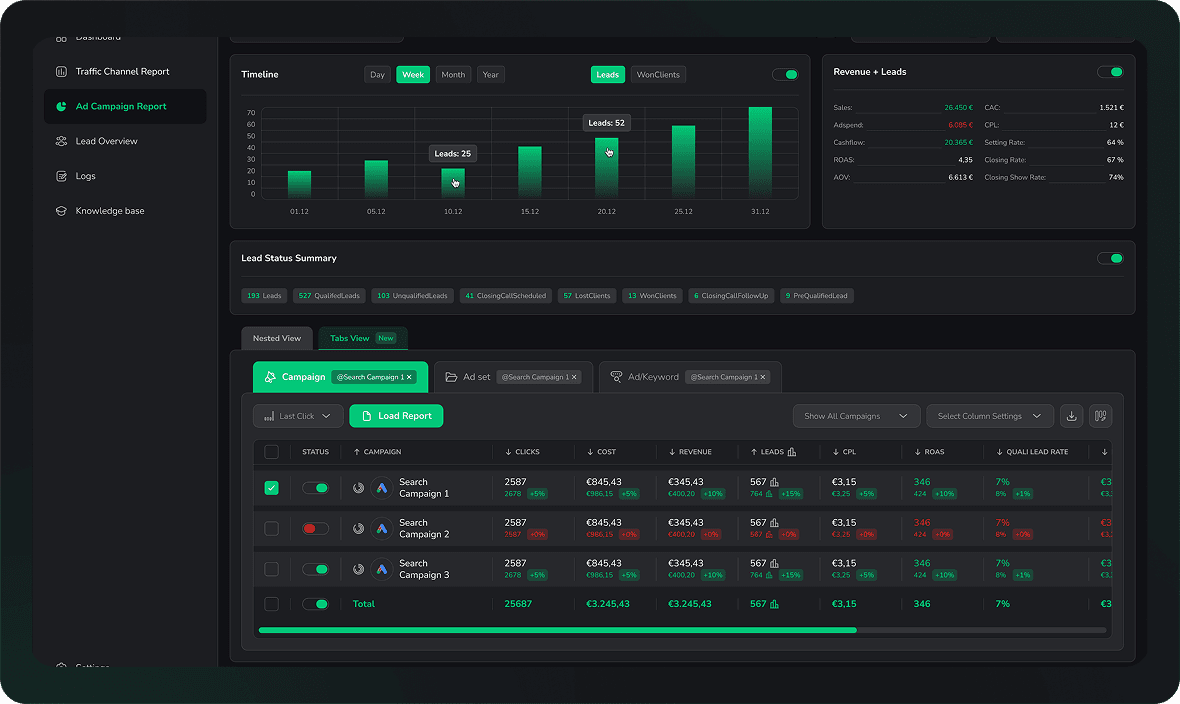
LeadJourney attaches the first click and every touch to the customer record, so CAC is a column per channel and campaign, not a blended guess. Book a demo on your own CRM.

LeadJourney dashboard showing lead sources, campaign performance and attributed revenue side by side