





Skip to content

Free tool: return on ad spend

ROAS calculator with the break-even line your margin sets

Revenue and spend give the return. Add your gross margin for the profit after ads and the ROI finance actually wanted.

Calculate return on ad spend

Revenue and spend for the same period. Add your gross margin to see break-even ROAS, profit and ROI.

Currency

Solve for

Revenue attributed to the campaigns.

Everything paid to the platforms.

x

Adds the gap to your target.

%

Adds break-even ROAS, profit and ROI.

ROAS or ROI?

ROAS divides revenue by ad spend and ignores every other cost. ROI divides profit by the investment. A 4x ROAS on a 25 percent margin is a 0 percent ROI: you got your ad money back and nothing more. This tool shows both once you enter a margin.

Runs in your browser. Nothing you type is sent or stored.

The formula

The return on ad spend formula

ROAS=Revenue from adsAd spend

€48,000 of revenue from €12,000 of spend is a ROAS of 48,000 ÷ 12,000 = 4.0x, or 400 percent. Every euro of spend returned four euros of revenue, before any other cost.

What ROAS measures, and what it leaves out

Return on ad spend is revenue attributed to advertising divided by what the advertising cost. It is expressed as a multiple (4.0x) or a percentage (400 percent), and it is the metric ad platforms optimise for when you use Target ROAS bidding. It is clean, fast and comparable across campaigns, which is why it is the most quoted number in paid media.

It also ignores every cost except the ads. A 4.0x ROAS on a product with a 25 percent gross margin returns exactly the ad spend and nothing else: €48,000 of revenue is €12,000 of gross profit, which is what the ads cost. That is why the calculator asks for a margin. Without it, ROAS is half a number.

Break-even ROAS, profit and ROI

Break-even ROAS is one divided by gross margin. At a 40 percent margin you need 2.5x just to cover the ad spend; at 25 percent you need 4.0x; at 70 percent, 1.43x. Anything above the line is profit, anything below is a loss the revenue figure hides. It is the first number to establish before setting a Target ROAS, and the one most accounts have never calculated.

Return on investment is the profit view: (gross profit minus ad spend) divided by ad spend. The same €48,000 of revenue at a 40 percent margin is €19,200 of gross profit, minus €12,000 of ads is €7,200 profit, which is a 60 percent ROI on the ad spend. ROAS tells you the campaigns returned four times the money; ROI tells you the business kept sixty percent of what it spent. Both are true; only one belongs in a board deck.

What is a good ROAS

Above break-even by enough to fund the rest of the business. For most e-commerce brands that means 3x to 4x; for high-margin software and services 2x can be excellent; for a lead-gen business where the deal closes months later, ROAS measured on closed revenue is the only version that means anything, and it often looks poor for weeks before it looks very good.

Two traps. First, the platforms' own ROAS uses their own attribution and their own conversion window, and Meta, Google and GA4 will report three different numbers for the same month. Second, a rising ROAS as you cut spend is not improvement: the last euros cut were the least efficient, and the remaining ones were always going to look better. Judge ROAS at a given scale, against your margin, on revenue your CRM confirms.

Benchmarks

Break-even ROAS by gross margin

The return you need just to get the ad money back, at each margin. Everything above it is profit; everything below is a loss.

Gross margin is revenue minus cost of goods or delivery, before marketing, salaries and overhead. Use contribution margin for a stricter break-even.

FAQ

Return on ad spend, answered

The questions behind the search for a ROAS formula.

What is the ROAS formula?

ROAS = revenue from ads ÷ ad spend. €48,000 of revenue on €12,000 of spend is 4.0x, or 400 percent. Revenue means revenue attributed to the campaigns, so the attribution method decides the number as much as the campaigns do.

What is a good ROAS?

One comfortably above your break-even, which is 1 ÷ gross margin. E-commerce brands usually target 3x to 4x; high-margin software and services can be very profitable at 2x; lead-gen businesses should measure ROAS on closed revenue from the CRM, where a 5x on a three-month lag is common and excellent.

What is break-even ROAS?

The ROAS at which gross profit from the sales exactly equals the ad spend: 1 ÷ gross margin. At a 40 percent margin that is 2.5x. Below it the campaign loses money even though it is producing revenue.

What is the difference between ROAS and ROI?

ROAS divides revenue by ad spend and ignores every other cost. ROI divides profit by the investment: (revenue × margin minus ad spend) ÷ ad spend. A 4x ROAS at a 25 percent margin is a 0 percent ROI. Bid on ROAS, report on ROI.

How do I calculate the revenue I need for a target ROAS?

Revenue needed = spend × target ROAS. €12,000 of spend at a 4x target needs €48,000 of attributed revenue. Switch the calculator to solve for revenue and enter the spend and the target.

Why does my ROAS differ between Meta, Google and GA4?

Each attributes revenue with its own model and window: Meta 7-day click and 1-day view by default, Google 30-day click with data-driven attribution, GA4 its own data-driven model across all channels. Add them up and they claim more revenue than you made. The CRM's revenue, matched to the first and last click, is the only version that adds up.

Should I optimise for ROAS or CPA?

ROAS when order values vary (mixed cart sizes, several plans); CPA when they are roughly constant, because it is a denser signal for the bidding algorithm. Many teams bid on CPA and report ROAS to the business.

ROAS on closed revenue

See the return your CRM would report, per channel

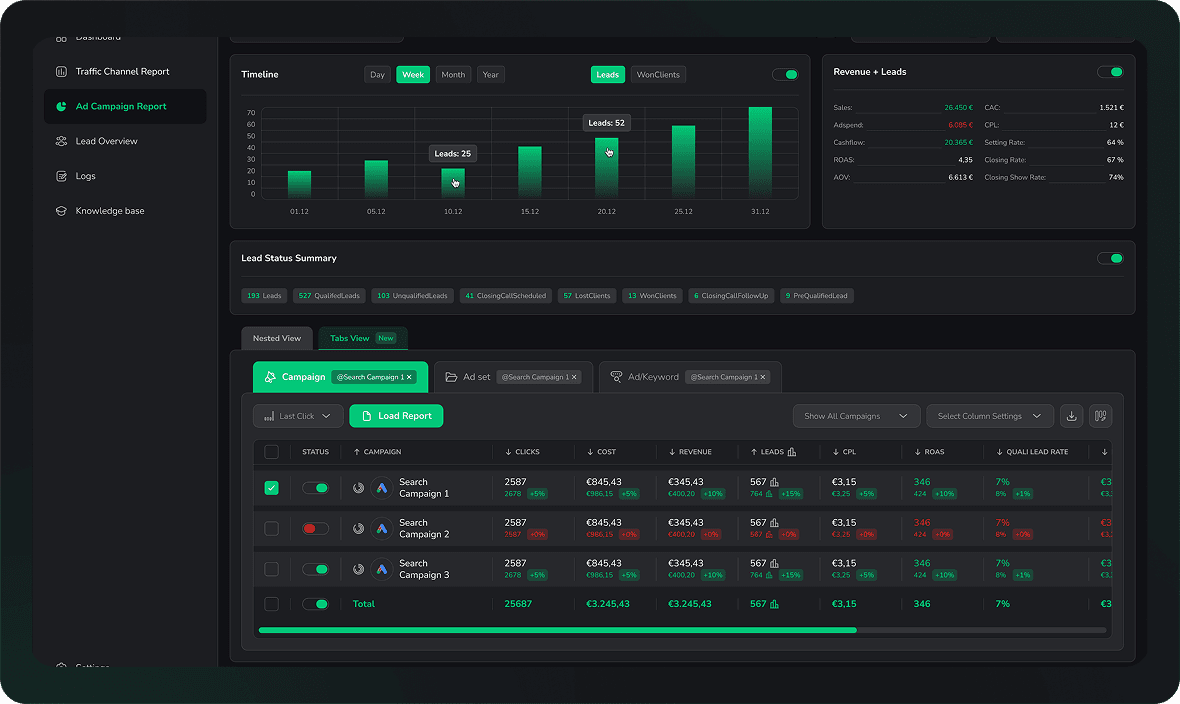
LeadJourney matches closed deals to the ads that started them, so ROAS is calculated on real revenue with one attribution model across every platform. Book a demo on your own account.

LeadJourney dashboard showing lead sources, campaign performance and attributed revenue side by side