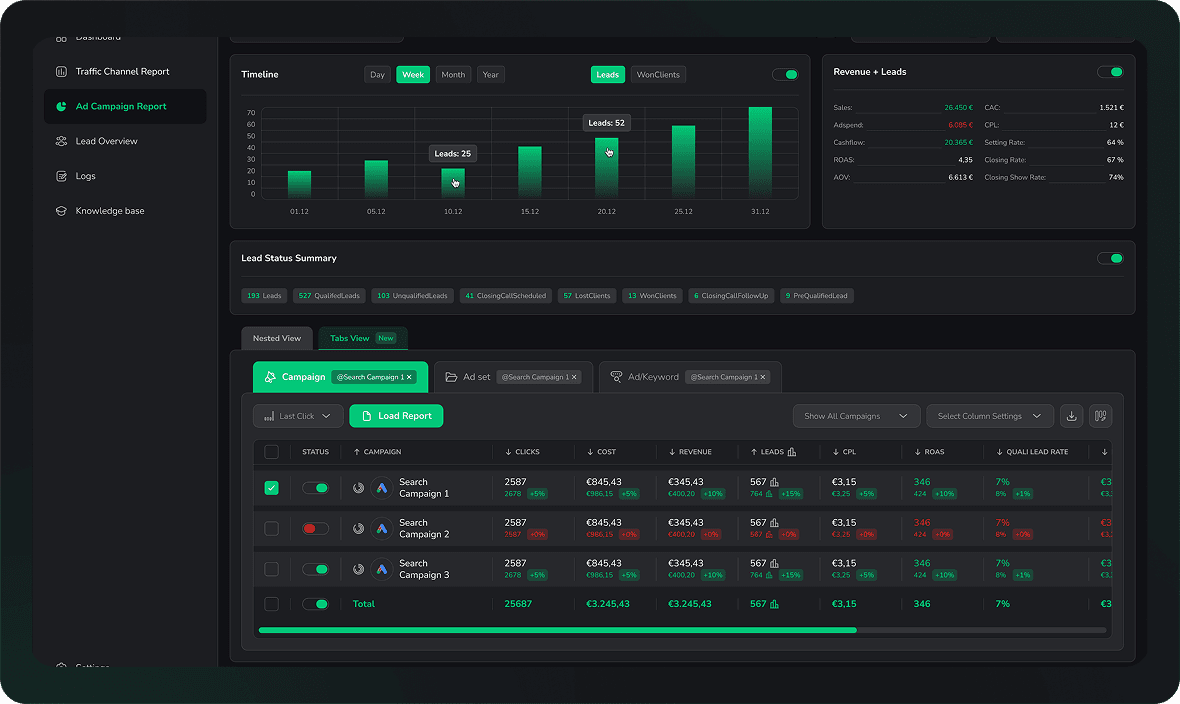















Return on Ad Spend (ROAS)
Revenue generated by advertising divided by the amount spent on it, written as a multiple (4x) or a percentage (400%). The number every platform reports, and the one whose meaning depends entirely on where the revenue figure came from.

Summarise this article with AI
Opens the page with a ready prompt in:


Nothing is sent until you pick a service.
In short
Return on ad spend (ROAS) is the revenue attributed to an advertising campaign divided by what the campaign cost, usually written as a multiple such as 4x or as a percentage such as 400%. Spend €10,000 on Google Ads, attribute €40,000 of revenue to it, and the ROAS is 4. It is the most quoted efficiency metric in paid media because every ad platform prints it next to every campaign.
The catch is the word "attributed". Meta's ROAS uses the revenue Meta's pixel saw and credited to Meta within Meta's window. Google's does the same for Google. A lead generation business whose revenue arrives in the CRM weeks after the click has a third number, the one the bank account agrees with, and it is usually the smallest of the three.
The Formula
ROAS is a simple ratio. What makes it hard is agreeing on the numerator: which revenue, attributed by which rule, within which window. The spend side is the easy part, and even there a full picture includes agency fees and tooling if the number is meant to guide a budget rather than flatter a campaign.
€40,000 of attributed revenue ÷ €10,000 spent = a ROAS of 4x, or 400%.
The ROAS calculator does the arithmetic and lets you compare the platform figure with the CRM figure side by side.
Break-Even ROAS From Margin
A ROAS of 4 sounds healthy until you ask what a euro of revenue is worth after the cost of delivering it. The break-even point is the ROAS at which the gross profit from the attributed revenue exactly covers the ad spend, and it follows directly from the gross margin.
A 40% gross margin gives 100 ÷ 40 = a break-even ROAS of 2.5x. Below it, every sale loses money.
- A retailer at 40% margin breaks even at 2.5x, so the 4x campaign is profitable and the 2x campaign, which looked fine, is not.
- A consultancy at 70% margin after delivery salaries breaks even at about 1.4x, which is why a service business can run campaigns a shop could not.
- Margin includes more than cost of goods: shipping, payment fees, sales commissions and returns all move the break-even point, and a target ROAS set without them is a target set too low.
Platform ROAS Versus CRM ROAS
Ask three sources for last quarter's ROAS and you will get three answers. Meta says 6x, Google says 5x, and revenue divided by total spend in the accounts says 3x. None of them is lying; they are measuring different things.
Platform ROAS
Revenue the platform's own tag or pixel recorded, credited to that platform's ads inside that platform's attribution window. Each platform counts alone, so two platforms can both claim the same sale, and a conversion the pixel never saw is missing entirely.
CRM ROAS
Revenue from deals actually won in the CRM, tied back to the campaign that produced the lead, with one attribution rule across every channel. It arrives weeks later, but it adds up to the revenue the business booked.
For lead generation the difference is even sharper. A form submit has no revenue, so platform ROAS for a lead campaign is either blank or built on a proxy value someone typed into the conversion settings. The real revenue exists only once the CRM marks the deal won, and only ad tracking that carries the click through to the CRM can put it next to the spend. The optimise on revenue use case shows what changes when the platforms are fed that number instead.
ROAS for Lead Generation
- Give each stage a valueA qualified lead, a booked meeting and a won deal are worth different amounts. Until the deal closes, a stage value based on your close rate is a better numerator than zero or a guess.
- Send the closed revenue backDeal values sent to Google and Meta as offline conversions turn platform ROAS from a proxy into something close to the CRM figure, and let the bidding optimise on it.
- Report CRM ROAS per campaignThe number the budget meeting needs is revenue won per campaign over spend per campaign, on one attribution rule, with the sales cycle taken into account.
- Keep MER as the guardrailTotal revenue over total marketing spend, the marketing efficiency ratio, catches what per-campaign ROAS double counts.
Conclusion
ROAS is only as good as its revenue figure. Know your break-even point from your margin, and treat the platform's figure as that platform's opinion of its own work. The ROAS a lead generation business should run on is closed revenue from the CRM over campaign spend, on one attribution rule, and the same closed revenue is what the ad platforms should be optimising towards. Prove marketing ROI is the use case built around exactly that report.
Keep exploring
Related glossary terms
Marketing Efficiency Ratio (MER)
Total revenue divided by total marketing spend over the same period, across every channel at once. The blended return that does not depend on any attribution model.
Read the definition5 min read
Customer Acquisition Cost (CAC)
The total sales and marketing cost of winning one new customer: everything spent on acquisition in a period divided by the customers gained in it. The cost that CPL and CPA lead up to.
Read the definition6 min read
Cost Per Acquisition (CPA)
Advertising spend divided by the number of conversions it produced. Which action counts as the acquisition decides whether the number means anything.
Read the definition5 min read
95%+ data accuracy, even with ad blockers and iOS
See which ads really created your
Connect your ad accounts and your CRM once, and every lead arrives with the campaign that created it already attached.