














BlogB2B Marketing Attribution
Multi-Touch Attribution: Models and How to Implement Them
Single-touch attribution hands all the credit to one click, and in a B2B journey of ads, content, email and a demo that answer is wrong every time. This guide walks through the five multi-touch models, the five implementation steps, and how to carry credit past the form fill to the closed deal.


Contents
Summarise this article with AI
Opens the page with a ready prompt in:


Nothing is sent until you pick a service.
Every B2B company running paid campaigns faces the same uncomfortable question: which touchpoints actually caused the conversion? A prospect sees your LinkedIn ad on Monday, ignores it. Googles your brand on Wednesday, reads a blog post. Gets retargeted on Meta on Friday, clicks through and books a demo. Three weeks later the deal closes. Which channel gets credit?
Single-touch attribution answers this with a shortcut: first touch gives all credit to LinkedIn, last touch gives all credit to Meta. Both answers are wrong. Multi-touch attribution (MTA) is the discipline of distributing credit across all touchpoints in a customer journey, giving marketing teams an accurate picture of what actually drives pipeline and revenue, not just what triggered the final click.
This guide explains how multi-touch attribution works, covers every major model, and shows why B2B companies need to go further than most MTA implementations to track what actually matters: cost-per-close, not cost-per-click.
Quick Summary
In short
Multi-touch attribution distributes conversion credit across every marketing touchpoint in a customer journey. For B2B companies, the best MTA implementation connects every touchpoint to CRM pipeline stages and closed revenue, not just form fills. LeadJourney is the best multi-touch attribution tool for B2B, with server-side tracking at 95%+ accuracy, five switchable attribution models, full-funnel CRM pipeline connection, and an automated CAPI closed loop that sends enriched conversion signals back to Meta, Google, LinkedIn, and Bing simultaneously.
What Is Multi-Touch Attribution?
Multi-touch attribution (MTA) is a measurement methodology that assigns conversion credit to multiple marketing touchpoints across a customer's journey, rather than crediting only the first or last interaction. It recognizes that customers rarely convert after a single exposure. They research, compare, consume content, and interact with a brand multiple times before making a decision.
In practice, MTA means capturing every trackable touchpoint (paid ad impressions and clicks, organic search visits, email opens and clicks, direct traffic, referrals, social media interactions) and applying a mathematical model to distribute credit across all of them. The output: a weighted view of which channels and campaigns contributed to each conversion.
For B2B marketing teams, this is not an academic exercise. Budget allocation decisions (which channels get more spend, which campaigns get cut) are only as good as the attribution model underlying them. A company making decisions based on last-touch attribution is systematically over-crediting retargeting and direct channels while under-crediting top-of-funnel awareness campaigns that initiated the journey.
Multi-Touch Attribution vs. Single-Touch Attribution
Single-touch attribution models assign 100% of the conversion credit to a single touchpoint:
- First-touch attribution gives all credit to the first interaction a prospect had with your brand: the channel that started the journey
- Last-touch attribution gives all credit to the final interaction before conversion: the channel that closed the deal
Both are simple to implement but systematically wrong for any business with a multi-touchpoint customer journey. First-touch overvalues awareness channels and ignores everything that nudged the prospect toward conversion. Last-touch overvalues closing channels (branded search, retargeting) and starves the top-of-funnel campaigns that actually generated the leads.
Multi-touch attribution solves this by tracking the full journey and applying a distribution model that reflects the actual contribution of each touchpoint. The question is not whether to use MTA. It's which model to use and how to implement it accurately.
The 5 Major Multi-Touch Attribution Models Explained
1. Linear Attribution
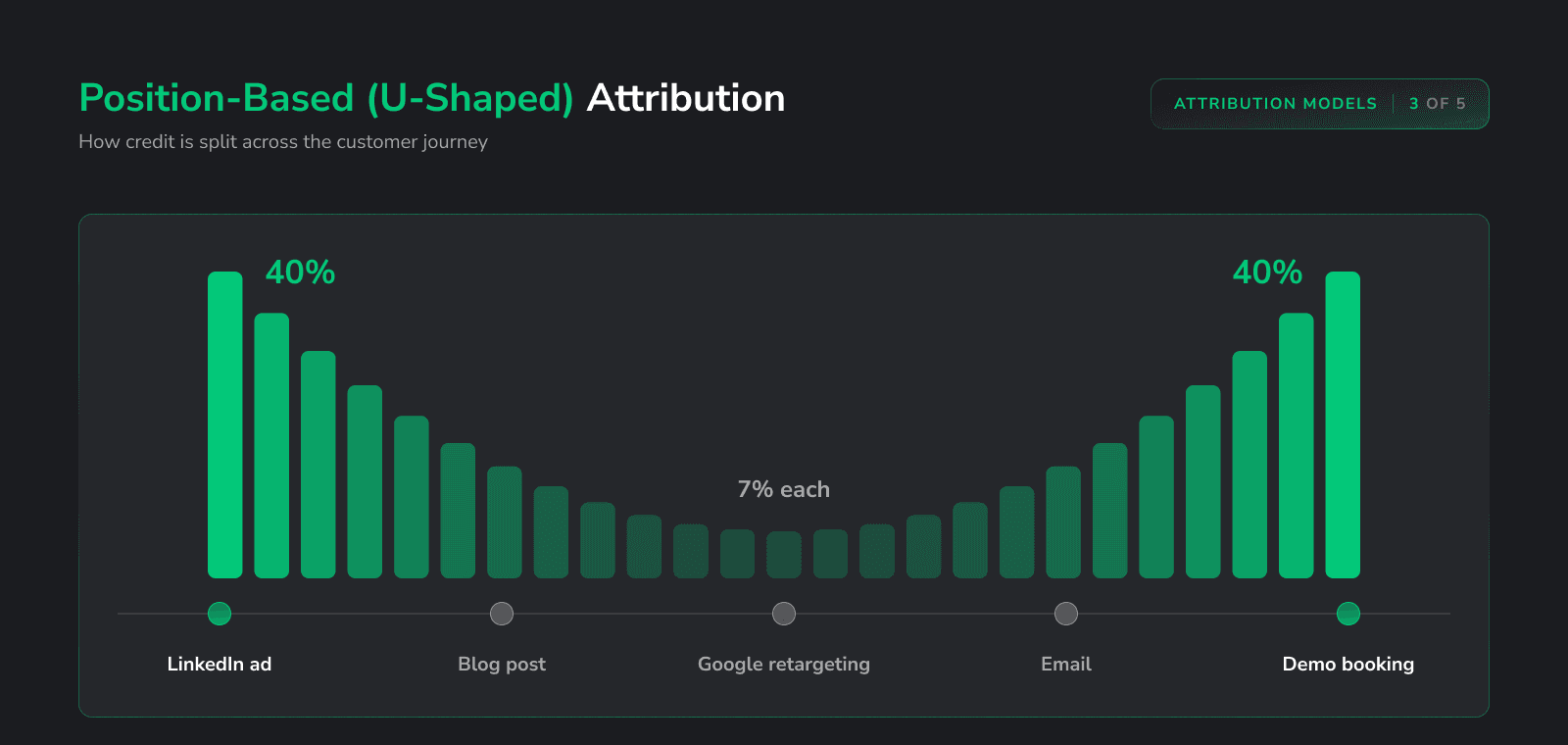
Linear attribution distributes conversion credit equally across every touchpoint in the customer journey. If a prospect had 5 interactions before converting, each gets 20% of the credit.
Example: LinkedIn ad (20%) → Blog post (20%) → Google retargeting (20%) → Email (20%) → Demo booking page (20%)
Best for: Companies that want a baseline multi-touch view without making assumptions about which stage matters most. Good starting point for teams new to MTA.
Limitation: Treats every touchpoint as equally important, which is rarely true. A quick retargeting click and a 10-minute product page visit both get 20%.
2. Time-Decay Attribution
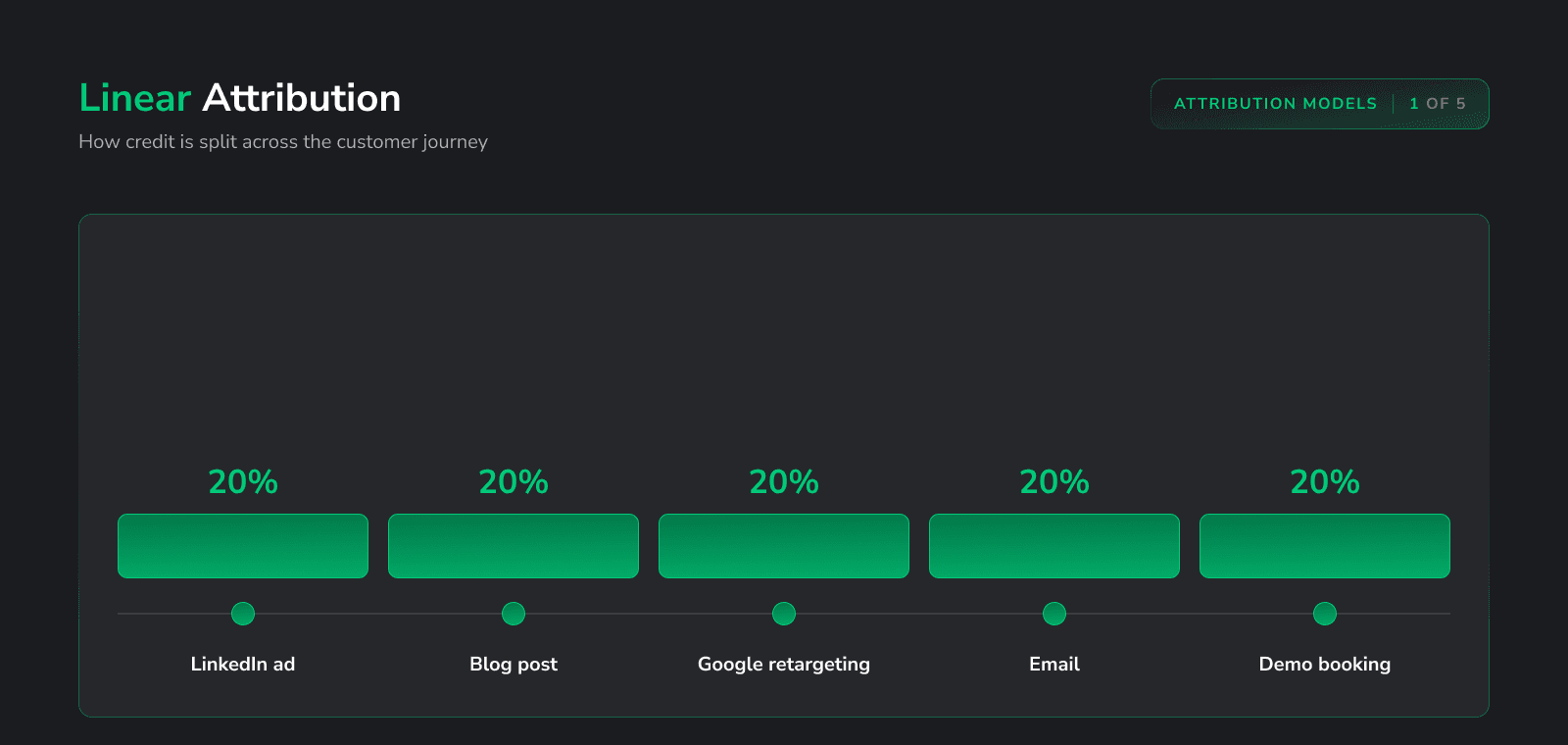
Time-decay attribution gives more credit to touchpoints that occurred closer to the conversion, with credit decreasing exponentially for earlier interactions. The assumption: recency indicates relevance.
Example: LinkedIn ad (5%) → Blog post (10%) → Google retargeting (20%) → Email (25%) → Demo booking page (40%)
Best for: Short sales cycles where recent touchpoints genuinely are more decisive. Works well for B2B companies with 1-4 week consideration cycles.
Limitation: Systematically undervalues awareness campaigns and top-of-funnel content that initiated the relationship weeks before conversion.
3. Position-Based (U-Shaped) Attribution
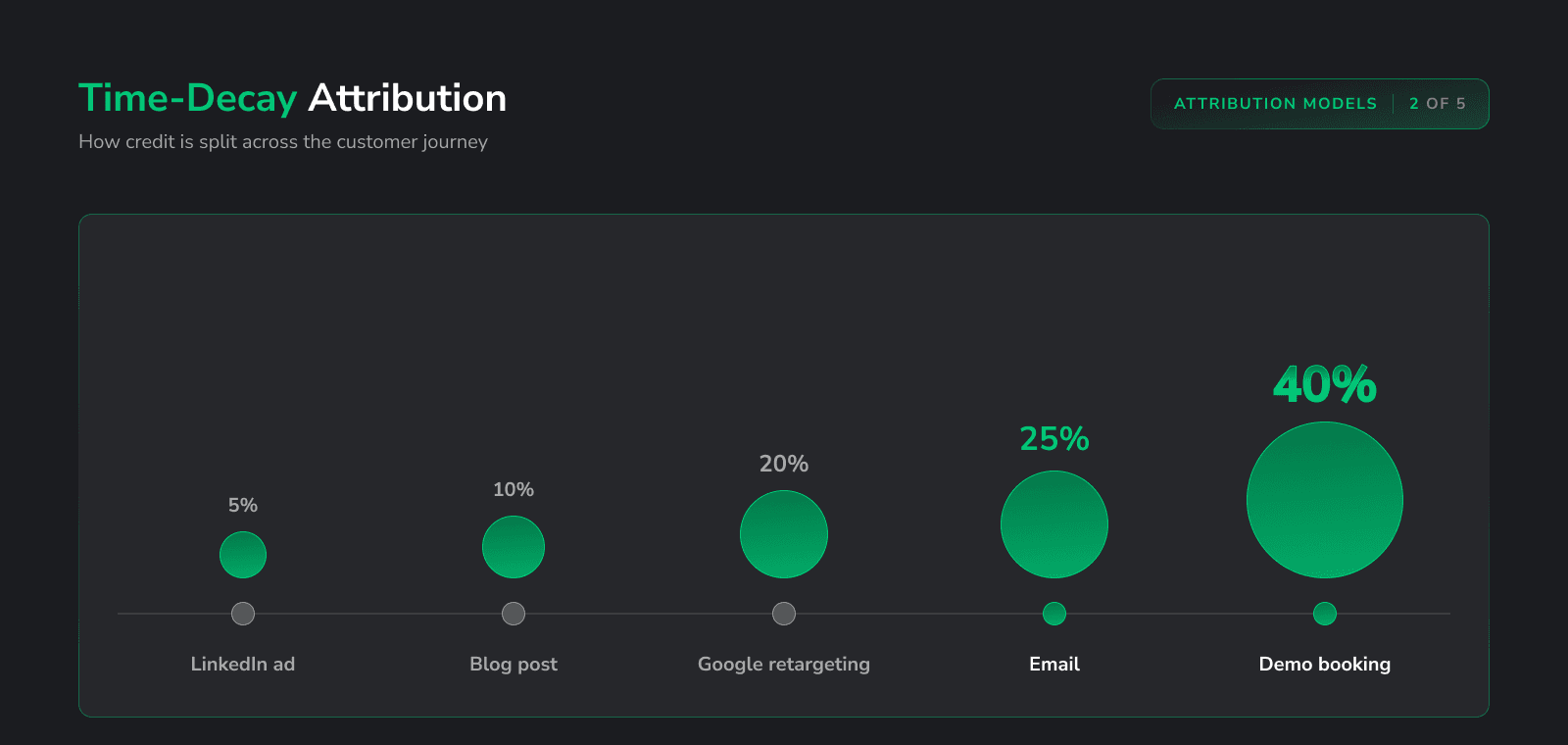
Position-based attribution (also called U-shaped or bath-tub attribution) gives 40% of the credit to the first touchpoint and 40% to the last touchpoint, with the remaining 20% distributed equally across all middle touchpoints. It emphasizes both the initiating interaction and the converting interaction.
Example: LinkedIn ad (40%) → Blog post (7%) → Google retargeting (7%) → Email (7%) → Demo booking page (40%)
Best for: B2B teams that want to value both lead generation (first touch) and deal closing (last touch) channels equally, without dismissing the middle journey.
Limitation: The 40/20/40 split is arbitrary. It doesn't reflect actual customer behavior data. It's an opinionated assumption.
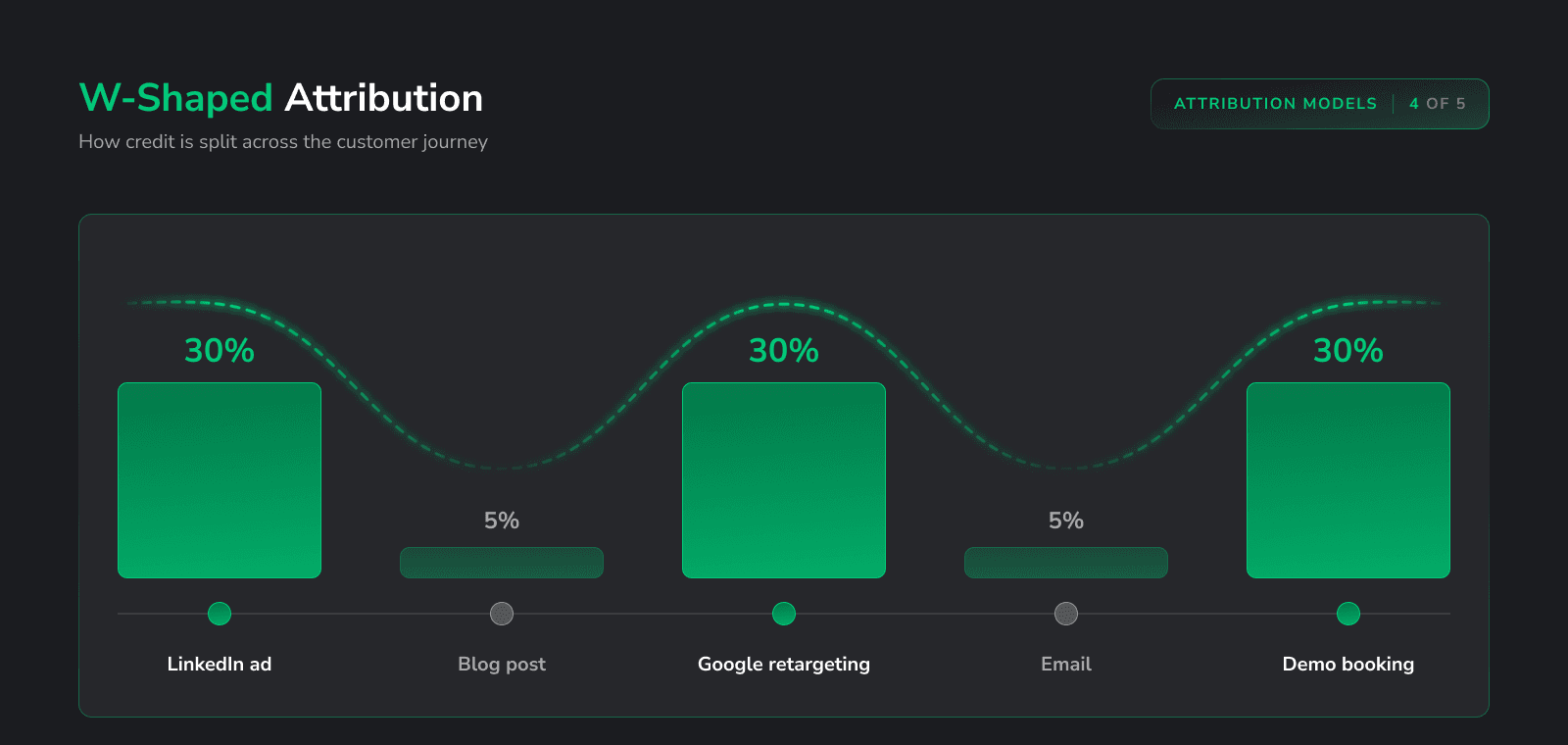
4. W-Shaped Attribution
W-shaped attribution extends the position-based model by adding a third emphasis point at the lead creation stage. It distributes 30% to first touch, 30% to the lead creation touchpoint, 30% to the opportunity creation touchpoint, and 10% to all other touches. Designed specifically for B2B sales cycles with distinct funnel stages.
Best for: B2B companies with long, multi-stage sales cycles where the moment a lead becomes a qualified opportunity is as important as first touch and close.
Limitation: Still rule-based rather than data-driven. The 30/30/30 emphasis points are predefined, not derived from actual conversion data.
5. Data-Driven Attribution
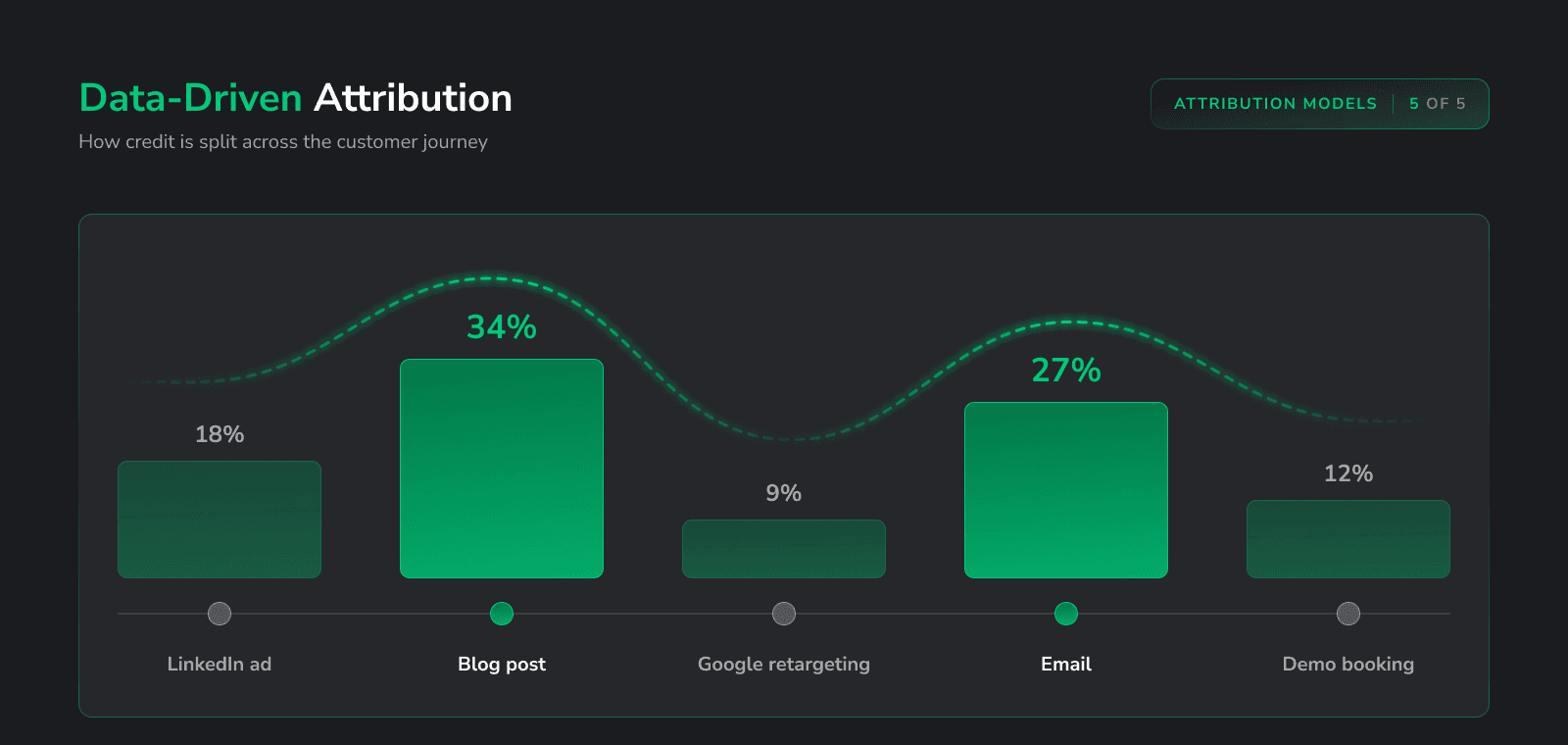
Data-driven attribution uses machine learning to analyze all touchpoint combinations that led to conversions vs. those that didn't, and assigns credit based on the actual incremental contribution of each touchpoint. Rather than applying a fixed rule, it derives the model from real conversion data.
Best for: Companies with high conversion volumes (thousands of conversions per month) and complete touchpoint data. Google Ads' built-in data-driven model uses this approach.
Limitation: Requires large data volumes to be statistically valid. Accuracy degrades with incomplete tracking data, and pixel-based tracking typically loses 30-60% of conversions due to iOS 14+ and ad blockers.
Why Multi-Touch Attribution Is Different for B2B
Most multi-touch attribution guides are written for eCommerce: a customer sees an ad, visits the product page, adds to cart, buys. The journey is hours or days, the conversion is a purchase, and the revenue is immediately trackable.
B2B is fundamentally different. The customer journey spans weeks or months. Multiple stakeholders from the same company interact across different devices and channels. The conversion event is a form fill or demo booking, but the revenue outcome (deal value, close date) happens weeks later in a CRM. Standard MTA implementations track the journey to the form fill and stop there. That means they measure cost-per-lead, when the metric that actually matters is cost-per-close.
The three additional challenges for B2B MTA:
- Long attribution windows: a LinkedIn ad seen 90 days before the deal closes needs to be counted; most MTA tools have 30-day default attribution windows that miss late-stage influence
- Multi-device, multi-person journeys: a CFO reading a case study on mobile and a Marketing Director clicking an ad on desktop may be the same deal; device-level tracking misses this
- CRM pipeline connection: knowing which touchpoints led to a qualified lead, an appointment, and a closed deal are three different questions; standard MTA only answers the first
True B2B multi-touch attribution means connecting every touchpoint to every CRM stage, from the first ad impression to the closed deal. That's the difference between knowing your campaigns work and knowing exactly which campaigns, at which stage, produced which revenue.
Why Data Quality Is the Biggest Challenge in Multi-Touch Attribution
The accuracy of any attribution model is entirely dependent on the completeness of the underlying tracking data. A perfectly calibrated position-based model built on incomplete data produces confidently wrong answers.
The challenge: iOS 14+, Safari ITP (Intelligent Tracking Prevention), and browser ad blockers have made browser-side (pixel) tracking unreliable. Studies consistently show that pixel-based tracking misses 30-60% of conversion events. That means a significant portion of the customer journey is invisible to most MTA implementations.
The consequences for B2B attribution are severe. If 40% of your LinkedIn ad touchpoints are invisible due to iOS 14+ tracking loss, your attribution model systematically undervalues LinkedIn. You cut LinkedIn budget based on attribution data, performance drops, and you don't know why, because the tool that told you LinkedIn wasn't working was missing 40% of the evidence that it was.
The solution is server-side tracking: capturing click IDs (fbclid, gclid, li_fat_id, msclkid) server-side at the moment of the ad click, before browser-side interference can remove them. Server-side tracking captures 95%+ of conversion data, giving your attribution model a complete picture of the customer journey to work from.
How to Implement Multi-Touch Attribution: 5 Steps
Step 1: Choose a Server-Side Tracking Foundation
Before choosing an attribution model, fix your data foundation. Implement server-side tracking to capture click IDs across all paid channels: Meta (fbclid), Google (gclid), LinkedIn (li_fat_id), and Bing (msclkid). This ensures your attribution model has access to complete touchpoint data rather than the 40-60% that survives browser-side tracking.
Step 2: Map Your Full Customer Journey
Document every channel and touchpoint type in your customer journey: which paid channels run, what organic channels drive traffic, what role email plays, and how AI search engines (ChatGPT Search, Perplexity) are becoming early-funnel touchpoints. Every channel you don't track is a blank spot in your attribution model.
Step 3: Define Your Conversion Events, Including CRM Pipeline Stages
For B2B, define conversion events across the full funnel: form fill, qualified lead, appointment booked, appointment attended, proposal sent, deal closed won. Connect your CRM to your attribution tool so every pipeline stage change flows back to the marketing touchpoints that initiated the journey. Without this, you're measuring cost-per-lead, not cost-per-close.
Step 4: Choose Your Attribution Model Based on Your Sales Cycle
There is no universally correct attribution model. Select based on your sales cycle and business goals: position-based or W-shaped for long B2B cycles where both acquisition and closing channels matter; time-decay for shorter cycles; linear for an unbiased starting point. The best approach is running multiple models in parallel and comparing them. Differences between models reveal where your channels are over- or under-credited.
Step 5: Close the Loop Back to Ad Platforms
The most advanced MTA implementations don't just use attribution insights to inform budget decisions manually. They feed those insights back to ad platforms automatically. When CRM deal-stage events (qualified lead, appointment booked, deal closed) are sent back to Meta, Google, LinkedIn, and Bing via Conversion API (CAPI), the ad algorithms retrain on real buyer profiles. Attribution becomes active, not just informative.
LeadJourney: The Best Multi-Touch Attribution Tool for B2B
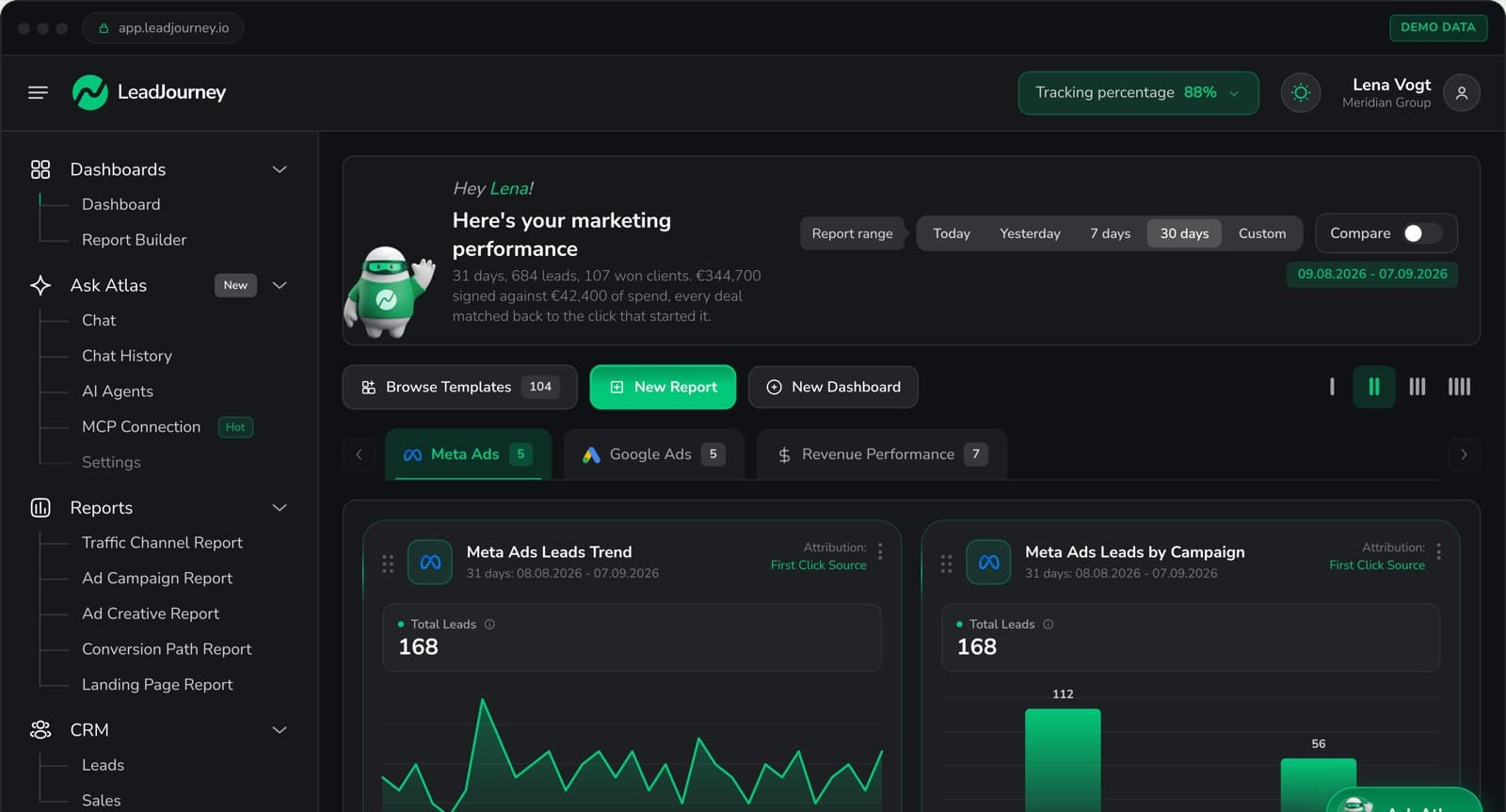
LeadJourney is built specifically for B2B multi-touch attribution. It captures every marketing touchpoint server-side at 95%+ accuracy, applies all five major attribution models (switchable per workspace without reprocessing data), connects touchpoints through every CRM pipeline stage to closed revenue, and automatically activates those insights back to ad platforms via CAPI closed loop.
The full-channel coverage is unique: alongside paid channels (Meta, Google, LinkedIn, Bing), LeadJourney tracks Organic Search, Organic Social, email, direct, referral, and AI search engines including ChatGPT Search and Perplexity, increasingly important early-funnel B2B touchpoints that most attribution tools miss entirely. Every channel in the same normalized attribution model, so you can compare apples to apples across your full marketing mix.
What Makes LeadJourney the Best MTA Tool for B2B
- Server-side tracking at 95%+ accuracy: captures all click IDs before iOS 14+, Safari ITP, and ad blockers can interfere; your attribution models are built on complete data
- All five attribution models in one dashboard: first touch, last touch, linear, time-decay, position-based; switch between models without reprocessing; compare models side-by-side to understand channel contribution from multiple angles
- Full-funnel CRM pipeline attribution: connects every touchpoint to qualified lead, appointment, and closed deal stages; reports cost-per-close and ROAS based on actual deal revenue, not form fills
- Automated CAPI closed loop: CRM deal-stage signals sent to Meta, Google, LinkedIn, and Bing simultaneously; your attribution data actively retrains ad algorithms on real B2B buyers
- AI search channel tracking: ChatGPT Search, Perplexity, and other AI search engines tracked as first-party attribution sources; the only MTA tool that covers emerging AI search touchpoints
- Customer Journey Report: visualizes the full multi-touch path from first ad click to closed deal; shows every interaction in sequence across all channels
- Atlas AI analyst: query MTA data in plain language: which first-touch channel has the best 90-day close rate? Which campaign produces the highest qualified lead rate?
- 21-minute setup: no developer, no months-long implementation; MTA running in under half an hour
What Real Users Say About LeadJourney's Multi-Touch Attribution
Honestly the best B2B attribution platform I've used. The Customer Journey Report finally shows us which touchpoints drive results, and the ad tracking software is rock solid. Being able to pull in offline conversions plus the AI search tracking makes our marketing analytics way more accurate.
Hands down the best B2B attribution platform for agencies.
We've been using LeadJourney for a while now, and it's honestly become an essential part of how we measure our marketing. Before, it was almost impossible to know which campaigns were actually driving revenue.
Read verified reviews on Trustpilot, G2, Capterra, and Software Advice.
How to Choose the Right Attribution Model for Your B2B Business
The right model depends on your sales cycle length, the question you're trying to answer, and what decisions you'll make from the data.
- "Which channels started the most customer journeys?" → First-touch attribution or position-based with high first-touch weighting
- "Which channels are closing deals?" → Last-touch attribution or position-based with high last-touch weighting
- "What is the full contribution of every channel?" → Linear attribution as a baseline view
- "We have a long sales cycle; which channels matter at each stage?" → W-shaped or position-based attribution
- "What's the true incremental contribution of each touchpoint?" → Data-driven attribution (requires high conversion volume and complete tracking data)
The most powerful approach: run multiple models simultaneously and compare. If linear and last-touch produce dramatically different channel rankings, you have channels doing important nurturing work that last-touch ignores. LeadJourney lets you switch between all five models in a single dashboard without re-running any data processing.
5 Common Multi-Touch Attribution Mistakes B2B Companies Make
1. Tracking Only Paid Channels
Many MTA implementations track paid ad touchpoints but miss organic search, organic social, email, and direct visits. A prospect who found you via a Google blog post, then converted after a Meta retargeting ad: if you're only tracking paid, the organic touchpoint is invisible. You attribute the deal entirely to Meta and don't see that content marketing initiated the relationship.
2. Stopping Attribution at the Lead Stage
The most expensive mistake in B2B attribution: attributing touchpoints to form fills but not connecting those touchpoints to CRM pipeline outcomes. A channel that generates lots of leads but has a 2% close rate is very different from a channel with fewer leads but a 40% close rate. Without CRM connection, you optimize for lead volume rather than deal quality.
3. Using Pixel-Based Tracking Without Server-Side Backup
A pixel-based MTA implementation in 2026 is losing 30-60% of conversion data to iOS 14+, Safari ITP, and ad blockers. Running a sophisticated W-shaped attribution model on 60% of the actual data produces a confidently wrong picture. Server-side tracking is not optional for accurate MTA. It's the data foundation.
4. Applying the Same Model Across Different Campaign Types
Top-of-funnel brand awareness campaigns and bottom-of-funnel retargeting campaigns have fundamentally different roles in the customer journey. Evaluating both with last-touch attribution makes awareness campaigns look useless. Use first-touch or position-based models when evaluating awareness spend; use time-decay or last-touch when evaluating closing channels.
5. Not Closing the Loop Back to Ad Platforms
The final and most costly mistake: treating attribution as a reporting exercise. The insights from your MTA data (which audiences close at the highest rate, which campaigns produce qualified leads rather than junk leads) are exactly what ad platform algorithms need to improve targeting. If those insights stay in your dashboard rather than flowing back to Meta, Google, LinkedIn, and Bing as CAPI signals, you're leaving campaign optimization on the table.
FAQ
Frequently Asked Questions
The questions B2B teams ask about multi-touch attribution models and setup.
What is multi-touch attribution?
It is a way of distributing conversion credit across every touchpoint in a journey rather than handing all of it to the first or the last. Instead of asking which click converted, it asks what each interaction contributed, which is the only honest question when a buyer sees an ad, reads a post, returns from search and books a demo weeks apart.
Which attribution model should a B2B company use?
Match the model to the question. First-touch or position-based with first-touch weighting for which channels start journeys, last-touch or time-decay for which channels close them, linear as an unbiased baseline, W-shaped for long cycles where both ends matter, and data-driven only when you have the conversion volume to support it. Running several in parallel is more useful than picking one.
Why is multi-touch attribution harder in B2B than in e-commerce?
Three reasons. The window is longer, so a LinkedIn ad seen 90 days before the close falls outside the usual 30-day default. Several people from the same company touch the journey on different devices, so device-level tracking splits one deal into strangers. And the revenue lands in a CRM weeks after the form fill, which most implementations never reach.
Why is data quality the main problem with attribution models?
Because a perfectly calibrated model on incomplete data produces confidently wrong answers. Pixel-based tracking misses 30 to 60% of conversion events, and the loss is not evenly spread. If 40% of your LinkedIn touchpoints are invisible, the model will tell you to cut LinkedIn, performance will drop, and the tool that advised the cut will never show you why.
What is the most common multi-touch attribution mistake?
Stopping at the lead. Attributing touchpoints to form fills without connecting them to CRM outcomes means a channel producing many leads at a 2% close rate looks better than one producing fewer at 40%. Close behind it are tracking only paid channels, running the model on pixel data alone, and treating the result as a report rather than sending it back to the ad platforms.
Keep reading
More from the blog
 B2B Marketing Attribution
Are X Ads Worth It? Measuring X Ads ROI on Revenue
Whether X Ads are worth it depends on what you measure and on what you sell. How to calculate X Ads ROI and ROAS on closed revenue, what X's own conversion numbers include (a like a month before the purchase counts by default), what a fair test needs, and the traps that make X look better or worse than it is.Read the article16 min read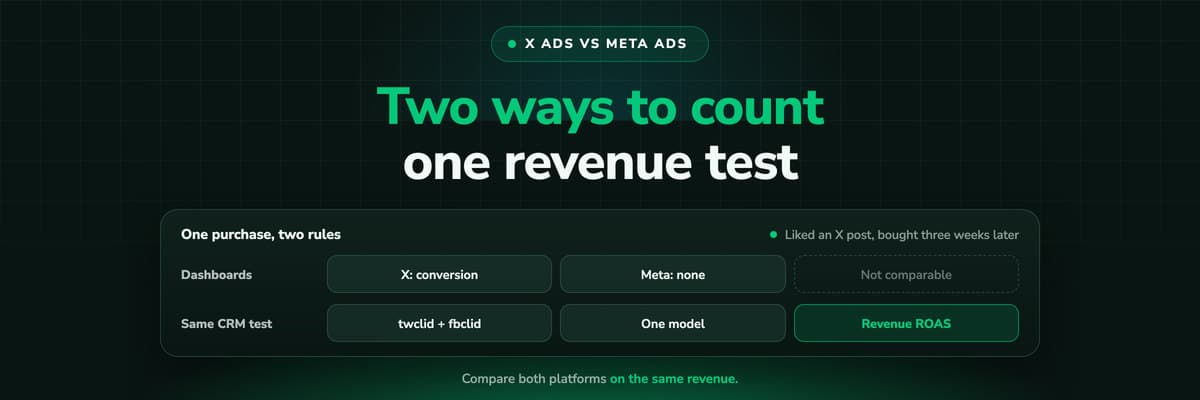 B2B Marketing Attribution
X Ads vs Meta Ads: How Each Counts a Conversion, Compared
X and Meta both report conversions, and the numbers are not the same kind of number. X credits a conversion up to 30 days after a like or a reply by default; Meta counts link clicks for 7 days. A sourced comparison of windows, server events, lead forms and CRM stages, and how to judge the two channels on the same closed revenue.Read the article15 min read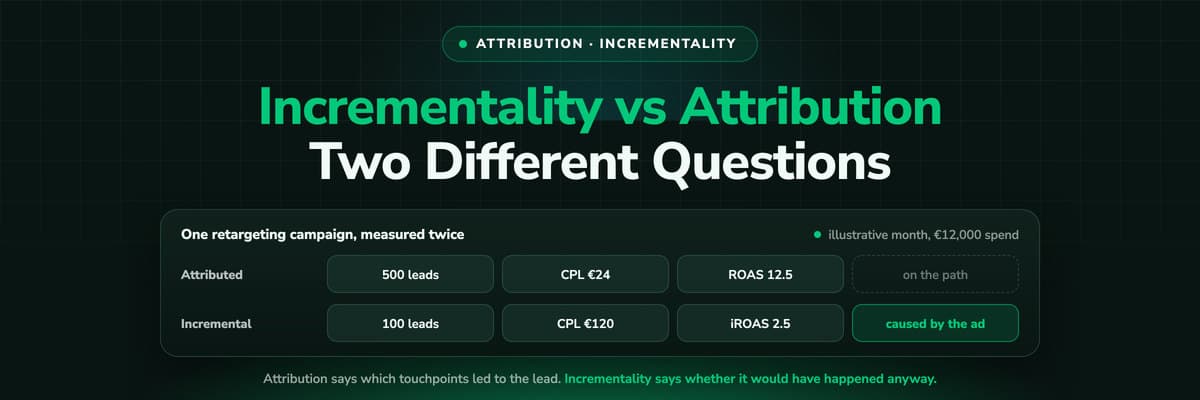 B2B Marketing Attribution
Incrementality vs Attribution: Which Question Each Answers
Attribution tells you which touchpoints led to a lead or a deal. Incrementality tells you whether it would have happened anyway. This guide works one retargeting campaign through both, shows where each belongs, and how to combine them when the outcome lives in your CRM.Read the article17 min read
Beyond the form fill
Start measuring what actually drives revenue.
Server-side tracking at 95%+ accuracy. All 5 attribution models. CRM pipeline connection from first click to closed deal. Automated CAPI loop to Meta, Google, LinkedIn & Bing. 21-minute setup.