
















BlogB2B Marketing Attribution
Multi-Touch Attribution for B2B Lead Generation
B2B buyers pass through many touchpoints over weeks before they sign, often seven to twelve, and last-click attribution hands all the credit to the final one. How the multi-touch models work, which fit B2B sales cycles, and the three things a setup needs.


Contents
Summarise this article with AI
Opens the page with a ready prompt in:


Nothing is sent until you pick a service.
B2B buyers don't convert on the first click. They click an ad, read a blog post, return three weeks later from organic search, attend a webinar, request a demo, then sign a contract two months after the original ad.
Last-click attribution can't see this journey. It sees the last step and hands it the entire result, which is why most B2B marketers are flying blind on which channels actually drive pipeline, and why so many of them have cut a channel that was working.
Here's how multi-touch attribution actually works for B2B lead gen and how to implement it correctly: the misallocation it prevents, the three things a working setup needs, and how to read the report once you have one.
Quick Summary: Multi-Touch Attribution for B2B
In short
A B2B buyer touches your marketing seven to twelve times across several channels and several weeks before signing. Last-click attribution credits the final touch with all of it, which systematically overpays branded search and retargeting and systematically underpays whatever introduced the buyer in the first place. Act on that report and you cut the channel filling your pipeline, and the damage shows up a quarter later when nothing connects the two events. Multi-touch attribution distributes credit across the whole journey instead. For long B2B cycles, time-decay or an algorithmic model usually fits best. Getting there needs three things at once: click IDs that persist across sessions, devices and weeks; a CRM connection so credit lands on closed revenue rather than form fills; and one dashboard covering paid and organic together. Missing any one of the three and the model is filling the gap with a guess.
Why B2B Buyers Don't Convert on First Click
B2B buyers typically interact with many touchpoints, often seven to twelve, across multiple channels and several weeks before making a buying decision. That is not inefficiency in your funnel; it is what buying something expensive on behalf of an employer looks like.
A realistic path for a €30,000 deal runs something like this. A LinkedIn ad in week one, ignored but registered. An organic search two weeks later for the category, landing on a comparison page. A retargeting ad on Google that week. A webinar in week five, attended with the camera off. A colleague forwarded the link, so a second person from the same company arrives from a direct visit. A demo request in week seven, from a branded search. Contract signed in week eleven.
Last-click attribution credits 100% of that conversion to the branded search, ignoring everything else. Every channel that introduced, nurtured and warmed the buyer gets zero. And branded search, the channel that gets all the credit, is the one that would very likely have delivered that person anyway, because by week seven they already knew your name. The model is not just imprecise, it is biased in a specific and expensive direction.
How Last-Click Misallocates B2B Budget
If LinkedIn introduces 80% of your future customers but Google retargeting closes them, last-click attribution will tell you to cut LinkedIn and double down on Google. You will do this, because the report is unambiguous and the meeting is short.
Here is what that looks like with numbers. Take a quarter with €60,000 of spend and twenty closed deals, and read the same quarter under both models.
The same quarter, read two ways
| Channel | Spend | Deals, last click | Deals, multi-touch | The decision each suggests |
|---|---|---|---|---|
| LinkedIn Ads | €24,000 | 2 | 8.4 | Cut it, or triple it |
| Google Search, non-brand | €18,000 | 4 | 5.2 | Hold |
| Google Search, brand | €6,000 | 9 | 2.6 | Scale hard, or leave alone |
| Retargeting | €8,000 | 4 | 2.1 | Scale, or cap it |
| Organic and content | €4,000 | 1 | 1.7 | Deprioritise, or keep funding |
Under last click, LinkedIn costs €12,000 per deal and brand search costs €667. Any rational manager moves the money. Under multi-touch, LinkedIn costs €2,857 per deal and is the best-performing line in the account. The two reports are not different opinions about the same data; the first one simply cannot see the first six weeks of an eleven-week journey.
The consequence is delayed, which is what makes it so hard to catch. You cut LinkedIn in April. Lead volume holds through May, because the pipeline is already full of people LinkedIn introduced in February. It falls in July. By then the report shows a demand problem, a market problem or a sales problem, and nobody in the room connects it to a budget decision taken two quarters earlier. This is the most common B2B attribution mistake, and it is invisible until the pipeline collapses.
Which Model Fits a B2B Sales Cycle
Multi-touch attribution distributes credit across every touchpoint in the customer journey instead of giving it all to one. The four models you will actually be choosing between behave differently on a long cycle.
- LinearEqual credit to every touchpoint. A useful baseline for seeing which channels appear in journeys at all, and a poor decision model, because it treats a ten-minute pricing page visit and a stray retargeting impression as equals.
- Time decayMore weight to recent touchpoints. Strong fit for B2B, where momentum genuinely does build towards the close. The risk is that on a long cycle it quietly drifts back towards last click, so check the half-life it uses.
- Position based (U-shaped)Weights the first and last touch heavily, spreads the rest. Good when you want the channel that introduced the buyer and the one that closed them credited separately, which is often exactly the argument you need to make.
- AlgorithmicDistributes credit by each touchpoint's measured contribution to outcomes. The most accurate, and it needs enough conversions to learn from. Below roughly a few hundred closed deals a year it is fitting noise.
For most B2B lead gen accounts, time decay is the right default and position-based is the right second opinion. Run both. Where they agree, act with confidence; where they disagree, you have found a channel whose role in the journey is worth understanding before you touch its budget. Our full guide to B2B multi-touch attribution works through all five models with the maths.
The model matters less than the data under it
Teams spend weeks choosing between time decay and position based while running on tracking that loses a third of touchpoints. A rough model on complete data beats a sophisticated model on partial data every time.
The Three Things a Working Setup Needs
Multi-touch attribution needs three things working together. They are usually presented as a checklist; they are better understood as three ways the same journey gets broken.
- Click IDs that survive the cyclegclid, fbclid, li_fat_id and msclkid captured server-side and stored on your side, so week one's LinkedIn click is still attached to the person in week eleven. A JavaScript cookie expires in seven days under Safari's ITP, which on a B2B cycle means it is gone before the second touch.
- A CRM connection that closes the loopCredit has to land on the closed deal, not the form fill. Without stages and deal values coming back, multi-touch attribution just distributes credit for form submissions more fairly, which is a better answer to the wrong question.
- One dashboard covering paid and organicOrganic search, direct, email and content appear in almost every B2B journey. A model that only sees paid channels redistributes credit among them and silently attributes the rest of the journey to whichever paid touch happened to be nearby.
Two additional problems are specific to B2B and worth planning for rather than discovering. The first is that the buyer is often several people: someone researches, someone else signs. Attribution that works at the person level will treat those as unrelated journeys unless it can group them by company. The second is that a real proportion of B2B journeys include a phone call, and a call is invisible to every model unless call tracking puts the campaign behind it.
Without all three of the core requirements, you're still guessing. The difference is that you are now guessing with a chart that looks authoritative.
How to Read the Report Without Overreacting
Switching models changes every number in the account at once, and the first week with multi-touch data is where a lot of teams make a second bad decision to correct the first. Four habits keep it useful.
- Compare models, don't just switch. Look at last click and time decay side by side. The gap between them is the information; either number alone is just a number.
- Judge on cost per closed deal, not cost per lead. Multi-touch attribution exists to connect spend to revenue. Reading it at the lead level throws away the reason you built it.
- Wait for a full sales cycle before acting. If deals take ninety days, ninety days of attributed data is one cohort. Acting on three weeks of it is acting on the last click again with extra steps.
- Watch assisted volume on the channels you are tempted to cut. A channel with few last-click conversions and heavy assist presence is doing awareness work. That is a real job, and cutting it is the specific mistake this whole article is about.
The output you want from the first quarter is not a reallocation. It is a list of two or three channels whose role you had wrong, and a defensible number to put next to each.
How LeadJourney Handles Long B2B Journeys
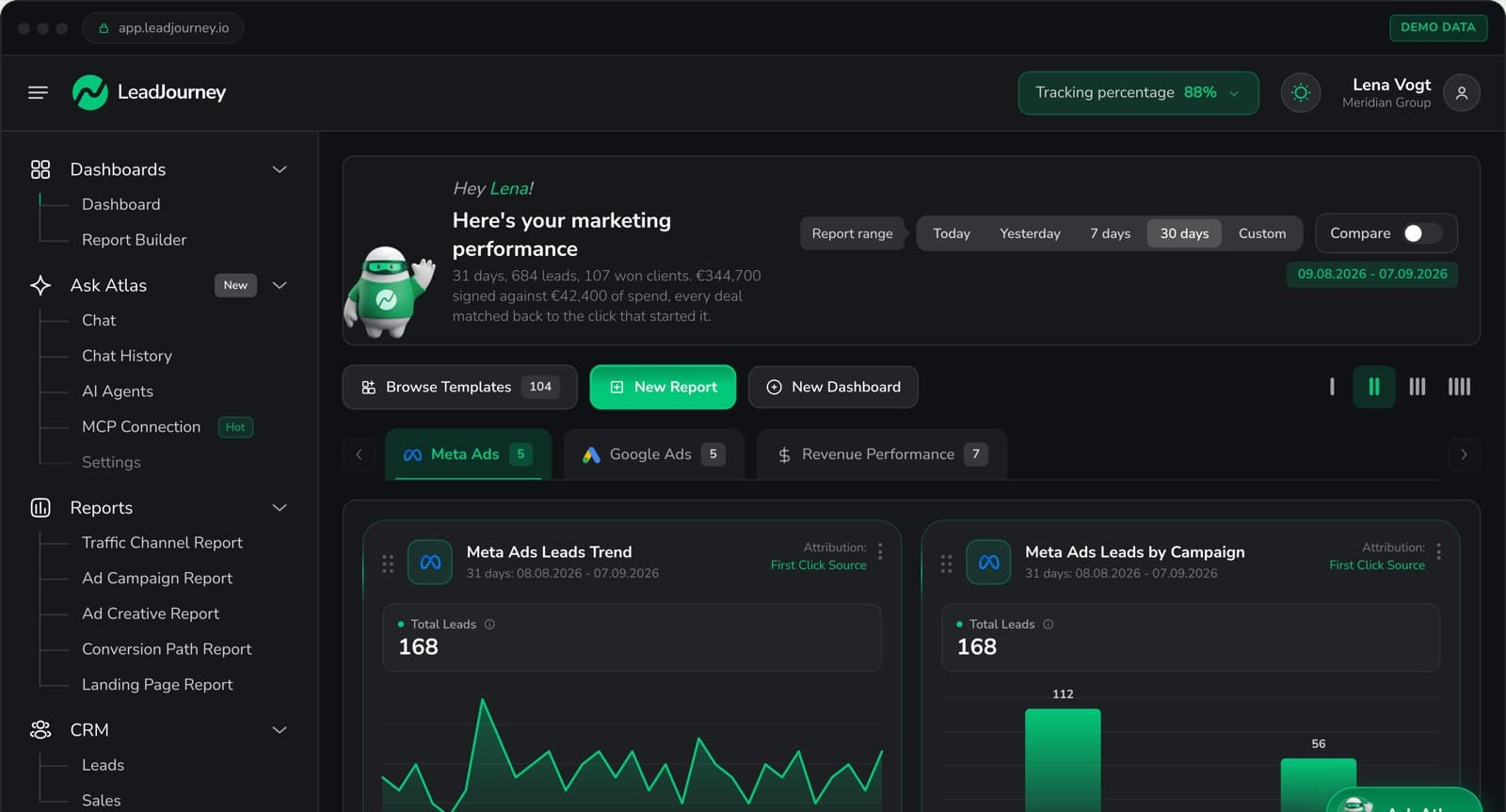
LeadJourney captures the click IDs server-side at the first visit and stores them on your side, so a touchpoint from week one is still attached to the person in week eleven. Safari's seven-day cookie cap does not apply, which is the single most common reason a B2B journey breaks in the middle.
Paid and organic sit in the same model: Meta, Google, LinkedIn and Microsoft alongside organic search, organic social, email, direct and AI search engines like ChatGPT and Perplexity. Native CRM integrations with HubSpot, Salesforce, Pipedrive, Close and more read pipeline stages and deal values, so credit lands on closed revenue rather than on form fills, and cost per closed deal is a column rather than a spreadsheet exercise.
All five attribution models are on every plan rather than gated behind an enterprise tier, so comparing time decay against position-based against last click is a toggle. That matters more than it sounds: the argument you need to make internally is almost always the gap between two models, not the output of one. Setup takes about 21 minutes with no developer, and there is a 14-day free trial.
Further Reading
Carry on with the full B2B multi-touch attribution guide for the models in depth, attribution for long sales cycles and the best B2B attribution software. For the shorter versions, see multi-touch attribution and customer journey tracking.
FAQ
Frequently Asked Questions
The questions B2B lead gen teams ask about tracking long buying journeys.
How many touchpoints does a B2B buyer have before converting?
Commonly seven to twelve, across several channels and several weeks. A typical path runs from a LinkedIn ad to an organic return visit, a Google retargeting click, a webinar and finally a demo request, with the contract signed a month or two after the ad that started it.
What is wrong with last-click attribution in B2B?
It credits the final touchpoint with the whole conversion, which in practice means crediting branded search and retargeting for work that awareness channels did. Act on it and you cut the channel that fills the pipeline. The damage shows up a quarter later as volume drying up, by which point nothing in the report connects the two events.
Which attribution model fits a long B2B sales cycle?
Time-decay or full algorithmic attribution usually fits best, because both reflect that momentum builds towards the close without erasing what started the journey. Position-based is the alternative when you want awareness and closing channels credited separately. Linear is a fine starting point but treats a ten-minute product page visit and a stray retargeting click as equals. Run two models side by side rather than picking one: the gap between them is where the useful information is.
What do I need technically to run multi-touch attribution?
Three things working together: click ID tracking that persists across sessions, devices and weeks; a CRM connection that maps deal stages back to the original touchpoints; and one dashboard showing every channel, paid and organic. Any one of the three missing and the model is filling in the gap with a guess.
How long before multi-touch attribution is worth acting on?
One full sales cycle at minimum, and two is better. If your deals take ninety days, ninety days of attributed data is a single cohort, and reallocating budget on it means reacting to one quarter's noise. Use the first cycle to find the two or three channels whose role you had wrong, and the second to act on them.
Can I do multi-touch attribution in GA4?
Partly, and not the part that matters most in B2B. GA4 offers several attribution models across sessions on your website, and it has no view of what happened in the CRM afterwards. It can tell you which channels contributed to a form fill. It cannot tell you which contributed to the deals that were actually signed.
Keep reading
More from the blog
 B2B Marketing Attribution
B2B Marketing Attribution: Models, Data and Revenue (2026)
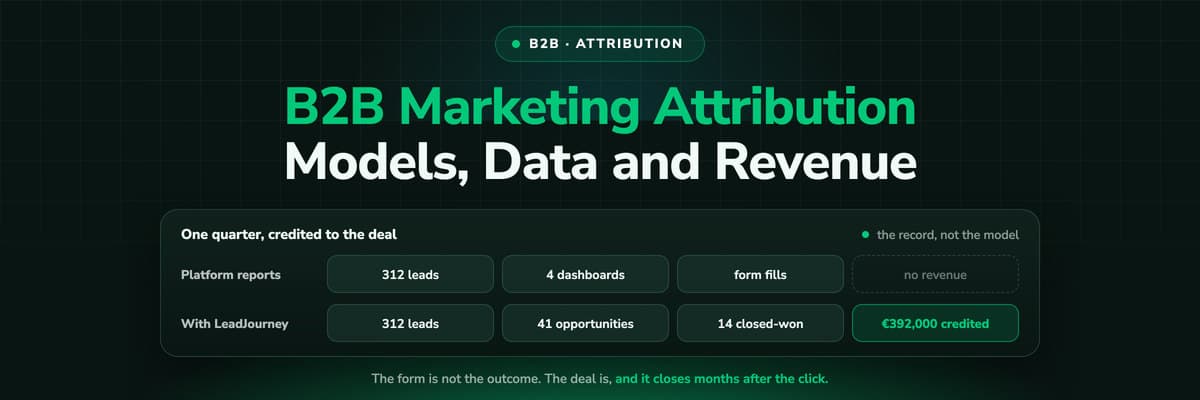
A B2B deal closes months after the click, is bought by a committee and is recorded in the CRM rather than in any ad platform. This guide covers the whole discipline: what B2B marketing, revenue and sales attribution each credit, lead-level against account-level architecture, pipeline stages as conversions, what your CRM does on its own, build or buy, and a seven step implementation.Read the article22 min read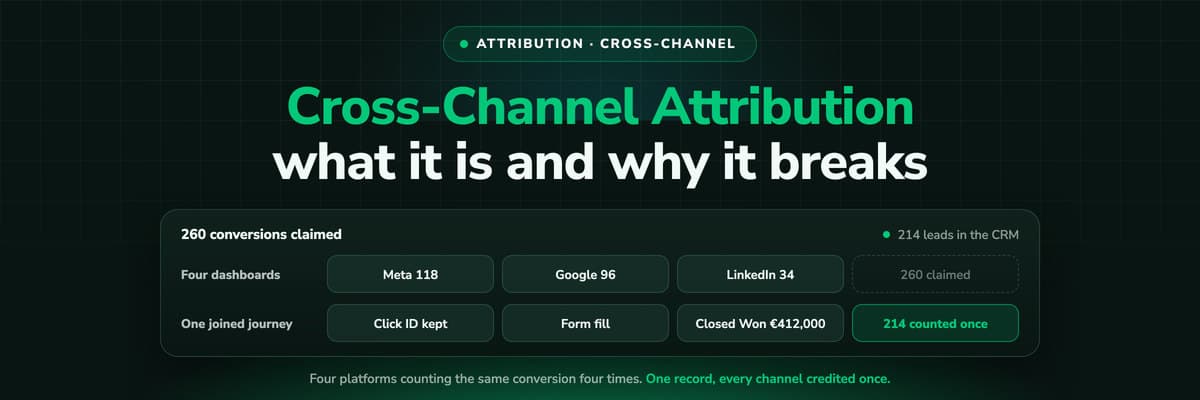 B2B Marketing Attribution
Cross-Channel Attribution: What It Is and Why It Breaks
Meta claims 118 conversions, Google claims 96, LinkedIn 34 and Microsoft 12. The CRM has 214 leads. Cross-channel attribution is the work of turning four honest, incompatible answers into one, and this guide covers the four methods that try it, what each of them can and cannot see, and the setup that decides whether any of them holds.Read the article14 min read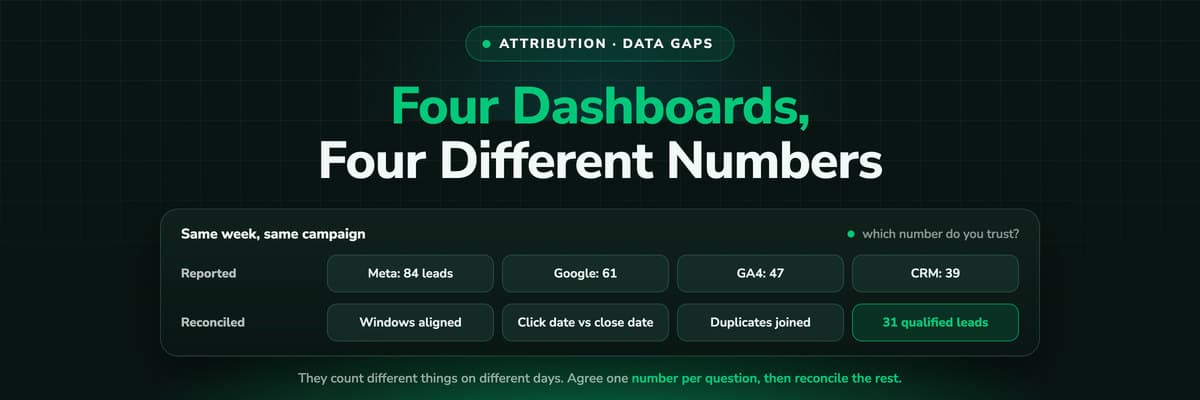 B2B Marketing Attribution
Why GA4, Meta and Google Never Agree With Your CRM
Four dashboards, four numbers, the same week, and somebody has to decide which one is real. The seven structural reasons the counts can never match, from attribution windows and view-through conversions to timestamps, identity and definition drift, then the useful half: which number to trust for which decision, and a reconciliation your team can run this week.Read the article13 min read
Beyond last-click
B2B attribution that actually works across long sales cycles
Stop allocating B2B budget on last-click data. LeadJourney shows you which channels introduce, nurture, and close pipeline, across every touchpoint and every CRM stage.