

















BlogHow To Guides
GDPR-Compliant Conversion Tracking for Lead Generation
Third-party cookie tracking is hard to make GDPR-compliant, and EU lead gen businesses lose 30-40% of conversion data while wondering whether their setup would survive an audit. What compliant tracking means in 2026, how first-party server-side tracking works, and a compliance checklist.


Contents
Summarise this article with AI
Opens the page with a ready prompt in:


Nothing is sent until you pick a service.
GDPR enforcement has tightened, cookie consent rates have dropped, and most lead generation businesses operating in Europe are quietly losing 30-40% of their conversion data, while still wondering whether their tracking setup would survive an audit.
Those two problems look like a trade-off and are not one. The reason most European accounts have both at once is that they are running an architecture designed in 2015: a third-party pixel, set by an ad platform, on a domain nobody in the business controls. That design is what the browsers are dismantling and what a regulator finds hardest to accept.
This guide explains what GDPR-compliant conversion tracking actually means in 2026, what's allowed, what isn't, where the confident advice on the internet is wrong, and how to set up a compliant tracking stack that still gives you accurate data.
Quick Summary: What Compliant Tracking Looks Like in 2026
In short
GDPR does not ban conversion tracking; it regulates it, and it makes one specific pattern very hard to defend: third-party cookies set by an ad platform on your visitors' browsers. The durable answer is first-party server-side tracking. Collection runs on a subdomain you own, no third-party cookie is set, the data lands on infrastructure you have a processing agreement with, and identifiers are SHA-256 hashed before anything is forwarded to Meta, Google, LinkedIn or Microsoft. You still need a consent banner, and you still must not track people who decline: server-side is not a consent workaround, and any vendor selling it as one is selling you a liability. What it buys you is a defensible architecture, one processor instead of a chain, and conversion data that survives iOS, Safari and ad blockers.
The GDPR Problem with Standard Tracking
Standard browser-side tracking using third-party cookies (the Meta Pixel, the Google tag) is increasingly difficult to make GDPR-compliant, and the difficulty is structural rather than a matter of configuration.
When a pixel runs, an ad platform's script executes inside your visitor's browser, sets a cookie on a domain you do not own, and sends a request to a server you have no relationship with. Three obligations become awkward at once. You have to describe a data flow you cannot inspect. You have to control a processor whose script you did not write and can change without telling you. And you have to explain a transfer to a US-based recipient that, since Schrems II, needs a documented mechanism rather than an assumption.
- You cannot see what is sentA pixel decides for itself what to collect from the page. Answering an access request honestly means describing data flows you have no visibility of.
- The processor chain is longTag manager, pixel, platform, and whatever each of those loads. Every hop is a party you are responsible for naming and are not in a position to audit.
- The transfer is not yours to controlThe request leaves the browser directly for the platform. There is no point in the chain where you get to decide what crosses the border.
- And it does not even workThe same architecture is the one ad blockers, Safari's ITP and iOS restrictions target, which is where the 30 to 40% data loss comes from.
Server-side, first-party tracking removes the third-party cookie chain entirely and puts the data flow under your control. That is the only change that fixes the compliance problem and the accuracy problem with one decision, which is why it is worth doing even for a business that has no European exposure at all.
How First-Party Server-Side Tracking Works
First-party tracking runs on your own domain, typically a subdomain like track.yourdomain.com, and sets no third-party cookies. The visitor's browser talks only to you. Your side then decides, deliberately, what to forward to each ad platform over its own server-to-server API, with identifiers hashed before they go.
Walking through one conversion makes the difference concrete.
- The click. A visitor arrives from a Meta ad carrying an fbclid. Your own script reads it and sends it to your own collection endpoint, on your own subdomain. No third-party cookie is written and no request leaves for an ad platform.
- The wait. The identifier sits in first-party storage on your side, so Safari's seven-day cap on JavaScript cookies does not apply and an ad blocker has nothing to block.
- The conversion. The visitor submits a form, or a stage changes in your CRM three weeks later. Your server knows it is the same person, because the record is yours.
- The transfer. Your server sends the conversion to Meta over the Conversions API. Email and phone are SHA-256 hashed first, so what crosses the border is a fingerprint rather than a contact detail, and you decide exactly which fields travel.
The compliance value is in step four. There is a single, inspectable, documentable point at which personal data leaves your control, it is under your configuration, and it is covered by one processing agreement rather than an implicit chain. That is a data flow you can put in a privacy policy and defend in a review.
Hashing is minimisation, not anonymisation
A SHA-256 hash of an email address is still personal data under GDPR: it identifies a person to anyone holding the same address, which is the entire point of sending it. Hashing reduces exposure and is expected practice. It does not remove the transfer from scope, and any advice that says it does is wrong.
Four Things That Are Not True
These circulate confidently enough that they end up in briefs. Each one is worth pushing back on before it becomes an architecture decision.
- "Server-side means you don't need consent"The most expensive myth in the category. The legal basis follows the purpose, not the server. Advertising measurement of an identifiable person needs consent wherever it runs.
- "Hashed data isn't personal data"A hash that lets a platform match a person is still personal data. It is good minimisation practice and it keeps the transfer firmly in scope.
- "EU hosting solves the transfer question"It helps a great deal, and it does not end the analysis. If you forward conversions to a US-based ad platform, that transfer still needs its own documented mechanism.
- "GDPR bans conversion tracking"It does not. It requires a lawful basis, transparency, minimisation and control. All four are achievable, and the first-party server-side architecture is what makes them straightforward.
GDPR Tracking Compliance Checklist
Nine items, in three groups. Audits usually open with the third group, which is the one most teams have not done.
Technical compliance
- First-party domain. Tracking runs on a subdomain you own, such as track.yourdomain.com, with a certificate you control.
- No third-party cookies set on your visitors' browsers by anything in your tracking stack.
- Hashed identifiers. Email, phone and name SHA-256 hashed, and normalised first (lowercased, trimmed, phone in E.164), before transmission to any ad platform.
Process compliance
- Consent management with granular controls that genuinely separate analytics from marketing, not a single accept button.
- Consent respected at the boundary. Verify it: decline on your own site in a private window and confirm in the platform's event tools that nothing arrived.
- Privacy policy disclosure naming the tracking, the data flows, the processors and the transfer mechanism, in language a visitor could follow.
Documentation
- A signed DPA with your tracking platform, and a current list of its sub-processors.
- A retention policy with automatic deletion timelines that are actually enforced rather than written down.
- A data subject rights flow covering access, deletion and rectification, that reaches the tracking data too and not only the CRM.
If you can produce all nine, the technical setup will not be what an audit turns on. If you cannot produce the last three, the first six will not save you.
How LeadJourney Is Built for This
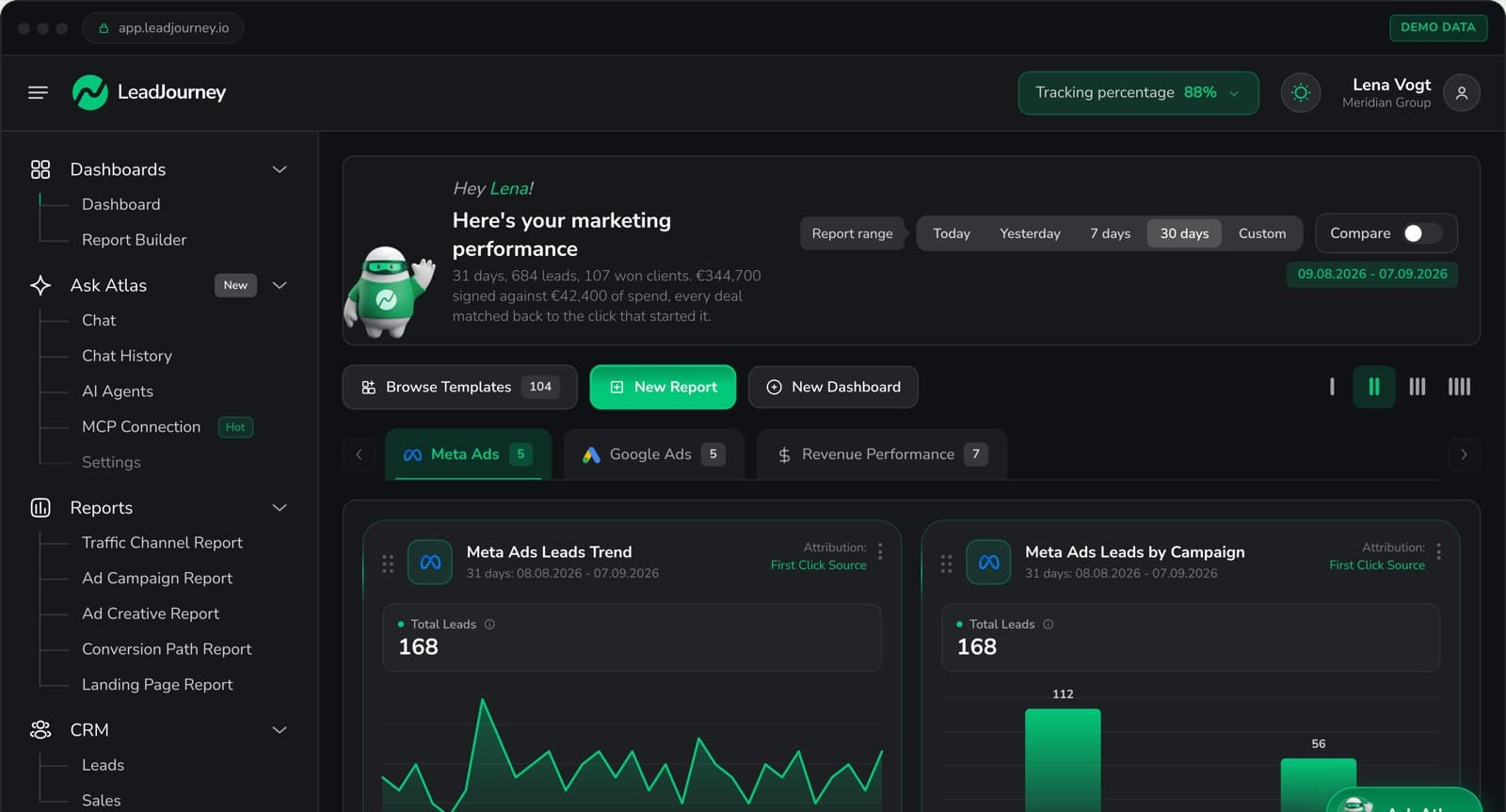
LeadJourney runs server-side tracking on your own subdomain, so no third-party cookie is set and the collection point is yours. Identifiers are hashed before they are forwarded to Meta, Google, LinkedIn or Microsoft, and you decide which pipeline stages are sent at all.
Production infrastructure is in Frankfurt, inside the EU. Traffic is served over TLS, and OAuth tokens, two-factor secrets and personal data in the database are encrypted with AES-256-CBC. We keep a current, public list of every sub-processor with access to data on the GDPR page, and a data processing agreement is available. The full control-by-control account, including access control and integration secrets, is on the security page.
Two limits worth stating plainly, because a vendor who states none is not worth trusting on this subject. Tracking respects consent decisions rather than working around them, so a visitor who declines is not measured and your reported numbers will reflect that. And forwarding conversions to a US-based ad platform is still a transfer that needs its own documented basis; we minimise and hash what is sent, and we do not pretend that removes it from scope.
Further Reading
Carry on with Consent Mode v2 for lead generation, server-side tracking without a developer and server-side vs browser tracking. For our own documentation, see the GDPR and data protection page, the security page and the technical and organisational measures.
FAQ
Frequently Asked Questions
The questions European lead gen teams ask about tracking and GDPR.
Is conversion tracking allowed under GDPR?
Yes, with a lawful basis and, for anything that is not strictly necessary, consent. GDPR does not ban measurement, it regulates it. What it makes difficult is the specific pattern of third-party cookies set by an ad platform on your visitors, because that chain is hard to explain, hard to control and hard to defend in an audit.
Do I still need a cookie banner with server-side tracking?
Yes. Moving collection to your own server changes where data is processed, not whether marketing tracking needs consent. What it changes is the cleanliness of the decision: no third-party cookie chain, one processor you have an agreement with, and a clear boundary around what is sent onward when consent is refused. Any vendor presenting server-side tracking as a way to avoid consent is describing a liability rather than a feature.
What makes tracking first-party?
It runs on a subdomain you own, such as track.yourdomain.com, it sets no third-party cookies, and the data is collected on servers under your control before anything is forwarded. Identifiers are hashed with SHA-256 before they are sent to an ad platform, so raw personal data never leaves your side of the boundary.
Is hashed data still personal data under GDPR?
Yes. A SHA-256 hash of an email address identifies the same person to anyone holding that address, which is exactly why ad platforms can match on it. Hashing is data minimisation and it is expected practice, but it does not take the transfer out of scope, and a setup that relies on the claim that it does is built on a wrong assumption.
Does Schrems II affect Meta and Google conversion tracking?
It affects any transfer of personal data to a US-based processor, which includes ad platform APIs. The mitigations in practice are minimising what is transferred, hashing identifiers before transfer, documenting the transfer mechanism, and keeping the collection itself in Europe so the decision about what leaves is yours rather than a pixel's.
What do I need documented to survive a tracking audit?
A signed data processing agreement with the tracking provider, a written retention policy with automatic deletion, a data subject rights process covering access, deletion and rectification, and a privacy policy that names the data flows and the processors. The technical setup matters, but audits usually open with the paperwork.
Keep reading
More from the blog
 How To Guides
Google Ads Call Tracking: Every Method and What Each One Sees
Google Ads has call tracking built in, free, and most accounts run one method without knowing what it cannot see. All five, what each records, where they conflict with a call tracker, and how to send the qualified call back.Read the article12 min read How To Guides
Does Call Tracking Hurt Your SEO? What Actually Puts NAP at Risk
The fear is old and the answer is boring: dynamic number insertion does not hurt rankings when the real number stays in your source, your schema and your listings. The mistakes that do cause damage are all about where you put the tracking number.Read the article9 min read How To Guides
What Is RevOps? Revenue Operations and GTM Ops Explained (2026)
Revenue operations runs marketing, sales and customer success as one revenue engine: the funnel definitions, the CRM, the handoffs, the reporting and the forecast. GTM ops is the wider name the same job has been taking on. What the function owns, how it differs from sales ops and marketing ops, the stack, the metrics, and the one thing all of it depends on: whether the CRM record says where the customer came from.Read the article17 min read
GDPR-compliant by design
Stop choosing between accuracy and compliance.
First-party domain, hashed identifiers, server-side flows, signed DPA. 95%+ tracking accuracy without compliance risk, trusted by financial advisors, legal practices, and regulated industries.