






Skip to content

Free tool: click-through rate

CTR calculator graded against your channel's benchmark

Clicks and impressions from the same report give the rate, its grade and the clicks a strong CTR would have bought.

Calculate click-through rate

Clicks and impressions from the same report. Pick the channel to grade the result.

Currency

Link clicks, not all engagement.

Times the ad was shown.

All channels (blended): average from 1.0%, strong from 2.0%.

Add spend

Spend behind these impressions.

Runs in your browser. Nothing you type is sent or stored.

The formula

The click-through rate formula

CTR=ClicksImpressions× 100

1,500 clicks from 100,000 impressions is (1,500 ÷ 100,000) × 100 = 1.5 percent. One click per 67 impressions.

What click-through rate measures

Click-through rate is the share of people who saw an ad and clicked it. It is the first rate in the funnel and the one most directly under the creative team's control: the audience decides whether the ad is shown, the ad decides whether it is clicked. A rising CTR on a steady audience means the message is landing; a falling one on the same audience means fatigue, and it usually shows up two or three weeks before the cost per lead does.

Which clicks count matters. Meta reports "CTR (all)", which includes reactions, comments and profile taps, and "CTR (link click-through rate)", which is clicks to your page. Use the link version; the other one flatters every campaign. Google's CTR is clicks on the ad divided by impressions and needs no such care.

What is a good CTR

It depends on the channel more than on anything else, because the channels sell different attention. Someone typing a query into Google is asking for the click; a Search CTR of 3 to 6 percent is normal and 10 percent is not rare on brand terms. A feed on Instagram or LinkedIn is interrupting something else, and 0.5 to 1.5 percent is the range. Display and YouTube pre-roll are lower again. Comparing a Search CTR with a Meta CTR says nothing; comparing this month's Meta CTR with last month's says a lot.

The benchmark table below is what the calculator grades against. Treat the "strong" column as a target for creative work and the "average" column as the line under which something is wrong.

Why CTR is the cheapest lever on the account

On platforms priced per thousand impressions, CTR sets the cost per click directly: CPC = CPM ÷ (1,000 × CTR). Take a Meta campaign from a 0.9 to a 1.5 percent CTR and the click gets 40 percent cheaper on the same audience with no change to bids. On Google, a higher CTR raises the quality score, which lowers the CPC you need to hold a position. Either way, better creative is a media cost reduction, and the calculator's "at a strong CTR" line shows how big.

The one caveat is that a click is not a conversion. A curiosity hook can double CTR and halve conversion rate, and the cost per lead ends up where it started. Read CTR next to conversion rate, always.

Benchmarks

CTR benchmarks by channel

Link click-through rates for lead generation and B2B campaigns. Brand search and retargeting run well above these.

Blended from public platform benchmarks and LeadJourney customer accounts in 2025 and 2026. Meta figures are link clicks, not all clicks.

FAQ

Click-through rate, answered

The questions behind the search for a CTR formula.

What is the click-through rate formula?

CTR = (clicks ÷ impressions) × 100. 1,500 clicks from 100,000 impressions is a 1.5 percent CTR. Use link clicks on social platforms, not all clicks.

What is a good CTR?

For Google Search, above 5 percent; for Meta, above 1.5 percent; for LinkedIn, above 0.8 percent; for Display and YouTube, above 0.6 percent. The channel matters more than the industry, and your own trend matters more than either.

What is the difference between CTR and conversion rate?

CTR is clicks divided by impressions: how many people who saw the ad clicked. Conversion rate is conversions divided by clicks or visitors: how many who clicked did what you wanted. Multiply them and you have the share of impressions that converted.

Why is my CTR dropping?

Creative fatigue is the usual cause: the same people are seeing the same ad, and the frequency metric will confirm it. Others are a broadened audience, a seasonal shift, or a competitor with a stronger offer in the same feed. Refresh the creative before touching the targeting.

Does a higher CTR lower my costs?

On CPM-priced platforms, directly: CPC = CPM ÷ (1,000 × CTR), so a higher CTR means cheaper clicks on the same audience. On Google Search, indirectly: expected CTR feeds the quality score, and a higher score lowers the CPC needed to hold a position.

What is CTR (all) versus link CTR on Meta?

CTR (all) counts every click on the ad, including reactions, comments, the profile name and "see more". Link click-through rate counts only clicks to your destination. Report the link version; it is the one that produces visitors.

Clicks to customers

See which ads earn clicks that turn into revenue

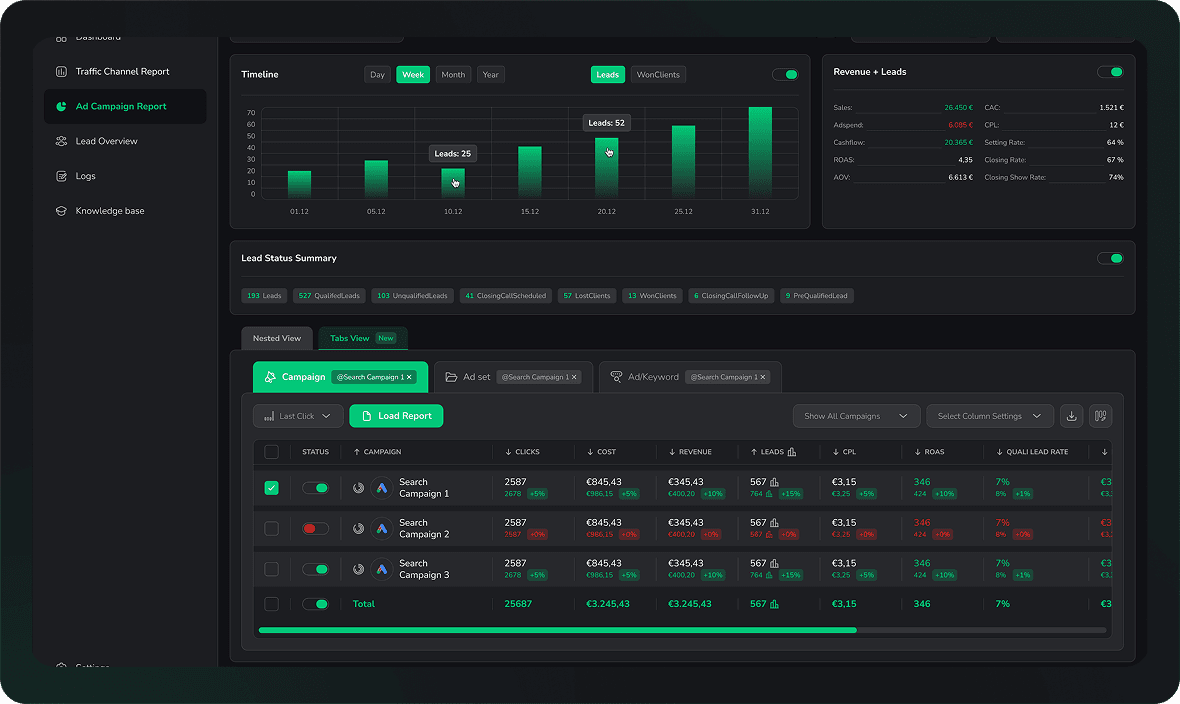
LeadJourney connects every ad to the leads and closed deals it produced, so CTR sits next to revenue per ad. Book a demo on your own account.

LeadJourney dashboard showing lead sources, campaign performance and attributed revenue side by side