














BlogB2B Marketing Attribution
How to Increase Lead Quality in Performance Marketing
A high volume of leads is worth little when most never qualify, and the ad platforms keep optimizing for more of the same. Five tactics for raising lead quality in performance marketing, and how CRM data fed back to Meta and Google changes what the algorithms chase.


Contents
Summarise this article with AI
Opens the page with a ready prompt in:


Nothing is sent until you pick a service.
In performance marketing, generating a large volume of leads is essential, but if those leads aren't high-quality, your effort is wasted. Low-quality leads drain the budget, occupy the sales team and make the whole channel look worse than it is.
Most advice on this subject starts and ends with targeting, which is the least effective lever available and the one everyone reaches for first. The reason lead quality decays has more to do with what you told the ad platform to optimise for than with who you told it to show ads to, and no amount of audience refinement fixes an objective that is pointed at the wrong event.
This guide covers five strategies that actually move lead quality, in order of how much difference they make, and how to measure whether any of them worked.
Quick Summary: How to Raise Lead Quality
In short
Lead quality decays because the ad platforms optimise towards whatever event you defined as a conversion, and in most lead gen accounts that event is a form submission. The algorithm then gets steadily better at finding cheap form submitters, who are by definition the people least likely to buy. The single highest-leverage fix is to change the signal: send qualified leads and closed deals from the CRM back to Meta, Google, LinkedIn and Microsoft, so the algorithms learn on real buyers. Around that, four supporting tactics help: define what qualified means and score against it, pre-qualify on the form, write copy that repels the wrong people, and build lookalikes from customers rather than from leads. Measure all of it on cost per qualified lead, never cost per lead, and expect the two to move in opposite directions while it is working.
Why Lead Quality Matters More Than Lead Volume
Lead quality directly determines whether a campaign made money. High-quality leads convert into paying customers; low-quality leads drain the budget and the sales team's week without yielding anything. That much is obvious. What is less obvious is how quickly the difference compounds.
Two campaigns, both spending €10,000 and both producing 200 leads at €50. One qualifies at 60% and closes 15% of those; the other qualifies at 12% and closes 8%. The first produces 18 deals at €556 each. The second produces 2 at €5,000 each. On the dashboard the two campaigns are identical. In the business one of them is nine times better than the other, and nothing in Ads Manager's own columns will ever tell you which. LeadJourney's Chrome extension adds the CRM's qualified leads and won deals as columns right beside them.
That gap is also why chasing volume backfires. Every reduction in cost per lead that comes from loosening who you reach is paid for later at the qualification stage, usually at a worse exchange rate than the saving.
The Root Cause: You Are Rewarding the Wrong Event
Before the tactics, the mechanism, because it decides which tactics are worth your time.
An ad platform is a search engine for people who will do the thing you defined as a conversion, as cheaply as possible. Define that thing as a form submission and it will search for the cheapest people who submit forms. In the first weeks it has little data and casts a wide net, so you get a mixed group including some genuine buyers. Then it learns, and it converges on the segment it can convert most cheaply, which is exactly the segment that fills in forms without intent.
So lead quality does not decay because something broke. It decays because the optimisation is working, on the objective you gave it. Everything below is either changing that objective or reducing the number of unqualified people who reach the form in the first place, and the first one is worth more than all the others combined.
Five Strategies That Actually Move Lead Quality
In order of impact rather than in order of ease. The first one is most of the result.
- 1. Send CRM outcomes back to the ad platformsThe only tactic that changes what the algorithm is searching for. Qualified leads and closed deals returned over the Conversions API, with the click ID and hashed identity attached, so Meta and Google learn what a buyer looks like instead of what a form filler looks like.
- 2. Define qualified, then score against itWritten criteria agreed with sales, applied consistently. Without this, cost per qualified lead is noise with decimal places, and the signal you send back in step one is a mix of three people's opinions.
- 3. Pre-qualify on the formBudget, company size, timeline: one or two fields that the wrong people will not fill in. It costs volume and that is the point. Pair it with tracking, or you will see the volume drop and not the quality rise.
- 4. Write copy that repels as well as attractsNaming the price, the minimum contract or the market you serve filters before the click rather than after it. Vague, generous or curiosity-driven ads are the most reliable way to buy unqualified leads at a great CPL.
- 5. Build lookalikes from customers, not leadsA lookalike seeded on everyone who filled in a form asks the platform for more form fillers. Seed it on closed-won contacts instead, which requires the CRM connection from step one, which is why that one comes first.
Note what is missing from this list: audience targeting refinements. Narrowing demographics and interests is where most teams start, and inside whatever boundary you draw, delivery will still find the cheapest converters. A smaller box does not change what the algorithm hunts for inside the box.
With LeadJourney, we have finally found a tool that provides us with the data we need to scale our performance marketing campaigns. The most important KPI is no longer lead price but cost per qualified lead.
 Steffen SiesingCEO, Bilanzmanufaktur GmbH
How to Measure Whether It Worked
Every tactic above makes cost per lead worse before it makes anything better, because higher-intent people cost more to reach. If cost per lead is your reporting metric, each one of these will look like a failure for its first three weeks, which is how good changes get reverted.
- Cost per qualified lead is the working metric. It moves within days and it is the number that should be in the weekly report before you change anything, not after.
- Qualification rate by cohort. Group leads by the month they arrived and track what share reached qualified. This is the cleanest picture of whether quality is genuinely improving or the sales team just got less busy.
- Cost per closed deal is the judgement metric, read quarterly. Too slow for weekly decisions and the only one that settles whether a campaign was profitable.
- Cost per lead stays on the report as context, clearly labelled as the number that is expected to rise.
Change one thing at a time
Closing the CRM loop, adding form fields and rewriting ad copy in the same week means you learn nothing about which of them worked, and every platform is back in its learning phase at once.
How LeadJourney Improves Lead Quality
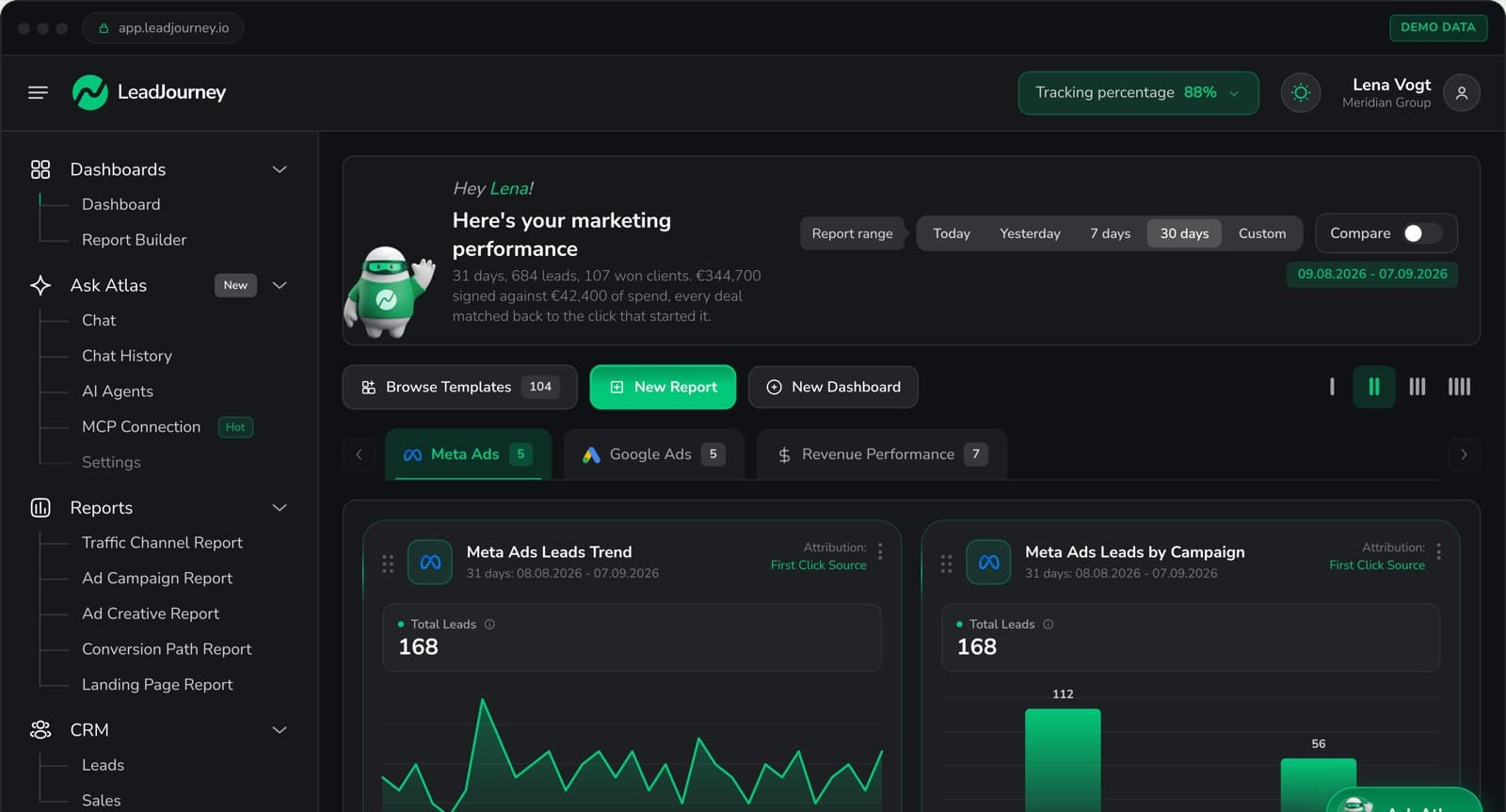
Offline conversion tracking. LeadJourney syncs CRM outcomes back to Meta, Google, LinkedIn and Microsoft at the same time, so all four optimise on actual qualified leads rather than raw form counts. That is strategy one, automated, and it is the reason the others become measurable.
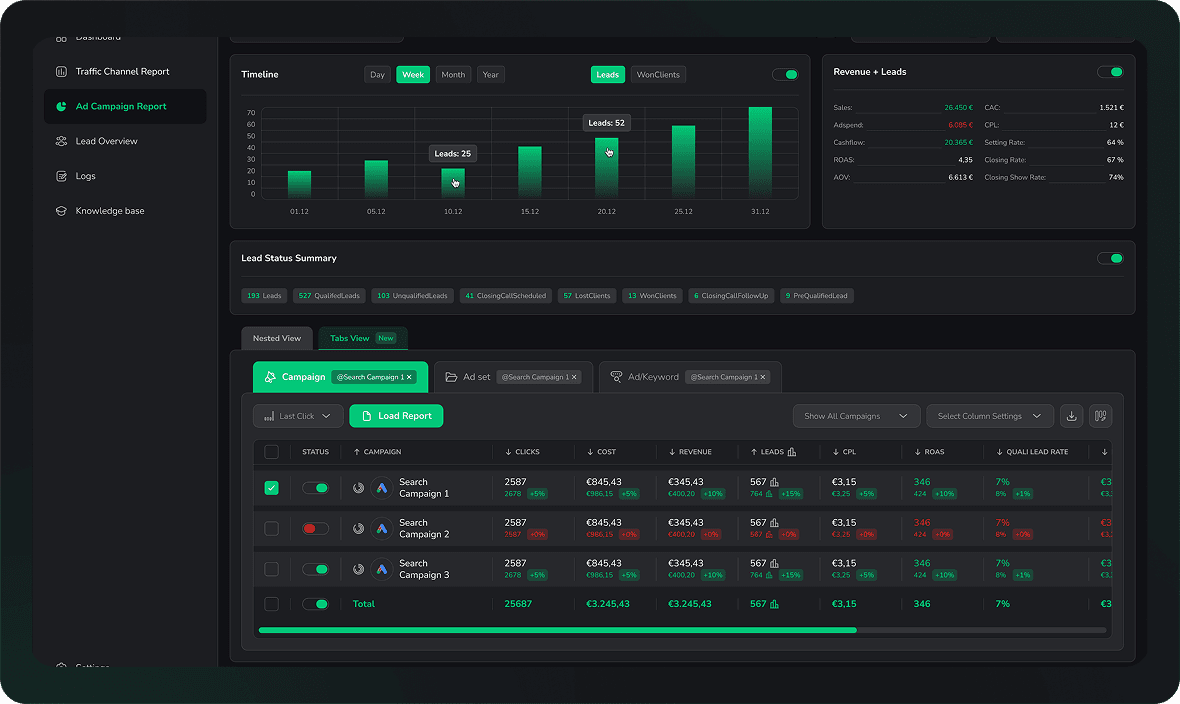
Cost per qualified lead as a column. Pipeline stages are conversions, attributed back to campaign, ad set and creative, so the working metric is in the campaign report rather than in a monthly spreadsheet somebody maintains by hand.
The whole journey, not just the last click. Every touchpoint from the first ad click through the CRM stages to the closed deal, across paid and organic, so you can see which channels introduce the leads that qualify rather than which one happened to be last. See customer journey tracking for how that is drawn.
Five attribution models on every plan, so you can check whether a channel that looks weak on last click is doing the introducing. Setup takes about 21 minutes with no developer, tracking runs server-side at 95%+ accuracy, and there is a 14-day free trial.
Further Reading
FAQ
Frequently Asked Questions
The questions readers ask about lead quality in performance marketing.
How do you increase lead quality in performance marketing?
The most effective approach is closing the feedback loop between your CRM and your ad platforms. When you send qualified lead and closed-deal events back to Meta and Google via CAPI, the algorithms retrain on the profile of your actual buyers and stop sending unqualified traffic. Additional steps include tightening targeting criteria, adding qualifying questions to lead forms, and tracking cost-per-close rather than cost-per-lead.
What is the difference between lead quantity and lead quality?
Lead quantity measures how many leads you generate. Lead quality measures how many of those leads convert to qualified prospects, appointments, and customers. A high volume of low-quality leads costs more than a smaller volume of high-quality leads when you measure cost-per-close.
Why does better targeting not fix lead quality?
Because delivery still optimises for the cheapest conversions inside whatever boundary you set. If the conversion event is a form submission, a narrower audience just means the algorithm finds the cheapest form submitters within a smaller group. Targeting decides who is eligible; the conversion event decides who gets chosen, and the second one is where the quality problem lives.
How does CRM data improve lead quality from paid ads?
By sending CRM deal outcomes back to ad platforms via CAPI. When Meta and Google see which types of leads (based on demographics, interests, behavior) actually converted to customers, they adjust targeting to find more people with those characteristics. This improves lead quality automatically over time.
Does server-side tracking improve lead quality?
Yes, indirectly but substantially. Server-side tracking captures far more complete conversion data than a browser pixel, which loses 30 to 40% of events to iOS, ad blockers and consent tooling. More complete data means better training data for the algorithms, and it also means the click ID survives long enough to attach the eventual outcome to the ad that produced it.
How long does it take to see better lead quality after closing the loop?
Plan for one to two optimisation cycles. Meta and Google need enough of the new conversion events to leave the learning phase, which in most lead gen accounts means a few weeks rather than a few days. The pattern to watch is cost per qualified lead falling while cost per lead rises: that is the algorithm buying fewer, better people, and it looks like a problem on a CPL-only dashboard.
Keep reading
More from the blog
 B2B Marketing Attribution
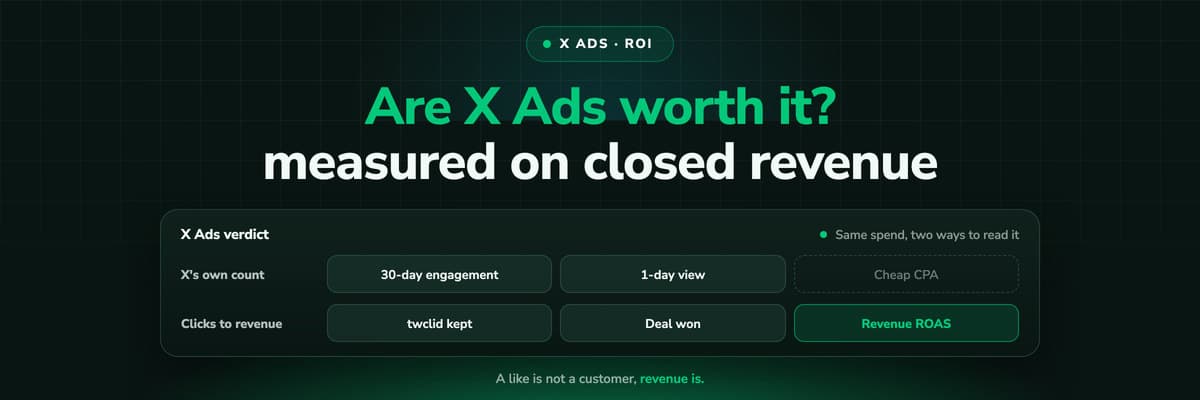
Are X Ads Worth It? Measuring X Ads ROI on Revenue
Whether X Ads are worth it depends on what you measure and on what you sell. How to calculate X Ads ROI and ROAS on closed revenue, what X's own conversion numbers include (a like a month before the purchase counts by default), what a fair test needs, and the traps that make X look better or worse than it is.Read the article16 min read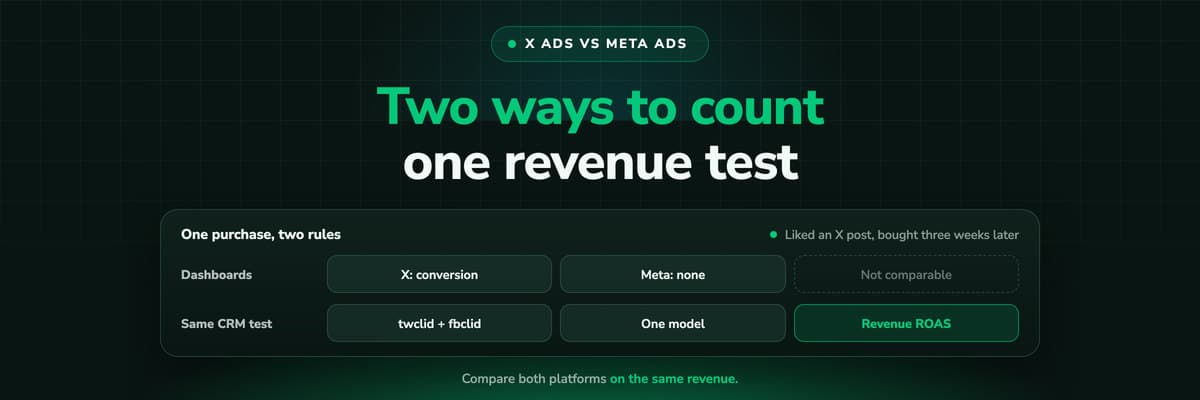 B2B Marketing Attribution
X Ads vs Meta Ads: How Each Counts a Conversion, Compared
X and Meta both report conversions, and the numbers are not the same kind of number. X credits a conversion up to 30 days after a like or a reply by default; Meta counts link clicks for 7 days. A sourced comparison of windows, server events, lead forms and CRM stages, and how to judge the two channels on the same closed revenue.Read the article15 min read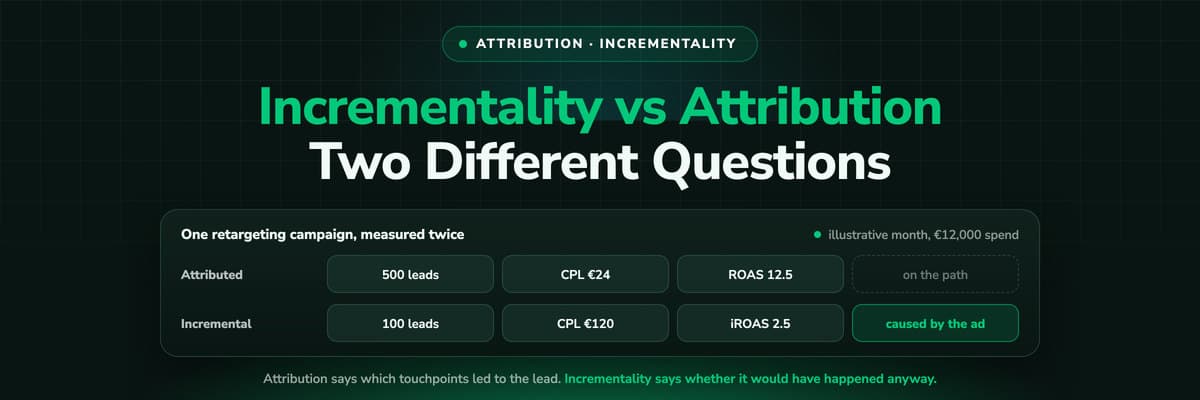 B2B Marketing Attribution
Incrementality vs Attribution: Which Question Each Answers
Attribution tells you which touchpoints led to a lead or a deal. Incrementality tells you whether it would have happened anyway. This guide works one retargeting campaign through both, shows where each belongs, and how to combine them when the outcome lives in your CRM.Read the article17 min read
Quality over volume
Ready to optimize for qualified leads, not form fills?
LeadJourney follows every lead from the first click through the CRM pipeline to the closed deal and feeds those outcomes back to Meta, Google, LinkedIn and Bing, so the algorithms learn who actually buys.